
Ma mian qun (马面裙), also written mamianqun and commonly translated as “horse-face skirt,” is a recognizable Chinese wrap-skirt tradition built around flat front and back panels, overlapping skirt sections, and pleats at the sides. The English name is a literal translation; it does not mean the skirt resembles a horse’s face. What makes the garment memorable is the balance between stillness and movement: the central panels feel composed, while the pleats open softly as you walk.
Today, a ma mian qun can accompany a festival, a family gathering, a museum visit, a workday, or an ordinary afternoon. Wearing one can be a quiet way to bring Chinese clothing heritage into daily life—with confidence, harmony, and room for personal style.
What is a ma mian qun?
A ma mian qun is best understood as a family of related skirt forms rather than one immutable pattern. Common identifying features include two sections that wrap and overlap around the body, unpleated areas that form the visible front and back “doors” or panels, and pleated areas placed mainly toward the sides.
Historical garments vary by period, region, wearer, occasion, and workshop. The number of cloth widths, waistband construction, panel width, pleat direction and density, openings, borders, ties, and decorative techniques are not universal. Modern designers may add elastic, zippers, pockets, adjustable fasteners, or shorter lengths. These are contemporary design choices; historical reconstruction and daily adaptation simply serve different purposes.
Why is it called a “horse-face skirt”?
In modern scholarship and clothing discussion, the name is often explained through a visual comparison between the skirt’s broad flat panel and a mamian, the projecting rectangular structure found along fortified walls. This is a useful memory aid, but the historical naming trail is not completely settled. The term mamian appears in Ming-period writing about a different garment construction, yet that alone does not prove a single, certain first naming of the skirt as we define it today.
So “Chinese horse-face skirt” is a familiar English search term, not a description of an animal shape. “Ma mian qun” or “mamian skirt” keeps the Chinese name visible while the explanation supplies the context.
How the structure works
| Part | What to notice | Why it matters |
|---|---|---|
| Skirt sections | Usually two sections or leaves that wrap and overlap | Creates coverage while allowing the skirt to move |
| Flat ends | Each section has unpleated areas at its ends | After wrapping, overlapping areas form the visible front and back panels |
| Side pleats | Folds arranged beside the flat panels | Adds volume and opens with the wearer’s stride |
| Waistband | May use ties, holes, fasteners, elastic, or a combination | Supports the garment and determines how it is put on |
| Borders and decoration | May be woven, embroidered, printed, applied, or left plain | Shapes the mood and often frames the lower skirt or panels |
You may hear people say the skirt has “four doors.” This refers to the two flat ends on each of the two skirt sections. Once wrapped, those areas overlap to create the front and back presentation; it does not mean four separate openings remain exposed.

A careful view of its history
Chinese dress has a long history of wrapped, paneled, and pleated skirts. Garments from the Song and Yuan periods help establish this broader background, but it is too simple to declare the Song xuanqun a skirt invented for women riding donkeys or to draw one unbroken evolutionary line from that garment to every later ma mian qun.
Surviving textiles and images make the panel-and-side-pleat relationship especially visible in Ming dress. Qing-period examples show further variation, including changes in pleating, proportions, ribbons, borders, embroidery, and regional decoration. Early twentieth-century ensembles continued to reinterpret pleated skirts as clothing and social life changed. No single sentence such as “everyone wore it,” “it peaked in one dynasty,” or “it disappeared because of Western fashion” can represent all periods, places, identities, and occasions.
The renewed interest in ma mian qun is part of a wider return of traditional Chinese clothing to contemporary life. Its cultural origin remains clear, while careful modern design can keep the tradition growing rather than turning it into a frozen costume.

How to measure and read a size chart
Do not rely on a universal letter-size chart or a body-height formula. Makers use terms such as “waistband length,” “finished waist,” “wearable waist range,” and “panel width” differently. Ask for the maker’s measurement diagram and compare every number using the same method.

- Choose the exact position where you want the waistband to sit.
- Measure that circumference while breathing normally. Keep the tape level and comfortably close, without pulling it tight.
- Measure the fullest area the skirt must pass or wrap around, especially if the garment has a fixed waistband or limited opening.
- Measure from the chosen waistband position to your preferred hem while wearing the underlayers and shoes you expect to use.
- Compare the panel width, total wrap, overlap, pleat tension, and maker’s stated wearable range—not just the letter size.
The fit check that matters most
A good fit allows normal breathing, sitting, stair climbing, and a comfortable stride. The front and back panels should remain centered enough for the design, the side pleats should not be pulled flat by strain, and the overlap should continue to cover you during movement. Wide waistbands, thick textiles, and heavy decoration make a real try-on especially useful.

How to wear a ma mian qun
Because closures differ, the garment itself—not a generic video—should guide the process.
- Find the outer panel, label, waistband opening, ties, or fasteners, and identify which surface is intended to face outward.
- Place the front and back panels on the body’s center lines.
- Wrap the sections and route the ties or fasteners exactly as the maker instructs.
- Secure the waistband so it feels stable but does not restrict breathing.
- Sit, take several full steps, raise a knee as if climbing stairs, and check the overlap again.
- Adjust the panels and pleats until the skirt hangs comfortably and the decoration reads as intended.
An underlayer is a personal and practical choice, not a rule. Depending on transparency, overlap, weather, activity, and comfort, you might choose a slip, shorts, trousers, or another layer—or none at all.

Everyday ma mian qun outfits
The easiest outfit begins with the life you are dressing for. A T-shirt and sneakers can make a light ma mian qun feel relaxed; a shirt and loafers suit a calm workday; knitwear and boots bring warmth; a sweatshirt or blazer creates a contemporary contrast; and a traditional Chinese jacket can support a more historically inspired or festive expression.
- Quiet daily look: soft knit or plain tee, comfortable shoes, and a skirt whose pleats move easily.
- Work or gathering: shirt, cardigan, or blazer with a secure waistband and practical hem length.
- Festival moment: a traditional top or coordinated modern jacket, with colors and motifs chosen for the occasion.
- Personal mix: boots, trainers, loafers, or flats according to weather, walking needs, and your own style.
There is no required body type, age, or gender for this skirt. Comfort, coverage, movement, textile weight, and the pleasure you take in the outfit are better guides than rules about looking taller or slimmer.

Fabric, motifs, and craftsmanship
Fiber alone does not determine quality. Silk, cotton, linen, regenerated fibers, synthetics, and blends can all work when the weave, weight, drape, abrasion resistance, wrinkle behavior, cleaning needs, and intended season suit the design. A fluid fabric may give the pleats a gentle rhythm; a firmer textile may hold a clearer architectural line.
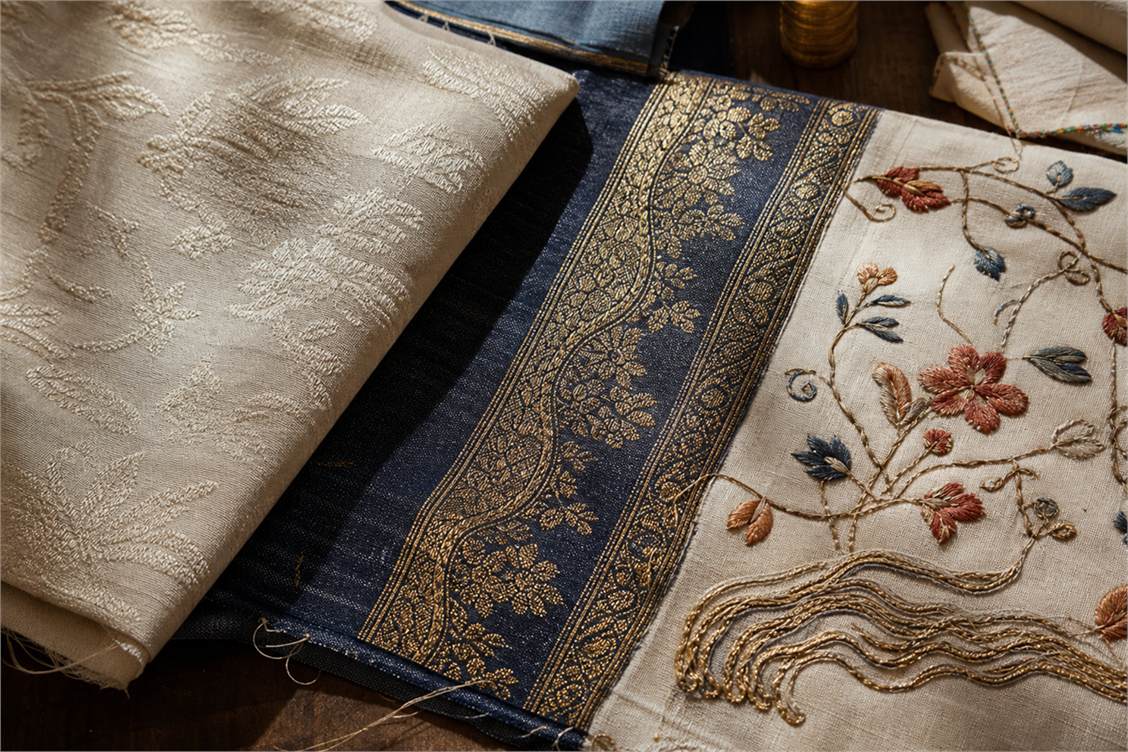
Decoration also deserves precise language. Zhijin and other metallic weaves place metallic-looking yarns into the textile structure; jacquard describes pattern formed in weaving; zhuanghua is a complex supplementary-weft weaving tradition; embroidery adds stitched imagery after the ground fabric is made. Couched gold thread, seed stitch, blue-toned embroidery, applied ribbons and bindings, and modern printing are distinct processes rather than interchangeable names.
Reading motifs with warmth and context
Peonies, lotus, butterflies, birds, clouds, waves, fruit, geometric borders, and auspicious objects can carry layers of cultural association. A peony may welcome flourishing beauty; lotus can suggest purity and renewal; paired or repeated motifs may celebrate harmony, continuity, abundance, or a joyful season. Meaning depends on the period, region, combination, placement, and occasion, so one motif should not be forced into a single marriage, fertility, status, or career message.
At their best, these designs express a wish—a medium through which people hope to bring about wealth, health, virtue, longevity, or a specific outcome in life. They allow a skirt to carry not only pattern, but also affection, confidence, celebration, and hope for a beautiful life. You can explore related symbolism in the Eastern Story archive.
Cleaning, ironing, and storage
Start with the sewn-in care label and the maker’s instructions. Fiber content is only one part of the decision: dye stability, metallic yarns, embroidery, adhesive interlinings, pleat setting, trims, and surface printing may all change what is safe. Do not assume every synthetic skirt is machine washable or every metallic textile should be hand-washed or dry-cleaned.
- Before cleaning: check the label, test an inconspicuous area if permitted, and look for loose threads, unstable color, or fragile decoration.
- Before heat or steam: check the label, begin at low heat, use a pressing cloth, and avoid direct pressure on metallic yarn, embroidery, print, adhesive layers, or permanently set pleats.
- For storage: clean the skirt first and keep it away from strong light and unstable heat or humidity. Keep insect products from direct contact with the textile.
- Choose support by weight: a broad supported hanger or padded clips may suit some skirts, while a heavy skirt may need loose, structure-aware folding with acid-free tissue so the waistband does not stretch.
Antique or old textiles, silk with unstable dye, metallic threads, complex embroidery, and brittle ornament should be assessed by a textile conservator or qualified specialist before washing, dry-cleaning, ironing, or steaming. Never wet a skirt and apply high heat in an attempt to reset its pleats.

Bringing tradition into a good everyday life
A ma mian qun does not need to remain behind glass or appear only at a grand ceremony. Once you understand its panels, overlap, pleats, and care needs, it can become a companion for ordinary days and meaningful celebrations alike. Choose the version that lets you move freely, wear it with respect for its Chinese roots, and let its calm lines and lively pleats become part of your own story.
Frequently Asked Questions
Related Posts


