
Throat chakra meaning centers on honest expression, attentive listening, clear boundaries, and the courage to let an inner truth take shape in words. Known as Vishuddha, it is the fifth center in the modern seven-chakra system. Many people choose blue stones, a pendant, a journal, or a quiet vocal practice as a companion for conversations, writing, teaching, and creative work—moments when a voice matters and care matters too.

Vishuddha belongs to Indian religious and yogic traditions and to later modern chakra practice. It is a spiritual and contemplative map rather than an anatomical organ or a medical diagnosis. That distinction leaves room for its cultural meaning: a way to reflect on how we speak, what we hold back, how we receive another person, and what kind of communication we hope to welcome into our lives.
What is the throat chakra?
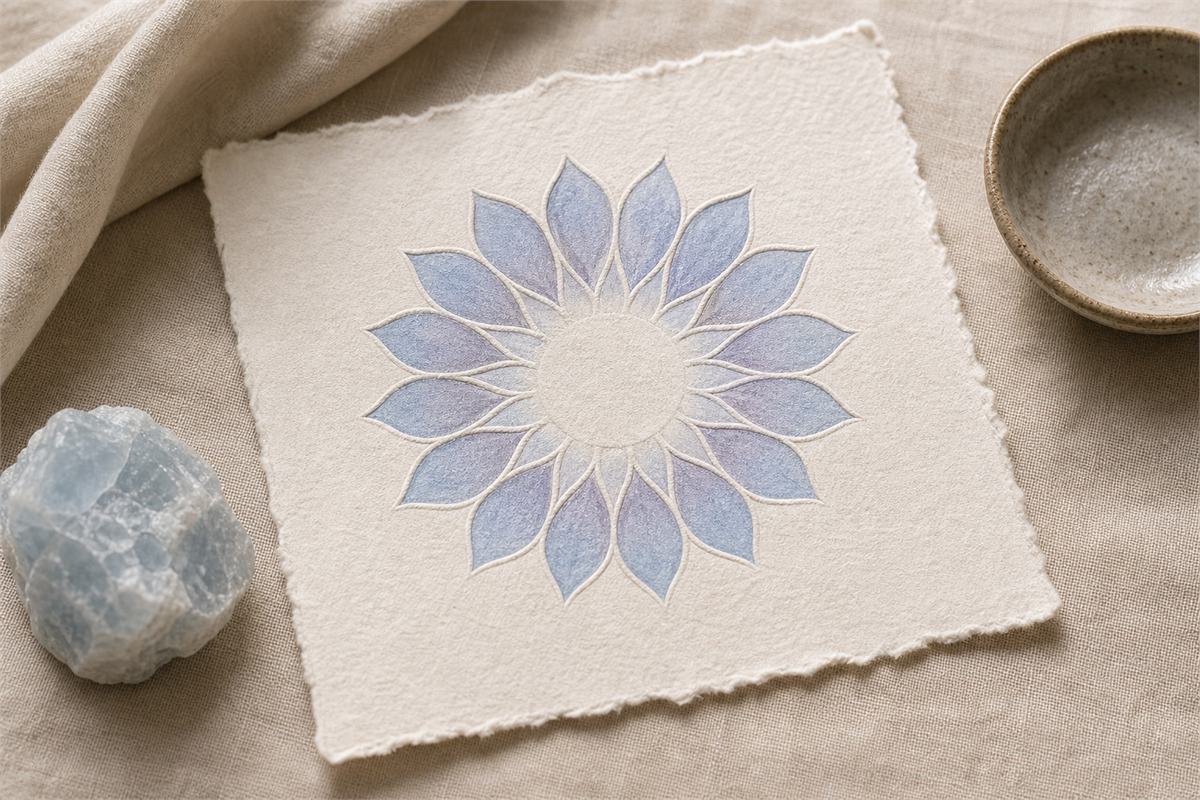
The Sanskrit name Viśuddha, commonly written Vishuddha or Vishuddhi, carries the sense of purity or purification. Traditional descriptions place this chakra at the region of the throat and portray it as a sixteen-petaled lotus. In the widely used seven-chakra arrangement, it is numbered fifth.
| Association | Traditional or modern context | Meaning for reflection |
|---|---|---|
| Fifth chakra | Modern seven-chakra system | The passage from inward understanding to outward expression |
| Throat region | Traditional contemplative location | Voice, sound, speech, and listening |
| Sixteen-petaled lotus | Traditional iconography | The sixteen Sanskrit vowels and the possibilities of voiced sound |
| Ākāśa, or space | Traditional subtle element | The openness in which sound and listening can occur |
| Haṃ, often written HAM | Traditional bīja, or seed syllable | A focal sound for gentle voluntary chanting |
| Blue | Especially common in modern chakra imagery | Clarity, calm, openness, and a spacious visual mood |
The familiar rainbow sequence that assigns one bright color to each chakra is largely a modern synthesis. Older descriptions are more varied: Vishuddha’s petals may be described as smoky or purple-toned, while a pale or sky-like blue became especially prominent in later teaching and popular visual culture. Blue remains a beautiful contemporary language for the wish to speak clearly, but it need not be presented as one timeless rule shared by every tradition.
True expression also makes room for listening
Throat chakra symbolism is often reduced to “speaking your truth,” yet its richer lesson is reciprocal. A clear voice can name a need without attacking. A generous listener can stay present without disappearing. Silence can be chosen with confidence, and a boundary can be stated without turning it into a punishment.

This makes Vishuddha meaningful in ordinary, tender moments: preparing for a difficult conversation, saying “no” with kindness, asking for clarification, apologizing precisely, sharing unfinished creative work, or listening long enough to understand what someone is truly asking. A blue object worn or kept nearby may be chosen to invite clarity, courage, and harmonious communication. It can carry the simple wish that both voices leave the conversation with dignity.
| Moment | Reflection question | One gentle next step |
|---|---|---|
| You are holding back an important message | What is the clearest respectful sentence? | Write it privately before choosing when and how to speak |
| You fear saying no | What boundary protects the relationship as well as me? | State what you can offer, what you cannot, and when |
| You are speaking faster than you can listen | Have I understood the other person? | Pause and summarize what you heard |
| A first draft feels impossible | What would I say to one trusted person? | Record a short voice note and keep its strongest sentence |
| Feedback feels difficult to receive | Which part is useful information? | Ask one clarifying question before answering |
The lotus, space, and the sound HAM
Traditional Vishuddha imagery brings together a lotus of sixteen petals, the subtle element ākāśa, and the seed syllable haṃ. The petals are associated with the sixteen Sanskrit vowels. Because vowels carry and shape the voice, the lotus offers a natural image for articulation and the many forms expression can take.
Ākāśa is often translated as space or ether. In a lived interpretation, space is what communication needs: a breath before replying, silence between sentences, enough safety for honesty, and enough attention to hear meaning behind words. The image is not simply about making more sound. It carries a wish for words to arise from a spacious mind and arrive with care.
HAM may be used as a soft, voluntary chanting focus. Sit comfortably, let the jaw remain easy, and use a pitch and volume that feel natural. One or a few unforced repetitions are enough to notice the meeting of breath, vibration, and silence; no fixed count is required. Stop if the voice or breath feels uncomfortable, or if you feel dizzy. Anyone with an existing throat, voice, breathing, or neck concern can choose quiet reflection instead and seek appropriate professional guidance when needed.

Blue stones for different communication wishes
Modern throat-chakra practice often gathers several blue minerals under the everyday phrase “blue crystals.” They are not one mineral family, and their cultural associations are not ancient chakra rules. Their colors, textures, and stories simply offer different ways to hold an intention. Choose the wish that feels closest to the life moment you are entering.
Aquamarine: clarity and composed courage
Aquamarine is the blue to blue-green variety of beryl. Its clear, water-like color is often chosen to welcome calm courage before a presentation, honest conversation, or new beginning. As jewelry or a small keepsake, it carries a wish to say what matters without losing gentleness.

Lapis lazuli: wisdom and sincerity
Lapis lazuli is a rock made from several minerals rather than a single crystal. Its deep blue, often crossed by pale calcite or golden pyrite, gives it a dignified visual presence. It is chosen for thoughtful speech, truthful self-knowledge, and the wish to let wisdom guide the voice.

Amazonite: kind but steady boundaries
Amazonite is a blue-green variety of microcline feldspar. Its soft green-blue appearance suits the wish to combine honesty with warmth: asking clearly, declining respectfully, and protecting a boundary without closing the heart. The related guide to amazonite with rose quartz and green aventurine explores how its meaning changes in a stone combination.

Blue chalcedony and blue lace agate: unhurried expression
Chalcedony is a microcrystalline form of quartz, while agate is a patterned variety of chalcedony. Pale blue chalcedony and banded blue lace agate are often chosen for patient wording, tender conversations, and the confidence to speak at one’s own pace. Commercial blue agate can also be dyed, so the material name and any treatment should be described accurately. Learn the mineral relationship in the chalcedony guide and the broader agate guide.

For other settings, crystals for career communication considers confidence in meetings and presentations, while crystals for trust and better communication focuses on close relationships. These different pages keep the throat-chakra story centered on Vishuddha’s cultural meaning rather than repeating the same stone list for every intention.
A short practice for voice, reflection, and creativity
- Arrive: sit or stand comfortably and let the shoulders, jaw, and breath settle without forcing them.
- Name the wish: choose one sentence such as “My voice matters,” “I can speak clearly and listen with care,” or “I can set a kind, steady boundary.”
- Make space: take several natural breaths. If it feels welcome, hum softly or repeat HAM once or a few times at an easy pitch.
- Write: finish the prompts “What I want to say is…,” “What I want to understand is…,” and “My next respectful action is….”
- Carry one step forward: underline one sentence to speak, send, revise, or keep for later.
A blue stone, pendant, or bracelet can sit beside the page or accompany the conversation as a personal ritual. The practice works best as an invitation, not a test. Some days the brave choice is speaking; on other days it is listening, waiting, or rewriting the sentence until it holds both truth and care.

If movement helps you settle, keep it easy: a comfortable shoulder roll, a small pain-free neck turn, or quiet breathing with a level head. Forceful breathwork, throat locks, deep backbends, shoulder stands, and plow pose require individual suitability and qualified instruction; they are unnecessary for this reflection.
How to choose and care for a meaningful piece
Begin with the wish and the story: clarity before a new chapter, courage for a conversation, patient listening within a relationship, or renewed creative flow. Then consider the actual object. A pendant should feel comfortable in weight and length; a bracelet needs a secure fit; earrings should suit the wearer’s preferred weight and metal. Color and intuition can be part of the choice, alongside accurate material, treatment disclosure, secure construction, and everyday comfort.

Care should follow the specific mineral, setting, cord, and metal rather than a single rule for every “crystal.” Use a soft dry or slightly damp cloth when appropriate, remove jewelry before bathing or swimming, and avoid long soaking, salt water, household chemicals, high heat, strong prolonged light, and hard knocks. Lapis lazuli and turquoise can be porous or sensitive, and dyed or stabilized material may need extra care. For a broader material-safe approach, see the crystal cleaning and care guide.

Moonlight, sound, smoke, or placement beside another cherished object may be meaningful personal rituals, but they are not required maintenance. The most lasting “renewal” may be returning to the intention: speaking one clear sentence, hearing another person fully, or opening the notebook again.
A wish for a voice that carries truth and care
Throat chakra meaning is ultimately relational. Vishuddha joins voice with space, expression with listening, courage with kindness, and creativity with the willingness to begin. A blue stone or symbolic object can be chosen to welcome that harmony—a medium through which people hope to bring about clearer understanding, sincere connection, and a more beautiful way of meeting one another.
Explore more objects that carry wishes for clarity, harmony, and auspicious new beginnings in the Blessing collection, or continue through the cultural guides in the Story archive.
Frequently Asked Questions
Related Posts


0 Comments