
A sandalwood bracelet is made from aromatic heartwood associated with trees in the genus Santalum, not simply any pale or scented wood. The best choice is a strand whose seller clearly identifies the material, discloses treatments, gives bead diameter and total weight, and uses comfortable, well-finished construction. Scent, color, grain, weight, or a “sinking” claim cannot by itself prove species, origin, age, authenticity, or quality.
This sandalwood bracelet guide explains the wood, common market names, scent and appearance, bead shapes, fit, non-destructive buying observations, treatments, religious context, daily wear, styling, gifting, and care. Sandalwood is also distinct from agarwood: sandalwood is aromatic Santalum heartwood, while agarwood is resin-rich wood formed in certain Aquilaria and Gyrinops trees.

What sandalwood is—and what the name does not prove
True sandalwoods are Santalum species in the sandalwood family. They are hemiparasitic trees: their roots connect to host plants while the tree also carries out its own photosynthesis. The aromatic material valued for carving, incense, oil, and beads is the heartwood. Ordinary sapwood, another fragrant timber, or wood scented with sandalwood oil is not equivalent to naturally aromatic sandalwood heartwood.

“Sandalwood” is also a broad commercial word. Some unrelated woods carry names containing “sandal” or “tan,” while products may be marketed by color, region, fragrance, or a seller-created grade. Green sandalwood, red sandalwood, little-leaf red sandalwood, thuja, white ash, applewood, and other aromatic woods are not interchangeable with Santalum heartwood. Qinan belongs to the agarwood market and should not appear as a sandalwood type.
For broader comparisons among wood, stone, and jewelry materials, use the Eastern Story material guide.
Indian, Australian, and Pacific sandalwoods
| Market wording | Botanical context | What a buyer should understand |
|---|---|---|
| Indian sandalwood | Usually Santalum album | A recognized aromatic sandalwood species grown in more than one country; “Indian” in a listing does not alone establish where a bracelet was grown or made. |
| Australian sandalwood | Often Santalum spicatum, although S. album is also cultivated in Australia | Ask which species the seller means. Australian origin and Australian sandalwood are not identical claims. |
| Pacific sandalwood | Several regional Santalum species | Fiji, Tonga, Vanuatu, and other regional names can refer to source narratives or market groupings, not one standardized species or grade. |
| “Old Mountain,” “New Mountain,” Fiji, or Tonga sandalwood | Commercial source names and market classifications | Useful only when the seller defines them. They do not form a universal quality ladder. |
Santalum album, often called Indian sandalwood, and Santalum spicatum, commonly called Australian sandalwood, are different species. Pacific islands also have other Santalum species with their own distributions and histories. Fragrance can vary among species and pieces, but descriptions such as creamy, milky, honeyed, amber-like, cool, spicy, or woody remain sensory impressions. They are not botanical tests.

Terms translated as “old mountain sandalwood” and “new mountain sandalwood” are especially inconsistent across sellers. Likewise, “black meat,” “red meat,” and “yellow meat” are marketplace color terms rather than a dependable age chart. Darker color does not automatically mean older wood, more oil, a particular origin, or higher quality. Claims of decades of aging also require more than an appearance or aroma story.

Scent, color, grain, and weight
Sandalwood heartwood is valued for a persistent warm woody fragrance, but a finished bracelet may smell faint or strong depending on species, the particular wood, surface finish, temperature, airflow, storage, and the wearer’s perception. A soft creamy or sweet impression can be pleasant, yet it does not prove that a strand is S. album. A sharp opening does not automatically prove imitation, and a scent that becomes quieter over time does not automatically prove anything is wrong.

Natural color ranges overlap. Grain may be straight, wavy, fine, or visually subdued after polishing. Weight depends on bead diameter, hole size, wood density, moisture, finishing materials, cord, spacers, and pendants. “Oily,” “heavy in the hand,” or “sinks in water” is never sufficient evidence of natural heartwood or superior quality. Fresh moisture can change density, and a water test risks swelling, staining, or cracking, so it should not be used.
Bead shapes, sizes, and bracelet construction
Round beads are familiar and roll smoothly between the fingers. Barrel beads show more side grain and can feel substantial. Abacus beads create a flatter, more articulated profile. Bamboo-section beads have a segmented rhythm; drum beads are rounded with broader faces; freeform beads emphasize organic variation; carved beads add detail but may have thinner edges. Shape is a design decision, not an inherent grade or price ranking.

Start with wrist circumference, then consider bead diameter and the space occupied by the strand. Larger beads increase bulk and the chance of hitting a desk or doorframe. Smaller beads generally sit closer to the wrist and layer more easily. Do not choose size mechanically by gender. Compare the actual inner circumference, bead diameter, total bracelet weight, and intended ease rather than relying on “men’s” or “women’s” labels.

Inspect drill holes for rough rims, splits, filler, and uneven alignment. Check roundness and whether adjacent beads differ unexpectedly in diameter. Elastic cord is convenient but eventually relaxes; braided cord can be adjustable but should slide without cutting into the holes. Examine knots, end finishing, spacer edges, pendant balance, and whether metal or stone components repeatedly strike the wood. Comfort during typing, driving, and lifting matters as much as appearance.

How to inspect a sandalwood bracelet before buying
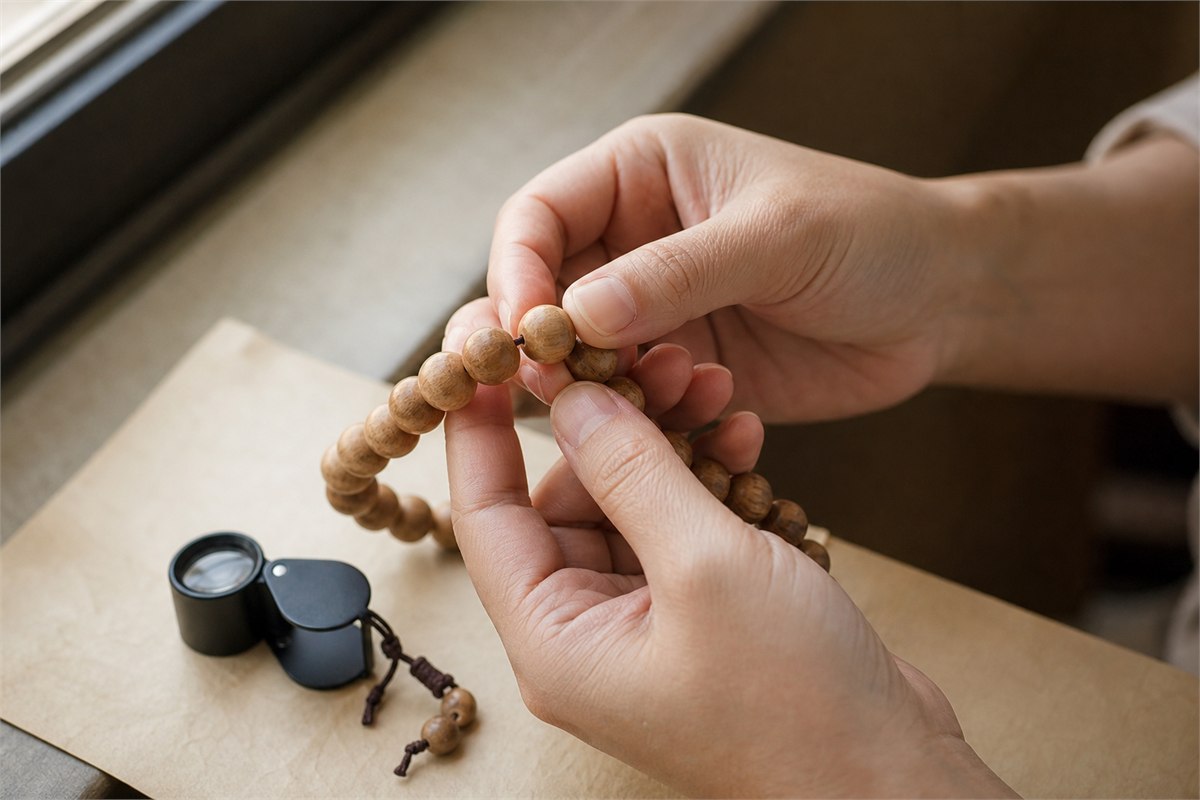
- Use natural light. Look across several beads for plausible grain variation, color transitions, a surface film, and color concentrated around holes.
- Inspect the holes and edges. Rough holes, glue, filled gaps, torn fibers, or thick coating can reveal construction and treatment issues.
- Smell briefly. Note whether fragrance is extremely concentrated at the surface or cord, but treat scent as one observation, not a verdict.
- Compare patterns. Repeated identical grain, molded seams, or unusually uniform speckling may justify questions about printed, pressed, or composite material.
- Check for residue. An oily film, wax buildup, sticky feel, or color transfer suggests that the finish deserves clarification.
- Confirm measurements. Ask for bead diameter, inner circumference, total weight, cord type, spacers, pendant material, and treatment disclosures.
- Read the return terms. Clear descriptions and workable returns matter because photographs and scent language offer only limited judgment.
These checks are intentionally non-destructive. Do not burn, heat with a needle, cut, scrape, soak, attempt a sinking test, or apply alcohol or chemical cleaners. Such methods can damage the bracelet, create unsafe fumes, or produce ambiguous results. No single visual or scent clue can establish species, provenance, age, or authenticity.

Common treatments and imitation materials
A bracelet may use another wood infused with fragrance or sandalwood oil. It may be dyed, oiled, waxed, coated, filled with resin or glue, or made from pressed or composite material. These categories are different: added fragrance changes the scent story; dye changes color; wax and oil change the surface; filler repairs or masks gaps; pressed material changes the construction itself.

Treatment is not diagnosed by one sign. Strong fragrance may come from fresh surface application, storage, or the wood itself. Uniform color may reflect selection or finishing. Gloss may come from polishing, wax, oil, or coating. Ask for a precise description and judge several observations together. Imitation also should not be described as automatically toxic or guaranteed to irritate skin; the relevant point is that its material and care needs differ from natural sandalwood heartwood.

Religious and cultural context
Sandalwood has important but distinct roles in Hindu, Buddhist, and other religious and fragrance traditions. It may appear as incense, paste, carved material, or prayer beads, with meaning shaped by the specific community and practice. A 108-bead mala is a religious practice object in several traditions, not a universal “luck bracelet.” When a strand is devotional, follow the guidance of that tradition rather than treating it as generic spiritual merchandise.
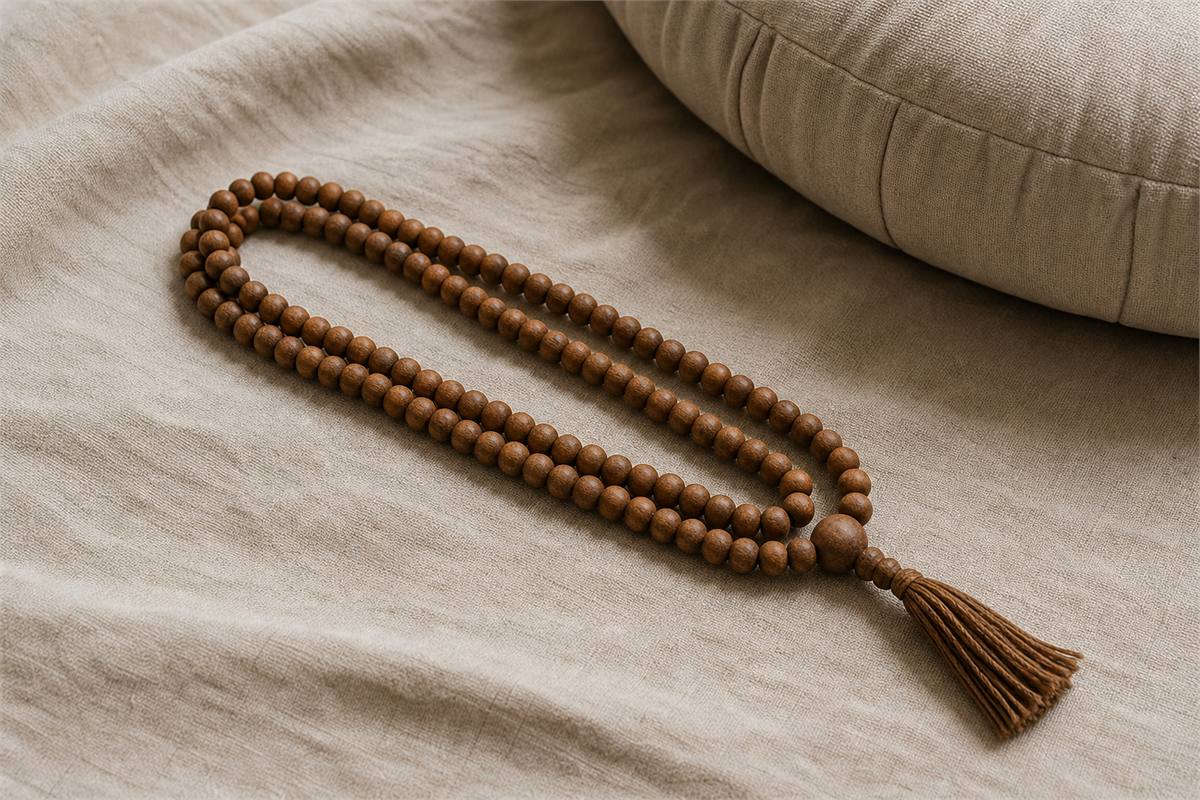
Wearing sandalwood to a temple, receiving a blessing, or choosing it as a reminder of prayer can be a sincere personal cultural choice. It does not promise protection, wealth, health, concentration, sleep, emotional treatment, or a change in fortune. If a mantra or sacred text cannot be checked accurately, it is better not to place it on a product or repeat it as decoration.

Modern claims such as “left receives and right releases,” left-hand fortune, right-hand cleansing, bad luck from wearing both wrists, a broken bracelet absorbing disaster, sleeping in the bracelet, ritual washing of a new strand, or sealing it to “restore” scent have no single universal traditional rule or objective effect. Choose a wrist by dominant-hand use, comfort, and collision risk. The same practical reasoning is explained in Eastern Story’s left-or-right wrist guide.
How to wear and style sandalwood bracelets
For everyday wear, use the wrist that keeps the bracelet away from repeated desk contact, tools, and watch hardware. Remove it for swimming, bathing, vigorous exercise, food preparation with strong odors, and work where the strand could snag. A comfortable bracelet should move without pinching and should not be so loose that heavy components swing into hard surfaces.

Style by color, proportion, texture, and clothing. Warm brown sandalwood works with linen, cotton, neutral knitwear, indigo, black, cream, and muted green. Jade, gold, silver, amber, and turquoise can provide contrast, but hard, sharp, or textured spacers may abrade softer wood. Use small smooth separators or leave a little cord space between unlike materials. More components do not create an “energy stack”; they simply change weight, wear, and visual balance.

Giving a sandalwood bracelet
Sandalwood suits recipients who enjoy natural materials, fragrance culture, understated jewelry, or a personal prayer practice. For a general gift, describe it as a warm wooden bracelet associated with fragrance, reflection, and craft. For a religious recipient, make sure the bead count, pendant, and language fit that person’s practice rather than assuming that every mala form has the same meaning.

Fit is part of thoughtful gifting. Obtain the wrist circumference when possible, note whether the recipient types or works with their hands, and avoid an oversized pendant for active daily wear. A simple note about the wood, bead dimensions, string construction, and care is more useful than promises of healing or luck.
Sandalwood bracelet care
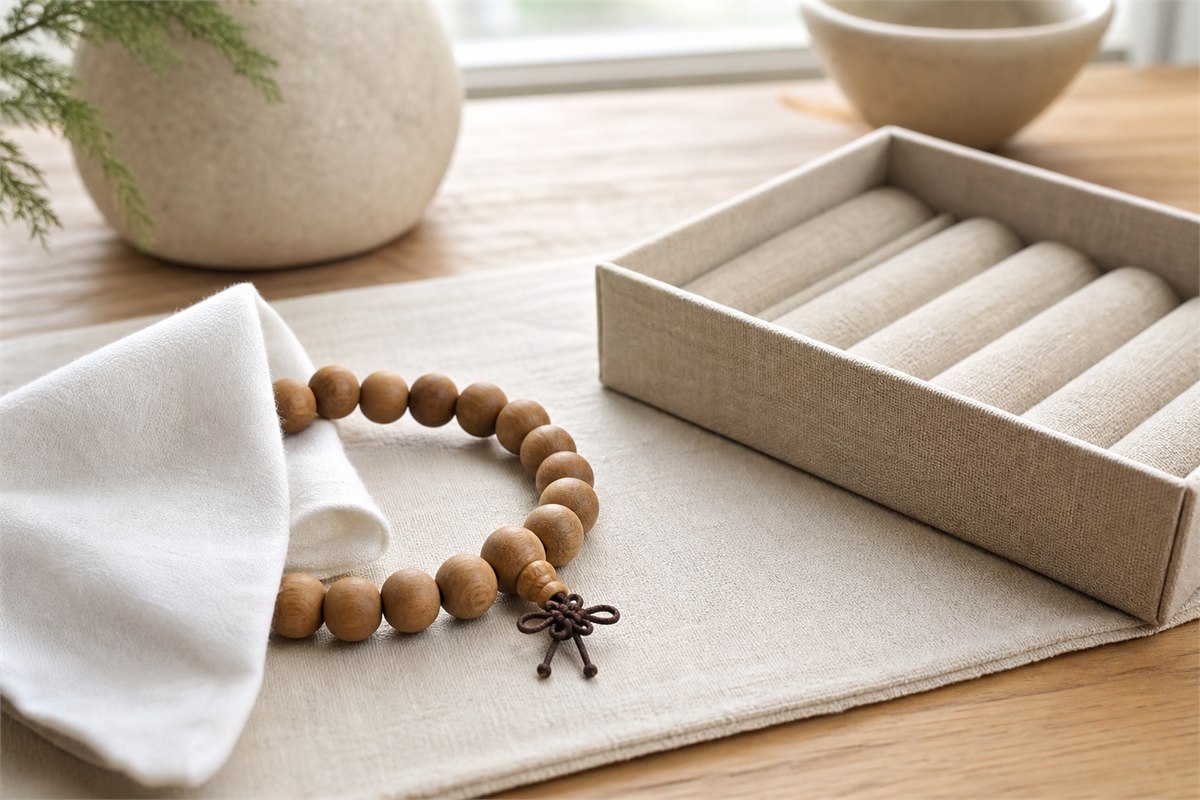
- Avoid prolonged water exposure and do not soak the bracelet.
- Do not leave sweat, perfume, skincare products, cleaning agents, cooking fumes, or other strong odors on the beads.
- Keep it away from extreme heat, direct sun, radiators, sustained high humidity, and repeated impact.
- After wear, wipe gently with a dry, soft, odor-free cloth.
- If splashed, blot promptly and let it air-dry in shade; do not use hot air.
- Store only after it is fully dry, separated from sharp or strongly scented objects.
- Do not apply oil or wax, and do not use ultrasonic or steam cleaning.
A changing sheen or quieter scent is not a failure that requires “recharging.” Do not add sandalwood powder, scented oil, water, or damp material to a container. Sealing is not a universal way to restore fragrance, and no single humidity percentage suits every climate and storage situation. For broader jewelry maintenance principles, see the Eastern Story care guide.

Legal and sustainable sourcing matters
Indian sandalwood and other wild sandalwood resources have histories of heavy demand, restricted harvest, and conservation concern. Prefer sellers who can clearly explain whether material is plantation-grown, reclaimed, or otherwise lawfully sourced, and avoid romantic marketing that celebrates illegal cutting or unexplained wild rarity. Species protection and local harvest rules differ by place, so a responsible purchase begins with transparent source information rather than a “rare old wood” story.

Frequently Asked Questions
Related Posts


0 Comments