
A heart scarab is an ancient Egyptian funerary amulet made for the deceased person's relationship with the heart, divine judgment, and continued life after death. It usually takes the form of a substantial scarab beetle placed over the chest or heart region. Many examples carry a version of Book of the Dead Spell 30B on the underside, asking the heart not to oppose its owner or give damaging testimony in the tribunal of the gods.
The heart scarab meaning is therefore more specific than the general symbolism of scarab beetles. It is not a modern love-heart beetle, a guaranteed passport to paradise, or a replacement organ. Its name comes from its funerary role, its position on the mummy, and the ancient Egyptian understanding of the heart as a center of life, memory, thought, emotion, and moral identity.
Heart scarab meaning at a glance
| Question | Direct answer | Important boundary |
|---|---|---|
| What was it? | An Egyptian funerary amulet connected with the deceased person's heart and judgment | Not every scarab-shaped amulet is a heart scarab |
| What did the spell request? | That the heart would not oppose, accuse, or create a case against its owner | It was not a blanket declaration of innocence |
| Where was it placed? | Usually on or near the chest or heart region of the mummy | Attachment and exact position vary by burial |
| Was it always Spell 30B? | Spell 30B is most common, but 30A, abbreviated formulas, other texts, and blank bases occur | Do not assign a spell without reading the object |
| What did it symbolize? | Successful transformation, moral continuity, renewal, and hoped-for acceptance after death | These were ancient religious intentions, not modern outcome promises |
In this guide
- Heart scarab vs. ordinary scarabs, seals, and pectorals
- Why the heart mattered
- The weighing of the heart
- What Spell 30B asks the heart to do
- Spell 30A vs. 30B
- Placement on the mummy
- Form, size, drilling, and inscriptions
- Materials and colors
- History and development
- The Heart Scarab of Hatnefer
- Other museum examples
- Modern replicas and Egyptian Revival jewelry
- Identification, buying, and provenance
- Care for ancient objects and modern replicas
- Frequently asked questions
Heart scarab vs. ordinary scarab amulet and seal
Ancient Egyptian scarab objects form several overlapping but distinct categories. For the broader beetle's links with renewal, the rising sun, amulets, and modern jewelry, begin with our complete guide to scarab symbolism. A heart scarab is narrower: it belongs above all to funerary preparation and the deceased person's heart.

| Object type | Typical purpose or context | How it differs from a heart scarab |
|---|---|---|
| Ordinary scarab amulet | Personal adornment, amuletic use, burial equipment, or a combination | Often smaller and not specifically tied to the heart spell or chest placement |
| Scarab seal or seal-amulet | A pierced or mounted object whose base could stamp a name, title, motto, or design | Its main evidence may concern identity and administration rather than funerary judgment |
| Commemorative scarab | A large inscribed issue recording a royal event, especially the series of Amenhotep III | The inscription commemorates events such as hunts, marriage, or a lake—not the heart's testimony |
| Heart scarab | Funerary protection of the deceased person's relationship with the heart and judgment | Often substantial, chest-associated, and inscribed with a heart formula |
| Heart amulet | An amulet shaped like the anatomical or hieroglyphic heart | It may carry Spell 30B without taking beetle form |
| Winged scarab or pectoral | A composite chest ornament, often with extended wings and additional deities or emblems | A winged pectoral is not automatically a heart scarab, though the categories can interact |
Size alone cannot settle the category. A small seal, a large commemorative scarab, and a heart scarab may all be beetle-shaped and inscribed. Read the text, observe the suspension or attachment system, examine the material and workmanship, and ask where the object was found and how it was positioned.
Why the heart mattered in ancient Egypt
Ancient Egyptian ideas of the body did not divide mind, memory, emotion, and morality in the same way as modern anatomy. The ib-heart could represent a person's inner life, memory, thought, intention, character, and moral identity. Another term, often written haty, could refer more closely to the physical heart or chest, although usage changes across texts and periods. Translating both simply as “heart” can hide this complexity.
Because the heart carried the person's identity and capacity for judgment, it was normally left inside the body during mummification while many other organs were removed and treated separately. A heart scarab therefore belonged beside the retained heart as ritual support. The amulet was not routinely inserted into an empty chest as a replacement for a missing organ.
The heart also had to remain available to its owner in the afterlife. Funerary texts include several formulas concerned with returning the heart, preventing it from being taken away, and stopping it from opposing the deceased. Spell 30A and 30B belong within this larger textual concern; they are not the only ancient Egyptian “heart spells.”
The weighing of the heart and the tribunal of Osiris
The familiar weighing of the heart scene is best understood as a tradition with many versions, not a single fixed cinematic sequence. In Book of the Dead judgment imagery, the heart is tested against Ma'at—the principle of truth, justice, and proper cosmic order—often represented by a feather or by the goddess herself. Osiris presides over the tribunal; Anubis commonly attends the balance; and Thoth records or presents the result. Ammit, a composite devourer with crocodile, lion, and hippopotamus features, waits near the scales in many scenes.
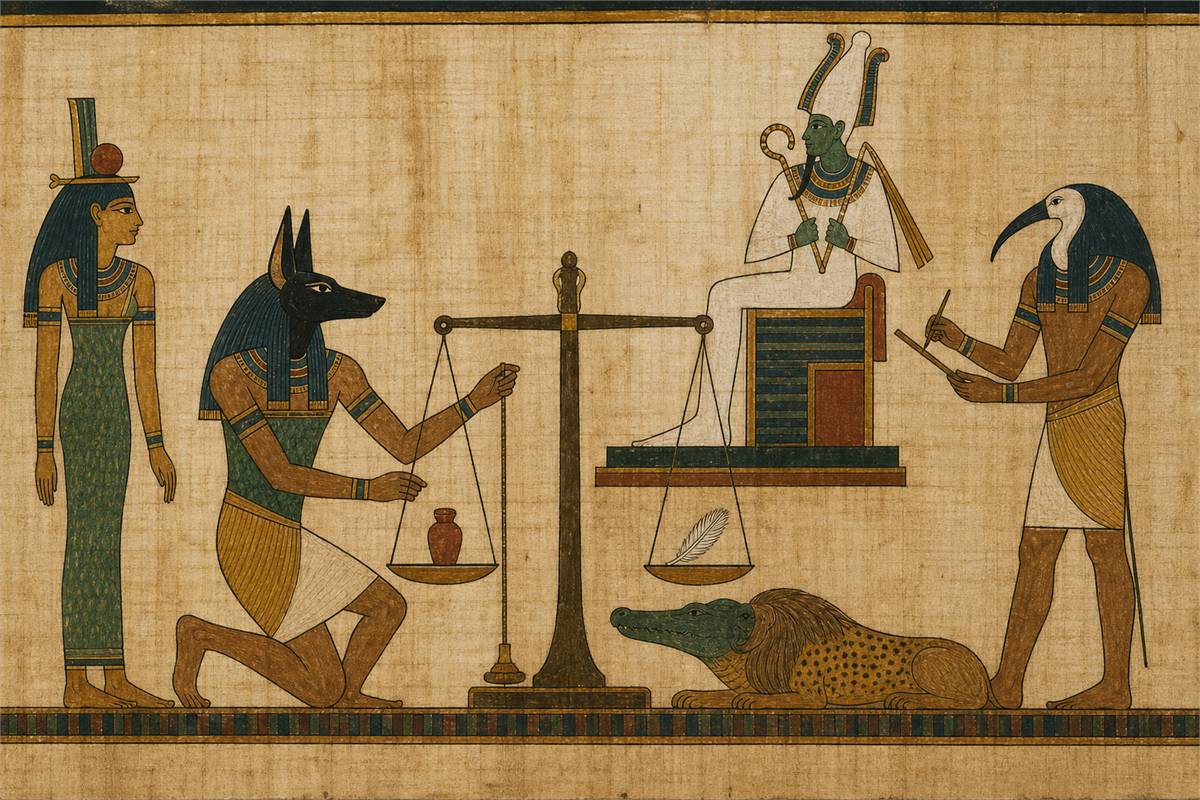
The desired image is balance with Ma'at and acceptance as justified or “true of voice.” Failure means loss of the hoped-for afterlife and, in many explanations, the devouring of the heart and a second death or non-existence. It is misleading to say that a sinful heart simply “sank” because it was heavy. Surviving vignettes emphasize correct balance, while the persons, symbols, and arrangement can differ between papyri, tombs, coffins, and periods.
Spell 30 and the Negative Confession are not the same text
Book of the Dead Spell 125 contains the famous declarations before Osiris and the assessors, often called the Negative Confession. The heart spells numbered 30A and 30B address the heart itself. They should not be rewritten as a list of virtuous deeds, a plea for Osiris to forgive wrongdoing, or an “innocence certificate” unless the particular inscription actually says so.
What Book of the Dead Spell 30B asks the heart to do
Book of the Dead Spell 30B is often called the heart scarab spell because it is so frequently carved on the flat underside of these amulets. Its core request is direct: the deceased addresses the heart associated with earthly life and asks it not to oppose its owner in judgment, not to create a hostile case, and not to act as damaging testimony before the divine officials.
A concise English paraphrase is: My heart, do not stand against me as a witness; do not oppose me in the tribunal; do not make a case against me before the keeper of the balance. This is a paraphrase of the recurring sense, not a claim that every object preserves identical words. Names, epithets, line order, spelling, omissions, additions, and the quality of carving vary.
The spell's religious aim was active but not mechanical. It sought harmony between the deceased and the heart that embodied the person's own memory and moral self. Describing it as “silencing” or “sealing” the heart can be a useful shortcut, but the fuller idea is that the heart should remain allied with its owner and should not obstruct the person's standing in the divine court.
Spell 30A vs. 30B
| Feature | Spell 30A | Spell 30B |
|---|---|---|
| Shared concern | Prevents the heart from being removed or opposing the deceased | Prevents the heart from opposing the deceased in judgment |
| Frequency on heart scarabs | Documented but less common | The version most strongly associated with heart scarabs |
| Textual history | Not attested before the Book of the Dead in the UCL synopsis | Belongs to a heart-formula tradition with Middle Kingdom antecedents, but the Book of the Dead numbering is modern |
| Notable example | Heart Scarab of Hatnefer, The Met 36.3.2 | British Museum EA29626 and many other inscribed heart scarabs |
| How to identify it | By reading the actual inscription or a reliable catalogue | By reading the actual inscription or a reliable catalogue |

The modern numbers were assigned by Egyptologists to organize a changing corpus. The ancient “Book of the Dead” was itself not one standardized book copied identically for every burial. It was a repertoire of compositions, called in Egyptian the chapters for going forth by day, selected and arranged on papyri and other funerary equipment. Earlier Pyramid Texts and Coffin Texts are important predecessors, but not every earlier heart-related formula should be renamed “Spell 30.”
Where heart scarabs were placed on the mummy
Heart scarabs are attested from the mid-Thirteenth Dynasty onward and were often positioned over the chest or heart region. Excavated examples and surviving fittings show several arrangements: hung from a long necklace, attached to a metal neck ring, set in a gold mount, tied or sewn into mummy wrappings, or incorporated into a pectoral arrangement. Some were found in situ; others reached collections without a secure archaeological position.

“Placed in the chest cavity” is therefore too broad. The amulet usually lay on, over, or close to the chest within the burial assemblage. Exact location can shift during wrapping, disturbance, excavation, or later handling, and the same word “necklace” may describe a piece designed for funerary placement rather than daily wear.
The physical heart was normally retained
The retained physical heart and the amulet performed different roles. The organ remained essential to the person's being and judgment; the heart scarab carried ritual form, text, and material support. A museum replica placed on a mannequin can illustrate the relationship, but it should not be treated as proof that every ancient scarab occupied precisely the same point or was attached in the same way.
Form, size, underside, drilling, and inscriptions
Many heart scarabs have a carved beetle on top and a broad, flattened base below. The back may mark the head, prothorax, wing cases, suture, legs, or feather-like details with varying naturalism. Some sit on an oval or heart-shaped plinth. Others combine a beetle head with the hieroglyphic or anatomical shape of a heart. Human-headed examples and winged forms show that the category was never limited to one template.
Museum examples commonly fall around five to nine centimeters long, but smaller and larger objects exist; no universal cutoff defines a heart scarab. The underside may carry multiple horizontal lines, vertical columns, the owner's name, a complete or abbreviated heart formula, deities, emblems, or no decoration. Blank spaces and later-added names show that some pieces could be produced as stock and personalized for a buyer.
Attachment is part of the evidence
Longitudinal drilling can suit a string or rotating seal, while transverse holes, edge perforations, metal tubes, loops, gold mounts, neck rings, or sewing holes can reveal a funerary attachment system. Wear around a hole may be ancient, later, or artificially produced. Look for tool marks, breaks, repairs, adhesive, added metal, and whether the holes agree with the object's supposed use.
Heart scarab materials and colors without oversimplification
A reliable list of heart scarab materials begins with individual museum records, not a modern crystal-color chart. Catalogued examples include serpentinite or serpentine, green jasper, basalt, steatite, feldspar, other stones, and glazed composition or Egyptian faience. Gold may form a mount, chain, foil, or setting; bronze may form a neck-ring core; paint and glaze may add surface color.
Egyptian faience is a quartz-rich, non-clay material whose surface becomes glazed through firing. Calling it “glazed pottery” hides its composition and technology. Older catalogues may use “glazed composition,” “green jade,” “serpentine,” or color-based stone names that later analysis revises. The Petrie Museum's heart scarab of Tjentay, UC12993, was once called green jade but is now described through a composite of quartz, magnesite, and dolomite.

Green and blue-green materials fit Egyptian associations with fresh vegetation, renewal, water, and restored life, while gold carried solar, divine, durable, and prestigious associations in many contexts. Yet color meaning was not a fixed recipe applied to every heart scarab. Red carnelian, lapis lazuli, turquoise, obsidian, and gold all belong to ancient Egyptian material culture, but that does not make each one a standard or ideal heart-scarab material.
When evaluating a modern listing, separate the motif from the substance. A “lapis heart scarab” may be lapis lazuli, dyed stone, glass, resin, or reconstructed material. Ask for the exact material and treatment rather than reading identity from a photograph. Our material guide offers a broader framework for those questions.
When heart scarabs appeared and how they changed
Heart scarabs are attested by the mid-Thirteenth Dynasty. They became familiar elements of elite New Kingdom burials and continued for many centuries, with the practice of placing large scarab-shaped amulets over the heart extending into the late first millennium BCE. Their texts, materials, carving, mounts, and relationship to pectorals changed across time.

This history is not a straight line from “ordinary daily seal” to “sacred heart scarab.” Scarab seals, name scarabs, personal amulets, commemorative scarabs, and heart scarabs overlapped. A Dynasty 12 seal-amulet, a Dynasty 18 royal commemorative scarab, and a New Kingdom heart scarab may be close in outline but answer different social and ritual needs.
New Kingdom popularity is visible in named examples, funerary necklaces, and the widespread use of Book of the Dead formulas. Later periods produced new forms and combinations, including human-headed scarabs, heart-shaped bases, winged glazed-composition pieces, and scarabs integrated into more elaborate mummy equipment.
The Heart Scarab of Hatnefer
The Metropolitan Museum of Art's Heart Scarab of Hatnefer, object 36.3.2, offers a rare combination of archaeological context, named owner, material detail, and surviving suspension. It dates to early Dynasty 18, about 1492–1473 BCE, during the reign of Thutmose II to the early joint reign. The Met excavated it in 1935–36 from the mummy of Hatnefer in the tomb of Hatnefer and Ramose below TT 71 at Sheikh Abd el-Qurna, Thebes.
The scarab is serpentinite with gold. It measures 6.6 centimeters long, 5.3 centimeters wide, and 2.8 centimeters high. Its plaited gold-wire chain is 77.5 centimeters long. The careful beetle carving and flexible chain make the object especially useful for understanding how a heart scarab could be suspended over the body.

Hatnefer's inscription is Spell 30A
The Met's current catalogue identifies the underside text as a version of Book of the Dead Spell 30A, the less common heart-spell version. Hatnefer's name was inserted over an erased name, showing that the object was not initially made for her. This is a valuable warning against assuming that every famous heart scarab carries 30B or that a named inscription proves one continuous ownership history from the moment of manufacture.
Hatnefer was the mother of Senenmut, a prominent official associated with Hatshepsut. That family connection helps explain the richness of her burial, but the scarab should not be called royal property or a pharaoh's amulet. The securely excavated ensemble matters more than an unsupported superlative such as “the finest heart scarab ever made.”
Other museum heart scarabs to compare
| Object | Date and material | What it shows |
|---|---|---|
| Heart scarab of Sobekemsaf II, British Museum EA7876 | Dynasty 17, about 1590 BCE; green jasper and gold | An early royal-name example with a human-headed scarab and Spell 30B on a gold plinth |
| Heart scarab with neck ring, British Museum EA29626 | New Kingdom, about 1400–1200 BCE; basalt, gold, and bronze | Spell 30B, a blank owner-name space, and a surviving metal suspension system |
| Heart Scarab of Bapu, Brooklyn Museum 37.480E | New Kingdom, Dynasties 18–20; jasper; 4.9 cm long | A named, inscribed stone example within the broad New Kingdom tradition |
| Heart scarab of Tjentay, Petrie Museum UC12993 | Dynasty 18; quartz-rich composite stone; 5.5 cm high | Spell 30B and the importance of revised material identification |
| Blue glazed-composition heart scarab, British Museum EA29223 | Date not specified on the catalogue page; glazed composition; 4.97 cm long | A blank undecorated base, demonstrating that not all heart scarabs were inscribed |
These examples also prevent a false “standard specimen” from taking over. A heart scarab can be human-headed or beetle-headed, inscribed or blank, mounted or unmounted, pierced or unpierced, and made from different stones or glazed materials. The category has a shared funerary purpose without one mandatory appearance.
Heart scarabs, Khepri, and solar renewal
The scarab beetle could evoke Khepri, the morning form of the sun associated with coming into being and renewal. Observers connected the beetle's rolling behavior with the sun's movement and interpreted the emergence of young beetles as self-generation. Modern biology gives a more precise account: dung beetles shape and bury brood balls or prepare nesting chambers; eggs and larvae develop within that provisioned environment rather than appearing from nothing.

This solar background helps explain why scarab form suited funerary hope, but it should remain supporting context. A heart scarab's defining issue is the heart and judgment. A full account of Khepri's names, solar theology, representations, and myths belongs to a separate deity guide rather than being repeated here.
Modern heart scarab replicas and Egyptian Revival jewelry
Today, “heart scarab” can describe several different products: a museum-authorized replica of a documented funerary object; a hand-carved beetle pendant inspired by heart scarabs; an Egyptian Revival brooch; a resin teaching model; or a modern heart-shaped beetle design with no close ancient parallel. A clear seller should state which category applies.

Western Egyptian Revival jewelry flourished from the nineteenth century into the early twentieth century and surged again after the discovery of Tutankhamun's tomb in 1922. Designers borrowed scarabs, lotuses, sphinxes, hieroglyphic forms, enamel colors, and archaeological settings. A circa-1900 Theodore B. Starr brooch in The Met, for example, uses an amethyst carved as a scarab within an Egyptian Revival composition. It is a modern revival jewel, not an ancient heart scarab.
Some revival jewels reused ancient carved objects. That history can be visually impressive but raises questions about provenance, legal export, damage, and irreversible resetting. A modern buyer usually has a better ethical option: an authorized museum replica, a clearly dated revival jewel with ownership history, or a newly made design that identifies its inspiration without pretending to be ancient.
How to read a modern product description
- Look for exact dimensions, weight, materials, treatments, metal fineness or plating, and whether moving wings or other mechanisms are modern design features.
- Ask whether any inscription reproduces a documented object. Invented or decorative signs should not be sold as an accurate ancient spell.
- Distinguish a beetle pendant, a winged scarab, a heart-shaped scarab, and a historically modeled heart-scarab replica.
- Treat crystal pendulums, energy carvings, and metaphysical desk objects as modern reinterpretations whose value lies in design or personal symbolism.
How to identify and buy an ancient heart scarab
Learning how to identify an ancient heart scarab begins with documentation, not visual confidence. Replicas can reproduce green stone, chips, dirt, drilling, and hieroglyph-like marks. Genuine ancient pieces can also look surprisingly clean, have later mounts, or carry old repairs. Color, patina, carving quality, and “museum style” are clues to investigate, never standalone proof.
Authentication requires several kinds of evidence
- Request provenance: ownership names, dates, invoices, auction catalogues, collection labels, excavation history, and any gaps in the chain.
- Check lawful export and import documentation for every country involved, including the source country and intermediate markets.
- Record exact dimensions, weight, photographs of every face, material claims, inscriptions, holes, mounts, chips, deposits, repairs, and restoration.
- Compare form and text with published museum objects from the proposed date; do not authenticate by matching one photograph.
- For significant value, consult an independent Egyptologist or antiquities specialist, a qualified conservator, and an appropriate laboratory before purchase.
- Review applicable cultural-property law and stolen-object databases. Decline objects linked to recent looting, vague “old European collection” stories, missing paperwork, or pressure to avoid records.
A responsible seller should be willing to document legal title and the history of the object. ICOM due-diligence principles emphasize establishing the full history since discovery or production and avoiding objects that may come from unauthorized excavation or illegal export. When the evidence is weak, walking away protects both archaeological knowledge and the buyer.
How to care for faience, stone, glass, metal, and resin scarabs
The safest care plan begins with identity and condition. Ancient Egyptian faience, low-fired glazed composition, stone, glass, gold, bronze, enamel, resin, adhesives, and mixed-media settings respond differently to water, heat, cleaning, and humidity. An ancient object with burial salts or old repairs may be more fragile than it looks.
Match care to the material and condition
| Material or object | Main risks | Practical care |
|---|---|---|
| Ancient faience or glazed composition | Flaking glaze, porous body, salts, water sensitivity, old adhesive | Do not soak, scrub, steam, or use ultrasonic cleaning; use inert support and a conservator for cleaning |
| Ancient stone | Chips, cracks, soluble deposits, restored breaks, unstable mounts | Avoid impact, polishing, oils, acids, and deposit removal; support the full object |
| Ancient or archaeological glass | Crizzling, weeping, flaking, scratches, thermal shock | Avoid washing unless a conservator confirms stability; keep a stable environment and padded support |
| Gold or metal settings | Soft metal deformation, solder failure, corrosion of mixed metals, chemical damage | Handle by supported body rather than chain; avoid commercial dips and force on ancient joins |
| Modern enamel, glass, or stone jewelry | Impact, loose settings, worn plating, skin reactions | Follow maker instructions; inspect edges, bail, clasp, chain, and settings before wear |
| Resin or glued replica | Heat, yellowing, scratches, solvent attack, adhesive failure | Keep away from heat and solvents; use a soft dry cloth and minimal pressure |

Keep collectibles in a stable, clean place away from direct sun, heat sources, vibration, damp, and abrupt environmental changes. Use an inert padded mount that prevents rolling and does not catch fragile surfaces. Never polish an ancient scarab to make it “look valuable,” remove burial deposits, re-cut the inscription, re-drill holes, or reset it in jewelry without professional conservation advice. For broader day-to-day principles, see the Eastern Story jewelry and object care guide.
Heart scarab gift meaning today
A modern heart scarab can be chosen as a symbol of renewal, remembrance, moral courage, resilience, or a major transition. These are contemporary personal readings informed by ancient themes; they are not one universal ancient gift code. The word “heart” also does not automatically turn the object into a romantic love symbol.
It can suit a museum lover, archaeology reader, Egypt enthusiast, collector of historical jewelry, or someone marking a graduation, move, new role, or private turning point. Consider the recipient's comfort with funerary imagery and religion. A person recovering from illness, grief, or a breakup may not want their experience turned into a dramatic sales metaphor.
For personalization, modern initials, a date, or a clearly contemporary message are more respectful than invented hieroglyphs presented as an ancient spell. Explain whether the gift is a museum replica, a modern design, an Egyptian Revival jewel, or an antiquity with documented provenance. Identity and honesty are part of the meaning.
Conclusion: read the object before the symbol
The Egyptian heart scarab joins beetle form, the deceased person's heart, funerary placement, material, and text into one of ancient Egypt's most concentrated ritual objects. Its central hope was not that guilt could be erased by a token. The amulet asked the heart—seat of memory and moral identity—to remain aligned with its owner through judgment and transformation.
To understand a particular scarab, begin with its object record: context, date, material, dimensions, underside, inscription, drilling, mount, and ownership history. Then compare the wider solar and renewal background in our scarab symbolism guide. That sequence keeps the heart scarab's distinctive funerary meaning clear.
Frequently asked questions
Related Posts


