
If you want to know how to tell if a crystal is real, start by defining what the seller means by “crystal.” A transparent bead may be natural quartz, laboratory-grown quartz, treated natural quartz, glass, plastic, or an assembled product. No single cold-touch, scratch, sound, UV, or double-image trick can separate all of those categories. A reliable answer comes from several pieces of evidence: a precise material name, honest treatment disclosure, natural-light photos, magnified observation, sensible size and weight data, a workable return policy, and—when the purchase matters—an independently verifiable gemological report.
At home, your goal is screening rather than certainty. Look for round bubbles together with glassy flow lines, dye concentrated in fractures or drill holes, a coating worn at edges, a join line in an assembled stone, or many beads repeating the same pattern. These are useful clues, but each needs context. High-clarity natural quartz exists; laboratory-grown quartz can contain internal features; and natural quartz can hold fluid inclusions with a gas bubble. The strongest crystal authenticity test is therefore an evidence ladder, not a party trick.
Quick answer
- Natural is not the same as untreated: a natural quartz may be heated, irradiated, dyed, filled, or coated.
- Synthetic is not glass: synthetic or lab-grown quartz is crystalline silicon dioxide with essentially the same structure and properties as natural quartz, but it grew in a factory rather than in the earth.
- Inclusions are supporting evidence: they can help, but “natural always has flaws” and “perfect always means fake” are both wrong.
- Use non-destructive screening: inspect disclosure, photos, patterns, color concentration, joins, measurements, price logic, and returns.
- Use a laboratory for high stakes: identification may require refractive index, specific gravity, polariscopy, microscopy, and spectroscopy interpreted together.
What This Guide Covers
- What “real crystal” can mean
- Quartz varieties, inclusions, and trade names
- A three-level evidence ladder
- How to identify fake crystals at home without damage
- Why popular home tests are unreliable
- Natural vs synthetic quartz
- Dyed quartz, treated crystals, and composites
- Professional testing and crystal certificates
- How to buy real crystals
- Care for quartz, treated material, and jewelry
- Health and high-pressure marketing claims
- Frequently asked questions
What Does “Real Crystal” Mean?
In everyday retail, crystal is an ambiguous word. Mineral collectors may use it for a naturally formed crystal with an ordered internal structure. Jewelry sellers may mean rock crystal quartz. Glassware makers may use “crystal glass” for a manufactured glass formulation. A listing can therefore be literally using the word crystal while still failing to tell you what the object is.
Ask the seller to place the item in one of five categories. This vocabulary is more useful than a simple real-or-fake label.
| Category | What it means | What a clear listing should say |
|---|---|---|
| Natural | Formed without human crystal growth. It may still have been cut, polished, or treated. | Natural quartz, amethyst, citrine, rose quartz, agate, or another precise identity. |
| Synthetic / lab-grown | Human-grown crystalline material with essentially the same chemistry, structure, and properties as its natural counterpart. | Synthetic quartz, lab-grown quartz, or hydrothermal synthetic quartz. |
| Simulant / imitation | A different material chosen to look like the named gem. | Glass imitation, resin imitation, acrylic bead, or another actual material. |
| Treated | A natural or synthetic material altered for color, clarity, stability, or surface effect. | Heat-treated, irradiated, dyed, filled, impregnated, or coated, with care information. |
| Composite / assembled | Two or more parts joined together, or fragments bound with a polymer. | Doublet, triplet, assembled stone, quartz-and-glass composite, or reconstituted material. |

A treated natural quartz is still natural quartz, but the treatment can affect value, stability, and care. A synthetic quartz is genuine crystalline quartz in a material-science sense, yet it is not natural. Glass and plastic are simulants when sold to imitate quartz. A composite may contain some natural quartz while the finished object is not a single natural crystal. The buying problem begins when one category is presented as another or important treatment information is hidden.
Know the Material Name Before Testing It
Crystalline and microcrystalline quartz names
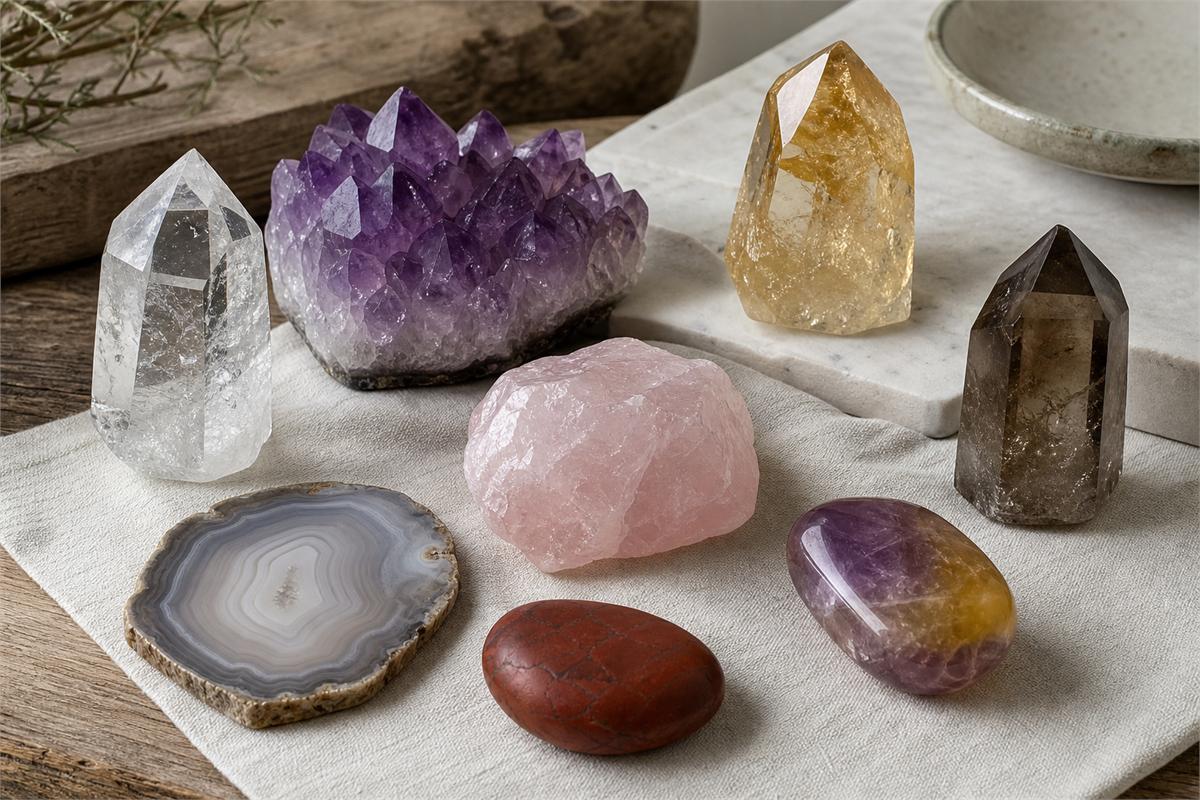
Rock crystal is colorless transparent quartz. Amethyst, citrine, smoky quartz, rose quartz, and ametrine are also members of the quartz family. Ametrine contains amethyst-colored and citrine-colored zones in one crystal. These colors arise through different combinations of trace elements, structural defects, natural radiation, geological conditions, and sometimes treatment. It is inaccurate to reduce every quartz color to one element such as “iron” or “titanium.”
Quartz also occurs in microcrystalline or cryptocrystalline forms. Chalcedony is the broad material group; agate usually shows banding or other structured color patterns, while jasper is commonly opaque and patterned or colored by mineral particles. They belong to the silica/quartz system even though they do not look like a clear six-sided crystal. For a broader mineral overview, see the Eastern Story Material Guide, and for the colorless variety start with What Is Clear Quartz?
Included quartz and market names
Rutilated quartz, tourmalinated quartz, phantom quartz, strawberry quartz, and fire quartz or hematoid quartz describe visible inclusions, growth patterns, or trade appearance. The name may suggest a likely inclusion, but color alone cannot confirm its mineral identity. “Rutilated” should mean quartz containing rutile, yet needle-like inclusions can be other minerals. “Strawberry quartz” has been applied to more than one kind of pink or red included quartz. “Fire quartz” and “hematoid quartz” usually refer to quartz colored or patterned by iron-oxide-related inclusions, but the exact inclusion still needs analysis.
Some names are even less standardized. “Titanium quartz” may be used for thick rutile-bearing quartz, for quartz with other metallic-looking inclusions, or for surface-coated rainbow quartz. “Rabbit hair quartz” usually describes fine hair-like inclusions and is a trade description, not a mineral species. “Super Seven” is sold as a multi-inclusion quartz, but the claimed list of seven minerals is not automatically verified in every bead. In Chinese-speaking markets, jiaohua shuijing (胶花水晶), often translated as glue-flower or jelly-flower crystal, describes quartz with flower-like internal patterns; it is a market name with inconsistent usage, not a formal mineralogical identity.
A phantom is a visible outline of an earlier growth stage inside a later quartz crystal. Green material inside a phantom may be chlorite, another mineral, or a mixture; a green color by itself is not a laboratory identification. Our guides to green phantom quartz, garden quartz, and rutilated quartz explain how these market categories are used.
Natural materials that are not quartz
Natural does not mean quartz. Obsidian is natural volcanic glass, not crystalline quartz; learn more in What Is Obsidian? Tourmaline is a separate mineral group. Fluorite is calcium fluoride. Moonstone is feldspar. Lapis lazuli is a rock made of several minerals. Malachite, jade, amber, and turquoise also need their own identification and care rules. A seller who calls every polished stone “crystal” may be using a broad retail category rather than a precise material description.

Use an Evidence Ladder, Not a Single Crystal Authenticity Test
| Evidence level | What it can do | What it cannot do |
|---|---|---|
| Level 1: seller and listing screen | Find unclear naming, missing treatment disclosure, filtered photos, inconsistent measurements, copied reports, pressure tactics, and weak return terms. | Prove mineral identity or natural origin. |
| Level 2: non-destructive observation | Reveal possible bubbles, flow lines, dye concentration, coatings, joins, repeated molds, surface wear, and unusual uniformity. | Reliably separate every natural, synthetic, treated, and imitation material. |
| Level 3: professional gemology | Combine refractive index, specific gravity, polariscopy, microscopy, spectroscopy, and other methods to identify material, origin category, and detectable treatments. | Answer claims outside the report scope, such as retail value, mine origin, or every treatment, unless the report explicitly addresses them. |

This ladder also protects the object. A good home screen should leave the polish, coating, glue, drill holes, cord, and setting unchanged. If certainty would require scratching, striking, heating, soaking, applying chemicals, or dismantling the piece, stop and use a laboratory instead.
How to Identify Fake Crystals at Home: A Non-Destructive Screen
1. Read the disclosure before studying the stone
Look for a specific material, origin category, treatment, dimensions, weight, construction, and care statement. “Natural crystal,” “healing crystal,” “premium crystal,” and “crystal glass” are not interchangeable identities. If the listing says citrine, ask whether it is natural-color citrine, heat-treated amethyst sold as citrine, irradiated quartz, synthetic citrine, or glass. Much of the citrine in commerce is heat-treated amethyst; that is a disclosed treatment question, not a reason to call every yellow quartz fake. The Citrine Bracelet and Bangle Guide explains this distinction in more detail.
For included quartz, ask what the inclusion is and how the seller knows. A confident mineral claim should come from supplier documentation or testing, not from color alone. For a bracelet, also ask whether all beads are represented as the same material, whether any are coated or dyed, and whether spacers, glue, elastic, or metal parts affect care.
2. Ask for neutral, natural-light evidence
Request clear photos or a slow video in indirect daylight, plus a neutral white-light view. Ask for the exact item, not a “representative” sample, and include front, back, side, drill holes, clasp, and any visible internal feature. Strong spotlights, dark backgrounds, beauty filters, saturation boosts, and wet surfaces can make color appear deeper and hide cloudiness, scratches, coatings, or fractures.
If it is a set of beads, compare several at once. Natural variation can be subtle or absent, especially in carefully matched high-grade material, so uniformity alone is not proof. However, identical internal swirls, bubbles, seams, or repeated “inclusion” patterns across many beads can indicate molding, printed effects, or mass-produced imitation.

3. Magnify bubbles, color, surfaces, and joins
A 10× loupe or a good macro photograph can reveal useful clues. Round gas bubbles scattered through a homogeneous body, especially with curved flow lines, strongly support manufactured glass. Mold seams, swirl marks, or a soft-looking surface can support plastic or resin. A flat boundary, glue layer, localized bubble trail, or abrupt material change can reveal a doublet, triplet, or other assembled product.
But “a bubble means glass” is too simple. Natural quartz can contain two-phase or three-phase fluid inclusions: a tiny gas bubble may sit or move inside a liquid-filled cavity, sometimes within a negative-crystal shape. Judge the bubble’s shape, setting, movement, distribution, and relationship to other features. One isolated round feature in a phone photo is not enough for a verdict.
For dyed quartz, look for color concentrated along surface-reaching fractures, pits, drill holes, grain boundaries, or a thin surface layer. Uneven natural color zoning can also follow growth structure, so again use several clues. Bright color is not automatically artificial, and even color is not automatically synthetic. Coatings may show abrasion at facet edges, color visible only on the surface, a rainbow film, or a different color where a scratch already exists. Do not create a scratch to test the idea.

4. Compare dimensions, weight consistency, price logic, and returns
For a single loose object, record its dimensions and weight and compare them with the seller’s description and any report. Quartz has a relative density of about 2.65, but heft by hand is a poor identification method. Common glasses can have densities close to quartz, lead-containing glasses can be heavier, and plastic is usually lighter. Mountings, hollow construction, metal findings, cord, bead diameter, and internal cavities further change the impression.
Within a matched strand, suspiciously inconsistent weights for supposedly identical solid beads—or identical weights paired with repeated molded features—may justify questions. Precise measurement is more informative than “it feels heavy.” Even then, weight supports an investigation; it does not establish natural origin.
Price is a plausibility check, not an authenticity test. Compare the exact variety, size, clarity, color, cut, matching quality, treatment, construction, and seller service. A low price may reflect common material, commercial grade, treatment, direct sourcing, or a simulant. A high price can reflect rarity—or simply marketing. The safest purchase gives you enough time to inspect the exact item and a written return policy that covers material misdescription.
Popular Home Tests That Do Not Prove a Crystal Is Real
| Popular test | Why it misleads | Safer use |
|---|---|---|
| Cold feel or slow warming | Temperature depends on room conditions, size, surface area, setting, and thermal properties. Glass can also feel cool. | Do not score authenticity from touch. |
| Heavy “pressure in the hand” | Quartz is about 2.65 SG; glass can be similar or heavier, while findings and construction change weight. Plastic is often lighter. | Use measured dimensions and weight only as supporting data. |
| Clear ringing sound | Shape, thickness, mounting, cracks, contact point, and material all change sound; impact can chip the piece. | Do not strike beads or stones. |
| Hair or text double image | Quartz is birefringent, but cut direction, optic axis, curvature, magnification, and viewing geometry control whether doubling is visible. | Leave optical identification to properly oriented instruments. |
| Four-light/four-dark or bull’s-eye pattern | A polariscope or conoscope requires correct equipment, orientation, and interpretation. A phone screen and improvised polarizers can create ambiguous patterns. | Use only as a trained screening method, never a final verdict. |
| 365 nm UV glow | Natural minerals, dyes, resins, oils, coatings, adhesives, and contamination can fluoresce; many treated materials are inert. | UV can flag a feature for laboratory follow-up. |
| Drill-hole finish | Chips, rounding, polish, and shape mainly reflect drilling, abrasion, and finishing quality. | Inspect for dye or coating concentration, not natural origin. |
| Hardness scratch test | Quartz is Mohs 7, but scratching compares surfaces and can damage polish, coatings, settings, or another bead. | Never use a knife, key, nail, glass plate, or two pieces of jewelry to scratch or strike-test a finished item. |

A flashlight is useful for illumination, not identity by itself. Side lighting, transmitted light, and reflected light can help you see fractures, joins, dye, bubbles, or surface films. “The whole stone glows” versus “only one bright spot appears” depends heavily on cut, opacity, contact angle, and the light source.
Avoid alcohol wiping, acetone, acids, bleach, salt soaking, boiling, heating, flame, or other chemical experiments. They can attack dyes, coatings, fillers, glue, cord, plating, porous companion minerals, or skin-contact finishes. Damage from a home experiment proves only that the experiment was harsh.
Natural vs Synthetic Quartz: Why Home Identification Is Difficult
Synthetic quartz is usually grown hydrothermally from a seed crystal under heat and pressure. It is crystalline silicon dioxide and can share the refractive index, birefringence, hardness, specific gravity, piezoelectric behavior, and many visual properties of natural quartz. Calling it “glass” is incorrect. The accurate description is synthetic, laboratory-grown, or hydrothermal quartz.
Natural quartz can be exceptionally clean. Synthetic quartz can contain seed remnants, growth zoning, particles, nail-head-like features, fingerprints, or other inclusions. Modern production can also yield material with few obvious clues. That is why “natural has cotton and cracks; flawless means synthetic” fails as a rule. Inclusions can support an origin determination when their identity and growth context are understood, but ordinary visible flaws are not a natural-quartz passport.

A laboratory may use microscopic growth features, twinning, the relationship of color zones to crystallographic directions, infrared spectra, and other evidence to separate natural from hydrothermal synthetic quartz. Even some professional cases require multiple methods. If the distinction affects a meaningful price, a collection record, or an important gift, buy the report rather than relying on a phone test.

Dyed Quartz, Treated Crystals, Coatings, and Composites
Treatment is not a synonym for fake. Heat, irradiation, dye, fracture filling, impregnation, and coating are used to change color, clarity, stability, or surface effect. The buying questions are: What is the underlying material? What was done to it? Is the treatment stable in normal wear? Does it require special care? Was it disclosed? Is the price appropriate for that identity?
| Process | What it changes | Useful buying and care questions |
|---|---|---|
| Heat | Can lighten, darken, or transform color. Much commercial citrine is heated amethyst. | Is heat treatment disclosed? Is the color stable under normal use? Avoid unneeded high heat. |
| Irradiation | Creates or changes color centers in some quartz. | Was the process disclosed and performed through a compliant supply chain? Do not assume all irradiated material is dangerous. |
| Dye | Adds or intensifies color, often in porous material or surface-reaching fractures. | Is dye disclosed? Can light, sweat, cleaners, or abrasion change it? Is color concentrated in cracks or holes? |
| Filling / impregnation | Reduces visibility of fractures or improves stability with resin, oil, wax, or glass. | What filler was used? Can heat, ultrasonic cleaning, steam, or solvents damage it? |
| Coating | Adds a thin colored, metallic, or iridescent surface layer. | Will abrasion wear the layer at edges? What cleaning method protects it? |
| Composite / assembled construction | Joins layers or binds fragments to create size, color, pattern, or stability. | Which parts are natural, synthetic, glass, or polymer? Where are the joins? Is soaking safe? |

“Crackle quartz” or “exploded quartz” is commonly made by heating and rapidly cooling quartz to create internal fractures; color may then be introduced into those fractures. Dense radiating cracks and color-filled fracture networks can support that interpretation, but appearance alone cannot reconstruct every processing step. The same caution applies to listings described as “injected,” “acid-washed,” or “enhanced.” Ask for the actual treatment statement or laboratory result.
Irradiation and heating are not automatic safety warnings, and they do not erase the quartz identity. Surface coatings and fillers may be more care-sensitive because they can scratch, soften, yellow, or react to heat and chemicals. Judge each product by accurate disclosure, applicable safety controls, stability, and price—not by a blanket idea that every treatment is fraudulent.

What a Qualified Gem Laboratory Can Test
For a non-destructive professional identification, the laboratory selects tests that suit the form of the object. A loose faceted stone, polished bead, rough crystal, carving, and assembled bracelet may not allow the same measurements.
- Refractive index: crystalline quartz is typically around 1.544–1.553. Natural and synthetic quartz overlap, so the reading can identify quartz while leaving origin unresolved.
- Relative density or specific gravity: quartz is about 2.65–2.66. Glass formulations overlap broadly, and composites or mounted objects can prevent a clean measurement.
- Polariscopy and optic testing: reveal optical behavior, birefringence, strain, twinning, or optic figures when the sample and orientation allow it.
- Gemological microscopy: examines growth zones, inclusions, bubbles, flow lines, filled fractures, coatings, seed evidence, drill holes, and assembly boundaries.
- Spectroscopy: Raman, infrared, UV-visible, or other spectra can help identify material, polymers, color causes, or natural-versus-synthetic indicators.
- Additional analysis: X-ray fluorescence or other chemical methods may support inclusion, coating, color, or origin questions.

The value comes from interpretation. A refractometer reading, UV reaction, or microscope image is not self-explanatory. A qualified gemologist weighs the result against the sample’s shape, construction, known treatment routes, and the limitations of each test.

How to Check a Crystal Certificate or Gem Report
Choose an independent, traceable gem laboratory recognized in the country or region where you are buying. Accreditation marks can be useful, but no single national mark applies worldwide. Check the laboratory’s legal identity, physical contact information, testing scope, report-verification system, and reputation among gem professionals. Do not rely on a laboratory logo shown only on a seller’s page.
- Match the object: compare the report number, weight, dimensions, shape, color, photograph, seal, and any laser inscription or item identifier with the exact piece.
- Read the identity line: “quartz” may state the species but not natural origin. Look for natural, synthetic/laboratory-grown, imitation, composite, or another explicit origin category.
- Read treatment wording: note “heated,” “dyed,” “irradiated,” “filled,” “impregnated,” “coated,” “no indications observed,” or any limitation statement.
- Verify independently: navigate to the issuing laboratory’s official website yourself and enter the number in its report-check tool. Avoid a QR code or link that could lead to a look-alike domain.
- Compare the archived record: the online identity, date, measurements, and image should match the paper or digital report.
- Understand the scope: an identification report is not automatically an appraisal, grading report, mine-origin statement, or safety certificate.

A real report can still be copied and paired with another object. A report number that exists online is only the first check; the physical match is equally important. For a strand, ask whether the report covers one tested bead, sampled beads, or every component. For a mounted piece, the laboratory may list testing limitations caused by the setting.
How to Buy Real Crystals Without Relying on Hype
Before paying, confirm these eight points:
- The exact mineral, glass, plastic, or composite name.
- Natural, synthetic/lab-grown, or imitation origin.
- All known treatments and coatings.
- Dimensions and weight of the exact item.
- Natural-light images, including drill holes and edges.
- What any certificate covers and how to verify it.
- Care requirements for stone, treatment, glue, metal, and cord.
- A written return and material-misdescription policy.

Be cautious when the seller changes the subject from material identity to energy stories, insists that a high price proves power, refuses natural-light images, uses the same certificate for many items, or says ordinary gem testing cannot understand a “special frequency.” Fear and urgency are also red flags: “this stone chose you,” “buy now or lose your chance,” or “your bad energy will worsen without it” are pressure tactics, not mineral evidence.
A strong seller can answer “What is it?” before “What does it symbolize?” Eastern Story values the cultural and personal meanings people carry through jewelry, but those meanings are most trustworthy when the material story is accurate. If you want a wider comparison of natural crystal, synthetic quartz, and crystal glass, continue to our Natural Crystal vs Artificial Crystal Guide.
Care for Quartz, Treated Crystals, and Crystal Jewelry
Care follows the complete object, not the word crystal. Plain, untreated quartz is relatively durable at Mohs 7, but it can still chip at edges or fracture after impact. A dyed, filled, coated, glued, plated, strung, or composite piece may be much more sensitive than the quartz itself. Companion stones in the same bracelet can also set the care limit.
- Wipe fingerprints, sweat, and dust with a clean soft cloth after wear.
- When the seller or laboratory confirms it is suitable, use a little lukewarm water with mild soap and a soft cloth; rinse briefly and dry completely.
- Avoid prolonged soaking for strung, glued, filled, coated, plated, assembled, or mixed-material jewelry.
- Keep jewelry away from sudden heat, steam, strong cleaners, acids, bleach, alcohol, and solvents.
- Limit prolonged strong sunlight for color-sensitive or treated material, and store pieces away from radiators, hot cars, and rapid temperature changes.
- Separate pieces in soft pouches or compartments so quartz does not scratch softer gems and harder jewelry does not abrade coatings or polish.
- Check elastic, knots, wire, clasps, glue, and drill-hole wear every 3–4 months, and sooner when the piece is worn frequently or exposed to sweat.
- Use ultrasonic or steam cleaning only when a qualified jeweler confirms the exact material, treatment, setting, and condition are suitable.

Not every crystal is harmed by water, and no universal cleaning schedule fits every owner. Clean when residue is visible or after conditions that leave sweat, cosmetics, dust, or salt on the piece. For mixed-material jewelry and a broader decision guide, use the Eastern Story Care Guide.
Physical cleaning and spiritual “cleansing” are different. A personal ritual may serve as a moment of reflection or intention, but it does not identify the material or repair physical damage. If you use a symbolic practice, choose a dry, low-risk approach that respects the actual stone, treatment, cord, metal, and adhesive; do not assume salt, water, sunlight, smoke, or heat is safe for every piece.
Crystal Healing Claims and High-Pressure Marketing
Quartz has real physical properties, including piezoelectric behavior used in electronics and timekeeping. That engineering fact does not turn a bracelet or loose stone into a medical device or a mechanism for changing the body, fate, or wealth. Crystals cannot diagnose or treat depression, anxiety, or physical disease, and they should not replace licensed medical or mental-health care.
A crystal can still be meaningful as jewelry, a mineral specimen, a cultural object, a gift, or a personal mindfulness cue. Someone may associate a color or stone with calm, courage, remembrance, or intention. That value belongs to personal practice and symbolism rather than a hidden medical force.

- Walk away from guaranteed cures, guaranteed wealth, or claims that one object solves many unrelated diseases.
- Reject fear-based messages that blame illness, misfortune, or relationships on a missing purchase.
- Be wary of urgent high-price upgrades, secret “quantum” measurements, and unverifiable energy certificates.
- Verify gem reports independently and keep copies of listings, invoices, and treatment disclosures.
- Leave immediately if a seller discourages medical care, medication, licensed counseling, or independent thought.
The Most Reliable Way to Tell If a Crystal Is Real
Begin with language, not tricks: identify the claimed material, natural or synthetic origin, treatments, and construction. Then inspect the exact item under neutral light, magnify bubbles and color distribution in context, compare measurements and weight, and judge the seller’s evidence and return terms. Ignore cold-touch, ringing, “pressure in the hand,” improvised double-image, drill-hole, UV, and scratch-test verdicts.
For an inexpensive decorative piece, that screen may be enough to decide whether the description and price feel reasonable. For a high-value, important, or disputed purchase, use a qualified independent laboratory and match its report to the physical item. That is how to buy real crystals with confidence while still leaving room for the beauty, craft, culture, and personal meaning that drew you to the stone.
Frequently Asked Questions
Related Posts


2 Comments