
A gold sheen obsidian bracelet is made from natural obsidian—a silica-rich volcanic glass—with a golden reflective effect that becomes visible as the beads or bangle move under light. “Golden obsidian bracelet” and “gold obsidian bracelet” are common retail phrases for the same jewelry category. The gold color is an optical appearance, not proof that the material contains gold.
The best pieces are judged by what you can actually observe: the strength and coverage of the sheen, how it moves, whether the cutter oriented it well, the black bodycolor, cracks and chips, polish, bead-to-bead matching, fit, construction, and any metal components. A beautiful moving band can be genuine, but terms such as “single eye,” “double eye,” and “cat eye” are market descriptions rather than universal gemological grades.
What Is Gold Sheen Obsidian?
Obsidian is a naturally occurring volcanic glass, usually formed from silica-rich lava that cools quickly enough to suppress extensive crystal growth. It has a disordered glass structure rather than the repeating crystal lattice of a mineral. That is why calling it a “cryptocrystalline mineral” is inaccurate. You can explore the broader material family in our guide to what obsidian is and how it forms.
Gold sheen obsidian is a gem and market name for obsidian that displays a golden internal reflection. Its bulk composition is still volcanic glass; it is not solid gold, gold ore, goldstone, or black crystal with gold paint. Obsidian commonly falls around Mohs 5–6, while density is composition-dependent and often around 2.2–2.5 g/cm³. These are useful reference ranges for a laboratory, not pass-or-fail shopping tests.

The glass can be black, very dark brown, gray-black, or locally translucent where it is thin. Thickness, lighting, flow bands, bubbles, inclusions, cut direction, and the particular volcanic source all affect transmission. Some genuine pieces show brownish light at a thin edge; others remain visually opaque in an ordinary phone-light check. Neither result settles authenticity by itself.
How Does the Golden Sheen Form?
The most responsible answer is that the sheen comes from light interacting with aligned internal structures created or arranged while the viscous volcanic melt flowed and cooled. Research on Mexican sheen obsidian has described flattened, flow-aligned lenticular features filled with gas or glass of a different composition, together with some oriented pyroxene or feldspar crystals. Their internal reflections can produce a broad metallic-looking glow.

Different deposits and specimens can look dramatically different, and more than one microscopic mechanism may contribute. That is why the familiar sales claim that gold sheen always comes from goethite, mica, hematite, magnetite, or another single mineral should not be treated as a universal explanation. Those phases may occur in some volcanic glasses, but the visual effect alone cannot identify a specific inclusion.
In confirmed natural material, the sheen is part of the stone’s internal optical structure rather than a gold-colored surface paint. Even so, seeing reflection below the surface is not a complete authenticity test: coated glass, layered glass, and other manufactured products can create complex reflections. Identification depends on the whole set of observations and, when needed, laboratory testing.

Market Names, “Eye” Effects, and Non-Standard Grades
Retailers use many names for the material, including gold sheen obsidian, golden obsidian, gold obsidian, golden shine obsidian, “gold eye,” and Chinese market names such as Jinyaoshi (金曜石), Jinsha Heiyaoshi (金沙黑曜石), and Huangjin Heiyaoshi (黄金黑曜石). These can help you understand a listing, but they are not separate mineral species.
| Market term | What it usually describes | How to read it |
|---|---|---|
| Star sand / weak sheen | Small or sparse golden flashes visible in a narrower lighting range | Describe strength, coverage, and lighting instead of assuming a fixed entry grade |
| Flowing gold | Broader cloudlike or sheetlike sheen that moves as the piece turns | Check continuity, direction, surface polish, and matching across the bracelet |
| Single eye | One dominant oval, arc, or band on a bead | A cutting and appearance term, not an international certificate grade |
| Double eye | Two visible arcs, bands, or opposing reflective zones | Judge symmetry, visibility, orientation, and whether the effect appears under one or more lights |
| Cat eye | A narrow or broad moving light band | Reserve strict chatoyancy for a sharp moving band produced by aligned structures; many listings show only eye-like sheen |
| Golden ring / full sheen | Reflection visible around much of a round bead as it rotates | Coverage depends strongly on bead shape, cut orientation, and lighting |

Gemological chatoyancy is a relatively narrow moving line of reflected light, typically displayed by a properly oriented curved surface over aligned inclusions or structures. A wide gold patch, halo, or “eye” on an obsidian bead may be attractive without meeting that stricter definition. Round beads also show different portions of an oriented layer as they rotate, so bead shape, drilling axis, polishing direction, and the number and position of light sources can radically change the effect.

Gold Sheen Obsidian vs Goldstone, Coated Glass, Resin, and Ordinary Obsidian
| Material | What it is | Typical visual character | What to request |
|---|---|---|---|
| Natural gold sheen obsidian | Natural volcanic glass with oriented internal structures that reflect golden light | Black to dark bodycolor with directional sheen that changes with angle | Clear material name, treatment disclosure, dimensions, photos or video under moving light, and return terms |
| Ordinary black obsidian | Natural volcanic glass without a strong gold-sheen effect | Glassy black, dark brown, gray-black, or banded appearance | Natural obsidian identification and disclosure of coatings or assembled construction |
| Goldstone | Man-made glass containing reflective copper crystals or related metallic inclusions | Dense, glittering coppery points distributed through glass | Labeling as manufactured glass or goldstone, not natural gold sheen obsidian |
| Coated or layered glass | Manufactured glass with surface film, backing, foil, or fused layers | Metallic flash may concentrate at a surface or boundary, though some effects look internal | Coating, assembly, and base-material disclosure |
| Resin or plastic composite | Polymer, sometimes filled, dyed, coated, or molded | Light weight, mold seams, soft surface, or uniform decorative effects may appear | Material composition and any embedded particles or coatings |
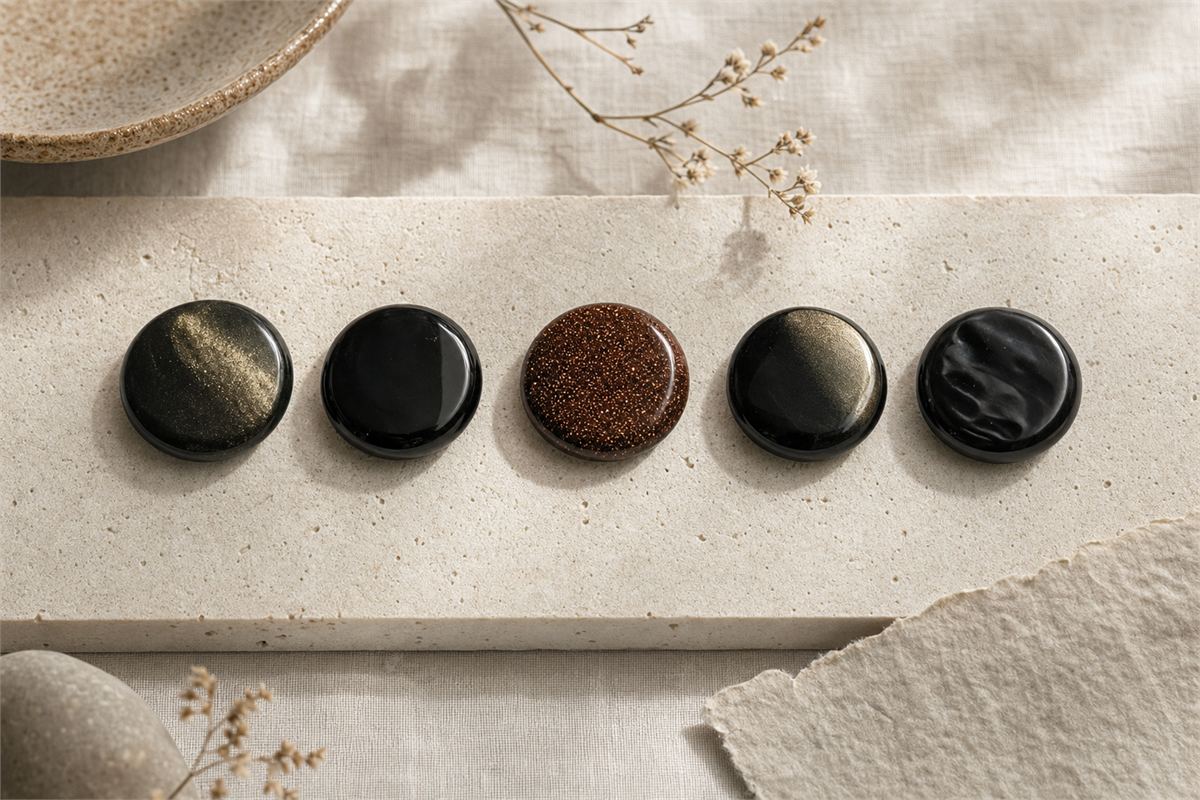
Goldstone deserves special attention because the names sound similar. Goldstone is an attractive decorative glass with copper crystals; it is intentionally manufactured and can be beautiful in its own right. It simply belongs in a different category from natural gold sheen obsidian. Our natural and artificial material guide explains why accurate disclosure matters more than treating every manufactured material as inferior.

What Determines Gold Sheen Obsidian Quality?
There is no universally accepted four-tier grading system for gold sheen obsidian. Quality should be described through observable factors, especially when comparing two bracelets at very different prices.
- Sheen strength: Is the gold effect vivid or faint under a reasonable single light source?
- Coverage: Does it appear as scattered points, a partial patch, a broad field, a defined band, or near-full rotation coverage?
- Directionality: Does the reflection move smoothly, and did the cutter orient the beads to show it?
- Bodycolor and contrast: A darker base can make gold reflection appear stronger, while gray or brown areas can create a softer look.
- Cracks and edge condition: Inspect surface-reaching fractures, chips at drill holes, bruised edges, repairs, and glue.
- Polish: A clean polish should reveal the optical effect without deep scratches, flat spots, orange peel, or excessive rounding around drill holes.
- Matching: In a full strand, compare bead diameter, shape, bodycolor, sheen direction, brightness, and drill alignment.
- Construction: String quality, knots, clasp, spacer edges, metal purity, setting security, and after-sales service affect the finished piece.

Natural obsidian may contain bubbles, flow lines, inclusions, or highly clean glassy areas. A visible bubble is not automatic proof of artificial glass, and a clean bead is not automatic proof of imitation. “Perfect” and “imperfect” are sales impressions; the diagnostic question is whether the observed features, optical properties, construction, and report agree.

Gold Sheen Obsidian Bracelet Price Guide in USD
The following ranges are practical retail reference bands for comparing the supplied product categories. They are not international grades or live market quotations. Sellers may use different names for similar appearance levels.
| Observable product level | USD reference | What should support the price |
|---|---|---|
| Basic strand with scattered points or weak sheen | $50–$100 | Correct material disclosure, wearable polish, sound drill holes, stated bead size, and fair return terms |
| Daily-wear strand with even, flowing gold sheen | $100–$500 | Better coverage, smoother movement, consistent beads, clean polish, secure stringing, and fewer distracting fractures |
| Clear directional “eye” effect with stronger matching and polish | $500–$1,000 | Well-oriented light bands or eye-like zones, high contrast, careful matching, refined finish, and stronger documentation |
| Strong double-direction or near-full sheen, premium matched strand, or complex precious-metal design | $1,000+ | Exceptional visible effect, labor-intensive orientation and matching, secure construction, and clearly itemized metal or design value |

Price changes with bead diameter, bead count, bracelet length, matched appearance, fractures, polish, sheen orientation, carving, and setting work. A bracelet with solid 18K or 24K gold, a Pixiu (貔貅), a gourd hulu (葫芦), gemstones, or elaborate metalwork must also be evaluated through gold purity, actual gold weight, solid or hollow construction, labor, brand, certificate, warranty, and return policy. The resale behavior of gold cannot be transferred automatically to the entire finished bracelet.
A $9.90 offer is a reason to slow down and verify the base material, coatings, bead diameter, number of beads, metal description, shipping terms, and return conditions. Price alone cannot identify a fake, but an unusually low quote often means that one or more product details are different from what the headline suggests.
Bracelet Forms, Bead Size, Fit, and Gold Components
Stretch bead bracelet
Round beads are the most common format because rotation reveals the moving sheen. Beads around 6–8 mm create a lighter, quieter look; 10–12 mm beads make the gold effect more visible; 14 mm and larger beads feel bolder and heavier. Larger beads can also magnify drilling errors, flat spots, and mismatch.

Knotted or clasped strand
Knotted cord, woven cord, or a clasp can reduce reliance on elastic and offer more adjustment. Check whether knots protect neighboring beads, whether the clasp edges rub the glass, and whether the design can be restrung without damaging decorative components.
Solid bangle or mounted bracelet
A one-piece obsidian bangle requires a sufficiently large, sound piece of rough and careful orientation, grinding, and polishing. Because obsidian is brittle, thin walls, hidden fractures, and hard impacts deserve extra attention. Metal-mounted cabochons or beads may use bezels, prongs, drilled posts, adhesive, or combinations of mechanical and adhesive support. Ask how the stones are held and how the setting can be serviced.
For fit, measure the wrist where the bracelet will sit and add ease according to bead size and comfort preference. Large beads reduce the usable inner circumference, so a strand labeled with the same length may fit tighter than one made with smaller beads. Use our bracelet size guide for wrist measurement, bead-size allowance, and bangle opening checks.

With gold-colored components, distinguish solid karat gold, gold-filled material, vermeil, gold plating, brass, and coated alloy. “Ancient gold,” “hard gold,” “5D,” and “5G” can describe manufacturing or surface styles in a market, but the invoice should still state fineness, weight, construction, and any plating or base metal. Sharp spacer edges and poorly finished holes can cut string or strike the obsidian even when the metal itself is softer.

How Gold Sheen Obsidian Is Cut and Polished
The maker begins by examining rough material under directional light to locate the plane or zone that produces the strongest reflection. Orientation matters: cutting across, parallel to, or at an angle to the internal structures changes whether the finished surface shows a broad flash, a moving band, a small eye, or little sheen at all.

- Plan and mark: Identify cracks, usable thickness, sheen direction, and the intended bead, cabochon, or bangle form.
- Saw and preform: Cut the rough with cooling and controlled pressure, then shape it without creating sharp stress points.
- Drill or prepare the setting: Support the piece, keep the hole centered, and smooth the hole edges to reduce chipping and string wear.
- Grind and refine: Progress through finer abrasives while preserving the chosen orientation and balanced shape.
- Polish: Produce a clear, even surface that lets the internal reflection read cleanly.
- Match and assemble: Arrange beads for size, bodycolor, sheen direction, and rhythm before stringing or setting.

Good polishing cannot create a sheen that is absent from the internal structure, but poor orientation or a scratched surface can hide a strong effect. This is also why two beads cut from neighboring areas of the same rough can look very different.
How to Identify Gold Sheen Obsidian Safely
Home observations are best used to decide what questions to ask, not to issue a final verdict. Avoid scratching, burning, heating, needle testing, impact testing, or breaking a bead. These methods damage jewelry, can release sharp glass fragments, and still fail to separate every imitation.
| Observation | What it may tell you | Why it is not decisive alone |
|---|---|---|
| Moving gold sheen | Shows the orientation and visual quality of reflective structures | Natural and manufactured materials can both produce directional effects |
| Cool touch | Can separate some plastics from glassy materials in the first moment | Natural obsidian and ordinary glass are both glass and can feel similarly cool |
| Weight | May reveal a very light resin or hollow construction | Ordinary glass can have similar heft; size, holes, metal, and assembly change total weight |
| Phone light or edge transmission | Reveals local thickness, translucency, flow bands, or a coating boundary | Color and transmission vary in genuine obsidian, while layered or colored glass can imitate them |
| Bubbles and flow lines | Provide clues about a glassy material and its formation or manufacture | Natural volcanic glass can contain bubbles and flow structures; manufactured glass can be clean |
| Sound or temperature change | Offers a general material impression | Construction, bead size, environment, and glass composition produce overlap |

For an expensive or disputed piece, use a qualified gemological laboratory that combines methods appropriate to glass and its inclusions. A report should match the exact bracelet or stone through its number and photograph, describe the material name, record weight or dimensions, disclose observed treatments or assembly, and identify the issuing laboratory. Verify the report number directly with the institution and review its scope and credentials.
A certificate addresses the sample examined and the tests performed. It is not an appraisal of retail value, a guarantee of a seller’s origin story or claimed age, or evidence for prosperity and protective symbolism. Keep the invoice, metal-purity statement, return terms, and service policy alongside the laboratory document.

Gold Sheen Obsidian Meaning and Cultural Symbolism
In modern Eastern-inspired jewelry and contemporary crystal culture, black and gold create a strong symbolic pairing. Black is associated with steadiness, boundaries, protection, and composure; gold carries wishes for prosperity, confidence, warmth, and visible purpose. A golden obsidian bracelet can therefore serve as a personal reminder to move through work and daily life with calm intention.
Some modern Five Elements practices classify black with Water and gold-colored metal with Metal, then read the combination through the generating relationship of Metal supporting Water. Other practitioners use different associations. These are living symbolic systems and personal traditions, not properties revealed by a gemological test. Our Feng Shui bracelet guide gives the wider context for elements, wrist customs, and bead design.
Gold sheen obsidian is also used with the wealth-guarding creature Pixiu (貔貅) or the blessing gourd hulu (葫芦). The motifs add their own gift language: Pixiu is associated with guarding prosperity, while the hulu carries wishes for blessing, protection, and longevity. Read our guides to Pixiu bracelet meaning and the hulu symbol before choosing a culturally specific design.

Obsidian in general has a long archaeological history as a cutting and tool material in many regions. That history should not be turned into an invented ancient lineage for every modern gold sheen bracelet. Apache tears refer to a particular obsidian form and cultural story, while claims that assign gold sheen obsidian bracelets to unrelated ancient civilizations require evidence specific to those cultures and objects. A material family’s history is not automatically the history of this market variety.
Which Wrist Should You Wear It On?
Modern crystal customs often summarize wrist choice as “left receives, right releases.” A wearer may choose the left wrist for prosperity or welcoming symbolism and the right wrist for protection or letting-go symbolism. This is a personal ritual, and customs vary by community and teacher.
For daily wear, the practical answer is usually the non-dominant hand because it contacts desks, doors, tools, and bags less often. Switch wrists whenever the bracelet interferes with a watch, keyboard, sport, work equipment, or comfort. Remove it for sleep if pressure, snagging, or elastic strain is likely; the reason is physical safety and comfort rather than a rule about sleep energy.

Styling and Stacking a Golden Obsidian Bracelet
Black and gold work across minimalist, tailored, street, and modern Eastern-inspired wardrobes. A single 8–10 mm strand fits easily with a white shirt, knitwear, denim, or a dark jacket. Larger beads or a strong “eye” effect make a bolder focal point, while a slim mounted bracelet can sit closer to formal jewelry.

- Minimal: Wear one matched strand and let the moving sheen provide the detail.
- Black-and-metal stack: Add a smooth silver or gold-toned bracelet with rounded edges and enough spacing to prevent repeated impacts.
- Textural contrast: Pair polished obsidian with soft cord or leather rather than another hard bead strand.
- Gemstone contrast: Tiger eye offers a fibrous golden-brown band with a different optical character; compare it in our tiger eye bracelet guide.
- Workwear: Keep the stack narrow enough to avoid striking a desk or keyboard throughout the day.

Obsidian is softer than quartz and brittle. Diamonds, sapphires, quartz, and many other gems can scratch it, while any hard edge, protruding setting, or repeated metal impact can chip it. Gold and silver are not automatically harder than obsidian, but clasps, corners, solder joins, and the overall construction can still create damaging contact.
How to Clean, Wear, Inspect, and Store Gold Sheen Obsidian
Plain, uncoated beads or bangles
Wipe after wear with a clean, soft cloth. If an intact plain piece needs more cleaning, use lukewarm water and a small amount of mild soap for a brief wash, then rinse carefully and dry completely with a soft cloth. Do not soak it for long periods, and avoid toothpaste, abrasives, alcohol, salt water, steam, and ultrasonic cleaning.

Coated, glued, plated, elastic, or complex jewelry
Follow the jeweler’s instructions first. Water and cleaning products may reach adhesive, cord, elastic, plating, porous accent materials, or metal joints even when the obsidian itself appears sound. Perfume, chlorine, cosmetics, sweat film, and household cleaners are most likely to affect surface cleanliness, coatings, glue, string, and metal components, so remove the bracelet before swimming, bathing, cleaning, or applying products.
String and setting inspection
Every 3–6 months, inspect elastic or cord for fuzzing, flattening, loss of stretch, discoloration, exposed knots, or abrasion at bead holes. Check clasps, prongs, bezels, drilled posts, spacers, and glued elements for movement. Replace the string when wear appears; frequent wear, heavy beads, sharp holes, heat, and chemicals may shorten its life, while occasional wear may allow it to last longer.

Heat and storage
Avoid drops, hard impacts, strong heat, rapid temperature change, a hot car, sauna conditions, and prolonged intense sun. Obsidian is volcanic glass, not an ordinary hydrated crystal that simply “loses water” in daily air. The practical concerns are thermal shock, existing fractures, adhesives, string, coatings, and metal components.
Store the bracelet clean and dry in a soft pouch or lined compartment, separated from harder jewelry and sharp hardware. Lay elastic strands naturally rather than stretching them over a hook. For broader jewelry-care guidance, visit the Eastern Story Care Guide.

Moonlight or placing the bracelet near a crystal cluster can remain a gentle personal ritual if the setting is secure and the piece stays dry and protected. Such rituals are optional symbolic practices, not required material maintenance. Avoid burying jewelry in salt, soil, or crystal chips that can scratch surfaces, enter drill holes, or affect metal and string.
Gift Guide and Buying Checklist
A gold sheen obsidian bracelet suits someone who enjoys black-and-gold design, volcanic materials, moving optical effects, or symbolic jewelry. As a gift, it can express wishes for protection, prosperity, steadiness, confidence, and a composed new beginning. Match the language to the recipient’s beliefs and present it as a thoughtful symbol.
- Confirm whether the listing means natural gold sheen obsidian, ordinary obsidian with gold-colored parts, goldstone glass, coated glass, or resin.
- Request moving video under one clear light, plus neutral-light photos of the entire bracelet, drill holes, clasp, and any fractures.
- Record bead diameter, bead count, bracelet length or inner circumference, weight, and adjustment range.
- Compare sheen strength, coverage, direction, polish, cracks, chips, and matching—not just a poetic grade name.
- For gold components, confirm fineness, grams, solid or hollow construction, plating, base metal, labor, and repair policy.
- Ask about coatings, dyes, adhesive, assembled layers, repairs, and other treatments.
- Check metal allergies, cord material, occupation, dominant hand, daily activity, and cultural comfort.
- For higher-value pieces, match the report number and photograph to the exact item and verify the laboratory.
- Review return, resizing, restringing, stone-loss, and after-sales terms before payment.

If the recipient prefers symbolism-led jewelry, explore the Eastern Story Blessing Collection. The most satisfying gift combines an honestly described material, comfortable fit, secure construction, and meaning the wearer genuinely welcomes.
Frequently Asked Questions
Related Posts


