Pan Chi Wen (蟠螭纹, pán chī wén) is a decorative motif formed by coiling and interlacing chi-dragons, creatures commonly described as hornless dragons. Their curling bodies turn a bronze vessel, mirror, or jade ornament into a flowing pattern. In contemporary jewelry and gifts, that movement carries beautiful wishes for vitality, continuity, protection, and steady growth.
Part of its appeal is the discovery: what first looks like a tangle of fine curves gradually reveals a head, a turning body, and a tail. The creature seems to move while remaining close to the object it decorates. It is a lovely image for a life that keeps growing while staying connected to the people and hopes at its center.

What the name Pan Chi Wen means
| Word | Chinese | Meaning |
|---|---|---|
| Pan | 蟠 | To coil, curl, or wind around |
| Chi | 螭 | A dragon-like mythical creature, commonly described as hornless |
| Wen | 纹 | Pattern or ornament |
The chi-dragon, or Chilong (螭龙), is the creature; Pan Chi Wen describes its arrangement as ornament. A single coiled chi can form a compact motif, while several can interlock across a larger surface. A sculpted chi used as a handle belongs to the same visual family, though its full body need not form a repeating pattern.

The received text of the early dictionary Shuowen Jiezi describes the chi as dragon-like and yellow and includes an alternative description of it as hornless. This helps explain the familiar name, while surviving artworks show considerable freedom in ears, horns, limbs, and tails. The motif is an artistic tradition with many forms.
The wishes carried by a coiling dragon
Pan Chi Wen shares the auspicious spirit of the Eastern dragon (龙). Its special charm comes from the way that energy is held in a curve: alert, flexible, and ready to move. For a personal keepsake, the coiling form offers a gentle way to welcome strength and good fortune into everyday life.
Vitality and steady growth
A body that bends and rises can feel full of possibility. In a modern pendant or bracelet, that movement can carry a wish for patient progress: the courage to begin, the resilience to keep learning, and the confidence to grow at your own pace. It makes a thoughtful symbol for a graduation, a fresh start, or someone finding their direction.

Continuity and connection
Interlocking creatures lead the eye from one curve into the next. As gift language, that visual rhythm lends itself to lasting friendship, family affection, and support that continues through change. The wish is warm and simple: may good things keep unfolding, and may the people who matter remain close.
Some jade designs pair a larger chi with a smaller one. Objects described as parent-and-child or mother-and-child chi (子母螭) can inspire wishes for care, guidance, and family continuity. For a particular carving, the object’s established description gives that relationship its context; two differently sized creatures can also be a compositional pairing.

Protection, peace, and dignity
An attentive head and a body wrapped around an ornament can suggest a companion keeping watch. Pan Chi Wen jewelry may be worn to invite peace and protective energy, or given with the blessing Ping An Ru Yi (平安如意): peace, and may your wishes unfold well. Its connection with finely made ancient objects also gives it a sense of dignity—an enduring form for a heartfelt wish.

How to see the dragon within the pattern
Begin with one creature rather than trying to understand the whole surface at once. On a dense bronze design, the eye or muzzle may be the clearest starting point. On jade, a raised head or a space beside the neck can make the route easier to follow.

- Find a head. Look for an eye, muzzle, ear, or open mouth. Heads can be rounded, angular, or highly simplified.
- Follow the body. Trace its C-shaped curl, S-shaped turn, hook, or longer winding path. Notice where it crosses another body.
- Locate the tail and visible limbs. A tail may curl, divide, or twist. Some designs show limbs clearly; others compress or abstract them.
- Find the repeated unit. See whether the creature faces a partner, turns around a center, or returns along a border.
- Step back to see the object. A narrow band, circular mirror, open pendant, and rectangular panel each give the dragon a different space to inhabit.
Curves, symmetry, and repeating fields
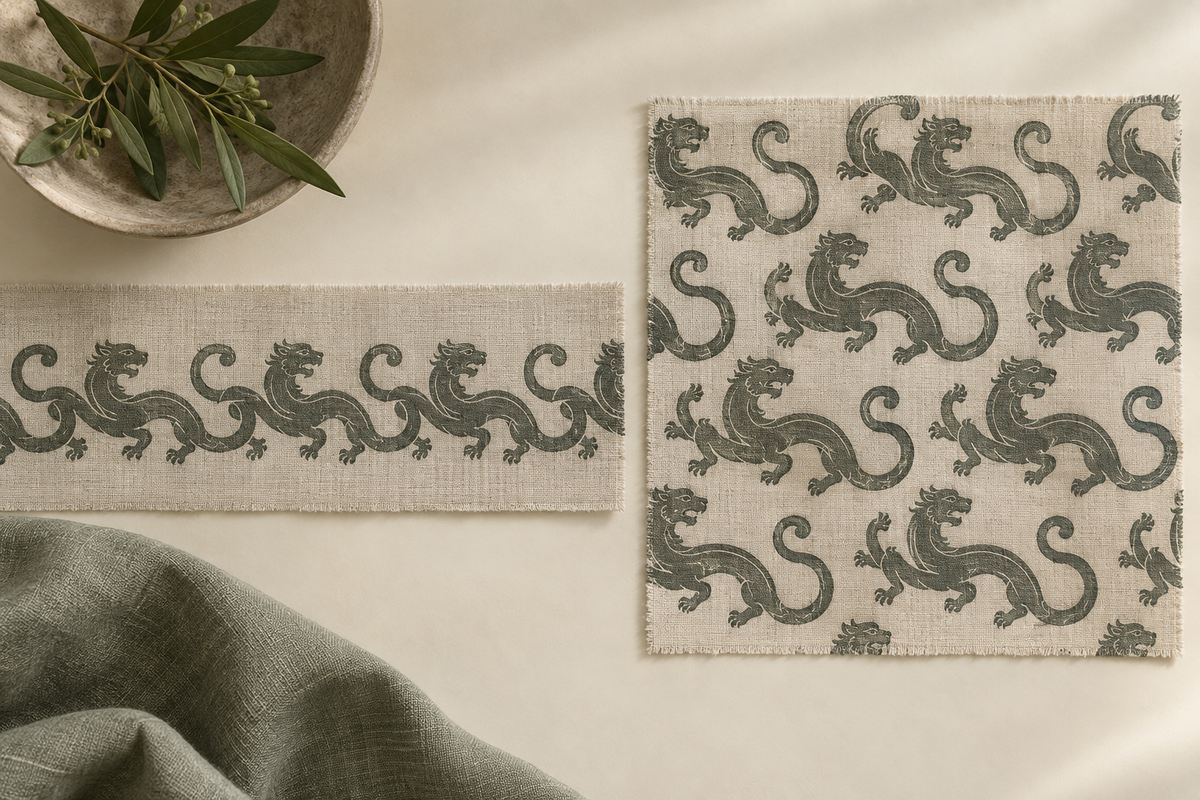
An S curve changes direction and gives the body a lively twist; a C curve makes a compact curl. Designers can rotate, reflect, and combine these forms. A border repeats along a strip, often called two-directional repetition (二方连续); an all-over field repeats across a surface in two dimensions, traditionally called four-directional repetition (四方连续). Other compositions center on a single creature or a balanced pair.
Movement and symmetry work comfortably together. A design may be orderly as a whole while its individual bodies twist in different directions. That balance is part of the pleasure: the pattern feels alive without losing its shape.
Main motif and background
On some bronzes and mirrors, larger animal curves stand out against the finer cloud-and-thunder pattern, Yunleiwen (云雷纹). The contrast gives the eye two levels to explore: the broad movement of the creature and the smaller rhythm behind it. Smooth areas and open spaces can create a similar contrast in jade.
Not every object has that background. Some leave space around the chi; others interlace the animals so densely that separating figure and ground becomes part of the discovery.

Pan Chi Wen and similar dragon or serpent motifs
| Name | What it describes | What to notice |
|---|---|---|
| Pan Chi Wen (蟠螭纹) | Coiling chi-dragon ornament | The creature and the way its body forms the pattern |
| Pan Hui Wen (蟠虺纹) | Interlaced small serpent-like ornament | The snake-like units and their repeated arrangement |
| Panlong Wen (蟠龙纹) | Coiled dragon ornament more broadly | The dragon’s particular form and the object’s description |
| Kui-dragon motif (夔龙纹) | A stylized dragon motif, often shown in profile | The profile, body structure, and surrounding composition |
| Chiwen (螭吻 / 蚩吻) | A named roof-ridge creature or ornament | Its position on a roof and its architectural identity |
Pan Hui Wen and Pan Chi Wen are especially easy to confuse. Fine serpent-like units often form a tightly repeated field, while chi motifs may show more individually readable dragon features. But physical size is an unreliable dividing line: both traditions include abstract, densely arranged designs. When looking at a museum object, use its collection description alongside what you can see.
The coiled arrangement also differs from the frontal organization of a beast mask such as the Taotie motif (饕餮纹). A mask draws attention toward a face and central axis; a coiling motif encourages the eye to travel along a body. Both can use symmetry.

Chiwen belongs to roof ornament and to versions of the “nine sons of the dragon” tradition. Its name should be kept distinct from chi and from Pan Chi Wen. The general chi-dragon has a broader history than any single list of dragon sons, and the coiling motif carries its own decorative identity.
From ancient bronzes to later treasured objects
Spring and Autumn and Warring States: interlacing comes alive
Coiling animal patterns became prominent on Eastern Zhou bronzes, including Spring and Autumn and Warring States objects. Lids, vessel bodies, bells, and mirror backs offered different spaces for repeating ornament. Regional workshops explored dense interlace, raised details, and lively animal forms alongside other decorative traditions.
These centuries brought changing patronage and a rich range of tastes and techniques. A vessel could serve ceremony, display skill, and delight the eye at the same time. The appeal of Pan Chi Wen lies partly in that combination: formal presence enlivened by restless curves.

A Spring and Autumn bronze ding in the Jin State Ancient Capital Museum at Houma gives a clear example. It has a rounded body, two upright side handles, three animal-hoof feet, and three rings on its lid; coiling chi ornament covers the body. The form supplies the order, and the pattern supplies the movement.
Bronze mirrors: movement around a center
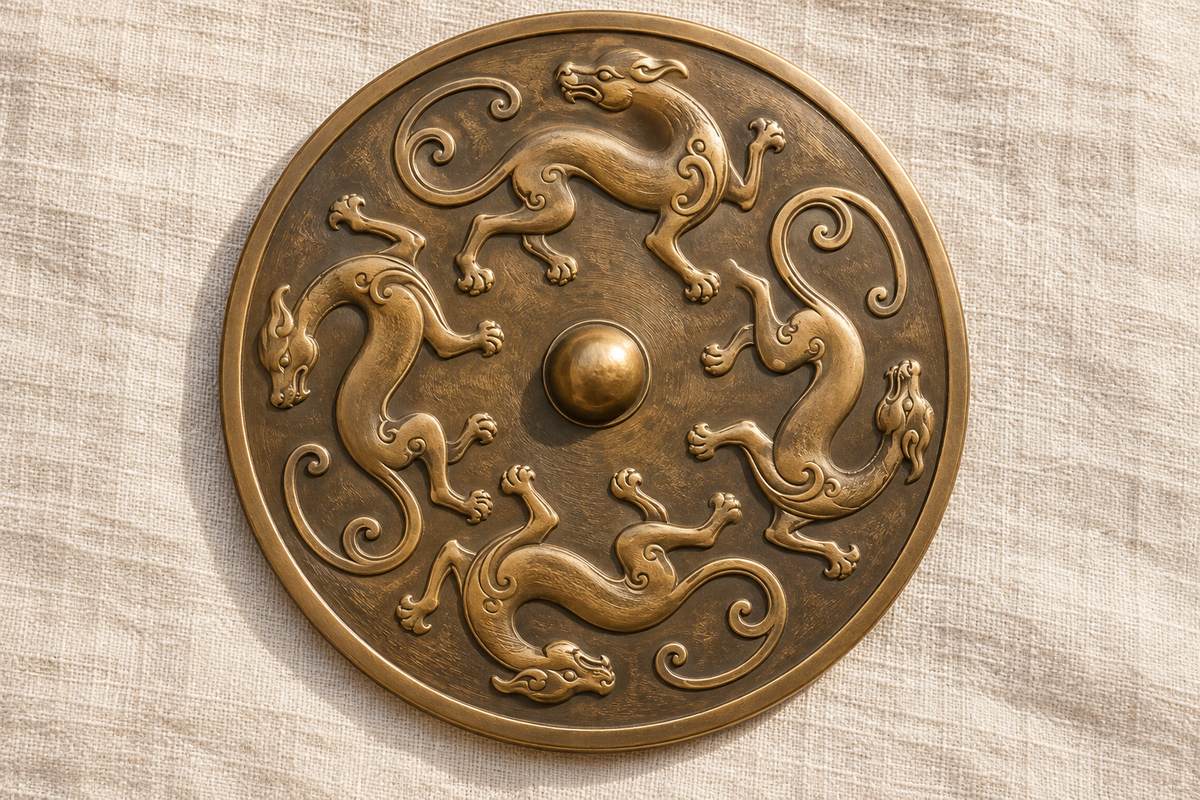
The Palace Museum’s collection includes a Warring States Pan Chi Wen mirror. On decorated mirror backs, animals and scrolling forms occupy the space around a central knob. Try following the pattern around that center: the composition can feel like a continuous circuit, even when it is built from separate units.
Dense ornament can also be easy to appreciate on a vessel with distinct decorative bands. A Pan Chi Wen dou in the Palace Museum stands 27.8 cm high and carries a band of the motif on both its lid and belly. Its lid has four rings. Comparing those two bands reveals how the same visual idea adapts to different curves.
Jade: the body becomes part of the form
Chi ornament flourished in Warring States and Han jade and remained an enduring choice in later carving. Pendants, jade bi discs (玉璧), belt hooks, and sword fittings let makers explore a creature in shallow relief, deeper modeling, and open spaces. The dragon might curl across a surface or help shape the ornament’s outline.
The National Museum of China’s Pan Chi Wen jade sword scabbard fitting offers an intimate example. Its chi has a strongly curved S-shaped body and a twisted tail, with a smaller chi head at the lower right. The museum describes both ears and a long horn on the larger creature—a useful glimpse of the variety within works bearing this motif’s name.
The small scale invites close looking. In relief jade carving (浮雕玉雕), the creature rises from its background; in openwork jade carving (镂空玉雕), openings let light help define the body. A curled tail can complete a rounded outline, while a gap beside a limb gives the whole piece a lighter feeling.

Later revivals: familiar curves in new surroundings
Later makers returned to the forms of ancient bronzes and jades, adapting chi ornament to their own tastes. The Palace Museum preserves a Song white-jade belt hook combining a horse-head hook with chi relief. Ming and Qing works carried the wider chi tradition into vessels, furniture, porcelain, and objects for the scholar’s desk.
A Ming blue-and-white vase in the Shanghai Museum has a chi applied in relief around its neck. A Qing twelve-panel screen in the National Museum of China combines chi carving with blessing characters and the longevity character Shou (寿). These objects show how an animal motif could travel into domestic surroundings and join a welcoming language of good wishes.

Related chi heads also appear in architectural decoration, including carved drainage spouts. A roof-ridge beast, a water outlet, a vessel handle, and a surface pattern each have their own form and purpose; enjoying their shared dragon imagery becomes easier when you notice where and how the creature is used.
Different crafts give the same curves a different feeling
A motif describes the design. Its material and method of making determine how that design catches light, holds space, and feels close to the hand.

| Craft | How it shapes the motif |
|---|---|
| Bronze casting | Forms a metal object in a mold; ornament may be modeled into the casting design |
| Lost-wax casting | Uses an expendable wax model to form a mold cavity for casting metal |
| Metal inlay | Sets a contrasting material into a prepared surface, making a line or detail stand out |
| Jade carving | Removes material by cutting, grinding, drilling, and polishing; can create incised lines, relief, or openwork |
| Chasing and engraving | Work a metal surface with tools; chasing displaces the surface, while engraving cuts into it |
| Filigree | Builds delicate ornament from fine metal wire |
The celebrated zun-and-pan set of Marquis Yi of Zeng in the Hubei Provincial Museum shows just how intricate bronze ornament can become. Its layered interlace rewards a slow look, from the vessel’s broad shape down to the smallest curling creatures. The Henan Museum’s cloud-pattern bronze jin, a stand for ritual vessels, offers another remarkable open structure: twelve dragon-like animals surround it and twelve more support it below. The museum describes lost-wax casting in its account of this particular stand.
Casting methods are established through study of each object’s construction. An elaborate tangle of creatures can be admired for its design without assigning its manufacture from the pattern alone.
In modern jewelry, chisel-work metal decoration (錾刻) may emphasize the face, body, or surrounding texture. Filigree can make the curves airy; incised lines can make them restrained. These are different ways of interpreting the motif, each with its own character.

Pan Chi Wen in modern design
A contemporary interpretation can keep the pleasure of following a creature through a curve while giving it a simpler, more open setting. A modern pendant might use one coiled body; a bracelet border might repeat a small unit; a hair ornament or textile pattern might draw attention to the head and curling tail.
Jewelry, clothing, and everyday objects
- Pendants and bracelets: a compact curve suits a small keepsake, while an interlaced band makes connection the visual theme.
- Textiles and accessories: a repeating unit can become a print, woven pattern, bag detail, or hair ornament.
- Desk and home objects: a border, screen opening, or small sculptural detail can bring the design into a quiet daily setting.
- Graphic and tattoo designs: a clear head-to-tail path helps a simplified motif remain readable; open space keeps closely packed lines distinct.
Color can change the mood. Bronze-inspired tones evoke old vessels; warm metal lines against a dark ground make the curve stand out; soft jade colors create a gentler presence. Red and black, muted gray, or a contemporary pale palette can all give a modern design a different voice. The historical connection comes from the chosen form, while the palette expresses the maker’s present-day interpretation.

Museum-inspired objects offer another route into this visual world. Hubei Provincial Museum documented a Marquis Yi zun-and-pan ornament among the cultural products displayed at a 2024 exhibition. A modern miniature lets someone enjoy the shape of a historic vessel in a personal setting, as an object made today with an older work as its inspiration.
Keeping the creature readable
For a new drawing, begin with the main body line, then place the head, visible limbs, and tail. Try the motif at its intended size: a complex interlace that works on a large panel may need more space on a small charm. Clear crossings and deliberate gaps help the viewer enjoy the movement.

A familiar hornless chi is a useful starting point, and museum examples can suggest other forms. Rounded eyes, a turned head, and a curling tail may provide enough character for a simplified design. This is a matter of visual clarity and artistic choice, rather than a fixed set of rules about how every ancient creature had to look.
Choosing a meaningful Pan Chi Wen gift
Start with the wish you want the object to carry. A single coiled creature may feel quietly protective; two interlocking bodies may speak to companionship; a continuous border may suggest good things unfolding over time. Choose the version that feels closest to the person and the moment.
| Moment | A wish the motif can carry | A personal message |
|---|---|---|
| A new beginning | Courage and steady growth | May you grow with confidence, one turning at a time. |
| A lasting friendship | Connection through change | Wherever life turns, may we stay connected. |
| A family celebration | Care and continuity | May love and good fortune continue through our family. |
| A thoughtful personal keepsake | Peace and protective energy | May you feel supported, centered, and ready for what comes next. |
Jade adds its own associations of refinement and endurance. Someone drawn to the quiet appearance of Hetian jade (和田玉) may enjoy how it softens a lively dragon design. Metal can give the same curves a brighter presence, while a small vessel-inspired object may suit someone who loves history and decorative art.
For everyday styling, give the motif a little space. A detailed pendant can become the focal point against a simple shirt, knit, or linen layer. A more abstract border may blend easily with modern clothing. A short note explaining the wish behind the design often makes the gift more personal than elaborate packaging.

The Eastern Story Blessing collection offers a place to explore objects chosen to welcome peace, good fortune, and meaningful connection. Let the story that feels right guide the choice.
A little care for a treasured piece
Check the actual material and construction of the object you choose. Jade may be jadeite or nephrite; metal may be solid, plated, or given an intentional patina. A modern bronze-colored finish evokes an aesthetic, while an antique object has its own history. Close photographs help you appreciate the design and condition, but dating an old object requires its broader history and specialist examination.
Store pierced jade and fine wirework separately so delicate projections stay protected. Avoid tugging a cloth through small openings. For modern jewelry, follow the maker’s cleaning instructions, especially where there are stones, adhesives, coatings, or fine joins. Keep abrasive polish away from plated or deliberately patinated surfaces, and avoid ultrasonic cleaning unless it is specifically suitable for the whole piece. Antique bronzes and fragile old jade benefit from conservation advice before cleaning.

The material guide and care guide provide further help with everyday pieces. A little attention to the actual object helps keep the story close for years to come.
A flowing pattern, a wish that stays close
Pan Chi Wen rewards both curiosity and affection. Look closely, and a quiet surface becomes a world of turning bodies and small discoveries. Choose it as a keepsake, and those same curves can carry a wish for growth, lasting connection, and peaceful days ahead.

Frequently Asked Questions
Related Posts