
Earthly Branch Zi (子) is the first sign in the twelve-branch cycle. It is used to label time, months, years, directions, and positions in traditional Chinese calendrical and correlative systems. In widely used reference tables, Zi is associated with the Rat (鼠), Water, north, the winter season, and the double-hour commonly mapped to 11 p.m.–1 a.m.
Those associations belong to different historical layers. The written character has ordinary meanings such as “child” and “offspring”; the branch is a technical ordinal sign; the Rat is a later animal correspondence; and Water, Yin–Yang, hidden stems, combinations, and clashes come from traditional classification systems. Reading the layers separately makes Zi far clearer than treating it as a personality type or a prediction.

What Is Zi, the First Earthly Branch?
The Twelve Earthly Branches (十二地支, shí'èr dìzhī) are ordered Zi, Chou, Yin, Mao, Chen, Si, Wu, Wei, Shen, You, Xu, and Hai. The cycle repeats after Hai. Zi is therefore “first” as a position in a recurring sequence, much as January is first in one modern month sequence without being the origin of time itself.
Early written evidence shows the branches used for cyclical notation. Over time they became part of systems for naming days, years, months, and double-hours, and for arranging directions and the twelve zodiac animals. A Zi year, Zi month, Zi day, and Zi hour all contain the same branch sign, but they refer to different units.

How to Pronounce Zi (子)
In modern Standard Mandarin, 子 is pronounced zǐ, with the third tone. For an English speaker, “dzuh” can serve as a rough memory aid, but the Mandarin initial is closer to an unaspirated ts sound and the final has no exact English equivalent. In careful speech, the third tone falls and then rises; in a sentence, its contour may change with the surrounding tones.

This is the modern Mandarin reading. It should not be presented as the sound used in Shang, Zhou, or Han times. Historical reconstructions vary by scholarly system, and the written sign is much older than modern pronunciation.
The Character Zi: Word Meaning vs Earthly Branch
子 is a common Chinese character as well as a branch sign. Depending on the word and period, it can mean a child, son, offspring, seed, egg, a small object, a component or subunit, or an honorific for a respected teacher or thinker, as in Kongzi (孔子, Confucius) and the Masters of early Chinese philosophy. It can also function as a noun-forming suffix in modern speech.
The Earthly Branch use is different: Zi works as the first label in a fixed twelve-part sequence. Its branch function should not be translated literally as “child,” “son,” or “seed” every time it appears in a date or time expression.
Early forms and the child pictograph
Oracle-bone and bronze forms associated with 子 depict a young child: a large head, moving arms, and comparatively undeveloped legs. The Chinese University of Hong Kong's ancient-script database also records an important complication. An older graph, 𢀈, was used for the first branch, while 子 could appear in other uses. From the early Zhou onward, 子 increasingly replaced 𢀈 as the first branch sign.
This history is why a neat story that “Zi originally showed a seed sprouting underground” is misleading. “Seed” is one later lexical use of 子, and growth imagery became attached to the eleventh month in correlative thought, but neither fact proves that the branch sign began as a picture of germination.

What the Shuowen Jiezi says
The Han-dynasty dictionary Shuowen Jiezi glosses 子 with the line “十一月,陽氣動,萬物滋;人以為偁。象形,” linking the eleventh month, moving yang qi, the growth of things, a human term, and a pictographic explanation. The wording matters because it preserves an influential Han interpretation. It is not the same thing as an oracle-bone explanation of why the first branch was named Zi.
Later writers expanded this monthly growth theme into images of hidden beginnings, renewal, and “life before emergence.” These can be read as later symbolic interpretations, especially in Yijing and calendrical thought, rather than as literal character origins.

Zi in the Twelve-Branch Cycle
The table below shows the most familiar modern reference correspondences. Clock times are conventional conversions of traditional double-hours, not proof that every historical community used the same standard clock.
| Position | Branch | Animal | Common double-hour | Cardinal context |
|---|---|---|---|---|
| 1 | Zi 子 | Rat 鼠 | 23:00–01:00 | North |
| 2 | Chou 丑 | Ox 牛 | 01:00–03:00 | North-northeast |
| 3 | Yin 寅 | Tiger 虎 | 03:00–05:00 | East-northeast |
| 4 | Mao 卯 | Rabbit 兔 | 05:00–07:00 | East |
| 5 | Chen 辰 | Dragon 龍 | 07:00–09:00 | East-southeast |
| 6 | Si 巳 | Snake 蛇 | 09:00–11:00 | South-southeast |
| 7 | Wu 午 | Horse 馬 | 11:00–13:00 | South |
| 8 | Wei 未 | Goat 羊 | 13:00–15:00 | South-southwest |
| 9 | Shen 申 | Monkey 猴 | 15:00–17:00 | West-southwest |
| 10 | You 酉 | Rooster 雞 | 17:00–19:00 | West |
| 11 | Xu 戌 | Dog 狗 | 19:00–21:00 | West-northwest |
| 12 | Hai 亥 | Pig 豬 | 21:00–23:00 | North-northwest |
The animal layer is the easiest to recognize today, but the branches are the underlying notation. For the wider animal sequence and its cultural use, see the Chinese zodiac symbols guide.

Zi Hour: Why It Is Commonly Mapped to 11 p.m.–1 a.m.
A traditional day could be divided into twelve shichen (時辰), each equivalent to about two modern hours. In the standard conversion used by institutions such as the Hong Kong Observatory, Zi hour runs from 23:00 to 01:00. It straddles modern midnight, which is why English explanations often call it the “midnight double-hour.” Traditional expressions such as yeban (夜半, midnight) and ziye (子夜, midnight or the middle of the night) are closely associated with this period.
The conversion is a practical bridge between two time systems. Historical time was kept with water clocks, watches of the night, sundials for daytime, local observation, and later mechanical clocks. Local solar time, seasonal conditions, and the absence of a single modern national time zone all matter. “Zi hour = 23:00–01:00” is useful today, but it should not be retrojected as one uniform ancient Beijing-time rule.

Does the Chinese Day Begin at Zi Hour?
There is no single answer for every historical, calendrical, and divination context. A modern civil date changes at 00:00. Some later Four Pillars methods treat the beginning of Zi hour at 23:00 as the change of the day stem-branch. Other methods divide the period into “late Zi” before midnight and “early Zi” after midnight, assigning the date differently.
For anyone comparing an almanac, a historical record, or a birth chart, the sound method is to record the exact clock time, place, time zone, and the convention used by the source. The branch label alone cannot decide the date boundary.

Zi Month, the Lunar Eleventh Month, and Solar Terms
Three different calendars are often compressed into the phrase “Zi month,” creating avoidable confusion:

- Lunar eleventh month: a synodic month beginning at a new moon. Under standard Chinese calendar rules, month 11 contains the winter solstice.
- Solar-term or stem-branch Zi month: in a common Four Pillars convention, the interval from Heavy Snow (大雪) to Moderate Cold (小寒). These terms are solar-longitude markers, not lunar phases.
- Gregorian month: a fixed civil-calendar month. No Gregorian month is permanently identical to either of the first two.
Heavy Snow, Winter Solstice, and Moderate Cold
In the solar-term sequence, Heavy Snow is at 255° of solar longitude, Winter Solstice at 270°, and Moderate Cold at 285°. The common solar-term Zi month therefore contains the winter solstice and spans the 30° sector between Heavy Snow and Moderate Cold. Its Gregorian dates fall around early December to early January, but the exact instant varies by year and time zone.
Winter Solstice and the Returning Hexagram
The phrase “at winter solstice, one yang returns” and the Returning Hexagram Fu (復) belong to Yijing-based calendrical and cosmological interpretation. The single unbroken line beneath five broken lines became a visual language for return after maximum decline. This is an influential symbolic tradition, not a measurement of a physical energy entering the body or the ground.

Zi as the Northern Direction
In the twelve-branch directional circle, Zi marks north, opposite Wu (午) at south; Mao (卯) marks east and You (酉) west. These four cardinal branches provide a simple spatial frame that also helps explain why Zi–Wu is one of the six opposite branch pairs.
On a traditional twenty-four-mountain compass, the northern sector is divided into Ren (壬), Zi (子), and Gui (癸), with Zi centered on due north. Zi is often placed within the Later Heaven Kan (坎) sector. That statement belongs to a particular compass and trigram arrangement; it should not be generalized to every ancient map, cosmological diagram, or school of directional practice.

Zi, Water, Yin–Yang, and Hidden Stems
Traditional reference tables commonly associate Zi with the phase Water (水). They also reveal why short labels such as “Yang Water” or “Yin Water” can appear contradictory: the labels refer to different layers.

| Layer | Common Zi classification | How to read it |
|---|---|---|
| Branch phase | Water 水 | A correlative Five Phases category |
| Branch polarity sequence | Yang branch | Zi is first in an alternating branch sequence |
| Hidden stem | Gui 癸, Yin Water | A later Four Pillars table places the Yin stem Gui inside Zi |
| Seasonal association | Midwinter / north | A calendrical-directional correspondence |
The formula “Zi hides Gui” (子藏癸) is standard vocabulary in later BaZi teaching. Saying that Gui is its only hidden stem is clearer than describing Zi as “100 percent pure water.” Hidden stems are analytical categories, not a material composition. Images such as dark river, wisdom water, or imperial flourishing are interpretive metaphors used by particular schools.

Why Zi Is Paired with the Rat
Zi corresponds to the Rat in the established twelve-animal cycle. Textual evidence for a conventional branch-animal sequence is clear by the Eastern Han, and the pairing later became deeply embedded in calendars, art, tomb figures, festivals, stories, and everyday speech.
The exact historical reason for choosing Rat for Zi is not settled. Stories about a zodiac race, a rat opening heaven, a rat being active at midnight, or its front and rear paws crossing odd and even numbers are valuable folklore when tied to a particular telling. They should not be used as proof of the original pairing. The safe historical statement is that Zi–Rat was established early and later communities created several stories to explain it.

Is a Zi Year the Same as a Rat Year?
In year naming, yes: a year whose Earthly Branch is Zi is a Rat year. The terms are not interchangeable everywhere, however. Zi can also name a month, day, hour, or direction, while “Rat year” refers specifically to the animal-year layer.
A complete traditional year name combines one Heavenly Stem and one Earthly Branch. Thus 2020 was Gengzi (庚子), not simply Zi. The branch identifies the Rat position; the stem supplies the first part of the pair. The Year of the Rat guide explores the animal-year tradition in greater depth.

Where the Rat Year Begins
In modern public calendars and festival practice, the zodiac animal normally changes on Lunar New Year's Day, the first day of the first Chinese lunar month. It does not change on January 1. Someone born in January or early February must check the actual lunar-new-year date for that year.
Some Four Pillars schools change the year stem-branch at Li Chun (立春, Spring Commences), usually around February 4. This is a calculation convention rather than the general festival boundary. When a date falls between Li Chun and Lunar New Year, a public zodiac calendar and a Four Pillars chart may label the year differently. The Benmingnian guide explains how the twelve-year birth-year custom is used in modern life.

The Five Rat-Year Types
“Wood Rat,” “Fire Rat,” “Earth Rat,” “Metal Rat,” and “Water Rat” are shorthand based on the Five Phases category of the year's Heavenly Stem. Only the five yang stems pair with Zi because stem and branch pairings preserve odd-even polarity: Jia Wood, Bing Fire, Wu Earth, Geng Metal, and Ren Water.
| Stem-branch | Common animal label | Example years | Year-stem phase |
|---|---|---|---|
| Jiazi 甲子 | Wood Rat | 1924, 1984, 2044 | Jia 甲 = Yang Wood |
| Bingzi 丙子 | Fire Rat | 1936, 1996, 2056 | Bing 丙 = Yang Fire |
| Wuzi 戊子 | Earth Rat | 1948, 2008, 2068 | Wu 戊 = Yang Earth |
| Gengzi 庚子 | Metal Rat | 1960, 2020, 2080 | Geng 庚 = Yang Metal |
| Renzi 壬子 | Water Rat | 1912, 1972, 2032 | Ren 壬 = Yang Water |
The recent sequence is therefore 1924 Jiazi, 1936 Bingzi, 1948 Wuzi, 1960 Gengzi, 1972 Renzi, 1984 Jiazi, 1996 Bingzi, 2008 Wuzi, 2020 Gengzi, 2032 Renzi, and 2044 Jiazi. These labels classify years; they do not assign a fixed temperament or life outcome to everyone born in them.

Year-Stem Elements vs Na Yin Elements
Na Yin (納音) is a separate traditional classification applied to each two-year stem-branch pair. It often surprises readers because its phase can differ from the year stem. A Metal Rat label based on Geng does not make Gengzi's Na Yin Metal; Gengzi belongs to the “Wall Earth” Na Yin pair.
| Zi year | Stem-based Rat type | Na Yin name | Na Yin phase |
|---|---|---|---|
| Jiazi 甲子 | Wood Rat | Haizhong Jin 海中金, “Metal in the Sea” | Metal |
| Bingzi 丙子 | Fire Rat | Jianxia Shui 澗下水, “Stream Water” | Water |
| Wuzi 戊子 | Earth Rat | Pili Huo 霹靂火, “Thunderbolt Fire” | Fire |
| Gengzi 庚子 | Metal Rat | Bishang Tu 壁上土, “Wall Earth” | Earth |
| Renzi 壬子 | Water Rat | Sangzhe Mu 桑柘木, “Mulberry Wood” | Wood |
English translations of Na Yin names vary. The reliable comparison is the Chinese term and its assigned phase, kept separate from the phase of the year stem.

Why Jiazi Begins the Sixty-Year Cycle
Jia (甲) is the first of ten Heavenly Stems and Zi the first of twelve Earthly Branches, so Jiazi (甲子) is the first pair. Both sequences advance one step at a time: Jiazi, Yichou, Bingyin, Dingmao, and so on. Because the cycles have lengths 10 and 12, they return together after the least common multiple, 60.
The odd-numbered yang stems pair with odd-numbered yang branches, while even-numbered yin stems pair with even-numbered yin branches. Only 60 of the 120 mathematically possible stem-branch combinations occur. Jiazi begins the list because it joins the first allowed stem and first allowed branch, not because a Jiazi year carries a measurable “creation energy.”

Zi in Combinations, Clashes, Punishments, Harms, and Breaks
Later Four Pillars, almanac, and divination traditions organize branches through named relationships. The terms are part of an internal symbolic grammar; their conditions and importance vary by school. They are most useful here as a vocabulary map.

| Zi relationship | Traditional name | System note |
|---|---|---|
| Shen–Zi–Chen 申子辰 | San He Water grouping 三合水局 | A three-branch phase grouping |
| Hai–Zi–Chou 亥子丑 | San Hui northern grouping 三會北方 | Three adjacent northern branches |
| Zi–Chou 子丑 | Liu He pairing 六合 | One of six paired combinations |
| Zi–Wu 子午 | Chong 沖 | Opposite north–south branches |
| Zi–Mao 子卯 | Xing 刑 | Often called “incivility punishment” in later manuals; explanations differ |
| Zi–Wei 子未 | Hai 害 | One of six harm pairs in later tables |
| Zi–You 子酉 | Po 破 | A break pair used by some schools with less uniform emphasis |
A complete chart method may ask whether branches are adjacent, repeated, seasonally supported, or changed by other stems and branches. Turning one pair into a prediction of conflict, relocation, financial loss, illness, or relationship failure removes it from that larger method and overstates what the terminology can say.

Earthly Branch Zi vs Western Zodiac Signs
The Earthly Branches and the Western zodiac are separate historical systems. Zi is one position in a Chinese twelve-branch cycle used for time, dates, years, and directions. Capricorn and Aquarius are sectors of a zodiac defined through the Sun's apparent position along the ecliptic in Western astrology.
Modern charts sometimes match Zi month with Capricorn because their dates partly overlap, or with Aquarius through symbolic similarities. The proposed matches vary and do not form a standard historical equivalence. Zi month also changes by solar-term instant, while a lunar month follows new moons, so neither can be equated with a fixed Western sun-sign date range.

Zi-Rat Gift Ideas
A Zi-Rat gift can celebrate a birth year, Lunar New Year, a family story, or an interest in calendar culture. The strongest choice begins with the recipient rather than a stereotype about people born in Rat years. Consider age, personal style, daily routine, cultural connection, budget, material, size, safety, and return terms.
Jewelry and small metal objects
Gold- or silver-tone Rat pendants, bracelets, charms, and small desk objects work best when the motif is clear and the proportions suit the recipient. Check the stated metal fineness, total weight, dimensions, clasp, chain length, surface finish, and sharp edges. For children, choose age-appropriate construction and treat detachable charms or beads as small parts.

Paper, textile, tea, and collecting gifts
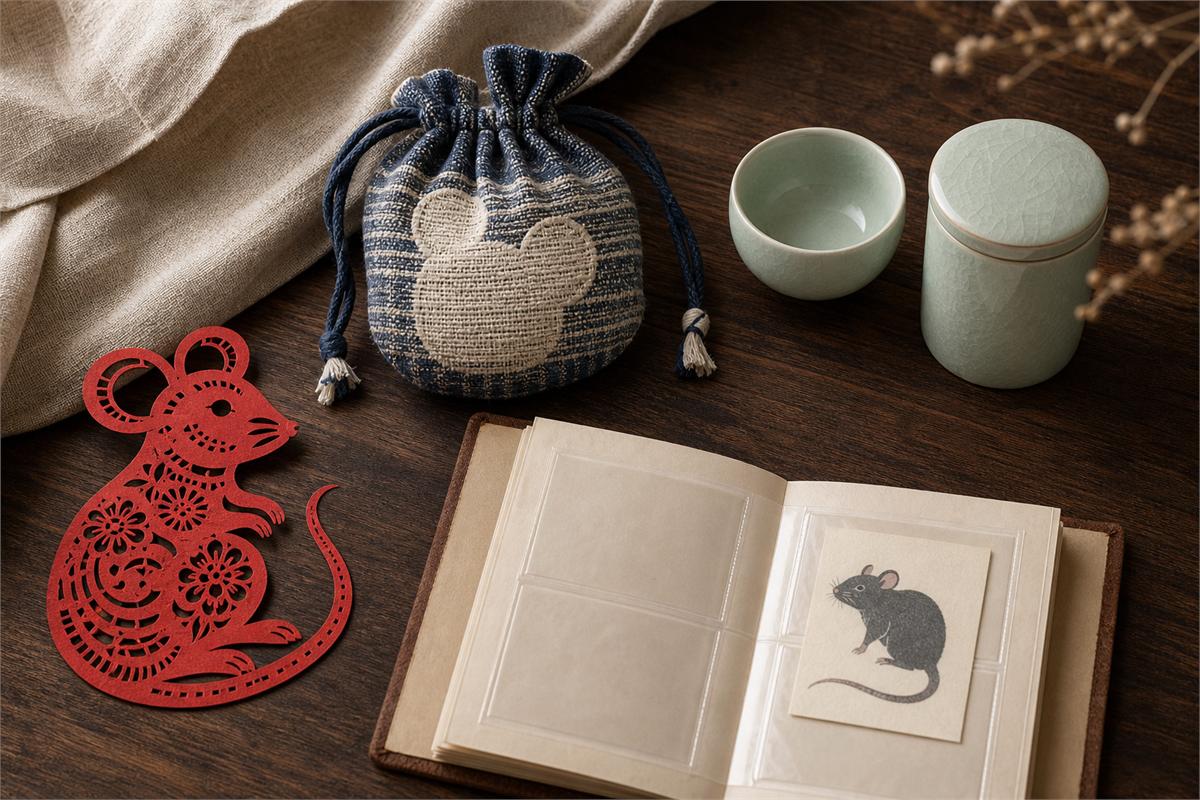
Rat-themed paper cuts, prints, woven ornaments, embroidered pouches, seals, notebooks, calendars, and books can foreground design and story without becoming personal fortune readings. A tea gift can pair a useful item with a short note explaining Zi and the Rat-year cycle. For stamps or limited-edition objects, confirm the issue, condition, edition details, seller return terms, and any workplace rules that apply to business gifts. Use the name of a specific craft or heritage project only when the maker and technique are clearly identified.
Practical gifts for different ages
A Rat illustration can appear on a toy, puzzle, book, pen case, desk organizer, phone stand, or travel accessory. Match the object to what the person already uses. For toys, review the age range, battery access, cords, magnets, points, and removable parts. For company gifts, choose restrained designs and check the recipient's gift policy before sending anything expensive.

What is a Zijinshu bead?
Zijinshu (紫金鼠, literally “purple-gold rat”) is a commercial name used for hard palm-family seeds or kernels fashioned into beads; one museum reference identifies a form made from queen-palm seeds. The name comes from color and rat-like holes or contours, not from the zodiac animal, and the material is not a gemstone.
If choosing this craft material, ask what plant seed is used and inspect the beads for cracks, damp odor, mold, unstable dye, loose fibers, rough drill holes, and weak cord. Keep seed beads dry, avoid sanding dust, and keep small components away from young children. Choose them for texture and handcraft appeal rather than because the word “rat” promises a personal result.

For more symbolic objects organized by meaning and occasion, browse the Blessing collection.
A Clear Way to Read Zi
Zi becomes easier to understand when its layers remain visible. It is first a branch sign in a twelve-part cycle; 子 is also an ancient character with its own word history; Rat is the animal correspondence; 23:00–01:00 is a modern time conversion; Zi month can refer to a solar-term interval or, in another context, the lunar eleventh month; and Water, hidden stems, Na Yin, and branch relations are traditional classification systems.
Together, these layers show how one compact sign helped organize writing, calendars, time, direction, art, and festival culture across centuries—without turning it into a fixed description of a person.
Frequently Asked Questions
Related Posts


