
A dragon holding, guarding, or chasing a pearl most often expresses a wish to move toward light while protecting what is precious. In Chinese art, the Eastern dragon long (龙) gives the image strength, movement, rain, and auspicious presence; the rounded jewel gives it a luminous center. Together they can suggest clarity, wholeness, vitality, worthy purpose, and a bright path ahead.
The exact meaning depends on what the dragon is doing, how the orb is drawn, and where the design appears. A pearl held in the mouth, a flaming orb just beyond the claws, and one jewel between two dragons are related compositions, but they are not automatically the same motif.

How to recognize the dragon-and-pearl motif
| What you see | A useful English description | What the relationship may express |
|---|---|---|
| The orb touches or rests in the dragon’s mouth | Dragon holding a pearl; dragon with a pearl in its mouth | Guardianship, possession, presentation, or the release of radiance |
| The orb appears to emerge from the mouth | Dragon breathing or blowing a pearl | Revelation, animation, or light entering the scene |
| One dragon reaches toward a separate orb | Dragon chasing a pearl | Purposeful movement, aspiration, and the pursuit of something precious |
| Two dragons face one central orb | Two Dragons Playing with a Pearl (二龙戏珠) | Shared focus, lively balance, harmony, and ceremonial auspiciousness |
| A coiled dragon surrounds or cradles the orb | Coiled dragon embracing a pearl | Concentration, shelter, wholeness, and keeping something valued close |
Chinese names such as long xian zhu (龙衔珠, dragon holding a pearl), long tu zhu (龙吐珠, dragon emitting a pearl), long xi zhu (龙戏珠, dragon playing with a pearl), and long gan zhu (龙赶珠, dragon pursuing a pearl) can overlap in museum descriptions, regional speech, workshops, and modern product listings. Yet their verbs still point to different visual actions. When an object has no documented title, a plain description of the visible action is often more accurate than forcing it into one fixed label.

What can the “pearl” be?
The English word pearl is convenient, but the round center is not always a natural pearl from a mollusk. It may be a precious jewel baozhu (宝珠), a luminous pearl mingzhu (明珠), a flaming jewel huozhu (火珠), a sun- or moon-like disk, or simply the visual center of a decorative composition. In modern jewelry it may also be an actual pearl, a gemstone bead, carved jade, metal sphere, glass, or a luminous element.

A flaming pearl is usually recognizable by a round core surrounded by flame-shaped curls, a branching tail, or rays. A Qing-period silk tapestry fan in The Metropolitan Museum of Art, for example, shows a dragon emerging from clouds and blowing a flaming pearl toward the ocean. A Central Chinese tapestry dated to the 1200s or earlier in the Cleveland Museum of Art shows multiple dragons pursuing spiral-patterned circular pearls with branching flame-like forms. These objects confirm the visual vocabulary without requiring every flaming orb to carry one universal doctrine.
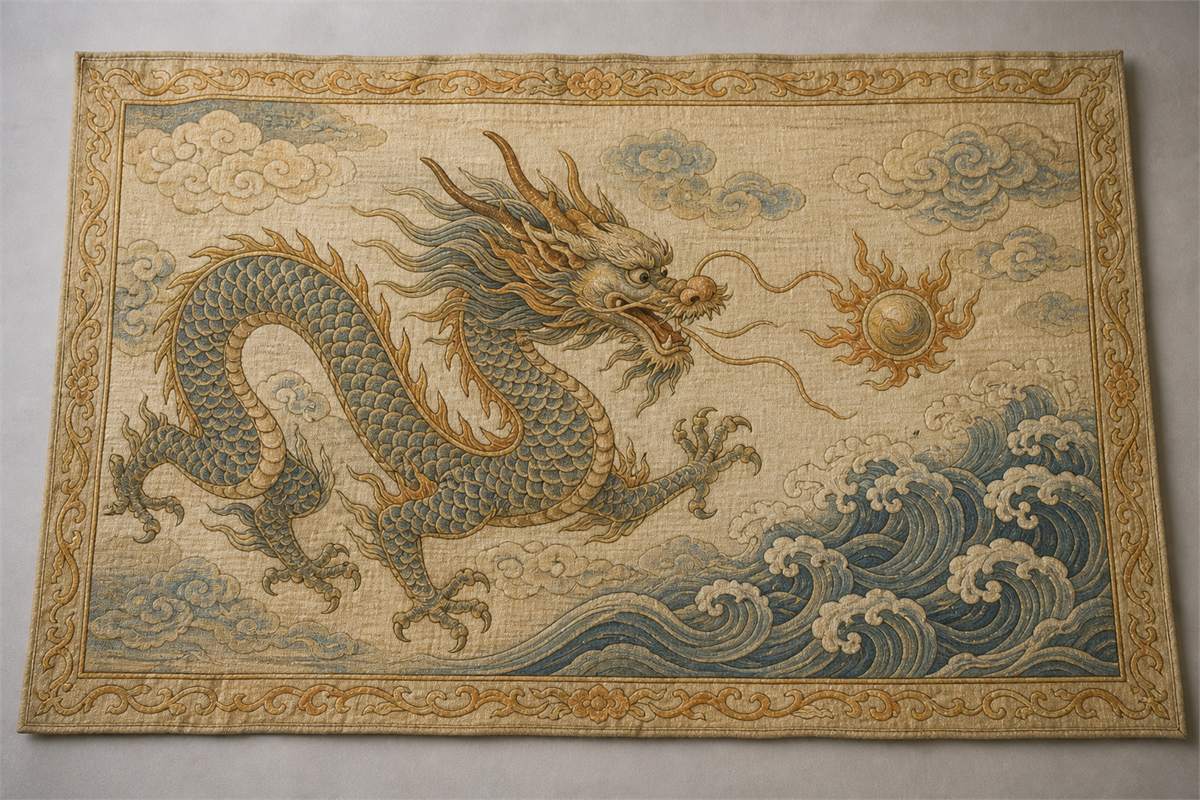
The jewel can sometimes invite a Buddhist comparison with the precious or wish-fulfilling jewel, including mani imagery. It can also invite celestial readings because it shines among clouds, rays, and weather-bearing dragons. Those associations are most convincing when the object’s date, religious setting, inscription, or documented collection history supports them. It is safer to say that the orb gathers ideas of brilliance, value, and concentrated meaning than to declare every dragon pearl a night-shining pearl, the sun, the moon, a dragon’s tear, or a single source of cosmic energy.
Why the dragon and pearl feel so powerful together
The dragon is rarely still. It coils, descends, rises, turns its head, or reaches through cloud and water. The pearl is small, round, and visually concentrated. This contrast gives the motif its emotional force: expansive movement gathers around one bright point.

- Light and clarity: a radiant center can carry a wish for a bright path and the confidence to see what matters.
- Wholeness: the circle is a natural symbol of completion, continuity, and things brought into harmony.
- Guardianship: a dragon holding or circling the jewel can express care for a family bond, a promise, a memory, or a cherished goal.
- Purposeful movement: a dragon reaching toward the orb turns aspiration into a visible action rather than a passive possession.
- Vitality: flames, waves, and streaming clouds make the jewel feel alive, as if the whole design is gathering breath and momentum.
These meanings have changed with time and setting. Dragons could appear within court hierarchy and imperial imagery, but they also flourished in religious art, festival decoration, textiles, ceramics, architectural carving, folk objects, and contemporary design. The dragon-and-pearl motif therefore carries more than one social identity. In jewelry today, it can be chosen as an intimate sign of courage, focus, protection, harmony, or companionship rather than a claim to historical rank.
What Two Dragons Playing with a Pearl means
Two Dragons Playing with a Pearl (二龙戏珠, er long xi zhu) places one luminous center between two active bodies. The dragons may mirror one another, spiral in opposite directions, rise from waves, or approach diagonally through clouds. “Playing” suggests motion, exchange, and shared attention; it does not always mean fighting for possession.
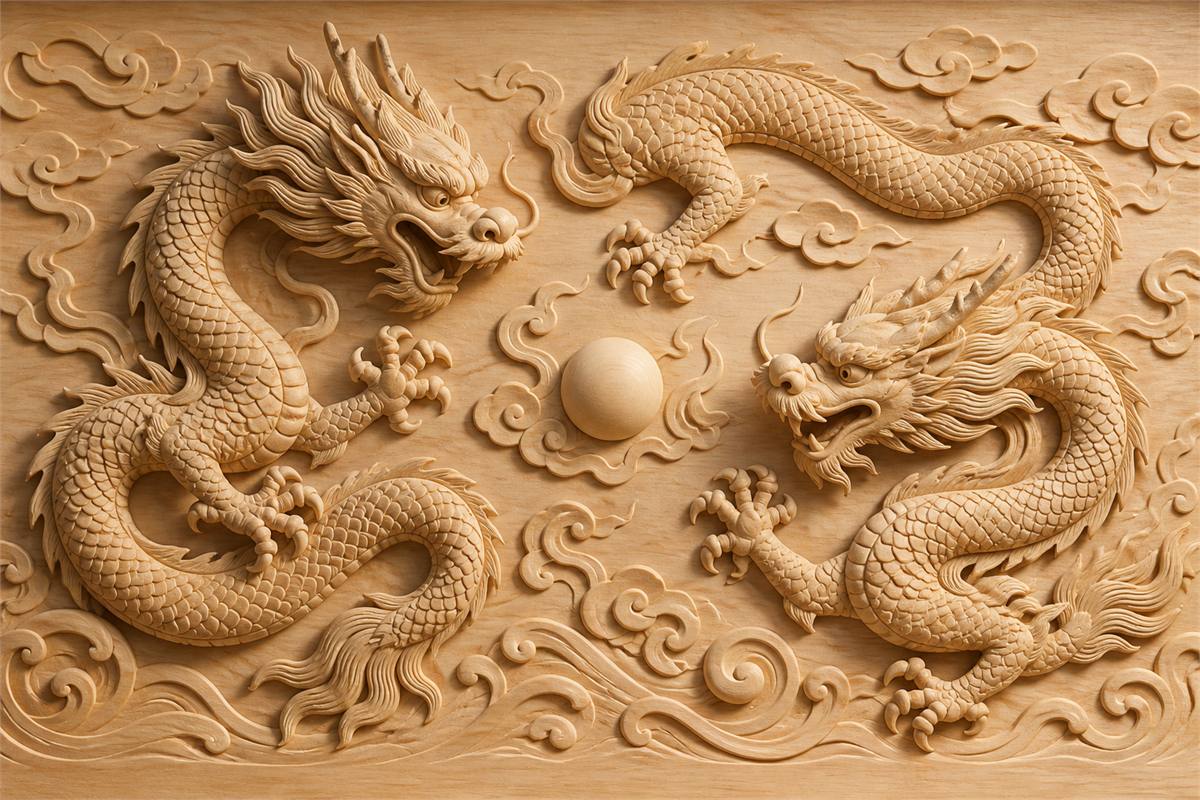
The design is especially effective in round, horizontal, or symmetrical spaces because it creates balance without becoming static. On a doorway, textile, vessel, bracelet, or ring, the paired dragons can carry wishes for cooperation, mutual courage, family companionship, and two strong lives moving around a shared value. As a gift, it can say: may the relationship remain lively, centered, and whole.
How clouds, waves, flames, and flowers change the scene
Clouds create height and auspicious movement
Clouds place the dragon in a shifting sky, linking the image with weather, ascent, distance, and revelation. Rounded ruyi-shaped clouds can also bring their own blessing language. The Ruyi cloud pattern guide explains how these cloud forms developed a distinct visual identity; in a dragon-and-pearl scene, notice whether they carry, conceal, or frame the jewel.

Waves return the dragon to water and renewal
Waves connect the dragon with rain, rivers, seas, and seasonal change. A pearl above a wave field may seem to rise from the depths, while a dragon descending toward it can suggest energy joining water and sky. In court objects, waves and rocks may also belong to a larger decorative hierarchy. In personal jewelry, the same lines can become a wish for resilience, flow, and the courage to keep moving through change.

Flames and rays make the pearl luminous
Flame tips, rays, and streaming tails make a small orb legible at a distance. They also direct the eye from the pearl back to the dragon’s gaze, claws, and turning body. Their strongest shared message is radiance: a bright center made active. Whether that light should be read as celestial, sacred, auspicious, or simply decorative depends on the complete object.

Flowers, bats, and borders add separate blessings
A lotus, peony, bat, lingzhi, meander border, or linked-bead border should be read as a companion motif rather than absorbed automatically into the pearl. These additions can introduce wishes for purity, flourishing, good fortune, longevity, continuity, or an orderly frame. The richest designs often work like a sentence: the dragon and pearl provide the main action, while surrounding motifs refine the tone.

From textiles and ceramics to jewelry
The motif moves easily across media because its essential relationship is simple: an energetic curved form and a concentrated round form. A textile can expand the scene into clouds and weather; ceramic painting can wrap the chase around a vessel; carving can hide and reveal the pearl as the object turns; metalwork can turn whiskers, flames, and scales into texture.

| Object | What to look for | How to read it well |
|---|---|---|
| Textile or embroidered panel | Direction of the dragons, cloud field, centrality, weave or embroidery structure | Read the motif within the garment, furnishing, or ceremonial setting |
| Ceramic or lacquer vessel | How the design continues around the body, border bands, waves, color, and documented date | Use a museum record or specialist study; claw count and glaze appearance alone are not a sound dating method |
| Architectural carving or ceiling | Whether the central form is a carved jewel, suspended element, mirror, or part of the ceiling structure | Do not exchange the names and meanings of different halls, mirrors, pendants, and coffered ceilings |
| Jade carving | Jadeite or nephrite, relief depth, openwork bridges, reverse carving, natural color placement | Distinguish material, carving method, and later blessing language |
| Modern jewelry | Actual material, weight, scale, comfort, setting, moving parts, and motif clarity | Choose the piece for its relationship, workmanship, and the wish you want it to carry |
Specific museum objects should be named only when their title, date, institution, and visible details can be verified. A modern museum-inspired product may borrow the atmosphere of an ancient object without preserving its original imagery or meaning. For example, the famous openwork dragon-and-phoenix double-ring jade pendant from the tomb of the King of Nanyue should not be relabeled as an ancient “dragon holding a pearl” merely because a later souvenir uses a round mirror or a pearl-like composition.

Choosing a dragon-and-pearl jewelry design
Begin with the relationship you want the piece to hold. A dragon reaching toward the jewel feels active and future-facing. A dragon cradling it feels protective and inward. Two dragons create a message about shared purpose. A quiet coiled form can make the pearl feel like a private light kept close.
Then look at whether the design remains clear at its real size. Long horns, whiskers, claws, flame tips, and raised scales can catch knitwear or scratch neighboring jewelry. Check the bail, chain links, ring shank, prongs, solder points, openwork bridges, and the clearance around any moving pearl. A rotating bead or articulated element can be delightful, but it needs enough space to move without grinding against softer material. Hollow gold offers volume with less weight, yet it is more vulnerable to pressure and dents than a similarly shaped solid piece.

Material names matter. Gold may be fine gold, 22K, 18K, or 14K; a matte “ancient gold” appearance describes a modern finish and style, while hard-gold processing, hollow construction, casting, chasing, engraving, and filigree are separate production choices. Silver should be identified by its stated alloy, such as 925 sterling silver, and a plated surface needs gentler wear than solid metal.
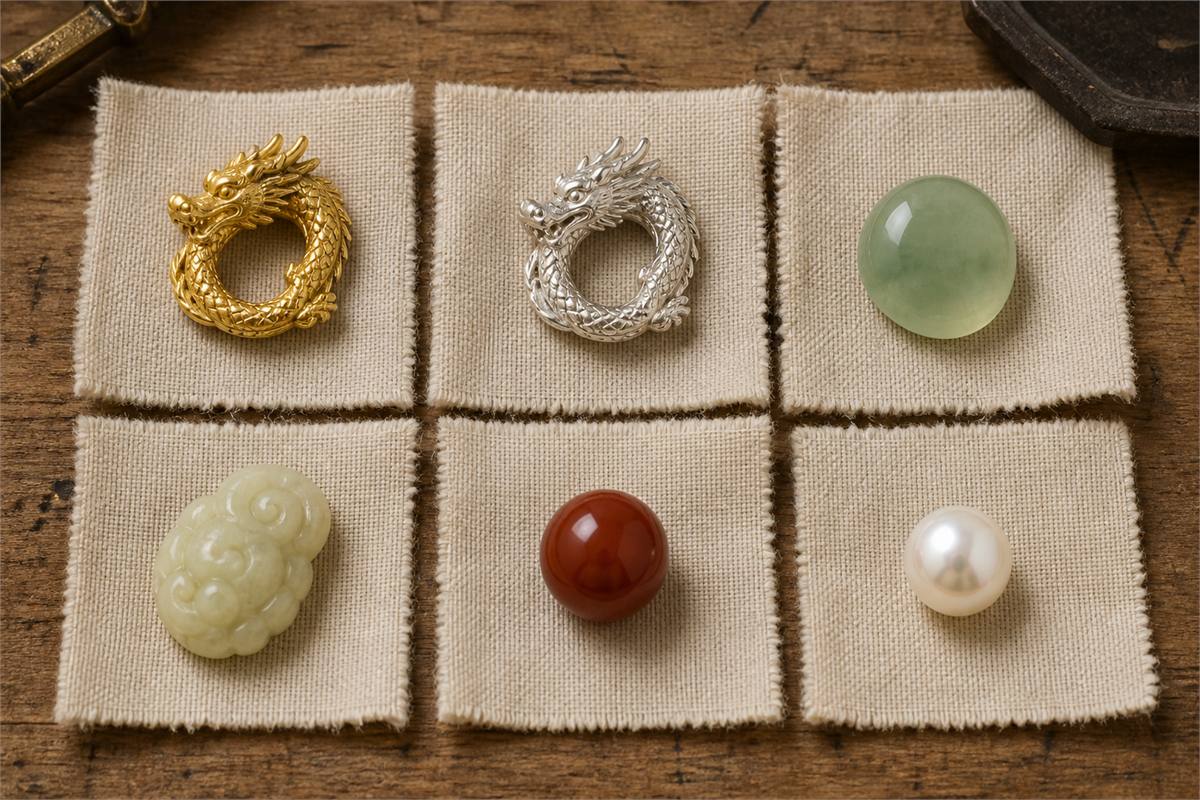
Jadeite and nephrite are both jade, but they are different gem materials. Dark “black jadeite” sold as mocui is dark-toned jadeite, while chalcedony, agate, glass, quartz, and albite-rich material sold under names such as “water-mo jade” belong to other material categories. The jade carving motif guide helps connect subject and technique, while the dragon pendant guide covers pendant proportions and wearing comfort in greater depth.
A natural or cultured pearl can give the motif a soft inner glow. This is different from a painted flaming-jewel pattern, and also different from the microscopic “flame structure” seen in some non-nacreous pearls such as conch or Melo pearls. Night-glow glass, luminous coatings, and LED components are different again. They can create a playful contemporary dragon pearl, but coatings, batteries, switches, and electronic housings should be cared for according to the maker’s instructions.
A meaningful gift for a bright path
A dragon-and-pearl piece can accompany a graduation, a new home, a creative beginning, a family milestone, or a season that calls for renewed courage. It suits anyone who connects with its movement and light; size, weight, comfort, craft, and personal taste are better guides than gender rules or zodiac prescriptions.

For one person, the pearl may stand for a clear goal. For another, it may hold the memory of family, the wholeness of home, or a promise to protect what matters. They express a wish—a medium through which people hope to bring about wealth, health, virtue, longevity, or a specific outcome in life. In this motif, that wish is gathered into one bright center and given a dragon’s courage to accompany it.
If the design is a gift, describe the visible relationship rather than promising a fixed result: “The dragon watches over the pearl as a symbol of what you hold precious,” or “May this bright pearl accompany you toward a clear and beautiful path.” For more ways to choose a wish-led object, explore the Eastern Story Blessing collection.
How to care for each material

- Gold: store away from pressure and sharp edges. Hollow forms need particular protection from crushing. Clean conservatively around articulated beads, soldered whiskers, and delicate filigree.
- Sterling silver: keep dry when stored and use a suitable silver cloth on accessible solid-silver surfaces. Avoid aggressive polishing on intentionally darkened recesses.
- Plated metal: wipe gently with a soft cloth. Abrasive compounds and repeated friction can remove the surface layer.
- Jadeite and nephrite: wipe with a soft cloth or use warm, mild soapy water when appropriate. Jade does not need soaking or oiling to “grow” a patina. Unknown treatments make steam and ultrasonic cleaning a poor default.
- Natural or cultured pearl: put it on after perfume and cosmetics, wipe it with a very soft clean cloth after wear, and keep it away from acids, heavy perspiration, rough contact, high heat, steam, and ultrasonic cleaning.
- Glow coating or LED element: avoid immersion unless the maker explicitly states that the item is water-resistant. Protect coatings from abrasion and follow the maker’s battery and charging instructions.
The larger dragon story
The Eastern Loong meaning guide explores the dragon’s wider history, rain associations, court contexts, zodiac identity, and modern symbolism. This page stays with one narrower question: how the dragon relates to a pearl, and how that relationship changes from holding to chasing, playing, guarding, or surrounding.
Read the action, then the orb, then the surrounding motifs, material, and setting. When those pieces come together, the dragon and pearl become more than a generic promise of luck. They become a carefully composed image of light held close, purpose set in motion, and something precious accompanied with courage.
Frequently Asked Questions
Related Posts


