
Citrine is the transparent yellow to orange or brownish-orange variety of quartz. That simple definition hides several buying questions: natural-color citrine is relatively uncommon, much commercial material is heated amethyst, other yellow quartz may be produced from smoky quartz or by irradiation and heating, and synthetic quartz or glass can imitate the look. Color alone cannot settle those questions.
This citrine guide brings mineral identity, treatment language, quality, cutting, jewelry use, care, birthstone tradition, and modern symbolism into one practical framework. It is designed for readers choosing a loose stone, bracelet, ring, pendant, carving, crystal cluster, or business gift—not for anyone seeking financial, medical, or metaphysical outcomes.
What Is Citrine?
Citrine belongs to the crystalline quartz family. Its main chemical component is silicon dioxide (SiO₂), and its color range runs from pale yellow through golden yellow and orange to brownish orange. Polished material normally has a vitreous, or glass-like, luster. Facet-quality citrine is transparent, while translucent material may be used for beads, cabochons, carvings, or decorative objects.
| Property | Practical meaning |
|---|---|
| Mineral family | Quartz |
| Composition | Silicon dioxide (SiO₂) |
| Color range | Yellow to orange and brownish orange; tone and saturation vary |
| Mohs hardness | About 7, which indicates scratch resistance rather than impact resistance |
| Luster | Vitreous on a well-polished surface |
| Transparency | Commonly transparent in faceted gems; translucent material also occurs |
| Toughness | Generally suitable for jewelry, but fractures, sharp impacts, and abrupt temperature change can cause damage |
A hardness of 7 does not mean the stone is unbreakable. Quartz can chip at exposed edges, break along an existing fracture, or become scratched by harder materials such as corundum and diamond. It can also scratch softer materials such as pearls. Rings and bracelets meet more surfaces than pendants, so setting protection and daily habits matter as much as the hardness number.

Natural Citrine and How Its Color Forms
Natural citrine forms when geological processes create a stable yellow-to-orange color in quartz. Its color is associated with iron-related defects and color centers, but there is no responsible one-line formula that applies to every yellow quartz. Different materials may involve iron in different structural environments, submicroscopic iron-bearing particles, and different histories of natural heat and irradiation.
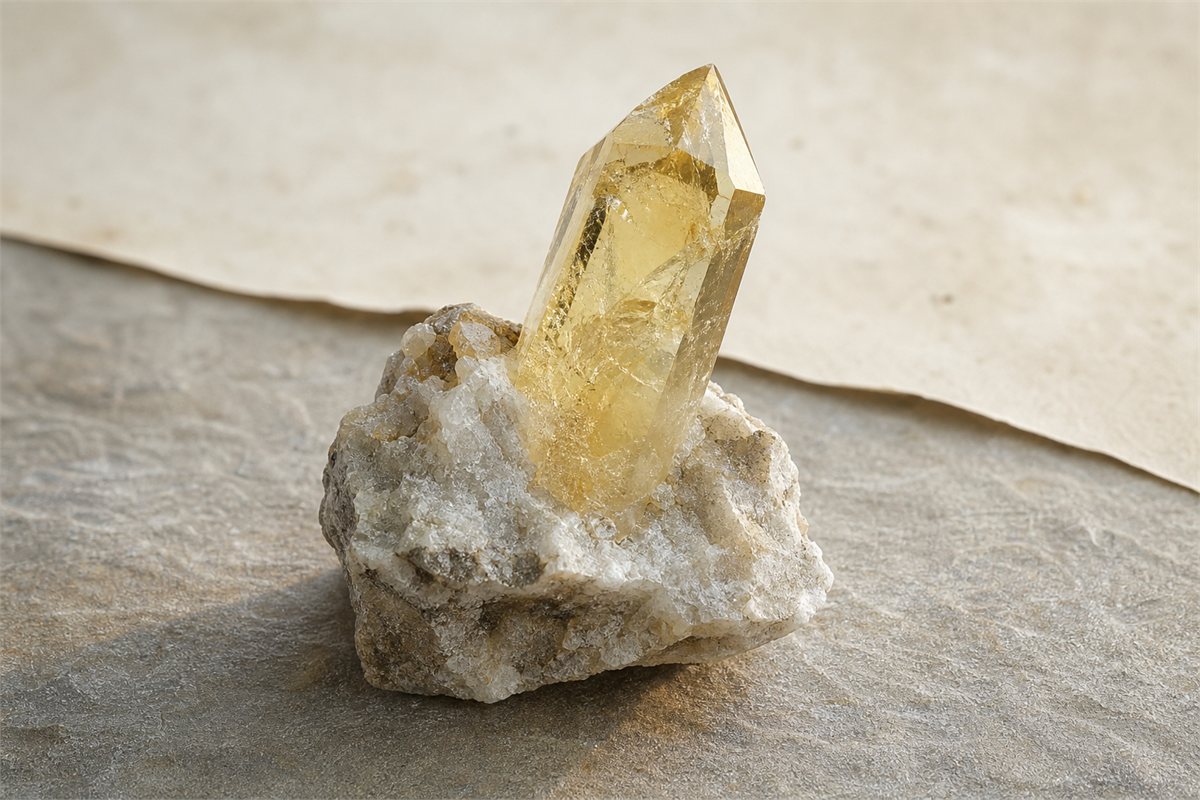
For that reason, “more iron means darker citrine” is not a sound grading rule. Color also depends on the type and position of the defect, crystal growth history, later geological conditions, optical path, cutting, and lighting. Two stones with similar visible color may have reached it by different routes, while two pieces from the same crystal can look different after cutting.
Why natural-color citrine is relatively uncommon
Quartz is abundant, but the combination of trace chemistry, structural defects, and geological conditions that produces attractive natural yellow or orange color is much less common. This explains why heated amethyst became an important commercial source of citrine color. It does not justify a universal market percentage: supply changes by place, time, product category, and seller, and broad numerical claims are rarely backed by transparent market research.

Natural Citrine vs Heat-Treated Amethyst
Heating some amethyst can change its purple color into yellow, orange, brownish orange, or reddish-brown tones. The material remains crystalline quartz, and the trade commonly sells it as citrine. Heat treatment is not the same thing as dyeing, glass, or a fake stone. It is still important purchasing information because natural-color and heated material occupy different collecting and pricing contexts.

A crystal cluster with pale or colorless points above a strongly orange-brown base is often associated with heated amethyst geodes, but that appearance is a clue rather than a universal test. Faceted natural citrine and heated quartz can overlap in hue, zoning, clarity, fractures, inclusions, and spectral behavior. “Uniform means treated,” “color zoning means natural,” and “cracks prove heating” are all unreliable shortcuts.

| Material route | What the label should make clear | What appearance cannot prove |
|---|---|---|
| Natural-color citrine | Quartz whose yellow-to-orange color formed without an artificial color-changing treatment | Natural origin cannot be established from color depth, zoning, clarity, or a photograph alone |
| Heated amethyst | Purple quartz heated to produce yellow, orange, or brownish-orange color | Strong orange color does not make it glass or dye, and pale color does not make it natural-color |
| Heated smoky quartz | Smoky quartz heated into yellow or related tones | A finished stone may resemble other yellow quartz |
| Irradiated and heated quartz | Quartz whose color was altered through a sequence that can include irradiation and heating | Yellow-green or lemon color is not a complete treatment history |
When the distinction matters, ask the seller to state in writing whether the color is natural, heated, irradiated, or otherwise altered, and whether the stone is natural-grown or synthetic. Keep the product page, photographs, messages, and return terms. If the seller cannot answer consistently and the uncertainty affects your decision, choose another item.
Synthetic Quartz, Glass, and Other Imitations
Synthetic yellow quartz and imitation materials belong in separate categories. Synthetic quartz has the same basic composition and crystal structure as natural quartz but grows under controlled conditions. An imitation only resembles citrine visually and may be glass, resin, a coated object, or another material.
| Category | What it is | Useful buying question |
|---|---|---|
| Natural quartz | Quartz formed in nature, whether its visible color is natural or later altered | What color treatment, if any, is disclosed? |
| Synthetic quartz | Quartz grown by people with quartz chemistry and structure | Is the material natural-grown or synthetic? |
| Glass imitation | Amorphous glass colored to resemble yellow quartz | Is the item glass, quartz, or a mixed-material product? |
| Resin or composite | Plastic-rich or assembled material that may copy color, clarity, or inclusions | Are resin, fillers, bonding, coating, or assembled parts present? |
| Coated material | A surface layer supplies or modifies part of the color or luster | Is there a coating, and what cleaning limits apply? |
Round bubbles can be a clue to glass, particularly when accompanied by flow-like features, but bubbles alone are not a final conclusion: natural gems can contain fluid-and-gas inclusions. Surface wear, concentrated color at a coating edge, repeated bead patterns, or molded seams can also be useful observations. Our quartz-versus-glass guide explains why several clues must be considered together.

Citrine vs Lemon Quartz
Lemon quartz is not a dependable synonym for citrine. In trade use, it often describes pale yellow, bright lemon-yellow, or yellow-green quartz with less orange than classic citrine colors. The boundary is not uniform across sellers, and some lemon quartz has been produced by irradiating and heating smoky quartz or other quartz material.
A name based on color does not reveal the complete material history. Do not use the shared lemon idea behind the words as proof that citrine and lemon quartz are identical. Ask for a plain statement of the material, natural or synthetic growth, known treatment, actual hue under neutral light, and return options. This is especially important when photographs shift yellow-green stones toward warm gold.

Common Citrine Trade Names Explained
Trade names can help a seller describe color or style, but they are not universal mineral varieties or fixed grades. Their meaning may change between countries, platforms, and communities. Translate each one back into observable properties and written product details.

| Name | What it usually tries to communicate | What still needs checking |
|---|---|---|
| Madeira citrine | Brownish-orange, orange, or reddish-orange color reminiscent of Madeira wine | It is a color term, not proof of origin, natural color, or a uniform grade |
| Palmeira citrine | A bright orange trade color historically linked to heat-treated amethyst from Brazil; it is also used more loosely | Confirm actual color, source claim, and treatment rather than assuming one mine or quality level |
| Golden quartz / golden citrine | A broad golden-yellow appearance | The phrase can cover different quartz materials and says little about treatment |
| Violent Yellow / 暴力黄 | Very vivid or saturated yellow in Chinese crystal-market language | High saturation is not a collecting grade and can occur in heated material |
| Brazil Yellow / 巴西黄 | A color-and-source marketing phrase | Color cannot prove Brazilian origin; Brazilian origin does not prove natural color or superior quality |
| Lemon Yellow / 柠檬黄 | Pale, bright, or slightly greenish yellow | Determine whether the seller means citrine, lemon quartz, or another treated quartz |
| Tower Citrine / 黄塔晶 | A non-standard label that may refer to tower-like color zones or heated amethyst clusters with caramel-colored bases | Definitions vary; ask for full-object images, material, treatment, and whether the form is natural crystal growth or carving |
| Yellow Azeztulite / 黄阿塞 | A brand-linked New Age name applied to quartz | It is not a mineral variety or an energy grade; identify the actual quartz and treatment |
| Imperial yellow, glassy, icy, jelly flower, explosive sparkle, crushed ice | Seller language for hue, clarity, inclusions, or visual texture | None is a consistent international grade; inspect the specific object |
What Citrine Color Actually Tells You
Color has three practical dimensions: hue, tone, and saturation. Hue describes whether the stone leans yellow, orange, red, brown, or green. Tone describes how light or dark it appears. Saturation describes color strength. A lively stone normally balances these qualities with enough brightness to show its design rather than becoming washed out or nearly black.

Color preference is not a single global ladder. Some buyers prefer bright yellow, others warm golden orange, and others reddish or brownish-orange shades. A deeper tone may suit a dramatic pendant but lose brightness in a small ring. A pale stone may look elegant in a large fantasy cut. Treatment history, cutting, clarity, size, setting color, and workmanship all interact with color, so “orange is always best” and “deep gold is collecting grade” are misleading rules.
Compare color under more than one light
View the item in indirect daylight and under a neutral indoor light, with automatic photo filters turned off when possible. Warm lamps can push pale yellow toward orange, while cool light can make brown less obvious. Ask for front, side, and hand-held photographs or video on a neutral background. This comparison records appearance; it still cannot determine natural color, treatment, or origin.

How to Evaluate Citrine Quality
A useful quality review begins with material identity and treatment disclosure, then considers visible beauty, durability, and workmanship. Large size or intense color cannot compensate for a poorly cut stone, unstable assembly, damaged drill hole, weak prongs, or unclear product description.
Color, clarity, and transparency
Transparent faceted citrine is often eye-clean, so a stone can look clear and still be natural quartz. Natural material can also contain color zoning, liquid-and-gas inclusions, mineral inclusions, healed features, or fractures. “Every natural stone has cotton and cracks,” “a clean low-priced stone must be fake,” and “flaws are an identity card” are all false absolutes.
Look for inclusions and fractures where they affect appearance or durability. A dark inclusion under the table may be more distracting than a small feature near the girdle. A surface-reaching fracture near a prong, drill hole, or thin edge deserves more attention than a protected internal feature. Clarity should support the intended design rather than serve as a rigid purity contest.

Cut, size, weight, and workmanship
In a transparent stone, check face-up brightness, evenness, symmetry, polish, windowing, extinction, and durability of the outline. Windowing is a transparent-looking area where light passes through without returning much brightness. Extinction is a dark area caused by cutting and viewing geometry. Small patches can shift as the stone moves; a large persistent window or dark center can weaken the design.
Carat is a weight, not a face-up dimension or quality grade. Quartz is available in large sizes, and two stones of equal weight can spread differently depending on depth and outline. Ask for millimeter dimensions as well as weight. For jewelry, inspect metal composition, plating, solder, setting security, finish, comfort, and how the stone's height changes wearability.

Citrine Cuts: Brilliant, Step, Radiant, Cabochon, and Fantasy
| Cut or form | How it handles light and design | What to inspect |
|---|---|---|
| Round brilliant | A round outline with brilliant-style facets designed for lively brightness and movement | Symmetry, face-up spread, center brightness, girdle, and edge protection |
| Oval | An elongated outline often using brilliant or mixed faceting | Bow-tie darkness, outline symmetry, windowing, and pointed-end protection |
| Cushion | A square or rectangular outline with curved sides and many possible facet patterns | Corner shape, brightness distribution, depth, and whether seller photos match the exact stone |
| Emerald or other step cut | Rows of long facets emphasize broad flashes, color, and internal clarity | Parallel facet alignment, polish, windowing, and visible inclusions |
| Radiant | A rectangular or square outline, often with cut corners, combined with brilliant-style or mixed faceting | Evenness, corner durability, windowing, and dark patches; it is not simply two standard cuts added together |
| Cabochon | A smooth curved top rather than a fully faceted crown | Dome symmetry, polish, base, surface features, and stability |
| Fantasy and concave designs | Individual artistic arrangements that may use unusual outlines, grooves, concave facets, or sculptural effects | Designer attribution when relevant, finish quality, thin points, cleaning access, and whether the seller's cut name has a defined meaning |
| Beads and carvings | Drilled or shaped material where finish and construction dominate | Hole edges, polish, symmetry, fractures, dye or coating clues, cord, and assembly |

Citrine has a moderate refractive index and low dispersion compared with diamond. Good cutting can create brightness and scintillation—the flashes seen as stone, light, or viewer moves—but should not be sold as diamond-like fire. “Black heart” is informal seller language; evaluate the actual cause, such as extinction, reflection, or setting shadow.

What Home Tests Cannot Prove
Home observation can help you document a purchase, but it cannot reliably separate natural-color citrine from heated amethyst, heated smoky quartz, or every form of synthetic quartz. Quartz is doubly refractive, yet trying to see doubled text through a mounted or irregular stone depends on direction, thickness, magnification, cut, and focus. It is not a dependable household identity test.
- Coolness, warming speed, heaviness, and tapping sound change with size, temperature, mounting, and handling.
- Scratching glass risks damage and does not distinguish all quartz categories or treatments.
- A flashlight may reveal zoning or fractures, but neither pattern establishes natural color or treatment.
- A round bubble can support a glass hypothesis, yet fluid-and-gas inclusions also occur in natural gems.
- Drill-hole chips, cotton-like features, rainbow fractures, price, and bead uniformity are clues, not conclusions.
Do not burn, strike, scratch, needle-test, chemically expose, or repeatedly soak jewelry. Safer observations include color under several lights, color concentration near fractures or surfaces, bubbles or flow-like features, wear at coating edges, drill-hole condition, surface scratches, bead-to-bead repetition, and whether the seller's statements remain consistent. Photograph what you see and use the return window when the description does not match.

Questions to Ask Before Buying Citrine
- What is the material: natural-grown quartz, synthetic quartz, glass, resin, coated material, or an assembled product?
- Is the yellow or orange color natural, heated, irradiated and heated, coated, dyed, or otherwise altered?
- Does the answer apply to the exact item, not merely to citrine as a general category?
- Can the seller provide current, unfiltered photographs or video in indirect daylight and neutral indoor light?
- What are the millimeter dimensions, carat or gram weight, cut or form, transparency, and known fractures or repairs?
- For jewelry, what metal or alloy is used, is it plated, are adhesives present, and how are stones or beads secured?
- For a bracelet or necklace, what are the inner circumference, bead size, cord or elastic type, clasp, and restringing options?
- What are the cleaning limits, shipping protections, return period, return condition, fees, and remedies if the item differs from its description?
Save the listing and the seller's written answers. A clear material description is more useful than a dramatic color name. For broader questions about alloys, plating, jade, gemstones, cords, and mixed components, consult the Eastern Story jewelry material guide.
This guide does not publish a universal citrine price table. Price depends on material and treatment disclosure, color, clarity, cut, size, mounting, metal weight, workmanship, brand, seller type, location, date, and whether a number is an asking price or an actual transaction. An isolated price without those conditions creates more confusion than guidance.

Choosing Citrine Beads, Rings, Pendants, and Decor
Bracelets and bead strands
Check bead diameter, hole smoothness, chips, fractures near holes, polish, color consistency, cord or elastic condition, knot protection, fit, and repair options. Perfect sameness can be a manufacturing clue, but natural beads can be deliberately matched. Very mixed beads can also be natural, treated, synthetic, or imitation. Our dedicated citrine bracelet guide covers fit, construction, color, and wearing decisions in more detail.

Rings and pendants
A ring needs protection from impact and abrasion. Inspect prongs, bezel edges, stone movement, girdle exposure, gallery height, comfort, and whether a large stone catches on clothing. Pendants usually face fewer strikes, but check the bail, chain strength, stone orientation, back access for cleaning, and whether metal edges touch skin.
Loose stones, carvings, clusters, and geodes
For a loose faceted stone, prioritize exact dimensions, cut performance, girdle condition, fractures, and intended setting. For carvings, inspect undercuts, thin tips, base stability, polish, tool marks, repairs, and coating. For clusters and geodes, check broken points, loose matrix, added bases, adhesives, surface color, transport packaging, and whether the seller describes heating clearly. A dramatic orange cluster may be decorative without being natural-color citrine.

Wearing on the left or right is a comfort and risk decision. The non-dominant side may meet fewer desks, tools, or door frames, but the best choice depends on work, fit, watches, mobility, and skin sensitivity. Combining citrine with rose quartz, tiger's eye, phantom quartz, rutile quartz, or blue lace agate is a color-and-texture choice. Separate harder stones from softer gems and watch for metal edges or bead-to-bead friction.
Citrine as a November Birthstone
Modern jewelry tradition recognizes citrine alongside topaz as a November birthstone. Birthstone lists developed and changed over time through religious associations, popular custom, and jewelry-industry standardization; they are cultural conventions rather than mineralogical properties. Citrine is also commonly associated with the thirteenth wedding anniversary.
A November-birthstone gift can focus on color, date, design, and the recipient's taste. It does not assign a personality or effect to everyone born in November. If the recipient prefers topaz, another color, or no birthstone symbolism, that preference should lead the choice.

Citrine Symbolism and “Merchant's Stone” Lore
Citrine's warm color has encouraged modern names such as Merchant's Stone, Wealth Stone, Happiness Stone, Little Sun, and Friendship Stone. These labels belong mainly to recent crystal lore, jewelry storytelling, and marketing. They should not be presented as one ancient belief shared across cultures.
Some modern practices connect citrine with the solar plexus chakra, energy clearing, charging, feng shui, five-element systems, zodiac signs, or rules about which hand receives and releases energy. Those systems may have personal or religious meaning for some people, but they are not gemological properties. Wearing or placing citrine is not an evidence-based method for changing income, investment performance, negotiation, leadership, focus, confidence, anxiety, digestion, or vitality.
If the symbolism matters to you, treat it as a story, reminder, design theme, or personal ritual. Physical cleaning still requires water, mild soap when suitable, drying, and material-specific care; moonlight, salt, smoke, clusters, and “charging” do not remove skin oils, dirt, or product residue.

Choosing Citrine as a Business Gift
Citrine can work as a business gift when the object suits the recipient and the exchange is permitted. Its warm color and Merchant's Stone nickname may feel relevant to commerce, but they do not make it a universally safe choice or promise a successful partnership.
- Check the recipient's taste, jewelry habits, size, metal sensitivities, religious or cultural stance, and preference for symbolic gifts.
- Review both organizations' gift, anti-bribery, procurement, conflict-of-interest, and value-limit rules before buying.
- Avoid timing or value that could appear to influence a tender, contract, hiring decision, inspection, or negotiation.
- Describe the material and known treatment plainly; do not hide gift value behind vague quality language.
- Consider portability, customs, fragile points, display stability, packaging, and a practical return or exchange option.
- Use motifs such as a wealth tree, ingot, pixiu, or geode only when the recipient welcomes that cultural language. Do not attach claims about attracting or retaining money.
For leaders, clients, and public-sector contacts, restraint matters. A modest, relevant object with a clear cultural note can be more appropriate than a large crystal display. When policy or context makes acceptance awkward, choose a lower-value shared item, a card, or no gift.

How to Clean Citrine
For stable, unfilled, uncoated citrine in a simple sound setting, warm water with a small amount of mild non-abrasive soap is a sensible default. Use a soft cloth or soft brush, clean briefly, rinse away residue, and dry thoroughly. There is no need to use only purified water, rinse for a fixed number of minutes, soak for hours, or follow a weekly schedule.
- Inspect the stone, drill holes, setting, cord, elastic, glue, plating, and surface for damage before adding water.
- Prepare warm—not hot—water with a small amount of mild soap. Avoid abrasive powders and harsh household cleaners.
- Clean gently, especially around prongs and behind the stone. Do not force a brush into a fracture or loose setting.
- Rinse briefly with the drain closed or use a separate bowl, then blot and air-dry fully before storage or wear.
- If a stone moves, a cord frays, plating lifts, glue softens, or a fracture changes, stop and arrange suitable repair.

Perfume, lotions, shower products, and cleaners often leave residue or affect plating, adhesives, cords, and metal finishes before they harm quartz itself. Put jewelry on after cosmetics dry and remove it for housework, swimming, bathing, sauna use, sport, or manual activity. The reasons are impact, loss, heat, chemicals, settings, and line wear—not a change in energy.
Light, Heat, Storage, Ultrasonic Cleaning, and Repair
Light and temperature
Some citrine and related colored quartz can fade after prolonged intense light exposure, while stability varies with material and treatment history. A brief period in ordinary room light is not the same as months in a sunny window. Avoid sustained strong sunlight, display-case heat, hot water, open flame, and abrupt changes between hot and cold, which can fracture quartz.

Ultrasonic and steam cleaning
Steam cleaning is not a good default for citrine because high heat and temperature change add avoidable risk. Ultrasonic cleaning may be acceptable for some sound, untreated, unfilled stones in secure all-metal settings, but fractures, fillings, dye, coating, glue, plating, delicate settings, and mixed materials can make it unsafe. When the full construction is unknown, use gentle hand cleaning.
Storage and maintenance
Store citrine clean and dry in a soft pouch or divided box. Separation protects it from harder diamond or corundum and prevents it from scratching softer pearls or other materials. Metal hardness varies, but sharp edges and repeated rubbing can still mark surfaces. The Eastern Story jewelry care guide offers a broader routine for mixed-material pieces.
Check elastic, cord, drill holes, prongs, bezels, clasps, jump rings, plating, and stone movement periodically. Fraying, looseness, deformation, lifted plating, a newly visible crack, or movement in the setting is a reason to stop wearing the piece until it is repaired. Ordinary dry storage is usually enough; a universal humidity target or desiccant requirement is unnecessary unless the finished object contains a humidity-sensitive component.

Citrine FAQ
Related Posts


0 Comments