
A leading seal, Yinshouzhang (引首章), is an expressive seal placed near the opening area of a calligraphy or painting composition, commonly toward the upper right of a vertical work. It introduces a note of red before the eye reaches the signature and often carries a short blessing, motto, studio name, poetic phrase, or memory. More than an ornament, it gives the work an emotional beginning: a wish for peace and joy, a reminder of the artist’s path, or a quiet invitation into the scene.

The leading seal belongs to the wider family of leisure seals, yet its identity comes from what it does at the beginning of a particular work. Its position, shape, script, red-and-white balance, and words should respond to the painting or calligraphy already present. There is no single correct distance, silhouette, or number of seals for every artwork. The best arrangement grows from the work’s format, brush style, inscription, blank space, mounting, and overall rhythm.
Why it is called a leading seal
The Chinese name Yinshouzhang joins yinshou, “to lead the beginning,” with zhang, “seal.” English descriptions may call it a leading seal, opening seal, or introductory seal. It is often placed in a quiet area near the beginning of a vertical composition, traditionally on the right side, where its color can awaken empty paper and prepare the viewer for the brushwork that follows.

A leading seal is therefore a role, not one mandatory shape or inscription. A seal carrying a personal motto may act as a leading seal in one painting and as a leisure seal elsewhere. A studio-name seal can also serve at the opening if its placement and visual weight suit the composition. The upper-right convention is a useful starting point, but horizontal works, album leaves, fans, modern layouts, left-to-right text, and existing inscriptions all ask for individual judgment.
What a leading seal can say
The smallest inscription can hold a large feeling. Some artists choose words that describe their relationship with ink and paper; others choose a blessing they want to welcome into daily life. A commissioned seal may remember a home, a teacher, a journey, a turning point, or someone loved. Used across a series, the inscription can become a recurring voice that quietly connects separate works.

| Text type | What it can carry | Examples and selection cues |
|---|---|---|
| Blessing phrase | Peace, joy, longevity, harmony, or good fortune | Ping An Xi Le (平安喜乐), “peace, safety, and joy,” or another phrase suited to the occasion |
| Personal motto | Discipline, openness, gratitude, or a life direction | Choose words you will still want beside future works |
| Poetic fragment | Season, landscape, literary atmosphere, or quiet reflection | Confirm the wording and source; shorten only when the remaining phrase still feels complete |
| Studio name | A creative home and sense of belonging | A studio or hall name can accompany a body of work without functioning as a personal name seal |
| Place or memory | A garden, mountain, journey, family place, or life chapter | A phrase such as “Place of Memory” can turn the seal into a private point of return |
| Series or date idea | A season, cycle, exhibition, or connected set | Keep the concept broad enough to remain meaningful across the series |
Two to four characters often suit a compact impression, but this is a practical tendency rather than a rule. A single character can feel concentrated; a longer phrase can work when the seal face and composition allow it. Words such as the blessing character Fu (福) carry wishes for a fortunate life, while phrases such as Chang Le (长乐), “lasting joy,” or Kang Ning (康宁), “health and peace,” can open a work with warmth. For more background on individual blessing words, see Eastern Story’s guide to auspicious characters.
Leading seal, leisure seal, corner seal, studio seal, and name seal
| Seal role | Typical relationship to the work | What it usually communicates |
|---|---|---|
| Leading seal (引首章) | Near the opening or upper area | Tone, blessing, phrase, and compositional entry |
| Leisure seal (闲章) | Any suitable expressive position | Motto, poetry, taste, aspiration, or personal feeling |
| Corner seal (压角章) | Near a lower corner or edge | Visual anchoring and often an expressive phrase |
| Studio-name seal (斋号章) | Near an inscription, identity group, or another suitable space | A named studio, hall, or creative home |
| Name seal (姓名章) | Usually near the signature | The artist’s identity |
| Collector’s seal (鉴藏印) | Added by an owner, viewer, institution, or custodian | Collection or appreciation history |
These categories can overlap because one physical seal may take different roles in different compositions. Text, placement, and use should be read together. Collector’s seals can contribute evidence to the study of ownership history, but no single impression independently proves authenticity, date, or an unbroken chain of custody. Scholars compare the seal with inscriptions, materials, mounting, documentary records, and the work as a whole.

Seal script and seal carving: choosing a voice for the words
Seal carving, Zhuanke (篆刻), brings calligraphy and carving together. Museums describe traditional seals as using archaic forms of writing for names, studio names, titles, poetry, and proverbs. The design must work twice: first as a character composition on the seal face, and again as a red impression on paper. That is why a carver considers character form, spacing, border, line weight, knife movement, and the amount of red left between strokes.

“Seal script” is not a label for one identical historical alphabet. Great Seal, Dazhuan (大篆), is a broad modern category associated with pre-Qin inscriptional traditions such as bronze and Stone Drum forms. Small Seal, Xiaozhuan (小篆), refers to the more regularized Qin court script associated with the unification of writing under the Qin empire. Later seal artists studied and reinterpreted ancient forms rather than simply enlarging or shrinking one style. Miaozhuan (缪篆), often discussed in relation to Han seals, adapts characters into compact, turning structures suited to the square seal face.
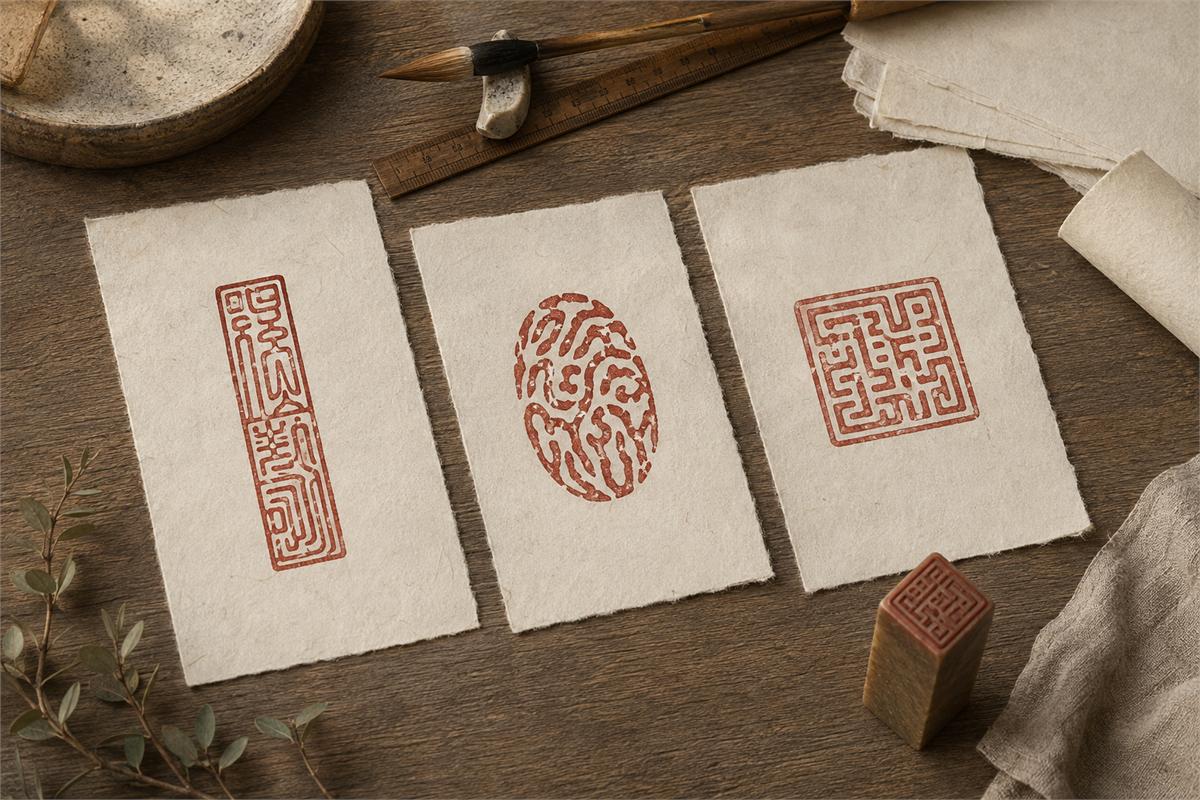
For a leading seal, the best script is the one that makes the chosen words feel at home beside the artwork. Balanced Xiaozhuan can feel calm and measured. An archaizing Dazhuan-inspired design may bring a more ancient, rugged atmosphere. Miaozhuan or Han-style structures can feel dense and architectural. A contemporary carver may also draw from historical models while adjusting the composition for a particular phrase. The goal is not to declare one script universally superior, but to give the inscription a truthful visual voice.
Zhuwen and Baiwen: how red and white change the mood
In Zhuwen (朱文), the characters print red because they remain in relief on the seal face. In Baiwen (白文), the incised characters appear as pale lines within a red field. These are also described as relief and intaglio impressions. Zhuwen often brings fine red lines and an airy presence; Baiwen can create a heavier, more concentrated red block. Yet either can work as a leading seal when the line, border, size, and surrounding composition are thoughtfully matched.

Look at visual mass rather than relying on a formula. A delicate Zhuwen impression may answer fine regular script or a pale landscape without competing with it. A restrained Baiwen design may give needed weight beside bold calligraphy. Existing name seals matter too: contrast can create lively conversation, while similarity can create calm continuity. Neither red-letter nor white-letter treatment should be selected in isolation from the work.
Shape, size, and composition
Leading seals are often oblong, oval, round, gourd-shaped, half-round, or naturally irregular because these forms can animate a narrow opening space and distinguish the impression from a nearby square name seal. A vertical rectangle can echo a column of writing; a rounded outline can soften an angular layout; a natural edge can add movement. Square examples are not automatically wrong. If the blank space, inscription, and other seals support a square form, it can be the right choice.

Size is judged against the writing, subject, margin, and red mass rather than one fixed fraction of the paper. An impression that feels modest on a large hanging scroll may dominate a small album leaf. The leading seal also does not have to be smaller than every name seal in every circumstance; it needs to remain in visual proportion to the complete work. Compare it at full scale before carving and again before stamping.
How to plan placement before touching the artwork
- Complete or stabilize the main brushwork, inscription, signature, and mounting plan.
- Make a clean trial impression on paper with similar absorbency.
- Cut out the true-size impression or place it beneath a transparent positioning sheet.
- Test several opening-area positions without assuming one standard distance from the first character.
- Compare its visual conversation with the signature, name seal, possible corner seal, and major painted forms.
- Step back to view the entire work, including borders and mounting margins.
- Check orientation, then use a clean guide to lower the seal vertically.
- Make the final impression with an amount of paste and pressure already tested on scrap paper.

A leading seal should not cover an important stroke, subject, colophon, or border. It may sit beside the first one, two, or several characters, but the exact height depends on the work. Sometimes a slight offset creates breathing room; elsewhere a closer relationship gives the composition energy. If a corner seal or name seal is already present, seek balance rather than forcing all marks onto a perfect diagonal or insisting on a fixed odd number. One leading seal is often enough, yet a work’s full seal program should be decided as a whole.

How red mass directs the eye
Entry and pause
Red attracts attention quickly. Near the beginning of a work, a small impression can create an entry point, a breath, and then a release into the brushwork. Too close to a mounting edge, it can feel trapped; too close to a major stroke, it may interrupt rather than guide. Quiet paper around the seal allows its words and color to be felt.

Diagonal balance
An upper mark may answer a name or corner seal lower in the work, creating movement across the composition. This relationship need not be geometrically exact. Scale, intensity, empty space, and the direction of brush energy matter more than drawing an imaginary line. Some works become calmer with only the leading and name seals; others have room for a lower balancing seal. Restraint is part of the design.

Tone and feeling
The inscription frames how the work is received. A phrase about stillness beside misty mountains can welcome contemplation. A blessing of Ping An Xi Le (平安喜乐) can accompany a family gift with wishes for peace and joy. A studio name can make the seal feel like a threshold into the artist’s creative home. The object carries a wish—a medium through which people hope to welcome harmony, gratitude, courage, remembrance, and a beautiful life.

Commissioning a personal leading seal
Begin with meaning before material. Decide what the seal should accompany: large calligraphy, album leaves, landscape painting, seasonal cards, a studio practice, or a group of gifts. Share photographs of representative works with the carver and explain the feeling you want the seal to carry. A quiet memorial phrase, a joyful blessing, and a rigorous study motto need different visual voices.

- Confirm the inscription: write it in standard characters, check quotations and names, and discuss any alternate historical character forms.
- Review the script source: ask how Xiaozhuan, Dazhuan-inspired, Miaozhuan, or another seal style supports the phrase.
- Compare Zhuwen and Baiwen: request true-size impressions so you can judge red mass beside your work.
- Choose shape through composition: bring the dimensions and margins of the works, rather than choosing an outline only because it is fashionable.
- Discuss edge treatment and orientation: a border, natural edge, or side mark can change how easily the seal is aligned and used.
- Record the story: when meaningful, a side inscription can preserve the maker, date, dedication, or origin of the chosen phrase.
A hand-carved seal can preserve the conversation between brush and knife, but “handmade” alone is not proof of quality and machine-assisted work is not automatically without value. Judge whether the characters are accurate, the design suits the intended artworks, the impression is clear, and the maker communicates the process honestly. Material should also be described accurately. Stone, jade, wood, metal, ceramic, and composites behave differently in carving and care; Eastern Story’s material guide offers a useful starting point.
How to make a clear impression
Use seal paste made for calligraphy and painting rather than an office ink pad. Gently work the paste to restore an even surface, then tap the seal face across it until the raised areas are covered without filling fine channels. Practice on an offcut of similar paper. For the final impression, support the sheet on a clean, flat surface appropriate to the paper, lower the seal vertically, apply controlled pressure without sliding, steady the paper, and lift straight up.

Thin Xuan paper, sized paper, album paper, and mounted works can respond differently. A soft underlay may help some impressions while a firmer support may suit others, so testing matters more than one universal setup. A transparent guide or an L-shaped paper guide can help alignment. Keep adhesive tape and glue away from the finished artwork; if you use a temporary reference marker, attach it only to the seal body where it will not transfer residue to the paper or carved face.
Care for the seal, paste, and paper
After use, lift loose paste from the face with a clean, soft, dry material and avoid scraping fine raised strokes. Store the seal so the carved face cannot knock against metal, stone, or another seal. Keep it away from direct sun, heaters, strong temperature changes, fragrance, household cleaners, and damp storage. Close the paste container carefully and keep finished impressions separate until fully dry.

Deeper cleaning and surface treatment depend on the exact material, existing wax or coating, old repairs, cracks, pigments, and the composition of the paste. Alcohol, water soaking, household oils, baby oil, and repeated skin-oil rubbing are not safe universal treatments. If paste has hardened in delicate carving or the seal has a waxed, fissured, porous, painted, or historically important surface, ask the maker or a qualified conservator before introducing liquid or oil. The safest routine is gentle dry care, stable storage, and material-specific advice. For broader handling principles, visit the care guide.
A red beginning with purpose
Yinshouzhang turns a small field of red into an invitation. It can open a poem, remember a place, honor a studio, carry gratitude, or welcome peace and happiness into a new work. Its beauty comes from relationship: words with feeling, script with carving, red with ink, and one impression with the surrounding silence. Chosen with care, a leading seal becomes a quiet companion to the artist and a meaningful detail for everyone who pauses to read it. Explore Eastern Story’s blessing collection for more symbols and phrases chosen to carry good wishes through everyday life.

Frequently Asked Questions
Related Posts


