
The scarab, based on the scarab beetle (圣甲虫)—a dung beetle (蜣螂/屎壳郎)—became one of ancient Egypt’s most recognizable symbols of sunrise, rebirth, protection, identity, and the cycle of life. Ancient Egyptians watched ball-rolling beetles push round dung balls across the ground and saw young beetles emerge from buried brood provisions. The movement suggested the sun crossing the sky; the emergence of new life suggested creation and renewal.
The symbol therefore joined the morning sun god Khepri (凯布利), funerary hope, royal and administrative identity, personal amulets, and jewelry. In modern design, the scarab carries a related but different language: resilience after difficulty, courage to begin again, a protective reminder, and an ancient form reimagined for pendants, rings, bracelets, brooches, seals, objects, and tattoos.
From Dung Beetle to Sacred Scarab
The sacred scarab was inspired especially by ball-rolling dung beetles. An adult beetle gathers dung, shapes it, and moves it away from competition. Some balls are food; others become carefully prepared brood provisions. To an observer in ancient Egypt, the beetle seemed to appear fully formed from the earth or from the ball itself. That apparent self-generation gave the insect a place in ideas about coming into being.

The Egyptian word kheper carried the sense of becoming, coming into existence, or transforming. The beetle’s round ball invited a solar comparison, while its determined backward movement turned a humble creature into a model of cosmic labor. The symbolism was not a claim that every beetle was worshipped as a god. It was a religious interpretation of visible behavior, condensed into amulets, seals, names, jewelry, funerary equipment, and temple imagery.

| Observed beetle behavior | Ancient Egyptian interpretation | Later or modern reading |
|---|---|---|
| Rolling a round dung ball | The sun’s movement across the sky and the ordered return of daylight | Persistence, focused effort, and moving life forward |
| Young beetles emerging from brood provisions | Creation, self-generation, regeneration, and life arising again | Renewal after loss or a major life change |
| Burial beneath the ground | A passage through darkness before reappearance | A private period of transformation |
| A hard, compact body | Protective amulet form and enduring existence | Strength, courage, and a personal psychological anchor |
Khepri and the Morning Sun
Khepri (凯布利) personified the sun at dawn: the moment light comes into being at the eastern horizon. He could appear as a scarab, as a scarab-headed man, or as a beetle connected with the solar disk. His name and the verb kheper reinforced each other, joining the deity with creation, transformation, and renewed existence.

In one familiar mythological sequence, Khepri is the morning sun, Ra (拉) is the sun in its full daytime or noonday power, and Atum (阿图姆) is the completed or evening sun. The sequence expresses one solar force through changing daily forms: emergence, radiance, completion, descent, and return. Ancient Egyptian theology varied by period and temple, so this is best read as a mythic pattern rather than a single formula imposed on every text.

The night journey mattered as much as the sunrise. Solar myths describe the sun passing through the underworld, confronting disorder, and returning at dawn. Khepri’s reappearance therefore signaled more than a pretty sunrise. It affirmed that darkness could be crossed, creation could begin again, and cosmic order could be renewed each day.
Rebirth, Creation, Resilience, and the Cycle of Life
The ancient Egyptian scarab gathered several meanings into one compact image. Rebirth came from the sun’s daily return and the beetle’s apparent emergence from the ground. Creation came from the belief that the beetle generated itself. Continued existence came from the word kheper. Protection came through the amulet’s form, material, color, inscription, and ritual placement.
The scarab also belonged to ideas of Ma’at: truth, balance, justice, and the ordered structure of the world. A sun that rises on time and a seal that verifies identity both participate in order, although in different ways. Royal names on scarabs connected kingship with divine legitimacy and enduring memory; official titles on seal scarabs tied the same recognizable form to bureaucracy, property, correspondence, and responsibility.

Modern design extends the image toward resilience, hope, strength, courage, and self-renewal. A person may choose a scarab after a difficult season, at the start of a business, or during a personal transition because dawn is a clear emotional metaphor. That use is contemporary gift language and personal symbolism. It draws inspiration from ancient imagery while speaking to modern experience.
Heart Scarab, Winged Scarab, and Scarab Seals
Scarab objects did not all perform the same job. Size, underside, wings, inscription, placement, and archaeological context distinguish personal amulets, administrative seals, funerary heart scarabs, and larger winged forms. Treating them as one generic “lucky charm” erases the specific work each object performed.
Heart Scarab (心脏圣甲虫)
A Heart Scarab (心脏圣甲虫) was a large funerary amulet placed on or near the chest of the deceased, sometimes within mummy wrappings. Many examples carry Spell 30B—often called Chapter 30B—of the Book of the Dead (亡灵书). The text asks the heart not to stand against its owner, speak hostile testimony, or create opposition during the judgment of the dead.

In ancient Egyptian funerary belief, the heart was weighed in relation to Ma’at, commonly visualized through the feather of truth. The heart scarab served within that religious and ritual system: it protected the heart’s role, supported a favorable judgment, and connected the deceased with regeneration. Its function belongs to ancient funerary practice, not to the ordinary use of every small scarab pendant.
Winged Scarab (有翼圣甲虫)
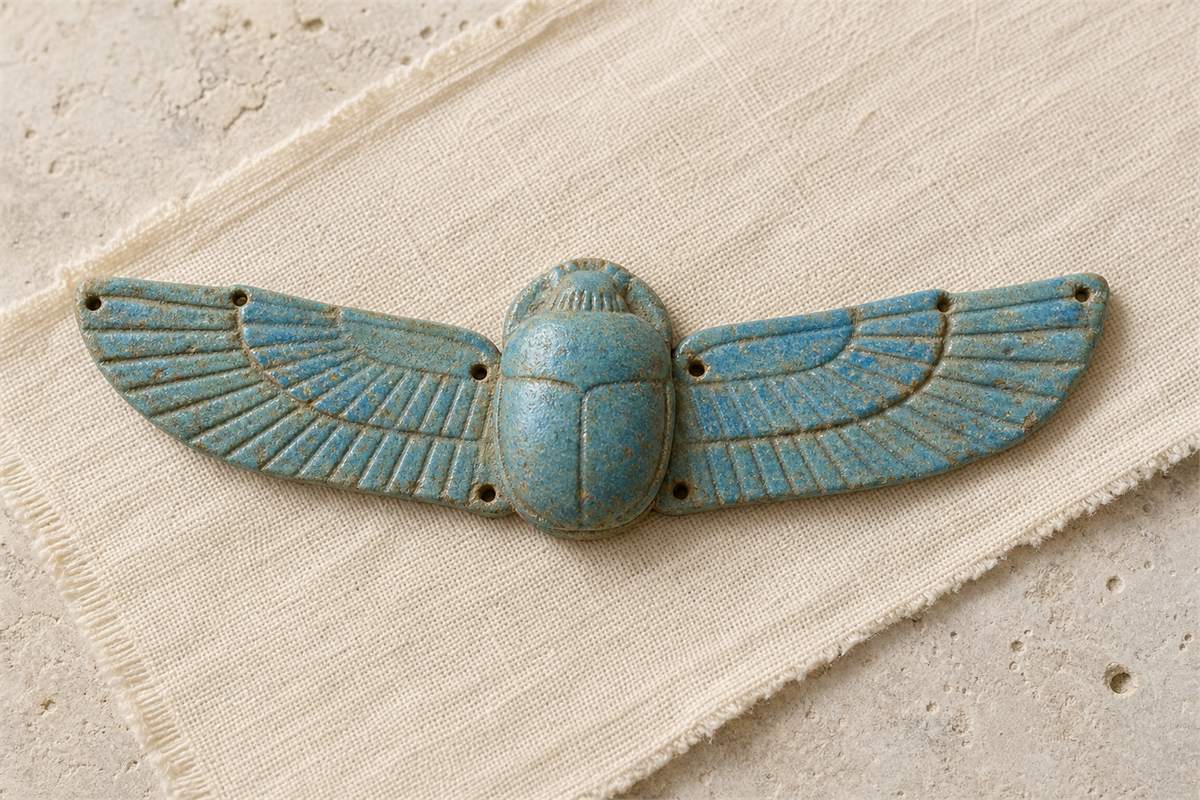
A winged scarab expands the solar image. New Kingdom royal jewelry includes elaborate scarab-centered pectorals, while later funerary examples could have separate wings attached and be sewn onto mummy wrappings or bead nets. The open wings suggest the rising sun, movement, protection, and renewed life. Form and date matter: a jeweled royal pectoral and a molded faience mummy amulet share solar imagery but differ in construction, audience, and use.
Scarab Seal (圣甲虫印章) and Daily Amulets
A scarab seal (圣甲虫印章) has a beetle-shaped back and a flat engraved underside. From the Middle Kingdom onward, many carried the names and titles of pharaohs, nobles, administrators, or other officials. Pressed into wet clay, the carved base could seal documents, boxes, bags, jars, doors, or corded containers. It was at once a practical device, a mark of identity, and an amulet.

Smaller daily scarabs could be pierced lengthwise, mounted in rings, threaded as beads, tied to the wrist, or worn as pendants. Their undersides might show names, deities, royal epithets, protective signs, animals, geometric scrolls, or short wishes. The object’s meaning came from the complete combination—not from beetle shape alone.
Materials, Colors, and Social Meaning
Egyptian scarabs were made in Egyptian faience (埃及彩陶/费昂斯), glazed steatite, other stones, amethyst, turquoise, lapis lazuli, carnelian, gold, silver, and additional materials. Faience was especially important because its bright blue-green glaze evoked life, vegetation, water, the sky, and regeneration. It could also be produced widely, allowing amulets to circulate far beyond the highest elite.

Turquoise brought sky-blue and blue-green color; lapis lazuli evoked deep celestial blue and carried the prestige of an imported material; amethyst offered violet color; carnelian and red stones introduced solar heat, vitality, and protective force. Gold suggested the imperishable flesh and brilliance of the gods, while silver was rarer in parts of Egyptian history and could carry lunar or luminous associations. Color and material strengthened a scarab’s message, but inscriptions and use remained equally important.
Material also communicated access and rank without forming a rigid caste chart. Gold, silver, large gems, and complex inlay concentrated in royal and elite settings because they required costly material and specialized labor. Faience and glazed steatite could be inexpensive and broadly available, yet finely made examples also appeared in prestigious contexts. An official’s title, a royal name, the quality of carving, and the object’s placement can reveal as much as the raw material.
Modern scarab jewelry adds agate, jade, jadeite, enamel, diamonds, and mixed metals. These materials create new visual and gift meanings rather than reconstructing a single ancient formula. Readers comparing stone identity, finish, treatments, and durability can use the Eastern Story material guide; the jade meaning guide shows how a material can carry a distinct cultural history when it enters a modern scarab design.

Scarab Jewelry Through Ancient Egypt, Greece, Rome, and the Egyptian Revival
The earliest true scarab amulets appeared by the First Intermediate Period, around 2124 BCE. Many early pieces are small—often around 1 cm—and use glazed steatite or related materials. During the Middle Kingdom, roughly 2030–1650 BCE, scarabs became widely used as combined seal-amulets. Names and titles on their undersides made them portable instruments of identity within an expanding bureaucracy.

During the New Kingdom, about 1550–1070 BCE, heart scarabs, commemorative royal scarabs, scarab rings, and elaborate solar pectorals gave the form new scale and political presence. The famous treasures of Tutankhamun show how gold, lapis lazuli, turquoise-colored inlay, glass, and other materials could turn the scarab into a centerpiece of royal jewelry. Winged scarab imagery also became important in funerary decoration.
In the Third Intermediate and Late Periods, funerary amulets multiplied and detachable winged scarabs were sewn to wrappings or bead nets. Faience remained central. From the later Late Period into the Ptolemaic era, 525–30 BCE, molded glass amulets also expanded the repertoire; monochrome examples were joined by bi- and multicolored forms. Production could be more standardized, but the religious value of color, shape, and placement remained active.
Scarab forms traveled through Mediterranean exchange. Greek and Etruscan makers adapted beetle-backed seal stones, often giving the engraved base scenes from their own visual worlds. Roman ring and engraved-gem traditions absorbed scarab and scaraboid forms into a broader culture of personal seals and status jewelry. The result was not one unchanged Egyptian religion spreading intact, but a long series of cultural translations.

Egyptian Revival jewelry gathered momentum in Europe and the United States from the 1860s into the early twentieth century. Designers mounted ancient or Egyptianizing scarabs in gold, combined them with enamel and gems, and treated the beetle as both talismanic image and archaeological fashion. Art Nouveau designers responded to insect anatomy and flowing natural forms; after Tutankhamun’s tomb was discovered in 1922, scarabs, lotus flowers, hieroglyphs, and pyramidal geometry entered the bold vocabulary of Art Deco.

The Dung Beetle as a Natural Engineer
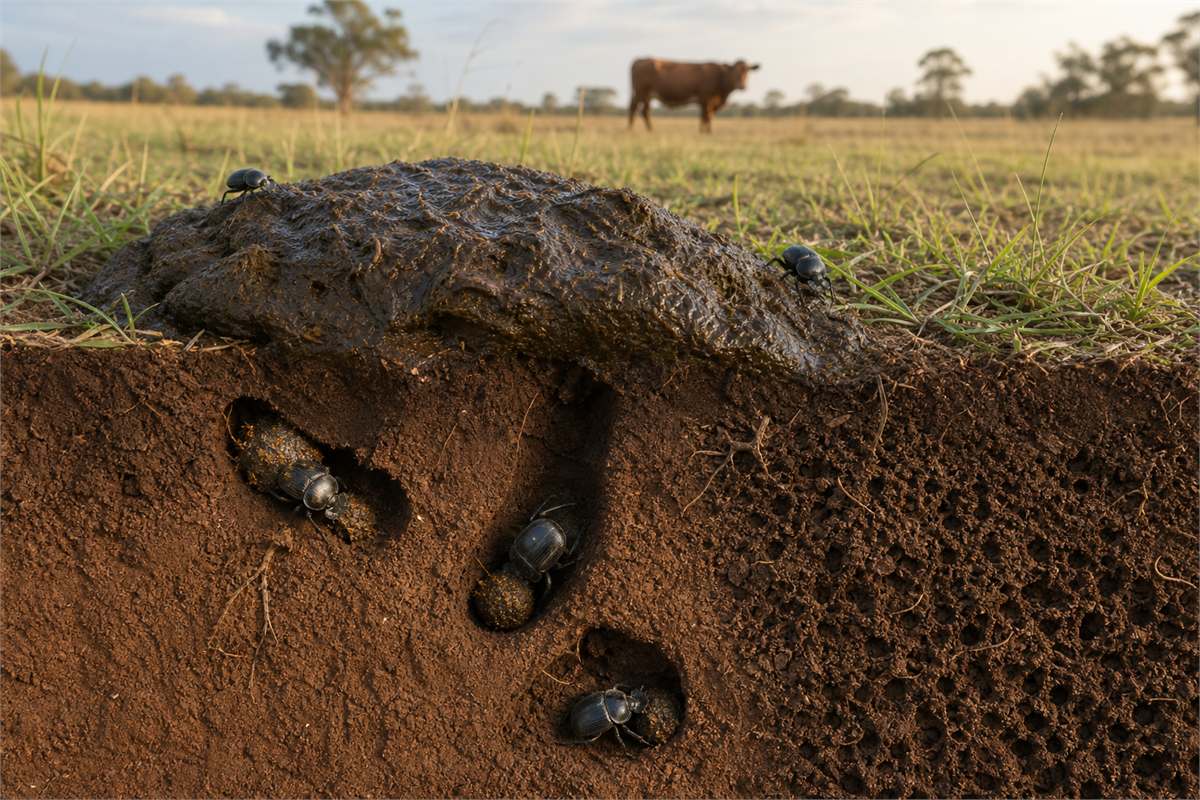
Real dung beetles are far more varied than the single sacred image suggests. Rollers shape and move balls; tunnelers bury dung beneath or near a dung pad; dwellers live within it. By removing and burying waste, they return nutrients to soil, improve soil structure, reduce habitat for pest flies and parasites, disperse seeds, and influence pasture productivity. Their work makes them ecological engineers and natural sanitation workers.
Their strength is famous, but the best-known number needs its exact setting. In a 2010 experiment, a male horned dung beetle, Onthophagus taurus, produced a maximum pulling force equal to 1,141 times its own body weight while resisting removal from a tunnel. The popular comparison is a 70 kg person pulling about 80 tonnes—the mass of six full double-decker buses. This was measured pulling force in a mating-competition context, not the everyday weight of every dung ball.
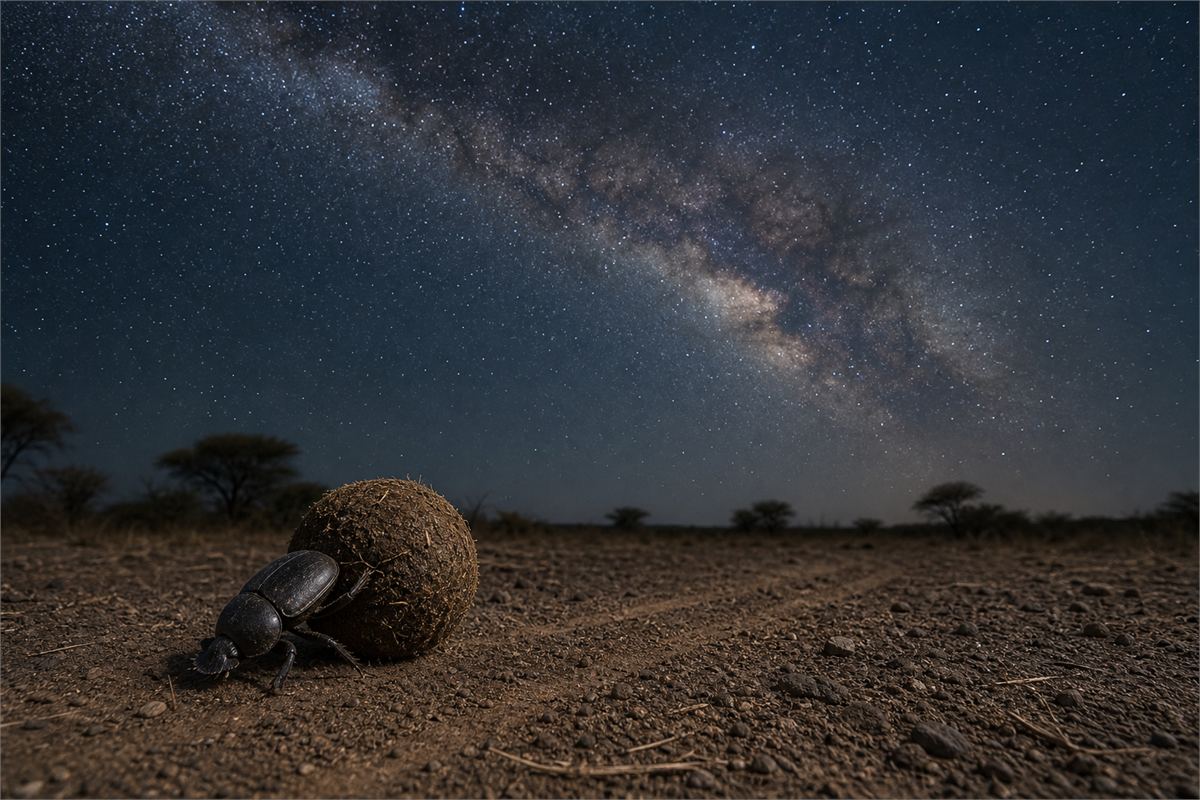
Navigation is equally remarkable. Experiments with the nocturnal African ball-roller Scarabaeus satyrus showed that beetles can keep a straighter course under a starry sky and can use the broad band of the Milky Way when the moon is absent. Straight travel helps a beetle escape competition around a dung pile. The animal is not reading constellations like a human navigator; it uses large-scale brightness information across the sky.
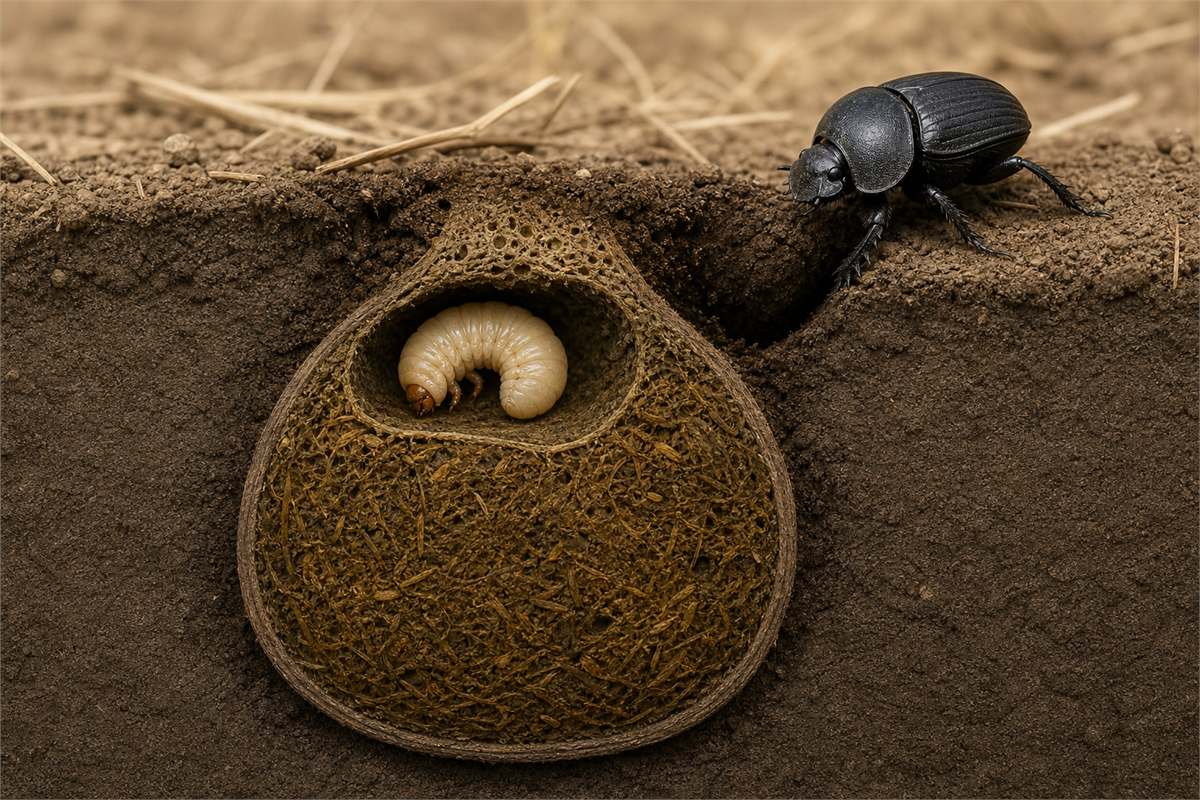
Breeding behavior reveals another layer. In many species, adults bury dung and shape a separate brood ball, sometimes spherical or pear-shaped, then place a single egg in a chamber near the top. The form slows water loss and can include a thinner porous area that supports ventilation. The larva hatches with a prepared food supply and develops inside it. Parental care varies: some species leave after provisioning, while others guard, maintain, or remain with the nest for much of the offspring’s development.
Australia offers a striking example of ecological intervention. Native beetles evolved mainly with the smaller, drier dung of marsupials and were poorly suited to the wet pads produced by introduced cattle. From 1969 into the mid-1990s, CSIRO programs introduced dung beetles from southern Africa and Europe; 53 species were introduced and 23 established. Their burial activity helped reduce dung accumulation, recycle nutrients, and suppress fly breeding on pastures.
Modern Scarab Jewelry, Tattoos, Games, and Design
Modern scarab jewelry ranges from archaeologically inspired seal rings to minimalist pendants, sculptural brooches, beaded bracelets, intaglios, reversible charms, and gemstone carvings. A designer may emphasize the beetle’s segmented shell, a sun disk, wings, an engraved underside, or a clean oval silhouette. Gold and lapis can evoke Egyptian Revival richness; silver and black agate can feel architectural; jade and translucent stones create a cross-cultural contemporary object.

Tattoos often use the scarab to mark transformation, survival, a return to confidence, or the decision to move forward after loss. Wings, sun disks, lotus flowers, geometric frames, and hieroglyph-inspired borders can change the composition. Cultural respect begins with distinguishing decorative invention from copied sacred or funerary texts: an attractive row of signs may carry a real name, prayer, royal title, or ritual statement.

In games, films, and animation, the scarab is frequently translated into a key, guardian, hidden mechanism, resurrection device, desert creature, or marker of an Egyptian setting. Franchises such as Yu-Gi-Oh! and Assassin’s Creed Origins draw on the visual power of ancient Egypt, but their scarab roles belong to fantasy and entertainment design. They show how quickly modern audiences read the beetle as “Egyptian,” mysterious, ancient, and connected with renewed life.
The 2010 FIFA World Cup opening ceremony in South Africa offered a different cultural translation: a gigantic dung beetle entered the field and pushed a giant football. The performance celebrated an African ecological icon known for tireless labor and replenishing the earth. It did not reproduce an ancient Egyptian ritual; it reinterpreted real beetle behavior through sport, scale, movement, and public spectacle.

How to Wear, Display, Collect, and Care for a Scarab
Modern scarab jewelry has no single universal religious dress code. A pendant can sit close to the chest, a ring can echo the rotating seal rings of antiquity, a bracelet can use a small pierced bead, and a brooch can make the beetle’s shell and wings more visible. Choose a scale that feels comfortable and a setting that protects raised legs, wings, inlay, and carved edges.

Choose with Material and Craft in Mind
- Identify the object. Decide whether you want a historically inspired seal, a modern beetle design, a funerary-style winged form, or a simple symbolic charm.
- Confirm the material. Ask whether the stone is turquoise, lapis lazuli, amethyst, agate, jade, glass, faience, or an imitation, and whether it has been dyed, filled, coated, or assembled.
- Inspect carving and setting. Check symmetry, underside engraving, drill holes, surface texture, metal joins, claws, bezel edges, and whether the piece sits comfortably against skin or fabric.
- Review dimensions. A 1 cm scarab reads as a small bead; a 3–5 cm carving becomes a pendant or display object. Photographs without scale can hide that difference.
- Treat antique claims seriously. Provenance, age, export history, restoration, and independent specialist opinion matter more than a dramatic sales story.
Care by Material
Gold and silver settings can be wiped with a soft cloth and checked for looseness. Turquoise, lapis lazuli, faience, old glass, and many composite materials benefit from dry, gentle care because moisture, acids, abrasion, or household chemicals can alter porous surfaces and old glaze. Jade and agate are tougher, yet carved legs and edges can still chip after impact. Avoid steam or ultrasonic cleaning when material, treatment, adhesive, or setting security is uncertain.
Display modern objects away from direct heat and hard edges. Store each piece in a lined compartment so metal, glaze, and gemstones do not strike one another. For an ancient scarab or genuinely old object, minimize direct handling, maintain a stable dry environment, avoid amateur polishing, and consult a conservator before cleaning. The Eastern Story care guide offers a practical starting point for jewelry and mixed-material objects.

Scarab as a Gift: Rebirth, Protection, and New Beginnings
A scarab makes a thoughtful gift when the message is clear. For someone emerging from a difficult period, it can mean, “The sun returns, and a new chapter is possible.” For a founder or professional changing direction, it can represent the courage to keep moving a heavy task forward. For a birthday, graduation, opening, or relocation, it can mark renewal, steady effort, and hope.

For a partner or close friend, a scarab can express enduring companionship: a small object carried through changing seasons. For an elder, a carefully chosen gold, jade, agate, or stone carving can honor resilience and long memory. A display scarab for an entryway, study, or collection can carry a modern household message of protection, order, and renewed energy while also inviting conversation about its history.

| Gift moment | Suitable form | Message to include |
|---|---|---|
| Recovery or personal restart | Pendant, bracelet charm, small object | Rebirth, returning light, and courage for the next step |
| New business or career turn | Seal-style ring, desk object, gold or agate scarab | Resilience, focused work, order, and forward movement |
| Birthday or graduation | Modern pendant, brooch, or bracelet | Growth, hope, strength, and a new cycle |
| Partner or important relationship | Paired charms, engraved pendant, or ring | Protection, transformation together, and enduring companionship |
| Elder or collector | Jade, agate, gold, faience-inspired, or documented antique | Long life, memory, dignity, and thoughtful keeping |
| Housewarming or opening | Display carving or framed seal impression | A guarded threshold, fresh beginnings, and an ordered home |
The Eastern Story blessing collection offers more symbolic jewelry and meaningful objects organized around protection, strength, harmony, love, clarity, and new beginnings.
Related Eastern Story Blessing and Material Topics
The scarab is one member of a much wider human vocabulary of amulets and protective objects. Compare its solar and regenerative history with evil eye amulet meaning, or explore how different cultures translate safety, fortune, and hope through lucky symbols around the world. For a broader jewelry-focused view, read the guide to protective jewelry and guardian symbols.
Material changes meaning as strongly as form. Continue with jade meaning and gift symbolism, the practical material guide, or the clear quartz guide for another example of how ancient use, mineral identity, modern symbolism, buying, and care should remain distinct. More cultural symbol research is available in the Eastern Story library.
Frequently Asked Questions
The Scarab’s Enduring Return
The scarab endures because it joins opposites: a humble recycler and a solar deity, decay and new life, a tiny seal and royal authority, the darkness underground and the first light of morning. Ancient Egyptians gave those connections religious, funerary, and administrative form. Later cultures and modern designers translated them into new jewelry, objects, stories, and personal milestones.
Choose a scarab by understanding which layer matters to you: Khepri’s dawn, the ancient amulet, the engraved seal, the heart scarab, the natural engineer, or the modern symbol of resilience. Then let material, craftsmanship, comfort, provenance, and the recipient’s story complete the meaning. Explore more cultural symbols of luck and protection or browse the Eastern Story blessing collection.
Related Posts


2 Comments