
Tibetan Buddhism is a family of Mahayana Buddhist traditions that preserves Vajrayana teachings and developed through centuries of translation, study, meditation, ritual, and cultural exchange in Tibet and the wider Himalayan and Inner Asian worlds. It shares Buddhism’s commitment to ethical conduct, wisdom, and freedom from suffering, while giving particular importance to compassion, lineage, monastic learning, sacred art, and carefully transmitted tantric practice.
For a beginner, the most helpful approach is neither to treat it as an exotic mystery nor to reduce it to colorful ritual. Tibetan Buddhism is a living religious world in which philosophy and daily kindness, scholarship and devotion, monasteries and households all meet. Its enduring emotional center is a wish that beings may live with greater awareness, patience, courage, and care for one another.
What is Tibetan Buddhism?
Tibetan Buddhism belongs to Mahayana Buddhism and preserves Vajrayana, or tantric, traditions inherited especially from late Indian Buddhism. “Tibetan” describes an important historical and cultural center, not a boundary around every community that practices these teachings. Related traditions have long histories in Bhutan, Nepal, Himalayan regions of India, Mongolia, and parts of Russia and China, and today they are practiced internationally.

People sometimes divide world Buddhism into Theravada, East Asian, and Tibetan traditions as a convenient introduction. That map can help at first, but Buddhist history is more interconnected and regionally diverse. Tibetan Buddhism is not a separate religion from Buddhism, and Vajrayana is not simply another name for everything Tibetan. It is better understood as a group of lineages that share broad Buddhist and Mahayana foundations while maintaining distinctive texts, methods, institutions, and artistic languages.
How Tibetan Buddhism developed
Buddhist ideas and objects reached the Tibetan plateau through several routes, but sustained royal support and translation activity began in the seventh century. The eighth-century reign of Trisong Detsen became especially important. Indian scholar-monk Shantarakshita helped establish monastic Buddhism, Padmasambhava became central to Tibetan accounts of tantric transmission, and Samye emerged as an early monastery and translation center. Religious histories also contain sacred narratives about these figures; a respectful overview can value those narratives without treating every devotional episode as a modern historical record.

After periods of political fragmentation and institutional disruption, new translation and teaching networks expanded from the late tenth and eleventh centuries. The Indian master Atisha arrived in Tibet in 1042 and influenced the Kadam tradition and later graduated-path teachings. Translators and traveling teachers brought additional Indian scriptures and commentaries, while Tibetan scholars organized, debated, and interpreted this material in their own institutions. This later transmission helped shape the Sakya, Kagyu, and eventually Gelug traditions; Nyingma preserved lineages associated with earlier translations as well as later treasure-text traditions.
This was not a single event in which “Indian Buddhism” simply merged with Bön to create one system. Buddhism developed in Tibet through multiple waves of translation, royal and local patronage, monastery building, teaching lineages, and interaction with existing Tibetan cultures. Bön has its own complex history, texts, institutions, and living practitioners. The relationship between Buddhist and Bön communities has included exchange, distinction, adaptation, and debate rather than a one-way absorption.
Beliefs shared with the wider Buddhist path
Tibetan Buddhist teachings begin with widely shared Buddhist foundations: the Four Noble Truths, dependent arising, karma, impermanence, and the cultivation of ethical conduct, meditation, and wisdom. The Buddha’s diagnosis of suffering is practical rather than pessimistic. It asks how craving, aversion, and confusion shape experience—and how a wiser way of seeing and living can loosen their hold.

As Mahayana traditions, Tibetan schools place great emphasis on bodhicitta (菩提心): the aspiration to awaken for the benefit of beings. Compassion here is more than a passing feeling. It can become a steady willingness to notice suffering, protect life, act patiently, and widen concern beyond oneself. Teachings on emptiness (空性) examine how people and things lack an independent, permanent essence. Emptiness and dependent arising are therefore connected: life matters precisely within a web of conditions and relationships.
Specific traditions organize these ideas in different ways. Lamrim, or “stages of the path,” is especially associated with Kadam and Gelug presentations, though graduated-path teachings appear more broadly. Lojong mind training, the “three principal aspects,” and other well-known frameworks are valuable in their proper settings, but none should be presented as the single mandatory summary used identically by every Tibetan Buddhist school.
The major schools and other living traditions
Four schools are commonly introduced first: Nyingma, Sakya, Kagyu, and Gelug. The color labels sometimes used in Chinese—“red,” “flowered,” “white,” and “yellow”—are external popular nicknames. They can obscure more than they explain, so the schools’ own names are the better starting point.
| Tradition | Historical formation | Often-associated teachings and institutions |
|---|---|---|
| Nyingma | “Ancient” transmission lineages connected with Tibet’s early translation period | Old Translation tantras, Dzogchen, and treasure-text traditions; major institutions include Mindrolling and Dorje Drak |
| Sakya | Developed around Sakya Monastery and the Khön family from the eleventh century | Lamdre (“Path and Result”), scholarship, ritual lineages, and a historically important relationship with the Yuan court |
| Kagyu | Networks tracing transmissions through Indian masters and Tibetan translators such as Marpa, with several branches | Mahamudra, meditation lineages, and institutions including Tsurphu and Drikung Til |
| Gelug | Formed around the teachings and reforms of Tsongkhapa in the late fourteenth and early fifteenth centuries | Monastic study and debate, Madhyamaka philosophy, graduated-path presentations, and institutions such as Ganden, Drepung, and Sera |

These descriptions are orientations, not rankings. Each school contains contemplative, ritual, scholarly, monastic, and lay dimensions. Samye, for example, is foundational to Tibetan Buddhist history and should not be reduced to a representative monastery of one modern school. Sakya’s relationship with Mongol and Yuan rulers was historically significant, but it cannot be summarized accurately as one school simply “ruling all Tibet” in a modern sense.
The four-school outline is also incomplete. Jonang remains a living tradition known for distinctive philosophical and contemplative transmissions. Bodong developed its own influential scholarly heritage, and the historical Kadam tradition profoundly shaped later Tibetan Buddhism. Smaller lineages and regional communities matter as well. Diversity does not mean that one school is more authentic, advanced, or complete than another.
Monasteries, teachers, and lay life
Monasteries have served as places of worship, education, translation, debate, art, ritual, community support, and textual preservation. A large monastery may include colleges with different curricula, while a small regional institution may combine study and local ceremonies in another way. Nuns’ institutions, retreat communities, and non-monastic religious specialists also belong to the picture.

Education varies by school, monastery, region, historical period, and gendered institution. Students may study logic, Madhyamaka philosophy, Prajnaparamita, monastic discipline, Abhidharma, ritual, grammar, poetry, medicine, or arts. Debate is particularly visible in some scholastic settings, using precise questions and responses to test reasoning. Geshe is a degree title in particular scholastic systems, with several levels and institutional requirements; calling it simply a “PhD in Buddhism” erases those differences. Khenpo commonly denotes an abbot, senior scholar, or teaching qualification in other settings, again depending on institution.
Lay Tibetan Buddhist life can include refuge and ethical commitments, household prayer, mantra recitation, offerings, generosity, pilgrimage, receiving teachings, sponsoring community rites, caring for relatives, and ordinary work. Not every practitioner performs the same rituals. Family tradition, language, location, school, age, and personal commitments all shape religious life. Compassion may appear as formal meditation, but it also lives in hospitality, patience, protection of the vulnerable, and mutual care.
Lineage, lamas, and tulkus
A lama is a respected teacher within a lineage, though the title and role vary. Teachers explain texts, guide meditation, transmit vows and instructions, and connect students with a community of practice. In Vajrayana, lineage matters because many practices depend not only on a printed method but also on empowerment, oral transmission, explanation, ethical commitments, and sustained guidance.

The Chinese expression often translated as “living Buddha” usually refers to a tulku (祖古), a person recognized within a lineage of intentional rebirth. Tulku traditions became important in several Tibetan Buddhist schools, but they do not form one uniform system unique in every detail to Tibetan Buddhism. Recognition processes have differed across lineages and historical periods, and not every revered teacher is a tulku. A beginner needs cultural understanding, not a do-it-yourself guide to identifying reincarnations.
Practice: from everyday foundations to Vajrayana
Public Buddhist learning can begin with ethics, the Four Noble Truths, dependent arising, compassion, and simple forms of attention or reflection taught openly. Reading history, visiting a monastery or center respectfully, listening to introductory teachings, and asking thoughtful questions do not require pretending to hold commitments one has not made.

Vajrayana includes mantra, visualization, mandala, ritual, and deity-yoga systems, but it is not one standardized course shared identically by every lineage. Some traditions use extensive preliminary practices; curricula and sequences differ. Tantric practice is normally received within a specific lineage through appropriate preparation, empowerment, oral transmission, and qualified instruction. This is a positive structure of relationship and responsibility, not a fear-based claim that public learning is forbidden.
A trustworthy teacher or center should identify its lineage, explain which teachings are public, make expectations and finances clear, maintain ethical safeguards, welcome sincere questions, and allow time for informed choice. Charisma, titles, elaborate objects, or promises of rapid attainment are poor substitutes for accountability and kindness.
Mantra, compassion, and the Six-Syllable Mantra
The best-known Tibetan Buddhist mantra is Oṃ maṇi padme hūṃ, closely associated with Avalokiteshvara, the bodhisattva of compassion. It appears in prayer, inscriptions, manuscripts, prayer wheels, and stones, and is recited across many communities. Its meaning has been interpreted in several ways within Buddhist traditions; reducing it to one literal English phrase or assigning one fixed emotion to each syllable misses that depth.

At its most accessible, the mantra invites remembrance of compassion: pausing before harm, recognizing another person’s pain, and returning to a wider heart. Some mantra practices are taught publicly, while others belong to specific liturgies or tantric transmissions. This compassionate context matters more than turning the mantra into a fixed translation or a technique detached from its tradition.
Sacred art, symbols, and material culture
Thangkas, sculptures, murals, manuscripts, mandalas, stupas, textiles, music, and monastery architecture help preserve and communicate teachings. A thangka may support teaching, devotion, ritual, or meditation. Mandalas can represent ordered awakened worlds and may appear in painting, architecture, offering practices, or temporary materials. Artists work within iconographic conventions, yet materials, proportions, composition, and regional styles are more varied than the idea of one universal visual code suggests.

Sacred images should be read within their lineage and ritual context. A color, hand gesture, implement, mount, wrathful face, or paired figure cannot be turned into a fixed entertainment “decoder ring.” Wrathful imagery may express forceful awakened activity in particular teachings, but it deserves careful explanation rather than promises about defeating enemies, transforming “negative energy,” or attracting wealth.
Material culture also requires distinctions. A bell and vajra can be paired ritual implements; offering bowls and lamps belong to particular devotional settings; malas support recitation; prayer wheels and prayer flags carry sacred texts and intentions; gau boxes may hold revered images or substances. Dzi-style beads, protective pendants, and modern “Tibetan” accessories can also belong to regional custom or commerce. They should not all be presented as universal Buddhist necessities with fixed powers.
Ritual, festivals, and respectful cultural encounters
Cham masked dance, circumambulation, prostration, incense offerings, prayer flags, large thangka displays, and other practices vary across communities and calendars. They are not one uniform list performed by all Tibetan people or every monastery. Cham in particular is a ritual tradition with specific texts, deities, music, and institutional settings—not simply a tourist dance about good defeating evil.
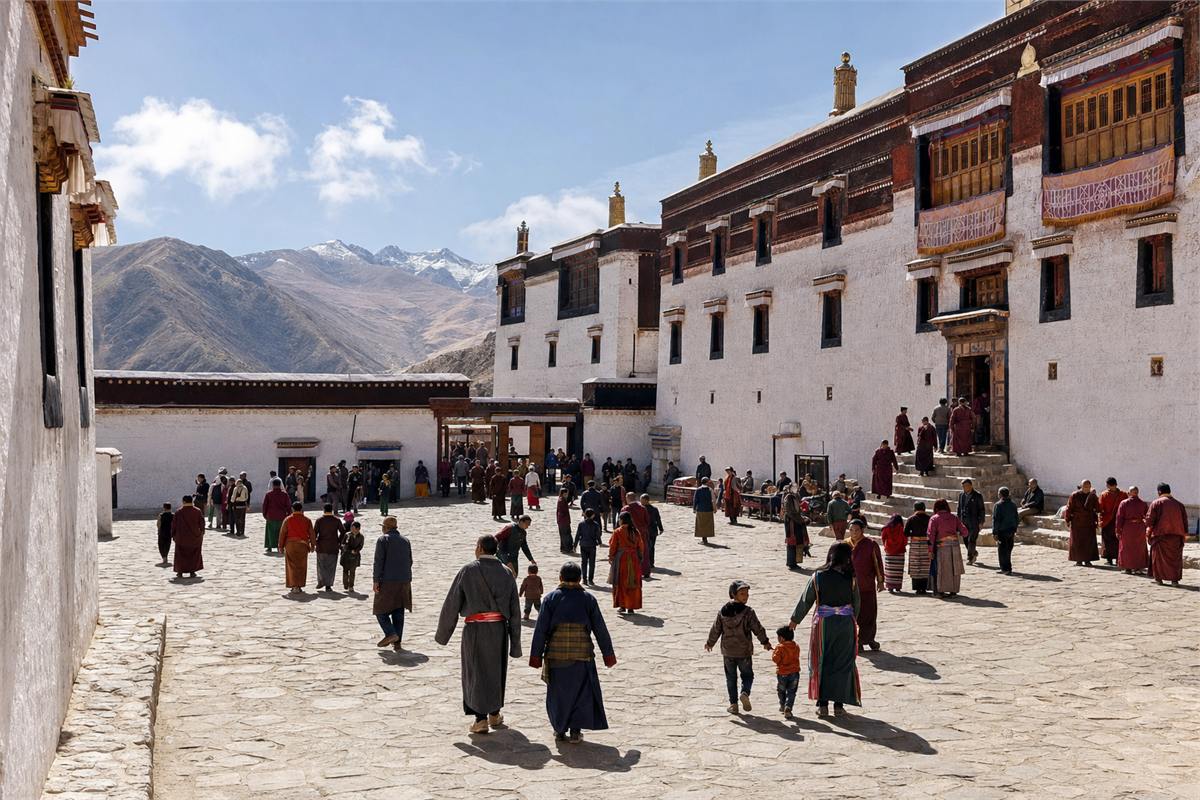
When visiting a sacred place, follow local instructions about dress, direction of movement, restricted spaces, offerings, and photography. Ask before touching ritual objects or joining an action. Avoid staging prostrations, masks, or sacred gestures for a photograph. Respect also means accepting that funerary customs and restricted rites are governed by religious, community, regional, and legal norms rather than offered as visitor experiences.
Death, rebirth, and bardo in context
Some Tibetan Buddhist traditions describe bardos—intermediate or transitional states—in teachings about life, meditation, dying, and rebirth. These are religious frameworks for practice and reflection, not clinical maps of what medicine can verify after death. Details such as forty-nine days, peaceful and wrathful appearances, or clear-light teachings belong to particular textual and lineage contexts and should not be imposed as one account accepted identically by every Buddhist.

For real end-of-life care, compassion includes the person’s wishes, appropriate medical support, family needs, local law, and guidance from trusted religious advisers when requested. In an emergency, contact medical services. Advanced practices connected with consciousness transfer or subtle-body systems require qualified lineage guidance and do not belong in a general introduction.
How to learn respectfully as a beginner
- Begin with the Buddhist foundation. Learn the Four Noble Truths, dependent arising, ethics, compassion, and the bodhisattva ideal.
- Add history before stereotypes. Notice the early and later transmission periods, translation culture, and the diversity of Tibetan and Himalayan communities.
- Meet the schools without ranking them. Read one clear institutional introduction from more than one tradition and note both shared ground and different vocabulary.
- Observe living communities carefully. Look for transparent lineage, ethical policies, patient teaching, and room for questions.
- Distinguish public learning from transmitted practice. History, philosophy, and cultural knowledge are open areas of study; specific tantric rituals may require empowerment and instruction.
- Treat art as sacred communication. Learn the figure, text, lineage, and purpose before assigning a symbol a fixed meaning or power.
- Let compassion become practical. Patience, listening, generosity, and protection of others give the subject a place in ordinary life.

The Eastern Story archive offers more cultural guides. Readers drawn to objects that carry wishes for peace, steadiness, and care can also explore the Blessing collection with attention to each object’s actual cultural setting.
Frequently Asked Questions
Related Posts


8 Comments