
Five Elements crystals are a modern way of arranging jewelry and decorative stones through the colors and symbolism of Wu Xing—Wood, Fire, Earth, Metal, and Water. The system is useful for building a color story, choosing a meaningful gift, or creating a personal reminder. It is not an ancient official list of gemstones, and the stones do not alter health, wealth, or destiny.
A practical chart often maps white, metallic, or clear stones to Metal; green stones to Wood; black or dark blue stones to Water; red, pink, orange, or purple stones to Fire; and yellow or brown stones to Earth. That chart is a contemporary synthesis, not a rule found in the early Five Phases classics. Understanding that distinction makes the framework more flexible, more culturally accurate, and much easier to use.
In the jewelry trade, “crystal” is often a broad retail term. The materials in a Five Elements display may include true crystals, polycrystalline materials, rocks, organic gems, and natural glass. Their care requirements are not interchangeable.
Five Elements Crystal Chart at a Glance
The traditional correspondences below provide the cultural foundation. The gemstone column shows common modern color-based choices rather than an authoritative historical inventory.

| Element | Traditional color, direction, and season | Symbolic design words | Common modern gemstone choices |
|---|---|---|---|
| Metal | White; west; autumn | Clarity, refinement, definition | Clear quartz, white chalcedony, moonstone, white agate, silver-toned or gold-toned metal |
| Wood | Qing (blue-green/green); east; spring | Growth, renewal, flexibility | Green aventurine, peridot, green tourmaline, malachite, green inclusion quartz |
| Water | Black; north; winter | Depth, quiet, adaptability | Obsidian, black agate, smoky quartz, lapis lazuli, aquamarine, blue kyanite |
| Fire | Red; south; summer | Warmth, visibility, vitality of expression | Garnet, carnelian, red jasper, amethyst, rose quartz, sunstone |
| Earth | Yellow; center; seasonal transitions in later systems | Stability, support, grounded form | Citrine, tiger’s eye, yellow jasper, amber, smoky quartz, pyrite |
This crystal elements chart should be read as a palette, not a diagnosis. A blue-green stone can reasonably support either Wood or Water in a modern design. Clear quartz may be placed with Metal because of its bright, colorless appearance, with Earth because it comes from the ground, or treated as neutral. Purple is commonly placed with Fire in contemporary charts, yet some sellers assign it to Earth or to a separate spiritual category. Variation is normal because the gemstone layer is modern.
Wu Xing Means Five Phases, Not Five Gemstone Batteries
Wu Xing (五行) is often translated as the “Five Elements,” but “Five Phases,” “Five Processes,” or “Five Agents” better expresses its dynamic character. Wood, Fire, Earth, Metal, and Water describe recurring modes of change and relationships: sprouting, rising heat, centering, contracting, and flowing are more useful images than five substances stored inside a person.

Chinese thinkers used these categories to organize observations across time, direction, color, music, governance, medicine, and ritual. Correspondence did not mean that every green object was literally made of Wood or that a white object contained a measurable Metal force. In the same way, a green bracelet can evoke spring growth without functioning as an “energy battery.”
For a wider introduction to the cultural vocabulary, read Eastern Story’s feng shui crystal guide. It helps to keep cultural symbolism separate from claims that can be tested physically.
Historical Five Colors and Directional Correspondences
The established Five Phases pattern associates Wood with the east and spring, Fire with the south and summer, Earth with the center, Metal with the west and autumn, and Water with the north and winter. The paired colors are qing for Wood, red for Fire, yellow for Earth, white for Metal, and black for Water.

Qing is especially important for English readers. Depending on the period and object, the word can span blue, green, blue-green, dark green, or even a dark cool tone. Translating it only as bright modern green makes the historical palette seem narrower than it was. This helps explain why teal and some blue stones appear under Wood in one chart but Water in another.
Earth’s seasonal placement also varies. The center is the clearest basic directional correspondence; later systems may connect Earth with late summer, the transition between seasons, or particular compass sectors. Those elaborations belong to specific cosmological or feng shui systems. A simple Five Phases display should not casually combine them with Bagua sectors, Flying Stars, or a universal “wealth corner.”
Why Modern Wu Xing Crystal Charts Vary
Ancient sources set out phases, colors, directions, seasons, and cycles, but they do not provide a standard catalog that says “amethyst equals Fire” or “aquamarine equals Water.” Today’s Five Elements crystal charts appear to blend several layers: classical color correspondence, modern feng shui practice, jewelry-market naming, personal aesthetics, and ideas that circulated through twentieth-century crystal and New Age cultures.

That modern synthesis is not automatically inauthentic; living traditions often acquire new forms. The key is honest labeling. A designer may say, “I use carnelian for Fire because of its orange-red color,” without presenting the choice as an ancient decree. The same honesty is useful when a trade name is involved.
“Crystal” does not always mean quartz

| Market name | What it is | Why the distinction matters |
|---|---|---|
| Clear quartz, amethyst, smoky quartz, citrine | Crystalline varieties of quartz | Generally Mohs 7, but treatments, fractures, settings, and cords change care |
| Aventurine and tiger’s eye | Quartz-rich or quartz-based materials with distinctive inclusions/structures | They are not simply colored clear quartz |
| Obsidian | Natural volcanic glass; non-crystalline | It can chip and develop sharp edges |
| Lapis lazuli | A rock made of several minerals, commonly including lazurite, calcite, and pyrite | Porosity, dyes, wax, and calcite affect cleaning |
| Moonstone | Feldspar | Cleavage and modest toughness matter more than a single hardness number |
| Aquamarine | Blue to green-blue beryl | Its mineral identity and possible fractures guide cleaning |
| Malachite | Basic copper carbonate mineral | Soft, brittle, and sensitive to acids and harsh cleaning |
| Pyrite | Iron sulfide mineral | Brittle; prolonged moisture can encourage surface alteration |
| Garnet | A mineral group, not one single species | Different garnets share a structure but vary in composition |
| Peridot | Gem-quality olivine | A distinct mineral, not green quartz |
| Amber | Organic fossil resin | Very soft and vulnerable to heat, alcohol, and perfume |
Names such as “golden hair crystal,” “silver rutilated quartz,” “titanium quartz,” “white rabbit hair,” “purple phantom,” and “strawberry quartz” are trade or market labels. Needle-like inclusions cannot be identified as rutile or “titanium” from color alone. Green phantom layers are often described as chlorite, but an actual inclusion may require gemological identification. Ask for a material description and treatment disclosure, especially when a poetic name carries a price premium. Eastern Story’s natural versus artificial crystal guide explains useful disclosure questions.
Metal Element Crystals: White, Clear, and Metallic
Traditional frame: Metal corresponds to white, west, and autumn. As a design language, it can suggest precision, clean boundaries, polish, and the beauty of a distilled form.

Modern candidates: clear quartz, white chalcedony, white agate, colorless rock crystal, moonstone, and jewelry metals such as silver or gold are frequent choices. Colorless materials are sometimes labeled neutral or Earth instead, and an actual metal clasp may communicate the theme more clearly than a transparent stone.
A monochrome Metal bracelet works well with frosted and polished surfaces, or with one reflective spacer between matte white beads. For home display, a clear point or a small white-stone dish creates an understated west-facing accent when the location is also physically safe. As a gift, the palette suits a milestone associated with editing, completion, or a fresh professional presentation—not because it guarantees success, but because the visual message is crisp.
Care: clear quartz is relatively hard, yet it can still be chipped by impact and scratched by harder materials. Moonstone needs more caution because feldspar cleavage makes it vulnerable to a sharp knock. Use a soft cloth; use mild soapy water only when the stone, treatment, setting, adhesive, and stringing method allow it. Avoid ultrasonic or steam cleaning for moonstone. For more detail, see what clear quartz is and the rutilated quartz bracelet guide.
Wood Element Crystals: Green and Blue-Green
Traditional frame: Wood corresponds to qing, east, and spring. Modern readers often translate the palette as green or blue-green and use it to express growth, renewal, and adaptable structure.

Modern candidates: green aventurine, peridot, green tourmaline, malachite, jade, and quartz with green inclusions. Malachite’s banding can evoke rings of growth, while peridot’s yellow-green feels like new leaves. A blue-green aquamarine or turquoise can sit between Wood and Water depending on the story.
For clothing, Wood colors pair naturally with cream linen, brown leather, or a pale Metal accent. A small green object on an east-facing shelf can mark spring or a new project, provided the shelf is stable and away from curious children or pets. A Wood-themed gift can symbolize encouragement, learning, or a new beginning without promising an outcome.
Care: green aventurine is quartz-based and usually more forgiving than malachite. Malachite is much softer and brittle; keep it away from acids, household cleaners, ultrasonic equipment, steam, abrasive cloths, and hard bead-to-bead contact. Wipe it gently and follow the seller’s care directions for any wax, resin, dye, or stabilization. The malachite guide covers its mineral identity and care. “Green phantom” is a visual growth pattern, not proof that every green inclusion is chlorite.
Water Element Crystals: Black, Deep Blue, and Flowing Color
Traditional frame: Water corresponds to black, north, and winter. Its design words include depth, reserve, reflection, continuity, and the ability to follow a changing path.

Modern candidates: black obsidian, black agate or onyx, smoky quartz, lapis lazuli, aquamarine, sodalite, and blue kyanite. Black follows the historical color most closely; blue is a common modern expansion inspired by the appearance of water. Deep blue lapis feels nocturnal, while transparent aquamarine gives a lighter, flowing interpretation.
A Water bracelet can be nearly monochrome, with differences in transparency and surface rather than many hues. Black obsidian with a small aquamarine accent creates a dark-to-light narrative. In a room, a dark blue bowl or secure stone object in the north can act as a seasonal display. Do not place a heavy sphere where it can roll, fall, or focus direct sunlight.
Care: obsidian is natural glass and can chip; retire a bead with a sharp fracture. Lapis lazuli is a multi-mineral rock that may be dyed or waxed, so avoid solvents, acids, prolonged soaking, steam, and ultrasonic cleaning. Aquamarine is beryl and usually durable, but fractures, inclusions, fillings, settings, or glued components may require conservative care. Read more in Eastern Story’s obsidian guide and black agate bracelet guide.
Fire Element Crystals: Red, Pink, Orange, and Purple
Traditional frame: Fire corresponds to red, south, and summer. In design, it can express warmth, radiance, celebration, visibility, and the moment an idea becomes vivid.

Modern candidates: garnet, carnelian, red jasper, rose quartz, rhodochrosite, sunstone, and amethyst. Red most closely follows the classical pairing; orange, pink, and purple are contemporary extensions. Purple amethyst is often assigned to Fire because it combines red and blue visually or because of its saturated presence, but other charts place it with Earth or treat it separately.
Fire colors can be strong in small doses: a single garnet focal bead, an orange-red carnelian row, or amethyst beside warm gold metal. A south-facing display can use a red textile beneath a secure mineral specimen rather than forcing every object to be red. For a gift, the palette suits a celebration, performance, creative launch, or affectionate message.
Care: garnet is a mineral group; most garnet jewelry tolerates gentle warm soapy water, but steam is not recommended and fractured stones need caution. Carnelian is chalcedony and generally durable. Amethyst and rose quartz are quartz, yet prolonged strong light or high heat can alter color in some material. Rhodochrosite is far softer and acid-sensitive; keep it separated from quartz beads. For amethyst mineral facts, color, and safe display, see the amethyst geode guide.
Earth Element Crystals: Yellow, Ochre, and Brown
Traditional frame: Earth corresponds to yellow and the center. Later systems may connect it with late summer or seasonal transitions. Its design vocabulary includes steadiness, nourishment, structure, and a dependable center.
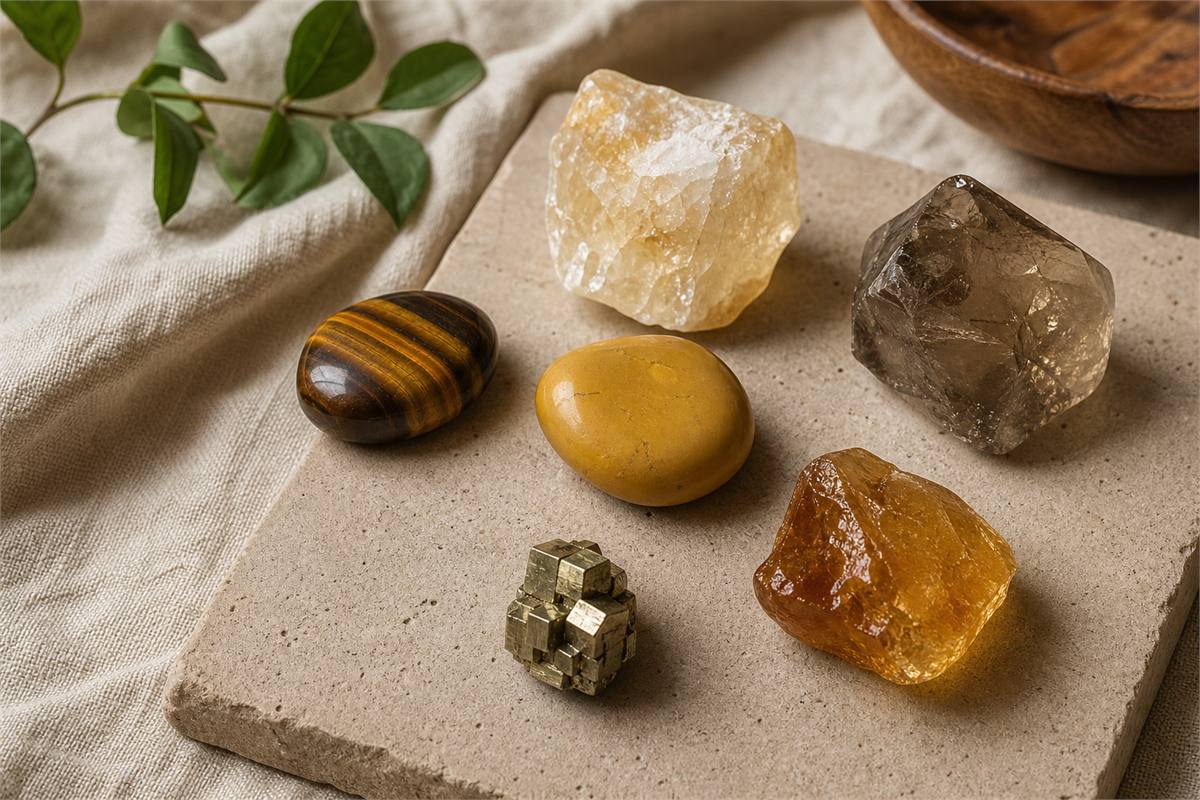
Modern candidates: citrine, tiger’s eye, yellow jasper, smoky quartz, amber, and pyrite. Warm brown tiger’s eye suggests soil and grain; citrine brings translucent yellow; amber adds honeyed warmth; pyrite provides an earthy metallic form. Some charts move pyrite to Metal because of its luster, and smoky quartz may be Water because of its darkness.
A tonal Earth bracelet can combine honey, ochre, and brown without looking heavy. Pair it with natural fibers or a simple brass-colored clasp. At home, a low stable arrangement near the center of a room can express the theme, but it should never obstruct a walkway. An Earth gift can mark a homecoming, steady friendship, or a practical new beginning.
Care: citrine and tiger’s eye are quartz materials, but dyed, coated, fracture-filled, or glued pieces need the seller’s instructions. Amber is organic fossil resin, exceptionally soft, and vulnerable to alcohol, perfume, high heat, and abrasion. Pyrite is brittle iron sulfide; keep it dry, avoid soaking, and store it away from humidity. The citrine bracelet guide, tiger’s eye guide, and amber bracelet guide provide material-specific detail.
The statement “all natural crystals are inherently Earth” is a modern interpretive shortcut, not a universally accepted traditional rule. It can be used as one poetic viewpoint, but it should not be combined with an absolute color chart and presented as a single ancient doctrine.
Use the Generating and Controlling Cycles as Design Tools
The two best-known Wu Xing relationships can organize a visual sequence. Keep the arrows accurate:
- Generating cycle: Wood → Fire → Earth → Metal → Water → Wood. A design can move from green to red, yellow, white, black, and back to green as a continuous narrative.
- Controlling cycle: Wood → Earth → Water → Fire → Metal → Wood. A design can use these pairings for contrast, interruption, or a deliberate focal point.


“Generating” does not require every bracelet to contain the next color, and “controlling” does not mean two stones become dangerous when worn together. In visual design, the first cycle can create flow and gradual handoffs; the second can create high contrast and rhythm. A black Water bead beside a red Fire bead is a striking color choice, not an energetic emergency.
How to Choose Crystals by Element Without the Missing-Element Shortcut
Choose in a sequence that starts with the object in front of you, not with a phone app telling you what your birth season supposedly lacks.

- Choose the message. Decide whether the object should remind you of clarity, growth, quiet, warmth, or steadiness.
- Choose the palette. Use the traditional color as an anchor, then allow neighboring shades when they tell the story better.
- Confirm the material. Ask what the stone actually is, whether it is dyed, coated, filled, stabilized, assembled, or synthetic, and how the seller recommends cleaning it.
- Check construction and comfort. Consider bead diameter, total weight, cord type, clasp, metal allergy, sharp edges, and how the piece meets a keyboard, watch, or desk.
- Keep the meaning proportional. A bracelet can be a cultural-aesthetic symbol and a personal cue. It does not replace healthcare, financial planning, or a life decision.
BaZi is not a simple “spring birth means missing Metal” calculator. A full Four Pillars analysis uses year, month, day, and hour pillars, calendrical conversion, the Day Master, relationships among stems and branches, overall structure, and changing time cycles; different practitioners may still interpret the same chart differently. Even if you consult a practitioner, a stone remains a symbolic accessory rather than a device that changes a birth chart.
Five Elements Crystal Bracelet Design
A good five elements crystal bracelet begins with wearability. Mohs hardness measures resistance to scratching, not resistance to chipping, cleavage, string wear, or impact. Two beads of similar hardness can still abrade each other over thousands of movements, while metal spacers, plated surfaces, pendants, knots, and elastic all create their own contact points.

Beads around 4–6 mm create a lighter, more detailed palette; 8 mm beads make each color more visible but add weight quickly. These are design examples, not mandatory sizes. Measure the wrist and choose the intended fit before ordering, using Eastern Story’s crystal bracelet size guide.

| Design story | Suggested construction | Practical compatibility notes |
|---|---|---|
| Metal → Water: clear to flowing | 6 mm clear quartz with 6 mm aquamarine; one smooth silver-toned clasp or spacer | Quartz and beryl are fairly hard, but inspect drill holes and avoid a sharp-edged metal spacer; check for aquamarine fractures or filling |
| Wood → Fire: spring to summer | 6 mm green aventurine alternating with 6 mm carnelian on knotted cord | Both are quartz-based materials; knots reduce bead-on-bead contact, but the cord still needs inspection |
| Fire → Earth: violet to honey | 6 mm amethyst with a centered 8 mm citrine or tiger’s eye bead | Quartz-family materials simplify care, yet strong light, heat, coatings, and fractures still matter |
| Water controls Fire: dark contrast | 6 mm black obsidian with 4 mm garnet accents and soft polymer or cord separators | Obsidian can chip; garnet is harder. Separators help, and a damaged glass bead should be replaced |
| Five-color continuous cycle | 6 mm clear quartz, green aventurine, black agate, carnelian, and tiger’s eye on individually knotted cord | Mostly quartz/chalcedony materials make a more compatible set, but knots, drill holes, clasp, and treatments still require care |
Soft and sensitive materials need extra space
Malachite, calcite, fluorite, amber, rhodochrosite, turquoise, azurite, and selenite are poor candidates for constant direct rubbing against quartz. Use a protective setting, soft separator, individually knotted construction, or a separate piece. A small difference in bead size does not remove contact if the bracelet flexes.

Metal components are a materials decision
Metal does not “cancel” Wood or Water. Choose sterling silver, gold, stainless steel, brass, or plated parts according to skin sensitivity, weight, tarnish behavior, color, budget, and repairability. A plated spacer may lose its finish where beads rub. Nickel-sensitive wearers should ask for an accurate alloy disclosure rather than relying on vague “hypoallergenic” wording.

Left or Right Wrist? Tradition and Practical Choice
Some contemporary bracelet traditions summarize the left side as receiving and the right side as releasing. That is a symbolic convention, not a universal historical rule or a measurable property of stones. Claims that obsidian must be worn on the right to expel negativity should be treated as personal ritual language, not fact.
For everyday wear, put the bracelet on the wrist where it is safer and more comfortable. The non-dominant hand often receives less impact, but that is not true for everyone. Consider a watch, keyboard or mouse use, lifting, handwriting, cooking, machinery, and the location of clasps or pendants. Remove a heavy, elastic, sharp, or intricately set bracelet for sleep, exercise, housework, bathing, or any activity that exposes it to impact, snagging, sweat, detergent, or sudden temperature change.

Five Elements Crystal Placement at Home
The five directions can create a culturally informed display: green or blue-green in the east for Wood, red in the south for Fire, yellow near the center for Earth, white in the west for Metal, and black in the north for Water. Treat this as a seasonal or aesthetic arrangement. The room must work safely before the symbolism is considered.

- Support the weight. Use stable furniture and museum putty, a ring stand, or a closed dish where appropriate. Keep heavy objects away from shelf edges.
- Control rolling and falling. Spheres require a fitted stand. Do not place stones above a bed, sofa, child’s area, or pet route.
- Protect from sun and heat. A transparent crystal or glass sphere can focus direct sunlight and create a fire risk. Strong light and heat may also fade some colored materials.
- Respect sharp surfaces. Crystal clusters can have needle-like points; carry them from the base and keep them away from traffic.
- Manage moisture and chemicals. Avoid steamy bathrooms, kitchen grease, cleaning sprays, salt air, and damp windowsills when the material is sensitive.
- Plan around electronics realistically. A stone does not shield a computer user from radiation. The actual concerns are heat, vibration, cables, liquids, and accidental knocks.

There is no universal rule that the southeast is always a wealth corner, that the entry diagonal is always a wealth position, or that the “Azure Dragon side” is the upper-left corner of every desk. Such rules combine different feng shui schools and simplified diagrams. If you use a Bagua or building-specific method, identify that method rather than blending it invisibly into the basic Five Phases directions.
A bedroom is not automatically unsuitable because a stone is “too energetic.” Decide by weight, sharp points, reflected or focused light, placement security, and whether the object feels visually restful to you. Opening a new piece can be as simple as recording its material, treatment, seller, purchase date, and care instructions; it need not be carried around the room to “learn” the space.
How to Care for Mixed Crystal Jewelry
The safest default is simple: after wearing, wipe the piece with a clean, soft, lint-free cloth; store it dry in a divided box or individual soft pouch; and keep it away from harder jewelry, chemicals, high heat, and abrupt temperature changes. Clean according to the most sensitive material, treatment, adhesive, finish, string, and setting in the piece.

| Material group | Conservative routine | Important risks |
|---|---|---|
| Quartz family and quartz materials: clear quartz, amethyst, citrine, smoky quartz, aventurine, tiger’s eye, chalcedony | Soft cloth; brief mild soap and lukewarm water only when untreated and construction allows; rinse briefly and dry thoroughly | Avoid long soaking of elastic or glued parts; high heat and prolonged strong light can alter some colors; coatings, dyes, fillings, and fractures need special care |
| Feldspar: moonstone, sunstone | Soft cloth; brief warm soapy water for suitable pieces | Cleavage and modest toughness; avoid impact, ultrasonic cleaning, and steam |
| Beryl: aquamarine | Soft cloth; mild soap and lukewarm water for sound, disclosed material | Fractures, fillings, inclusions, settings, and thermal shock can change what is safe |
| Garnet group | Soft cloth; warm soapy water for most sound stones | Avoid steam; ultrasonic cleaning is unsuitable for fractured or filled material |
| Obsidian | Soft cloth; brief mild soap and water if the construction allows; dry fully | Natural glass can chip, and a fracture can leave a sharp edge |
| Malachite, calcite, fluorite, rhodochrosite, azurite, selenite | Prefer a dry soft cloth and the vendor’s material-specific instructions; separate storage | Softness, brittleness, cleavage, acid sensitivity, coatings, and surface finish vary; no universal soaking, ultrasonic, or steam treatment |
| Lapis lazuli and turquoise | Soft cloth; only cautious brief cleaning when treatment and construction are known | Porosity, calcite, dyes, wax, resin, and oil can react to solvents, cosmetics, acids, heat, or soaking |
| Pyrite | Dry soft brush or cloth; dry storage with stable humidity | Brittle sulfide; prolonged moisture and unsuitable storage can encourage surface alteration |
| Amber | Very soft clean cloth; specialist or seller guidance for deeper cleaning | Organic and very soft; avoid alcohol, perfume, hairspray, heat, steam, ultrasonic cleaning, and abrasion |
Methods that are not universal care
Salt water, dry salt burial, acids, bleach, alcohol, strong alkali, ultrasonic cleaners, and steam are not universal crystal-cleaning methods. They can damage minerals, organic gems, treatments, adhesives, elastic, finishes, or metals. A silver-polishing cloth may contain abrasives or chemicals and should touch only the metal it is designed for—not every neighboring stone.
Moonlight, a geode, a cluster, sound, or a personal spoken intention may be meaningful rituals, but they do not remove dirt, disinfect a surface, reverse oxidation, repair a coating, or restore a physical “charge.” Smoke is particularly poor maintenance: it can leave residue and introduces flame and air-quality concerns. Clean when the object is actually dirty, not on a fixed one- or two-month schedule.
Do not seal every stone in an airtight bag as an automatic anti-oxidation measure. Trapped moisture can make storage worse. Aim for a clean, dry, stable, softly lined, divided environment. Inspect elastic and cord regularly and repair the piece when you see fraying, stretching, a slipping knot, cracked drill holes, a loose clasp, or plating wear; calendar-based replacement is less useful than visible condition.

A Five Elements Crystal Gift Guide
| Occasion or message | Palette idea | What to include on the gift card |
|---|---|---|
| New beginning or study | Wood: green aventurine or peridot | The modern color meaning, exact material, treatment disclosure, and care |
| Celebration or creative milestone | Fire: carnelian, garnet, or amethyst | A personal note about warmth or visibility—not a promise of success |
| Homecoming or dependable friendship | Earth: tiger’s eye, citrine, or amber | Whether the material is quartz, organic amber, treated, or assembled |
| Graduation, editing, or completion | Metal: clear quartz, white chalcedony, moonstone, or a simple metal detail | Fit, metal alloy, and cleaning instructions |
| Reflection, travel, or winter birthday | Water: black agate, obsidian, lapis, or aquamarine | Why the color was chosen and any chip, porosity, dye, or filling precautions |
The most considerate gift is transparent about what it is. Include a material-and-care card, keep the symbolism optional, and choose a comfortable size. Avoid ordinary jewelry made from giant clam shell: giant clams face conservation pressure, their trade is regulated, and legality depends on species, origin, documentation, and jurisdiction. A glass, ceramic, shell-free white stone, or responsibly sourced alternative can express the same palette without the wildlife concern.

For an optional personal touch, Eastern Story’s blessing guide offers ways to write a short intention while keeping it separate from a claim of guaranteed results.
Five Elements Crystals FAQ
A Flexible Framework, Used Honestly
The most satisfying Wu Xing crystal guide does not force every stone into one permanent box. It begins with the historical Five Phases relationships, states that the gemstone chart is modern, and lets color, material, construction, and personal meaning work together. That approach honors the cultural framework while leaving room for a bracelet or home display to feel genuinely yours.
Choose the phase story, confirm the mineral or material, design for real wear, and care for the most sensitive component. The result can be meaningful without needing to promise invisible forces or guaranteed outcomes.
Related Posts


0 Comments