
What is malachite? Malachite is a green copper carbonate hydroxide mineral, Cu2CO3(OH)2, best known for its light-to-dark banding, concentric “eye” patterns, and polished ornamental surface. It forms as a secondary mineral in the near-surface oxidized zones of copper deposits. People use it for cabochons, beads, carvings, veneers, decorative objects, and historically, green pigment. In modern symbolic practice, malachite meaning often centers on growth, transformation, protection, and the visual energy of green; those meanings belong to cultural and personal interpretation rather than medical treatment.
This guide separates mineral facts from trade descriptions and symbolic traditions. It explains how malachite forms, why it is banded, where notable material comes from, how to assess quality, how to compare real vs fake malachite, and how to wear, gift, clean, and store this relatively soft stone.
Malachite Properties at a Glance
| Property | Malachite | Why it matters |
|---|---|---|
| Mineral class | Carbonate | Explains its sensitivity to acids and harsh chemicals |
| Chemical formula | Cu2CO3(OH)2 | Copper is responsible for the characteristic green color |
| Crystal system | Monoclinic | Distinct crystals exist, but massive and fibrous aggregates are much more common |
| Mohs hardness | 3.5–4 | Easy to scratch compared with quartz, many gemstones, and metal edges |
| Specific gravity | About 3.6–4.0 | Relatively dense, although weight alone cannot establish authenticity |
| Streak | Pale green | A mineralogical property, not a home test for finished jewelry |
| Typical structure | Banded, concentric, botryoidal, fibrous, radiating, or massive | Creates the patterns prized in cabochons, beads, carvings, and veneer |
| Reaction to acid | Effervesces and dissolves in acid | Acid testing is destructive and should never be attempted on a finished piece |

What Is Malachite and How Is It Formed?
Malachite is a secondary copper mineral. It usually develops where primary copper-bearing minerals have been exposed to oxygenated water near the surface. As those original minerals weather, copper moves through fractures, cavities, and porous rock. When the chemistry is suitable—especially where carbonate is available—malachite can precipitate as crusts, rounded botryoidal masses, fibrous layers, stalactitic forms, or compact material.
There is no single formation time that applies to every specimen. The process depends on the deposit, fluid movement, host rock, climate, and changing chemical conditions. Malachite commonly occurs with other copper minerals, including blue azurite, turquoise-blue chrysocolla, red cuprite, and various iron oxides. Its presence can therefore be a visible clue to an oxidized copper zone, although it does not by itself reveal the size or commercial value of the underlying deposit.
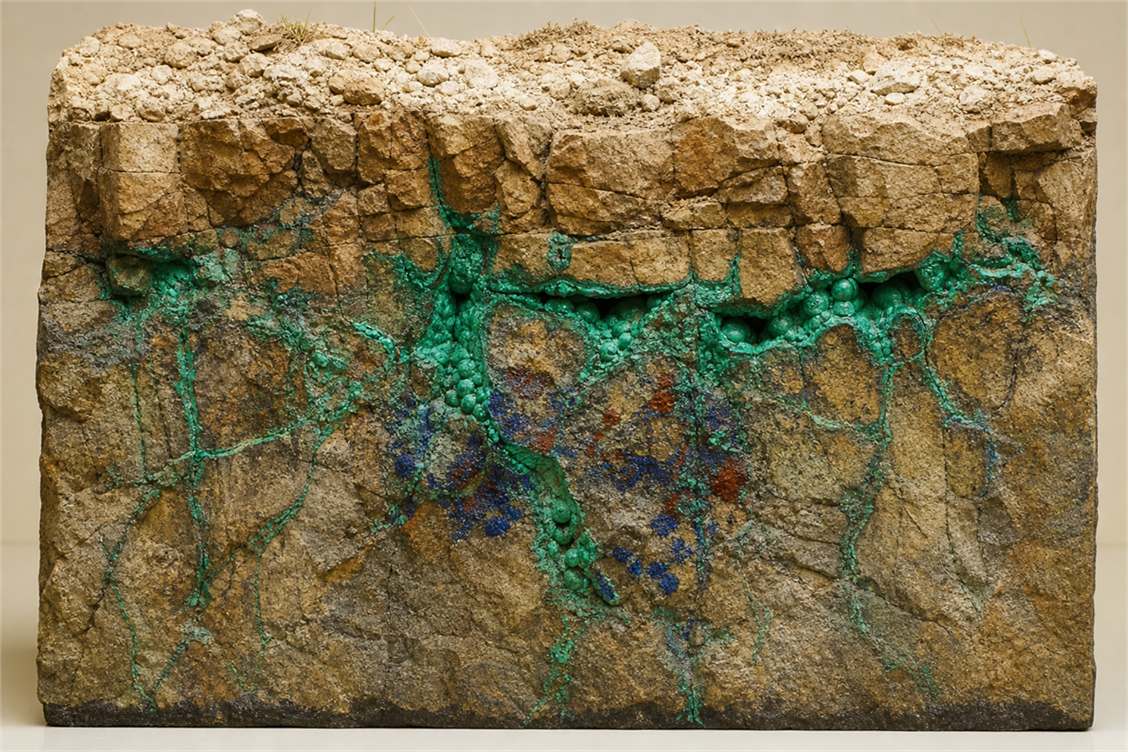
Why is malachite green?
The green comes from copper in the Cu2+ oxidation state. Electronic transitions involving these copper ions absorb parts of visible light and leave the green wavelengths that reach the eye. Malachite can range from pale mint and vivid grass green to deep forest green that appears almost black in narrow bands.
Why does malachite have bands and “eyes”?
The bands record successive growth. Differences in crystal orientation, fiber density, layer thickness, porosity, and local growth conditions create lighter and darker zones. Cutting across rounded or botryoidal growth reveals concentric rings; cutting along layered growth produces waves, stripes, fans, and landscape-like patterns. Natural patterning usually varies in width, direction, and color, but pattern alone is not proof of natural origin because sophisticated imitations can also look irregular.
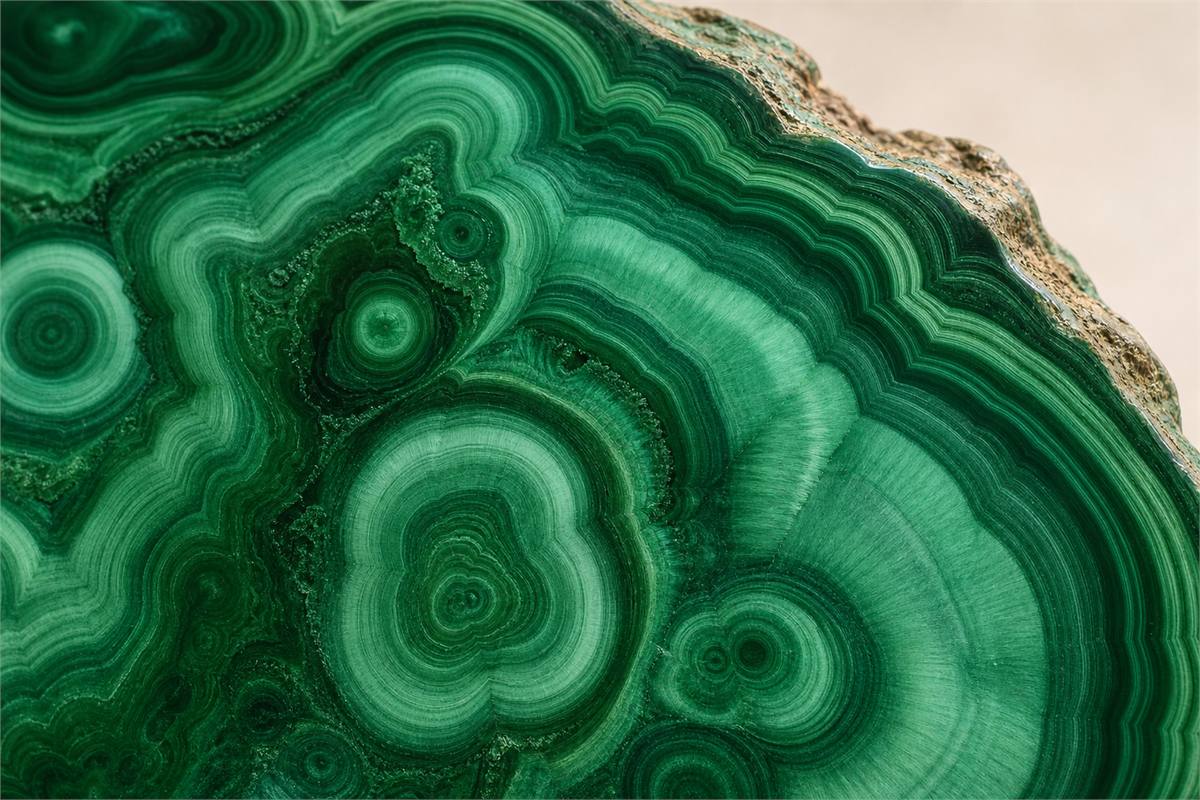
Fine parallel fibers can produce a silky sheen. When a suitable fibrous piece is cut as a domed cabochon, reflected light may form a moving line called chatoyancy, creating rare cat’s-eye malachite. Distinct malachite crystals are also uncommon and green—not brown. Needle-like, prismatic, or tabular crystals are generally collected as mineral specimens rather than used as everyday jewelry.

Malachite, Azurite, Chrysocolla, and Azurmalachite
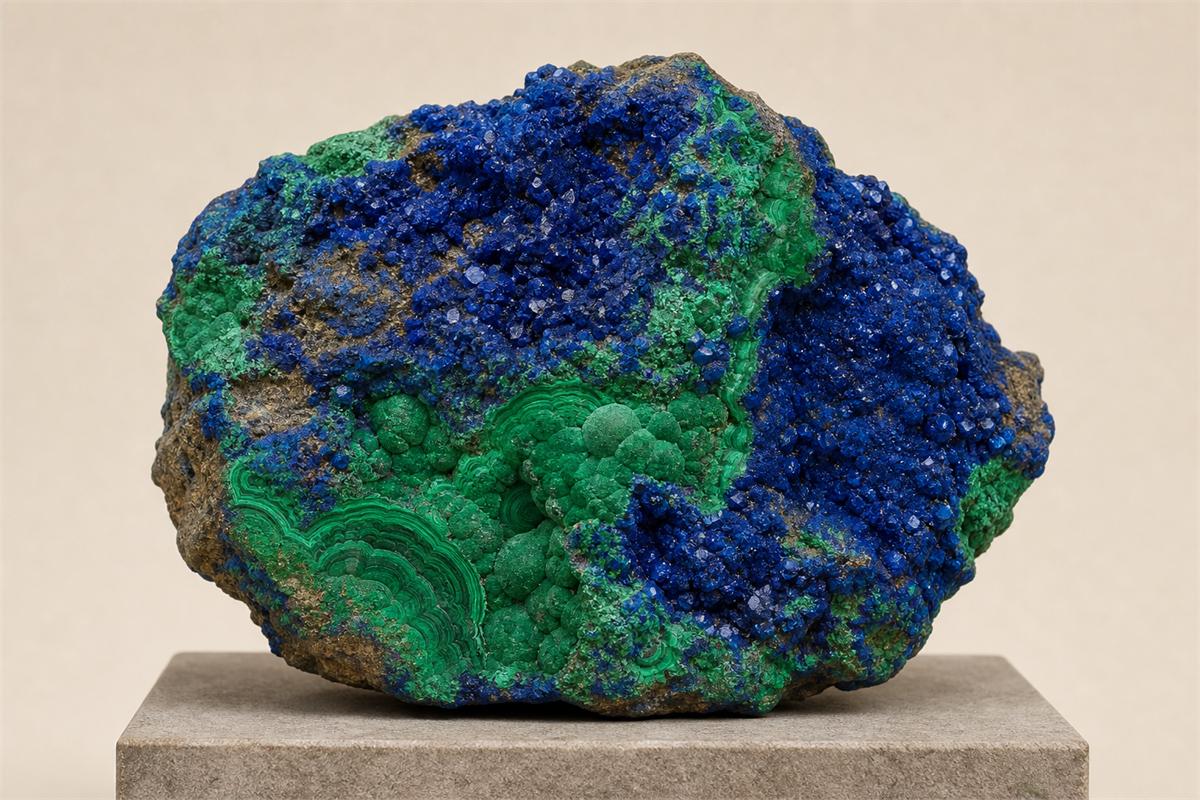
Copper deposits can produce several blue and green materials that are sold beside one another. Malachite is the green copper carbonate hydroxide described above. Azurite is a separate deep-blue copper carbonate hydroxide. Chrysocolla is a blue-green copper-bearing material with a more variable composition and structure. Cuprite is a red copper oxide that may occur in the same oxidized environment.
Azurmalachite, also written azurite-malachite, is a natural intergrowth or intimate mixture of blue azurite and green malachite. It is not simply a color variety of malachite. The informal Chinese trade phrase sometimes translated as “blue malachite” is not a single standardized mineral variety, so a seller should state whether the object is azurite-malachite, dyed material, or another blue-green stone.
Major Historical and Modern Sources
Malachite occurs at copper deposits in many countries, but a famous locality and a dependable modern supply are not the same thing. Historic Russian material from the Ural Mountains became celebrated in nineteenth-century decorative arts, yet those mines should not be treated as a steady source for today’s market. Provenance also needs documentation: a color pattern alone cannot confirm a mine or country.
| Region | Why it is known | Buying context |
|---|---|---|
| Katanga Copperbelt, Democratic Republic of the Congo | Major source of richly banded lapidary rough, botryoidal material, and mineral specimens | A leading source in the modern ornamental market; mine-level origin still requires evidence |
| Zambia | Copperbelt occurrences and associated copper minerals | Commercial descriptions should distinguish country claims from documented mine provenance |
| Tsumeb, Namibia | Classic mineral locality noted for malachite, azurite replacements, and diverse copper minerals | Especially important to specimen collectors; historic locality status does not mean continuous supply |
| Ural Mountains, Russia | Historic source for imperial decorative work and Russian mosaic | Strong historical importance; old-stock or antique origin claims need documentation |
| Arizona, United States | Classic occurrences around Bisbee and other copper districts | Better known for mineral specimens and historic localities than mass modern jewelry supply |
| Australia and other copper regions | Specimen and lapidary occurrences in oxidized copper deposits | Ask for specific locality evidence rather than relying on a broad country label |

China also has documented malachite objects and mineral-pigment traditions, but broad claims about the country’s “main producing areas” vary between geological, historical, and commercial sources. Without deposit-level documentation, it is better to identify an object by verified material and treatment than to assign a Chinese locality from appearance.
Types of Malachite and Common Trade Descriptions
| Description | What it usually means | What to verify |
|---|---|---|
| Banded malachite | Compact material with alternating green layers, waves, or concentric rings | Natural origin, treatments, thickness, cracks, backing, and pattern continuity |
| Botryoidal malachite | Rounded, grape-like surface formed by mineral growth | Whether the surface is natural, stabilized, repaired, or coated |
| Fibrous or “velvet” malachite | Fine radiating or parallel fibers with a silky surface | Fragility, loose fibers, coating, and suitability for handling |
| Crystalline malachite | Visible green crystals, often small and specimen-oriented | Repairs, glued crystals, matrix authenticity, and safe display |
| Cat’s-eye malachite | Rare fibrous material cut to show a moving light band | Stable chatoyancy, natural material, treatment, cut quality, and lab opinion for high value |
| Azurmalachite | Blue azurite naturally intergrown with green malachite | Natural intergrowth versus dye, coating, composite, or mislabeled chrysocolla |
| Reconstituted or pressed malachite | Malachite powder or fragments bonded into a manufactured body, often with resin | Accurate disclosure; it is not the same category as intact natural lapidary material |
| “Synthetic malachite” | Laboratory-grown malachite with essentially the same composition as natural malachite | Do not confuse true synthetic material with resin-and-powder reconstitution or a look-alike imitation |

Trade names describe appearance, not necessarily a formal mineral variety or value grade. Terms such as “royal,” “AAA,” “velvet,” or “old-mine” may be useful only when the seller defines them and supports any origin or treatment claim.
Historical Uses: Pigment, Decorative Arts, and Architecture
Ancient Egypt
Malachite was ground as a green pigment and used in ancient Egyptian cosmetics and decoration. Museum evidence supports its use as green eye paint, especially in early periods, while the wider symbolism of green in Egyptian art included vegetation, vitality, and renewal. More specific claims—such as a universal children’s amulet rule or a fixed traveler’s protection tradition—should not be repeated without object-level or textual evidence.

Mineral green in Eastern painting
In Chinese painting, mineral green known as shilü (石绿) is closely associated with malachite pigment. Particles could be washed and graded to produce different visual depths, then layered with mineral blues and other colors. The Northern Song handscroll A Thousand Li of Rivers and Mountains (千里江山图) is a celebrated blue-and-green landscape made with mineral pigments including stone green. Its brilliance reflects material choice, particle preparation, layering, conservation, and controlled display—not a promise that mineral pigment can never change.

Russian mosaic and imperial interiors
Nineteenth-century Russian workshops turned Ural malachite into dramatic architectural surfaces. The Malachite Room of the Winter Palace and the malachite columns of St. Isaac’s Cathedral became symbols of lavish stonework. Many large-looking components are not solid blocks. Craftspeople used “Russian mosaic”: thin pieces of malachite were cut, matched for pattern, attached to a structural core, ground, and polished so the joins became difficult to see. This technique used scarce, brittle material efficiently while creating the visual sweep of a much larger mass.

Malachite Meaning and Modern Symbolism
Malachite meaning today draws heavily from its color and growth structure. Green suggests vegetation, renewal, and movement. Layers that change from light to dark make an intuitive symbol of transition. Eye-like rings invite protective interpretations, while the fact that no two cut surfaces arrange their bands in exactly the same way makes malachite a natural language for individuality.
- Growth and renewal: the green palette is often chosen to mark a new chapter, creative project, or personal milestone.
- Transformation: changing bands and the mineral’s origin in a weathered copper zone give it a strong modern association with change.
- Protection: concentric patterns are used as eye-like protective symbols in contemporary jewelry and crystal traditions.
- Care and affection: malachite can express attentive love because its beauty rewards careful handling.
- Individuality: natural banding makes each composition visually distinctive, even though pattern is not an authenticity certificate.
In crystal traditions, malachite is sometimes called a stone of transformation and associated with the heart chakra, emotional release, or protection. These are symbolic and spiritual interpretations. They should be used as personal ritual or gift language, not as claims that a malachite stone treats anxiety, disease, sleep problems, or other health conditions.

Malachite Jewelry, Personal Style, and Gift Meaning
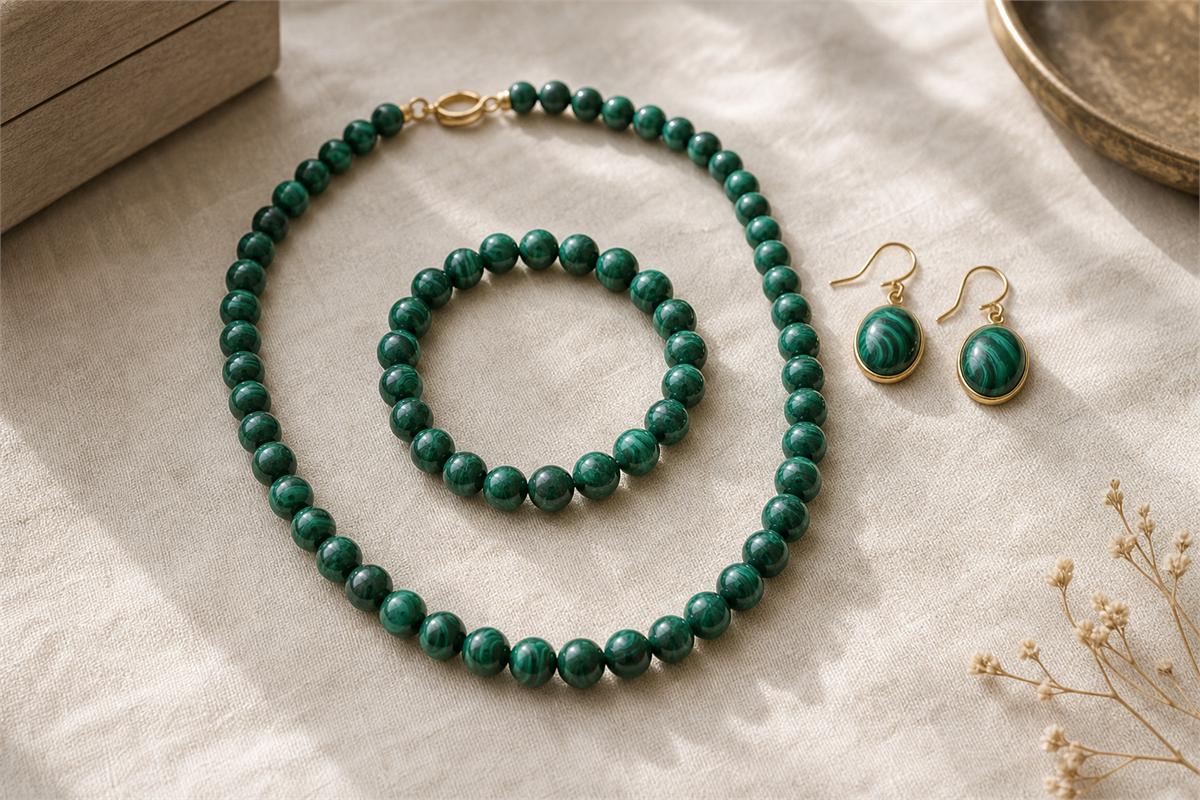
Malachite jewelry is visually bold even in a small scale. A polished cabochon shows broad areas of pattern; beads break the pattern into rhythmic green intervals; a pendant creates a graphic focal point; earrings frame the face with saturated color. Because malachite is soft and brittle, protected settings, smooth edges, and designs that avoid daily impact are more practical than exposed rings for constant wear.
Who does malachite suit aesthetically?
It suits people who enjoy strong green color, organic pattern, Art Deco contrast, maximalist accents, or quiet natural materials used as a single statement. Yellow gold makes the green feel warmer and more opulent; silver or white metal sharpens the contrast; dark wood, black fabric, cream linen, and brown leather emphasize its mineral character. A malachite bracelet works best when the wearer is comfortable removing it before sport, housework, bathing, and other high-contact activity.

Malachite gift meaning
As a gift, malachite can symbolize a fresh start, enduring care, creative courage, or the recipient’s one-of-a-kind character. It can suit birthdays, graduations, anniversaries, a new home, or a career transition. For a partner or close friend, the message can be simple: “I chose this pattern because it is as distinctive as you are.” Browse Eastern Story’s Blessing collection when you want to compare this kind of symbolic gift language with other materials and motifs.
Practical fit matters as much as sentiment. Consider the recipient’s color preferences, wrist or necklace size, metal allergies, tolerance for weight, and willingness to follow a careful cleaning routine. When visiting someone who is ill, present malachite as an aesthetic expression of care rather than as a healing object.

What Determines Malachite Quality and Value?
There is no single universal grade based only on bright color, complex bands, or an absence of visible cracks. Value depends on what the object is: a calibrated bead strand, a patterned cabochon, a mineral specimen, an antique mosaic object, and a contemporary carving are judged differently.
| Factor | What generally adds value | Important qualification |
|---|---|---|
| Natural identity | Confirmed natural malachite with clear treatment disclosure | Synthetic malachite is mineralogically different from resin imitation, but neither should be sold as natural |
| Pattern composition | Well-positioned eyes, waves, fans, or balanced bands suited to the cut | Pattern preference is partly aesthetic; complexity alone is not a grade |
| Color | Attractive, coherent green range with good contrast | One shade is not automatically superior for every object or market |
| Cut and polish | Even dome, intentional orientation, clean symmetry, and a smooth reflective surface | Wax, resin, or coating can improve appearance and should be disclosed |
| Thickness and construction | Adequate material depth, secure setting, and honest backing or composite disclosure | A thin malachite layer over a backing is not equivalent to a solid piece |
| Condition | Few distracting fractures, chips, pits, repairs, or coating defects | Natural cavities may be desirable in specimens but problematic in wearable jewelry |
| Size and matching | Large continuous patterned areas or well-matched beads and pairs | Larger is valuable only when identity, condition, cut, and design also support it |
| Provenance | Credible mine, collection, workshop, or antique history | Country names and “old mine” labels require documentation |
| Rarity and craft | Fine crystals, strong chatoyancy, important historical workmanship, or exceptional lapidary design | Material value and artistic or historical value should be evaluated separately |

There is no reliable universal dollar chart for malachite. Prices vary by object type, size, treatment, seller, workmanship, documentation, and market. Compare like with like and focus on disclosure rather than a rigid “entry,” “premium,” or “collector” tier invented from color alone.
Real vs Fake Malachite
Malachite imitations include molded resin or plastic, glass, dyed stone, printed patterns beneath a clear surface, powder-and-resin reconstituted material, coated objects, and thin malachite layers attached to a backing. True laboratory-grown synthetic malachite also exists, though it is much less common than inexpensive look-alikes and can be difficult to separate from natural material without gemological testing.
| What to inspect | Possible natural features | Possible warning signs |
|---|---|---|
| Banding | Changes in width, curvature, direction, texture, and tone | Identical motifs repeated across multiple beads or a pattern that stops like a printed layer |
| Surface and edges | Mineral polish, small natural pits, pattern continuing around an edge | Mold seams, peeling film, pooled coating, soft-looking rounded detail, or obvious printing |
| Magnification | Fine fibrous or granular structure and irregular internal growth | Round gas bubbles, resin-filled voids, pigment specks, fabric-like print dots, or a glassy layered construction |
| Back and drill holes | Pattern or material structure consistent with the front | A different backing, thin applied slice, colored coating concentrated at holes, or exposed resin |
| Weight | Natural malachite is relatively dense | Very light plastic can be suspicious |
| Seller information | Dimensions, weight, treatment disclosure, close photographs, and a clear return policy | Only filtered images, no back view, vague “natural crystal” wording, or refusal to state treatment and construction |

None of these observations is decisive by itself. Glass can be heavy; resin can contain mineral powder; natural pieces can have simple bands; and modern imitations can avoid perfectly repeated patterns. A separate natural vs artificial crystal guide can help you understand why several observations are stronger than a single home trick.
Tests to avoid
Do not scratch, burn, strike, grind, or apply acid to malachite. Acid can dissolve the mineral; heat can damage resin, coating, glue, and the setting; scratching permanently marks a soft surface. These tests are unsafe for the object and still may not answer whether it is natural, treated, synthetic, reconstituted, or composite.
Buyer Inspection Checklist
- Ask what the material is: natural malachite, synthetic malachite, reconstituted powder-and-resin material, imitation, or a composite.
- Ask about treatment: resin impregnation, wax, coating, dye, filling, repair, backing, and glue should be disclosed.
- Request natural-light images: examine the front, back, side, drill holes, clasp, setting, and any damaged area.
- Compare pattern across the whole object: look for structure and continuity without treating irregularity as proof.
- Record dimensions and weight: these help compare similar objects, but do not use “heaviness” as a verdict.
- Assess construction: check bead holes, stringing, metal edges, prongs, backing, surface thickness, repairs, and balance.
- Read the return policy: confirm the inspection window and whether a gemological opinion is allowed.
- Match evidence to risk: for an expensive jewel, rare crystal specimen, important provenance claim, or large decorative object, consult an independent gem laboratory or qualified gemologist. Some laboratories limit reports for oversized objects and complex composites, so confirm the service scope first.

How to Wear and Place Malachite
Wear malachite according to comfort and impact risk. A malachite necklace keeps the pattern visible and generally suffers fewer collisions than a ring. A malachite bracelet creates a dramatic green rhythm but meets desks, door frames, and metal watch cases more often. There is no scientific difference between wearing it on the left or right wrist; choose the non-dominant hand if that reduces knocks, or use the side that fits your habits and design.
For home display, treat malachite first as an object of design. Place a stable sculpture or bowl where its banding can be seen without creating a fall hazard. Use a secure shelf or cabinet away from children, pets, busy walkways, kitchen grease, bathrooms, direct heat, and damp windowsills. Heavy pieces need furniture and mounts rated for their weight.

Malachite feng shui symbolism
In some modern feng shui and crystal practices, green malachite is associated with the Wood element, renewal, family growth, or prosperity, and may be placed in an east or southeast area. These are optional symbolic correspondences rather than universal placement rules. Let beauty, object safety, room function, and personal belief come first. The broader feng shui crystals guide explains how symbolic placement fits within a wider home arrangement.
Avoid placing a malachite object at a crowded entrance as a supposed barrier, on a bedside ledge where it can fall, or in a humid place because a chart labels that position “lucky.” A well-composed display in a safe location is more useful than forcing the stone into a prescribed corner.

Malachite Safety, Cleaning, Storage, and Repair
Is malachite safe to wear?
Normal handling of intact, polished malachite jewelry is not the same exposure as inhaling dust during cutting. Wear finished pieces externally, keep them out of the mouth, and do not use malachite in drinking-water preparations, cosmetics, homemade powders, or topical remedies. Damaged, crumbling, or poorly sealed composite objects should be put aside for professional assessment.
Cutting, drilling, grinding, or polishing can create copper-bearing dust. This is professional lapidary work requiring wet methods, effective local exhaust ventilation, suitable personal protective equipment, and controlled cleanup. Ordinary readers should not process malachite at home.

Can malachite get wet?
Brief contact between clean water and intact, polished, untreated malachite is not automatically a dangerous event. Wipe it dry promptly. Avoid soaking, hot water, prolonged humidity, frequent washing, swimming pools, and salt water, especially when a piece contains glue, resin, coating, a composite backing, an antique setting, or an unknown treatment. Water can enter cracks or affect the non-malachite components even when the mineral surface initially looks unchanged.
How to clean malachite
- Remove the piece before bathing, swimming, exercise, cleaning, cooking, gardening, or applying skincare.
- After wear, wipe it gently with a clean, dry, soft, lint-free cloth.
- If local cleaning is necessary and the piece is modern, stable, and understood, use a barely damp soft cloth on the affected area.
- Immediately wipe it completely dry, including the setting, drill holes, joints, and backing.
- For antiques, complex settings, deep cracks, loose surfaces, valuable carvings, or unknown treatments, ask a conservator or jeweler familiar with malachite.
Avoid ultrasonic and steam cleaners, acid, vinegar, alcohol, bleach, ammonia, strong alkali, abrasive paste, household detergent, salt water, pressurized water, and long soaking. Do not use a silver-polishing cloth on the stone because it may contain abrasives or cleaning compounds. Apply makeup, lotion, hairspray, and perfume first; let them dry, then put on the jewelry. Remove perspiration and cosmetics after wear rather than leaving residue on the surface.
Oils are not a routine solution. White tea oil, baby oil, vegetable oil, “jade oil,” and similar products can enter pores and fractures, attract dust, alter color, interfere with coatings, and complicate later repair. Likewise, moonlight, crystal clusters, sage, and palo santo do not physically clean or restore malachite. If a personal ritual matters to you, keep it dry, smoke-free, chemical-free, and non-contact.

Storage
Store malachite separately in a clean, soft-lined compartment or fabric pouch so quartz, metal edges, and harder gems cannot scratch it. Make sure the piece is dry before storage. Keep it at a stable indoor temperature away from direct heat, strong chemical fumes, and abrupt temperature or humidity changes. Do not add a wet cotton ball, cup of water, or other moisture source to a sealed box, and do not seal residual moisture inside a plastic bag.

Professional repair and repolishing
A specialist should first identify the thickness of the malachite, the setting, backing, coating, adhesive, previous repairs, and any historical value. Light surface wear may sometimes be improved, but repolishing removes material and can soften a pattern, expose filling, thin a veneer, or disturb an antique surface. Not every scratch can be removed safely, and “repolish everything” is not an appropriate promise for a composite or historic object. Eastern Story’s jewelry care guide offers broader principles for protecting different materials.

Choose the Pattern, Then Protect the Surface
Malachite is memorable because mineral growth becomes visible design: copper gives it green color, layered formation gives it bands, and thoughtful cutting turns those bands into eyes, waves, and landscapes. Choose a piece for verified material, honest treatment disclosure, pattern composition, workmanship, comfort, and condition. Then protect what makes it beautiful—its polish, edges, and structure—with gentle wear, dry wiping, separate storage, and professional help when repair is needed. For more material-first buying context, explore the Eastern Story material guide.
Frequently Asked Questions
Related Posts


3 Comments