
Yin Liao Shi Yi (因料施艺) means designing and carving according to the material. In Eastern jade carving, the artisan first reads the raw stone: its shape, thickness, color zones, skin color, texture, iron lines, cottony areas, fissures, and natural marks. The subject is then chosen from the stone itself, so the finished carving feels as if nature and craft completed the work together.
This idea is one of the most important principles behind serious jade carving. It is also a useful way to understand why one carved jade pendant, plaque, bangle face, or display object can feel alive while another feels generic. A machine-made piece may be neat and repeatable. A strong Yin Liao Shi Yi work is built around one particular stone, one particular set of colors, and one particular decision made before the first cut.
Yin Liao Shi Yi Meaning at a Glance
| Term | Literal sense | What does it mean in jade carving | What to look for |
|---|---|---|---|
| Yin Liao Shi Yi (因料施艺) | Practice art according to the material | The stone guides subject, shape, depth, and detail | The design feels natural to that exact stone |
| Yin Cai Shi Yi (因材施艺) | Practice art according to the material | A broader craft phrase used across jade, stone, wood, root carving, and scholar objects | The maker respects material character instead of forcing a template |
| Qiaose Qiao Diao (俏色巧雕) | Clever-color carving | Natural colors become leaves, eyes, clouds, mountain lines, animal fur, or visual focus | Color and form match cleanly |
| Hua Xia Wei Yu (化瑕为瑜) | Turn a flaw into beauty | Fissures, skin, mineral spots, or iron lines become part of the subject | Natural marks are transformed, not hidden awkwardly |
| Tian Ren He Yi (天人合一) | Unity of heaven and human craft | Nature provides the stone; the artisan reveals its inner direction | The carving looks inevitable rather than forced |

What Yin Liao Shi Yi Means in Practice
At the simplest level, Yin Liao Shi Yi asks the carver to avoid forcing a fixed mold onto the stone. Instead of deciding, “I want to carve this shape,” the artisan asks, “What can this material become?” The answer depends on the raw stone’s outline, weight, internal direction, surface skin, polish potential, and weak points.

This is why the first stage is reading the stone. In jade workshops, this act is often called Xiang Yu (相玉), observing and judging the jade. A practiced eye studies the stone under natural light, turns it from several angles, marks fissures, checks where the color gathers, and decides where to keep, cut, hollow, polish, or leave blank.
The old saying Yi Xiang Ding Jiu Gong (一相顶九工) expresses the same idea: one act of reading the stone can be worth nine parts of carving skill. The line is not a mathematical formula. It means that a wrong first judgment can waste good material, while a good first judgment can make even an irregular stone feel rare and complete.
The Core Design Logic: Shape, Color, Texture, Flaw, and Subject
A finished carving usually begins with five questions. The first is shape: is the stone thick, thin, rounded, narrow, heavy, naturally curved, or irregular? A thick block may become a mountain scene or a display carving. A smaller curved piece may become a pendant, hand piece, bead, or bangle face.
The second is color. Hetian jade seed material may have warm skin color / Pi Se (皮色), sugar color, black-white Qinghua ink color, or small patches of yellow, brown, gray, and green. Turquoise may carry black iron lines. Jadeite may show green, violet, yellow, red, or floating flower-like colors. Under Yin Liao Shi Yi, these colors are not random decoration; they help decide the subject.

The third is texture. Long dark lines may become mountain ridges, branches, water veins, robe folds, or animal markings. Soft cottony mist may become cloud, fog, snow, or distant atmosphere. Dense, oily, fine material may suit smooth carving, while a stone with stronger pattern may suit a more pictorial composition.
The fourth is flaw. Eastern jade carving has a rich language around natural imperfections: fissure / Liu (绺), crack / Lie (裂), dirty inclusion / Zang (脏), stiff stone area / Jiang (僵), mineral spot, cotton, or iron line. A weaker design tries only to cover these marks. A stronger design turns them into branches, cliffs, insect eyes, old bark, animal texture, robe folds, or the visual rhythm of a landscape.
The fifth is subject. The best subject is not simply fashionable; it fits the material. A jade stone with strong black-white contrast may suit ink landscape, fish, birds, or animal forms. A rounded white seed material may suit a reclining ox, a smooth peace buckle, or a minimal figure. A turquoise with strong iron lines may become a miniature ink painting, a dry tree, or a wild mountain scene.
Core Techniques: Reading, Cutting, Clever Color, Following Form, and Leaving Blank
- Reading and selection: the artisan identifies the fine areas, weak areas, color zones, and natural direction before cutting.
- Removing dirt and avoiding fissures / Wan Zang Qu Liu (剜脏去绺): dirty inclusions and dangerous cracks are removed, avoided, hollowed, or integrated into the design.
- Following form: the natural outline is kept when it gives the piece strength, softness, or rarity.
- Clever-color carving / Qiaose Qiao Diao (俏色巧雕): skin color, mineral stain, iron line, or color patch becomes a planned part of the image.
- Using less carving when the material is strong: some fine material is best left as a smooth surface, a simple bangle, a plain pendant, or a peace buckle.
- Leaving blank: empty or quiet surfaces help the viewer read mist, snow, sky, water, or calm space.
These techniques are also why Yin Liao Shi Yi belongs naturally beside Eastern jade design, not just technical carving. If a reader wants the wider symbolic vocabulary of animals, flowers, clouds, and auspicious signs, the jade carving motif guide is the natural companion page.

Qiaose and Hua Xia Wei Yu: Turning Natural Marks into the Soul of the Work
The most visible form of Yin Liao Shi Yi is clever-color carving / Qiaose Qiao Diao (俏色巧雕). A yellow skin patch can become an autumn leaf. A dark spot can become a cicada wing, an insect eye, a distant bird, or an old tree knot. Sugar color can become a beast mask, animal fur, or a warm antique-style border.

This is not the same as simply liking a multi-color stone. Good Qiaose uses the right color in the right place. The color should look as if it belongs to the subject. If yellow skin becomes a leaf, it should sit where a leaf would naturally appear. If black iron lines become mountain branches, the line direction should help the composition. The design should feel clever, not forced.
Hua Xia Wei Yu (化瑕为瑜), turning a flaw into beauty, is the deeper principle. In an ordinary evaluation, a fissure, inclusion, skin patch, or iron line may lower the material’s plain value. In a masterful carving, the same mark can become the focus that makes the work singular. This is why a successful clever-color or flaw-transforming work often carries more artistic interest than a standard plain piece made by formula.
Classic Materials: Hetian Jade, Turquoise, Jadeite, Agate, Shoushan Stone, and Scholar Objects
| Material | Natural feature often used | Yin Liao Shi Yi treatment | Typical effect |
|---|---|---|---|
| Hetian jade seed material (和田玉籽料) | Skin color, rounded shape, fine white body, Qinghua black-white ink areas | Keep skin, follow rounded form, turn color patches into eyes, leaves, robe details, or landscape | Warm, dignified, one-of-one jade object |
| Turquoise (绿松石) | Black iron lines, blue-green zones, brown-yellow shell, uneven mineral patterns | Use iron lines as branches, mountain veins, old bark, or ink strokes | Pictorial and naturally wild |
| Jadeite / Fei Cui (翡翠) | Green, violet, yellow, red, floating flower color | Separate colors into flowers, birds, landscape layers, or auspicious motifs | Bright color and strong visual contrast |
| Agate and Nan Hong (玛瑙 / 南红) | Red-white bands, translucent layers, natural color ribbons | Use bands as clothing, clouds, trees, figure outlines, or seal scenes | Layered, painterly, often dramatic |
| Shoushan stone and seal material (寿山石) | Soft color zones and carving-friendly texture | Use color blocks for figures, pavilions, pines, and background space | Elegant scholar-object feeling |
| Wood, root, and scholar objects | Natural knots, twists, grain, cracks, and growth direction | Follow grain and root form rather than cutting into a standard object | Organic, aged, and literati in mood |

For readers comparing material value, Yin Liao Shi Yi should be judged together with material quality. A clever design cannot replace poor structure, dangerous cracks, or unstable treatment. The Eastern Story material guide, Hetian jade guide, and jade value guide help separate material facts from craft interpretation.

Northern and Southern Workshop Temperaments
Different Eastern workshop traditions often express Yin Liao Shi Yi with different temperaments. Northern jade carving, especially around the Beijing and Tianjin tradition, is often associated with dignified form, strong structure, courtly influence, and a preference for weight, order, and noble presence. In this setting, reading the material can mean preserving grandeur while using natural color as a formal accent.

Southern workshop traditions, including Jiangsu-Zhejiang carving and Guangdong carving centers, are often described as more agile, lively, and flexible. Su-style carving may emphasize elegance, flowing lines, and painterly restraint, while fast, small, clever workshop styles can respond quickly to color, outline, and natural texture. These are broad tendencies rather than rigid rules, but they help explain why the same principle can produce very different finished objects.
The shared core is still respect for material. Whether the final work is solemn, delicate, playful, minimal, or boldly pictorial, a strong Yin Liao Shi Yi piece should never look like a standard design pasted onto an unwilling stone.
Cultural Background: Tian Ren He Yi, Dao Follows Nature, and Kaogong Ji
Yin Liao Shi Yi carries a cultural idea that reaches beyond the workshop. In Eastern thought, Tian Ren He Yi (天人合一), the unity of heaven and human action, describes a state where human skill works with natural order instead of fighting it. In craft language, the artisan is not only a maker but also a listener and translator.

Dao Fa Zi Ran (道法自然), often translated as the Dao following what is natural, gives the same principle a quiet philosophical tone. A stone has its own direction. The highest craft does not erase that direction; it clarifies it. This is why the best pieces often look almost unmade, as if the mountain, fish, leaf, animal, or figure was already waiting inside the material.
The Eastern craft classic Kaogong Ji (考工记) gives another useful frame through the pairing of fine material and skillful work / Cai Mei Gong Qiao (材美工巧). Fine material is the foundation; skillful work is the transformation. Yin Liao Shi Yi joins both: the material must be read honestly, and the craft must elevate it without wasting its nature.
There is also an ethical dimension. Precious jade, turquoise, agate, and fine stone are limited resources. Xi Liao Ru Jin (惜料如金), cherishing material like gold, is not only about thrift. It is respect for natural formation, time, and the labor required to bring a stone from raw material to a meaningful object.
Classic Examples and How to Read Them
A Qing-era Hetian jade seed-material double-fish carving holding Lingzhi (灵芝) is a clear example of natural form and clever color working together. The rounded seed shape supports the full bodies of two fish, while black-white contrast and surface character help the fish feel alive. The Lingzhi motif adds auspicious life and a blessing meaning.

A sugar-color Qinghua Hetian bangle carved with antique beast-mask pattern shows another approach. The natural sugar band becomes the visual focus rather than a problem. Carving turns that band into a retro beast-mask rhythm, giving the bangle stronger New Chinese styling while preserving the value of the main body.
A plain reclining ox in white Hetian jade demonstrates the opposite side of the same principle. When the material is fine, rounded, and quietly powerful, the best choice may be restraint. Shallow incised lines for eyes, horns, and body structure can be enough. The work becomes strong because the carver avoids overexplaining the stone.
Turquoise iron-line carving adds a modern comparison. Black iron lines may be treated as defect in a pure-color market, yet under Yin Liao Shi Yi they can become ink branches, mountain veins, dry trees, or even skeletal texture in a bold contemporary piece. The value lies in whether the design uses those lines coherently.
How to Recognize a Strong Yin Liao Shi Yi Work
- The subject fits the stone: the design seems to grow from the material’s natural outline, thickness, and color direction.
- The clever color is exact: skin color, iron line, sugar color, or ink mark sits in a meaningful position.
- The carving has restraint: the artisan does not fill every surface with decoration simply to show labor.
- The flaw transformation is convincing: fissures, cotton, inclusions, or mineral marks become cliffs, branches, water, mist, eyes, or texture.
- The material still matters: the jade, turquoise, or stone has enough structure, luster, and stability to support the work.
- The result is unrepeatable: another stone would require another design.
A weaker piece often feels busy. It may use every color patch, every carved line, and every available surface, but the result looks crowded. A stronger piece lets the stone breathe. The viewer can see why a mark was kept, why an area was left blank, and why the final subject belongs to that exact material.

Buying and Appreciation Advice
When buying or appreciating this kind of work, begin with the material. Check whether the stone is stable, whether the polish suits the material, and whether important areas show good texture. In Hetian jade, warmth, fine structure, and soft luster matter. In turquoise, look for stable color, pleasing iron-line distribution, and a surface that supports the intended carving. In jadeite or agate, color boundaries should help the design, not confuse it.

Next, read the craft. Good Yin Liao Shi Yi is about cleverness, not quantity. Do not judge only by how much carving fills the surface. Look at where the carver chose to cut and where the carver chose to stop. The best work often uses a small number of decisive cuts to make the natural feature speak.
For wearable pieces, also consider comfort and care. A pendant, bangle, or hand piece should not catch fabric, scratch skin, or have thin, weak points in a daily contact area. The Eastern Story care guide is a practical next step for keeping jade, cord, beads, and symbolic jewelry in good condition.
Gift Meaning: One-of-a-Kind Blessing and Being Understood
As a gift, Yin Liao Shi Yi carries a meaning that goes beyond craft. Because the work is made according to one specific stone, it naturally suggests uniqueness, attention, and personal understanding. It can say: this was not chosen because it is common; it was chosen because its character fits the person receiving it.

The principle also carries a gentle emotional message. To design according to the material is to respect nature instead of forcing it. As a gift, that can become a blessing for someone to stay true to their character, grow according to their own rhythm, and be seen clearly by the giver. This is especially fitting for a partner, close friend, mentor, elder, or collector who values quiet meaning.
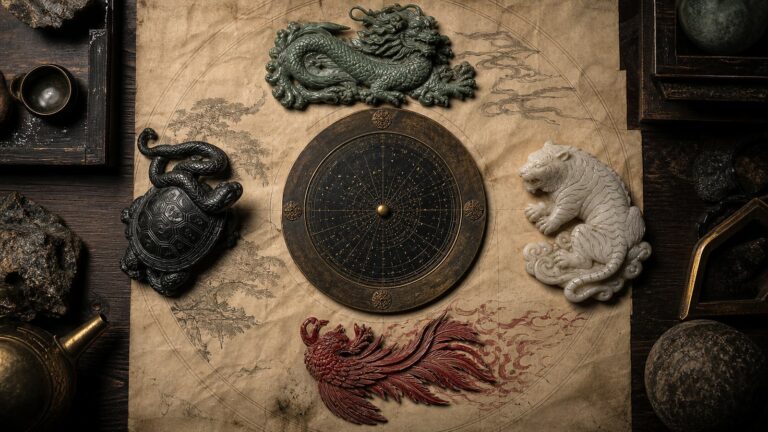
For family elders or professional gifts, landscape, four-direction animals, beast masks, fish, Lingzhi, pine, or mountain subjects can feel steady and dignified. For intimate gifts, a one-of-one carved pendant, hand piece, or jade object can express “I understand what makes you singular.” For readers looking for wearable symbolic objects rather than only studying craft, the Eastern Story Blessing collection is the natural shopping path.
Modern Wearing and Eastern Story Context
Yin Liao Shi Yi belongs naturally in modern symbolic jewelry because it turns material difference into meaning. A simple jade pendant can feel more personal when a small skin-color patch becomes a leaf or animal eye. A turquoise bead with iron lines can feel stronger when those lines become part of the visual identity instead of something to hide. A plain smooth form can be just as meaningful when the material itself is the message.

This is also why jade should not be understood only as a gemstone. In Eastern culture, jade (玉) often carries ideas of warmth, dignity, endurance, refinement, and inner virtue. The jade meaning guide explains the broader symbolic background, while this page focuses on how the artisan designs with the actual stone.
FAQ
Conclusion: The Stone Leads, the Artisan Responds
Yin Liao Shi Yi (因料施艺) is powerful because it reverses the usual order of design. The artisan does not begin by imposing a fixed shape. The artisan begins by listening to the material. Shape, skin, color, texture, flaw, weight, and polish potential all become part of the plan.
That is why this principle sits at the heart of serious Eastern jade carving. It joins craft skill, material knowledge, cultural philosophy, and emotional meaning. A successful work feels singular because it could not have been made from any other stone. Continue with Eastern Story’s jade carving motif guide, jade meaning guide, material guide, and Blessing collection when the meaning is meant to be worn, displayed, or given.
Related Posts



One Comment