
Chinese guardian lion meaning centers on protection, dignity, threshold guardianship, and auspicious strength. The guardian lion (守护狮) is not a native Chinese animal copied from nature. It is an Eastern cultural symbol shaped through Silk Road transmission, Buddhist guardian imagery, palace architecture, tomb guardians, folk entrances, lion dance culture, jade carving, and modern jewelry or gift design.
For today’s reader, a Chinese guardian lion (中国守护狮) usually answers three practical questions at once: what does the lion protect, why is it linked with authority and dignity, and how should a jade guardian lion, pendant, bracelet charm, or home object be chosen and placed? This page keeps that boundary clear. It focuses on guardian lion meaning, jade guardian lion meaning, stone lion placement, wearing symbolism, lion dance / awakening lion (醒狮), and guardian lion gifts.
Chinese Guardian Lion Meaning at a Glance
| Meaning layer | What it means | Common form |
|---|---|---|
| Protection | Guarding a threshold, home, business, body, or personal path | Stone lion (石狮), jade pendant, bracelet charm, desk object |
| Dignity and authority | Power, rank, confidence, and a formal presence that commands respect | Palace lions, official-gate lions, bronze lions, carved jade lion |
| Paired balance | Male-left female-right placement (左雄右雌), family continuity, and guarded order | Male lion with embroidered ball, female lion with cub |
| Good fortune | Auspicious blessing, prosperity wishes, and joyful celebration | Paired lions playing with a ball (双狮戏球), Tai Shi Shao Shi (太师少师), lion dance |
| Modern gifts | Care, loyalty, courage, career blessing, and protection symbolism | Jade guardian lion, waking-lion bracelet, gold lion pendant, home decor |

What Are Chinese Guardian Lions?
Chinese guardian lions are stylized lion figures used as protective and dignifying symbols in Eastern architecture, tomb art, temples, palaces, homes, shops, jade carving, jewelry, and festival culture. In English they are often called guardian lions, stone lions, foo dogs, or fu dogs. “Guardian lion” is the clearest term because the figures are lions, not dogs, and their main cultural role is guardianship.

Lions were not originally native to China. They entered the Eastern imagination through contact with Central Asia, tribute exchange, Silk Road movement, and Buddhist art. By the Han dynasty period, lion imagery had begun to appear as an exotic and powerful animal image. Over time, the lion was no longer treated only as a rare foreign beast. It became a kingly auspicious creature, a Buddhist guardian presence, and eventually a familiar protector at gates, tombs, temples, ancestral halls, shops, and homes.
This long transformation explains why a guardian lion can feel both fierce and warm. Its open mouth, curled mane, raised chest, and powerful paws create authority. Its round forehead, exaggerated eyes, bells, ribbons, and playful ball motifs make it approachable. The result is not a realistic zoo lion; it is an Eastern guardian creature with protection, status, family blessing, and celebratory energy woven together.
Protection and Dignity: The Two Core Meanings
Protection as threshold language
The first core meaning is protection. In Eastern folk tradition, the guardian lion stands at the boundary between inside and outside. A stone lion (石狮) at a gate watches the doorway, faces outward, and marks the entrance as guarded. A smaller jade guardian lion carries the same protective language into personal objects: a pendant near the chest, a bracelet charm on the wrist, a keychain, a bag charm, or a small desk object placed where the owner works and makes decisions.

Dignity as visible order
The second core meaning is dignity. A lion is the “king of beasts” in symbolic language, so it naturally points to rank, confidence, authority, and visible strength. In old palace and official settings, lions did more than decorate a gate. They announced that the place behind the threshold had order, power, and formal status. In modern jewelry and gifts, this meaning becomes more personal: a guardian lion can express courage, career confidence, loyalty to family, and the wish to stand firm with composure.
Protection and dignity work best together. A guardian lion is not simply an aggressive symbol. It protects by being composed, watchful, and visibly present. That is why the motif works for both traditional architecture and modern gifts: it offers a language of care without becoming soft, and a language of power without becoming harsh.
This is also why the motif travels so easily between objects. At a door, the lion speaks to the space. In jade jewelry, it speaks to the wearer. In a gift, it speaks to the relationship between giver and receiver: protection, respect, courage, and a wish that the recipient can stand firmly in the world.
From Han Dynasty Transmission to Palace and Folk Guardians
From rare animal to guardian creature
The guardian lion’s story begins with transmission. Lions entered China as rare animals and symbolic images through western regions and Buddhist cultural routes. In early periods, lion figures appeared in elite and sacred contexts: tomb roads, Buddhist guardian imagery, palatial spaces, and high-status art. They carried the aura of distance, power, and spiritual guardianship.

Palace, tomb, temple, and folk use
By later dynasties, lion imagery became more familiar and more public. Stone and bronze lions guarded palace gates, temples, government offices, ancestral halls, gardens, mansions, shops, and bridges. The bronze lions before major palace gates are among the most famous examples. The male lion presses one paw on an embroidered ball, a symbol of command and control over the realm; the female lion protects a cub, a symbol of family continuity and descendants.
Rank details and curled mane knots
In Qing dynasty gate culture, lion details could also reflect hierarchy. The number of curled mane knots on official stone lions was associated with rank: a first-rank official’s lion could have 13 curled knots, often called “Thirteen Taibao” in folk language, with fewer knots as rank descended. Officials below the seventh rank were not traditionally entitled to set up such formal lions. This rank system shows why the lion became a dignity symbol, not only a protection symbol.
Stone Lion Placement: Pairing, Direction, and Size
Pairing and direction
Stone lion placement is the most common practical question. Traditional placement uses a pair, with male-left female-right placement (左雄右雌) when viewed from inside the entrance looking outward. The male lion stands on the left and places one paw on an embroidered ball. The female lion stands on the right and protects a cub. Together they express guarded power, family continuity, and a balanced entrance.


Scale for homes, shops, and offices
The lion heads normally face outward. This matches the motif’s threshold function: the lions watch what approaches the entrance and mark the home, office, shop, or temple as protected. For large stone lions, size should match the building. In traditional placement language, the lion should not overpower the gate. A common modern guideline is to keep the lion below about one-third to one-fourth of the total gate height. For ordinary homes, a 50 to 80 cm pair feels more proportionate than oversized one-meter figures.
Modern home buyers often choose gentler interpretations. A small pair on a console, shelf, tea table, or office desk can carry the guardian meaning without the architectural weight of large outdoor lions. If a household prefers a softer auspicious creature, Qilin (麒麟), Pixiu (貔貅), Hulu (葫芦), or other symbols may be a better fit. For comparison, see What Is Pixiu? and Jewelry to Ward Off Evil.
Male and Female Guardian Lions: Ball, Cub, and Paired Symbols
A pair of guardian lions is read through its details. The male lion with an embroidered ball represents power, command, and the ability to hold the larger situation. The female lion with a cub represents family protection, nurturing continuity, and descendants. Together they are not simply “two matching statues.” They form a symbolic pair: authority and care, outside defense and inside continuity, public dignity and household blessing.
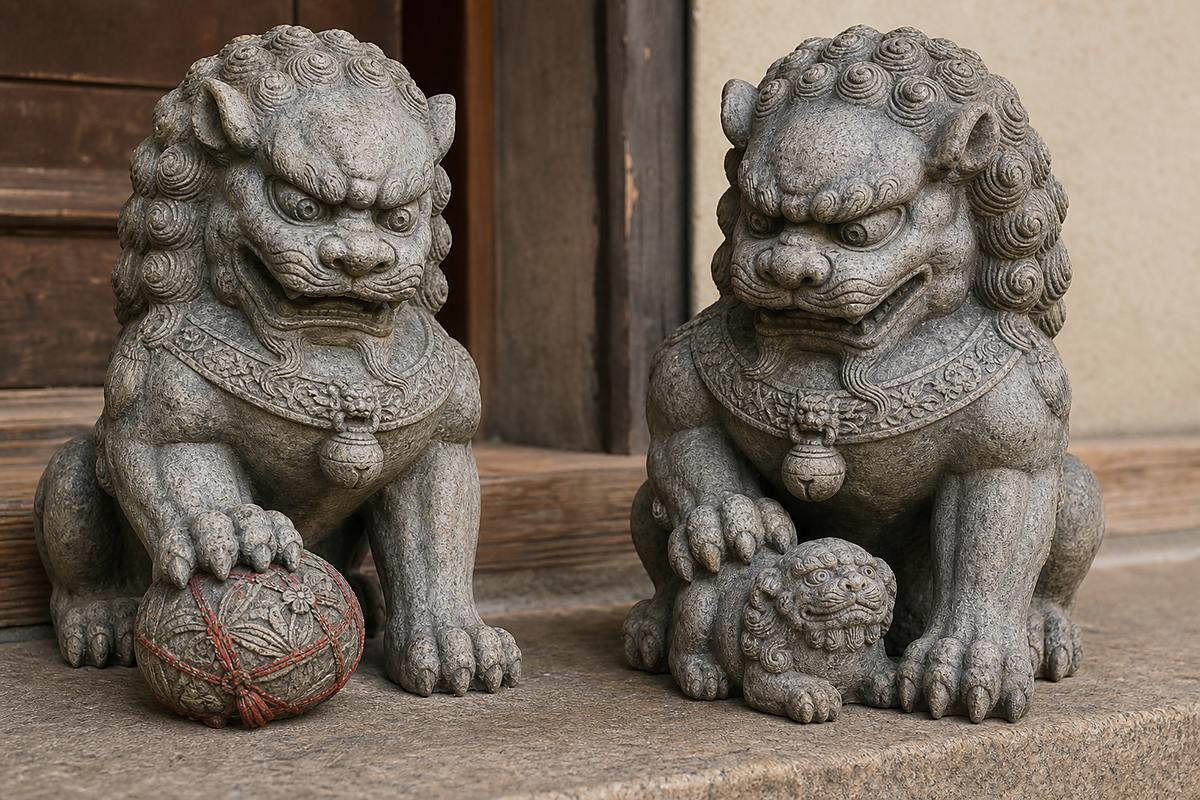
Paired lions playing with a ball (双狮戏球) add a more joyful and festive reading. The ball can suggest auspicious gathering, completeness, and the sound-based wish for good things to be “sought” or welcomed. In jewelry, embroidery, ceramics, and home objects, two playful lions can feel more celebratory than formal palace lions.
Tai Shi Shao Shi (太师少师), often shown as one large lion and one small lion, uses a sound association between lion and teacher or high official titles. It became a refined blessing for rank, learning, family continuation, and the hope that both older and younger generations rise with honor. This is a good example of how guardian lion art can combine animal strength with wordplay, official culture, and family wishes.
Lion Dance and Awakening Lion (醒狮): Courage, Celebration, and Protection
Lion dance expands guardian lion meaning from still sculpture into movement. In southern China and overseas Chinese communities, lion dance / awakening lion (醒狮) is a festive performance connected with courage, blessing, business openings, New Year celebrations, weddings, community identity, and the wish to awaken strength. The “awakening” idea is especially strong in Lingnan and Guangdong lion culture.

A popular cultural explanation says the southern awakening lion was once called Rui Shi, the auspicious lion, and later became Xing Shi, the awakening lion, because “awakening” carried the spirit of waking the national soul and stirring courage. Whether seen in a festival street, a business opening, a school performance, or a modern bracelet charm, the awakening lion is lively rather than static. It protects through energy, rhythm, and presence.
The cai qing (采青) ritual is one of the most memorable scenes. “Qing” is often represented by lettuce because the sound connects with “generating wealth.” The lion leaps, searches, climbs, or performs skilled movements to take the greens, then offers blessing to the space and people around it. Southern lion styles often use expressive heads, strong drum rhythms, and acrobatic movement; northern lion styles tend to look more rounded, furry, and playful. Both carry the guardian lion’s deeper message: vitality, courage, and auspicious arrival.
Jade Guardian Lion Meaning and Carving Details
Why jade changes the lion's mood
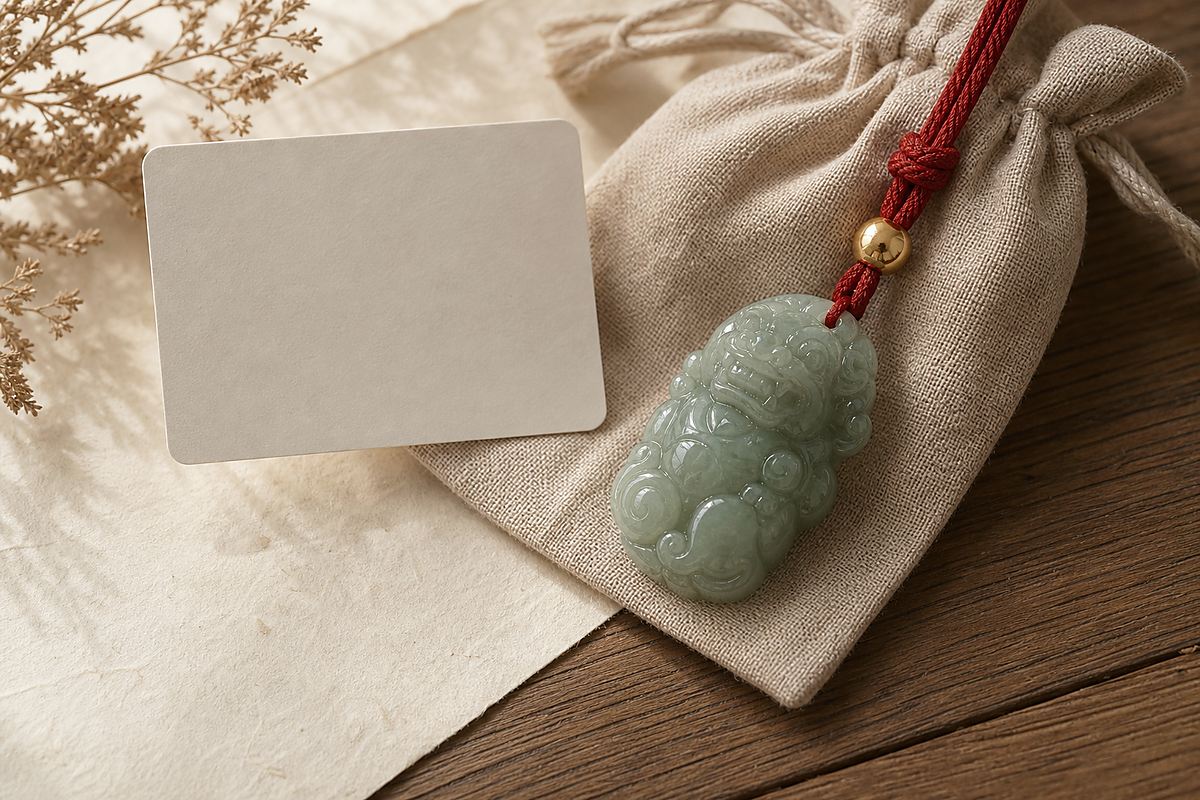
Jade guardian lion meaning brings together the lion’s strength and jade’s refined warmth. Jade has long been valued in Eastern culture for beauty, restraint, virtue, and lasting presence. A jade guardian lion (玉雕守护狮) therefore feels different from a stone gate lion. It is smaller, closer to the body, and more personal. It can be worn as a pendant, kept as a hand piece, used as a bracelet charm, or placed as a small desk object.

Hetian jade, jadeite, and color choices
Common jade materials include Hetian jade, white jade, green-white jade, spinach-green jade, sugar jade, pale pink-toned jade, and jadeite. Hetian jade often feels warm, oily, and restrained; jadeite can feel brighter and more translucent. The lion motif benefits from both. Hetian jade gives the lion a dignified, inward quality. Jadeite gives it a livelier, more decorative presence. For a broader motif map, read Chinese jade carving meanings and jade meaning in Eastern culture.
Carving quality: eyes, mane, paws, and ball
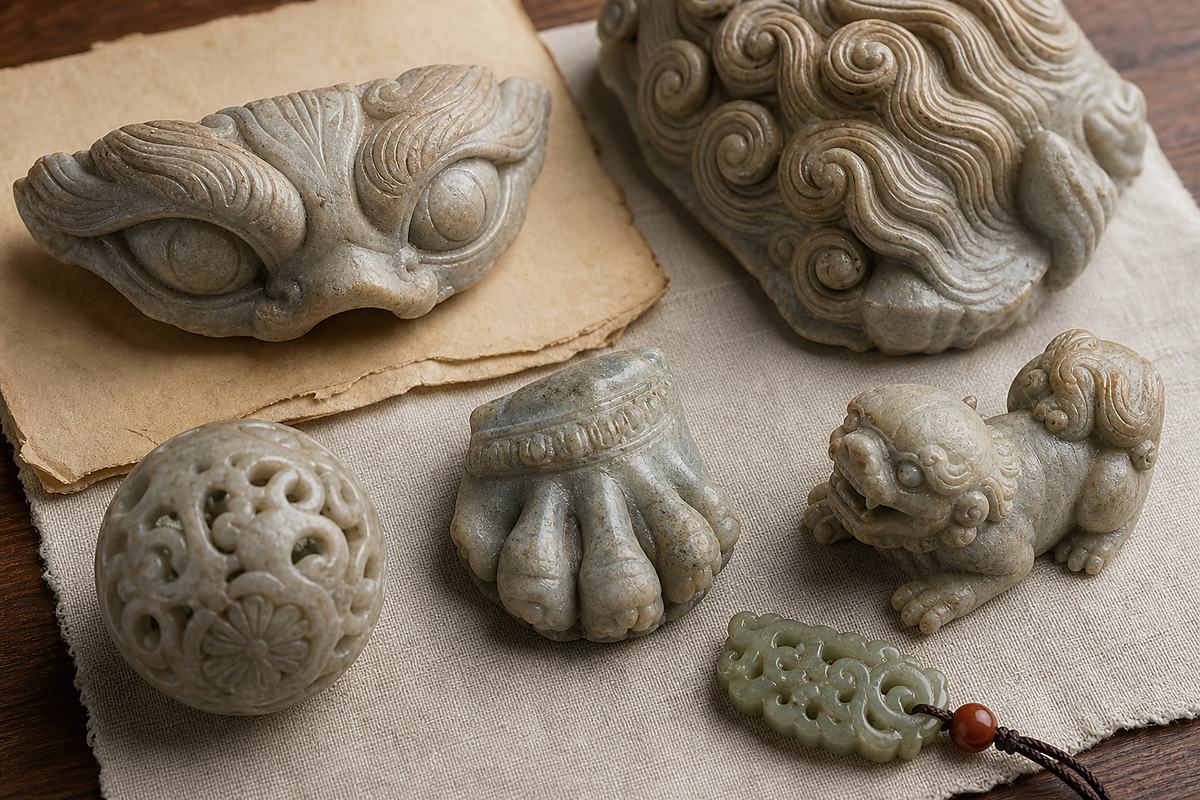
Good carving depends on spirit. Look at the eyes first: they should feel alert, not blank. The mane should have clear rhythm, whether it is deeply carved, softly rounded, or expressed through fine incised lines. The mouth, teeth, ears, paws, ball, bells, ribbons, and body posture should be readable at the object’s actual size. A small pendant needs cleaner, simpler shapes; a desk piece can hold richer detail. The best guardian lion carving feels “alive” without becoming messy.
| Object type | Best meaning | What to check |
|---|---|---|
| Hetian jade pendant | Personal protection, dignity, quiet confidence | Warm texture, balanced face, smooth edges near skin |
| Jadeite lion charm | Lively blessing, colorful style, festive protection | Clear color, readable lion head, secure setting |
| Awakening lion bracelet | Courage, daily good fortune, young Guochao style | Comfort, charm size, enamel or carving durability |
| Small jade desk lion | Career presence, guarded workspace, business blessing | Stable base, front-facing expression, suitable scale |
| Paired home lions | Threshold order, family continuity, formal protection | Correct pair, outward-facing direction, building proportion |

Wearing Meaning, Gift Meaning, and Traditional Preferences
Wearing a guardian lion
Wearing a guardian lion is usually a personal way to carry protection, dignity, courage, and auspicious confidence. It suits people who like strong symbolic jewelry, people starting a business or career stage, students needing courage, professionals who want a steady presence, and gift buyers who want to say “I hope you are guarded and respected.” A pendant near the chest feels more protective; a bracelet charm feels more casual and daily; a bag charm or keychain feels playful and modern.
Choosing one as a gift
As a gift, a jade guardian lion can express loyalty, care, and family or career blessing. For elders, choose a calmer jade carving with a rounded expression and warm material. For business owners, a more dignified lion or paired desk object can express guarded success. For young wearers, an awakening lion bracelet, enamel charm, or small white-jade lion pendant can feel fresh and wearable. For partners or close friends, a smaller guardian lion can say, “may you be safe, brave, and steady.”
Traditional preferences without fear-based rules
Traditional preferences around wearing are best treated as cultural choice language. Some folk buyers prefer to keep a personal jade guardian lion for their own use or receive it from someone close rather than passing it casually from hand to hand. Some buyers who follow zodiac compatibility language choose softer motifs if they are born in Monkey or Snake years, while others prefer guardian lion strength regardless of zodiac. Pregnant wearers, people who feel physically tired, or people who dislike strong beast imagery may simply prefer smoother, gentler symbols for comfort and mood. These preferences belong to folk buying habits, personal feeling, and symbolic style.
For care, protect the details. Lion teeth, ears, mane tips, and small balls can chip if struck. Keep jade away from hard impact, harsh cleaners, perfume, and long exposure to very dry heat. Store a pendant in a soft pouch or jewelry box when not wearing it. For general symbolic jewelry care, the Eastern Story care guide is a practical companion.
Modern Guardian Lion Jewelry, Products, and Gift Styles
Guochao style, gold, enamel, and everyday charms
Modern guardian lion design now moves across jade carving, gold jewelry, enamel charms, hand strings, bag charms, resin figures, ceramic lions, metal desk objects, and cultural IP. Guochao-style waking lion accessories are especially popular because they make the old guardian symbol lively, colorful, and easier to wear every day.


Gold guardian lion pendants often use 999 gold, hard-gold craft, enamel color, or ancient-gold finishes. Some designs take inspiration from bronze lions at palace gates; others use waking lion heads in red, green, gold, purple, black, or brown colorways to express auspicious wishes such as joy, health, wealth, peace, and long life. High-jewelry lion motifs, including Western lion emblems, usually emphasize courage, sovereignty, zodiac identity, and personal power. Eastern guardian lion jewelry adds threshold protection, family blessing, and folk celebration to that broader lion language.
Natural product paths for protection and courage gifts
For Eastern Story readers, the closest product path is symbolic blessing jewelry rather than literal stone-gate replicas. Browse the Blessing collection for meaningful bracelets and gifts, especially pieces chosen for protection, strength, good fortune, calm, or intention. Relevant companions include the Strength symbolic gemstone bracelet, the Red Thread of Intention bracelet with jade beads, and the Harmonized Fortune jade and red stone bracelet. They are not guardian lion pieces, but they share the article’s protection, courage, and blessing gift language.
How to Read a Guardian Lion Motif
Read posture, companions, and setting
Read a guardian lion by asking what it is doing, what it touches, and where it is meant to live. A standing or seated lion at a doorway emphasizes threshold protection. A lion with a ball emphasizes command, joyful gathering, and auspicious control. A lion with a cub emphasizes family continuity. A large-and-small lion pair points toward Tai Shi Shao Shi (太师少师), rank, learning, and generational honor. A dancing lion head points toward waking courage, celebration, and community blessing.

Read material and scale
Material changes the message. Stone and bronze are architectural and formal. Jade is personal and refined. Gold is celebratory and gift-ready. Enamel is youthful and festive. Resin, ceramic, and wood can soften the symbol for a desk, shelf, tea space, or entryway. The same lion can therefore move from palace dignity to folk protection to modern emotional support, depending on scale and material.
Compare nearby auspicious creatures by meaning
It also helps to compare nearby auspicious creatures by their main symbolic work. Guardian lions are separate from Pixiu, Qilin, dragon, phoenix, Xiezhi, Taotie, and the Four Symbols. They share the broader world of auspicious beasts and protective symbols, while the guardian lion's own identity is threshold guardianship, paired dignity, lion dance vitality, and jade or jewelry protection symbolism. For adjacent symbols, see Pixiu bracelet meaning, Chinese phoenix meaning, and Dragon and Phoenix meaning.
Choose by purpose, not by ornament alone
- For home entrance meaning: choose a balanced pair, keep the heads facing outward, and match the size to the building or furniture scale.
- For personal wearing: choose a pendant or bracelet charm with smooth edges, clear expression, secure setting, and a size that feels comfortable.
- For jade value and beauty: check texture, color evenness, carving detail, proportion, and whether the lion’s eyes and mane feel alive.
- For a business or career gift: choose a dignified lion, a lion with ball, or a small desk guardian that expresses confidence and guarded progress.
- For young daily style: choose awakening lion (醒狮) bracelets, enamel charms, bag charms, or smaller white-jade and pale-jade pendants.
- For elder or family gifts: choose a calmer rounded lion, paired lions, or a lion with softer auspicious companions rather than an overly fierce form.
Frequently Asked Questions

Chinese guardian lion meaning is powerful because it can stand still at a palace gate, leap through a lion dance, sit warmly in jade, or travel as a small daily charm. Across these forms, the lion keeps the same heart: protection with dignity, courage with celebration, and blessing with visible strength.
If you are choosing a guardian lion because you like its protective meaning, start with the form that fits the setting: a balanced pair for a doorway, a jade lion for personal wearing, an awakening lion charm for daily courage, or a symbolic bracelet from the Eastern Story Blessing collection when you want a softer protection-and-intention gift. For deeper context, compare the lion with Chinese jade carving meanings, Pixiu meaning, and broader protective jewelry symbols.
Related Posts


5 Comments