Chinese phoenix meaning centers on the Eastern phoenix Fenghuang (凤凰): an auspicious bird of virtue, harmony, noble beauty, renewal, and peaceful order. In Eastern culture, Fenghuang is more than a decorative bird. It gathers mythology, court symbolism, ethics, marriage language, jade carving, jewelry design, and folk blessing into one refined image.
English often translates Fenghuang as “Chinese phoenix,” but the translation needs care. The Western phoenix is famous for fire, death, and rebirth. Fenghuang carries a wider Eastern symbolic world: the four sacred creatures (四灵), the five virtues (五德), Dragon and Phoenix Bringing Auspiciousness (龙凤呈祥), Phoenix Comes with Ritual Music (凤凰来仪), Danfeng Chaoyang (丹凤朝阳), Phoenix Perches on the Wutong Tree (凤凰栖梧), Feng Qiu Huang (凤求凰), Phoenix Flying Together (凤凰于飞), and Birds Paying Homage to the Phoenix (百鸟朝凤).
Chinese Phoenix Meaning at a Glance
| Theme | Meaning of Fenghuang (凤凰) | Where it appears |
|---|---|---|
| Auspicious peace | A sign of good order, blessing, and a flourishing age | Classical sayings, court art, festival and home motifs |
| Noble dignity | Grace, rank, refinement, and queenly presence after the Qin-Han period (秦汉时期) | Fengguan Xiapei wedding attire (凤冠霞帔), robes, palace objects |
| Five virtues | Virtue, righteousness, propriety, benevolence, and trust in the five virtues (五德) | Confucian moral symbolism, carved motifs, gift language |
| Harmony and love | Balanced pairing, faithful affection, and family harmony | Feng Qiu Huang (凤求凰), Phoenix Flying Together (凤凰于飞), wedding patterns |
| Renewal | Rising through hardship, new life, and resilient hope | Modern phoenix nirvana (凤凰涅槃) language, personal gifts |
| Jade and jewelry | Refined blessing, feminine strength, and elegant cultural memory | Jade phoenix (玉凤), pendants, bracelets, carved plaques, high jewelry |
What Is Fenghuang (凤凰)?
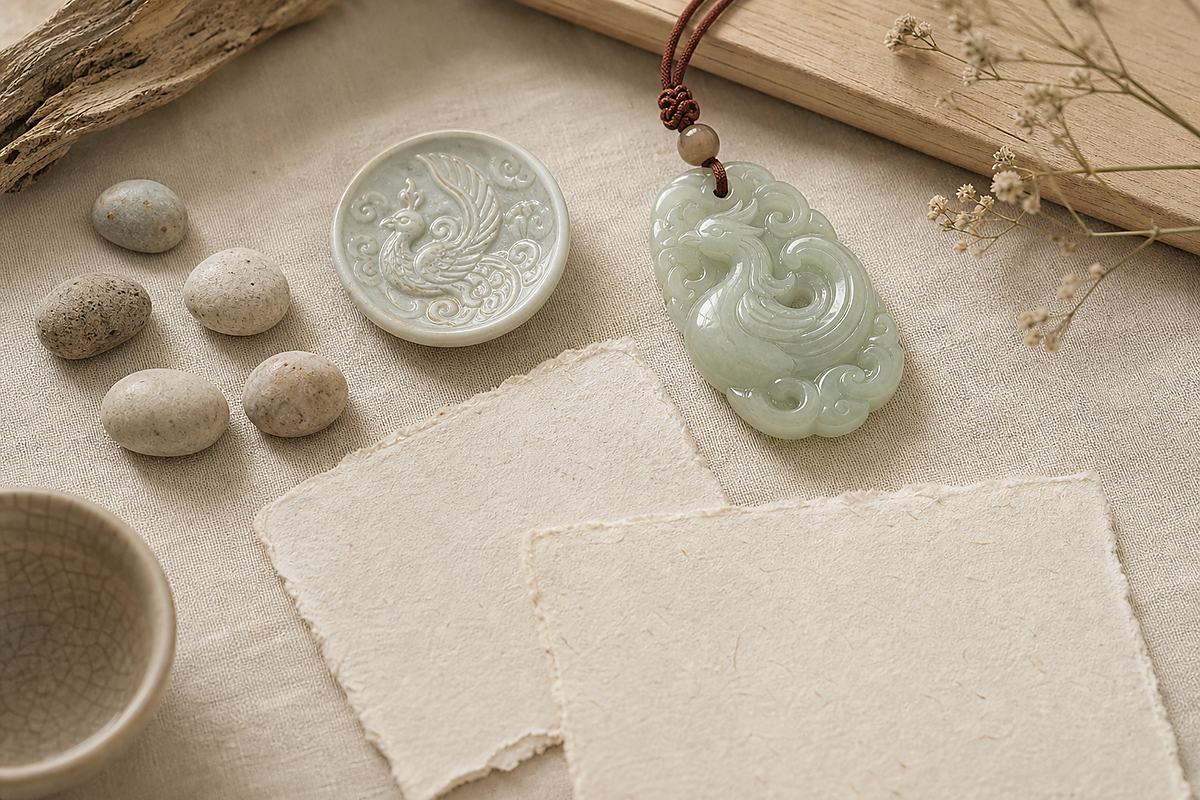
Fenghuang (凤凰) is the auspicious bird of Eastern mythology, often called the Chinese phoenix in English. In early language, Fenghuang could describe one sacred bird. Later tradition separated the name into male Feng (凤) and female Huang (凰), then brought them together again as Fenghuang, a single majestic symbol of auspicious beauty and moral order.

Ancient descriptions make the bird composite and marvelous. The Classic of Mountains and Seas (山海经) describes it as bird-like, brightly patterned, and richly colored. Later descriptions gather features such as a rooster-like head, swallow-like jaw, serpent-like neck, tortoise-like back, fish-like tail, and many-colored feathers. One common image gives it a height of about six chi, or roughly six traditional feet, making it a large, commanding sacred bird rather than a small decorative creature.
Fenghuang is also known for pure habits. The saying that it rests only on the wutong tree (梧桐), eats only refined bamboo seed or precious fruit, and drinks only sweet spring water (醴泉) turns the bird into an image of selectiveness, dignity, and moral cleanliness. Its call is often imagined as clear and resonant. When it appears, the world is ordered, peaceful, and bright.
Origin and Historical Evolution of the Eastern Phoenix
The Fenghuang image did not stay fixed. It grew across thousands of years, moving from ancient bird worship and regional totems into court symbolism, ethical philosophy, wedding language, textiles, porcelain, jade carving, jewelry, and modern design.
From 7400-Year-Old Bird Motifs to Classical Fenghuang
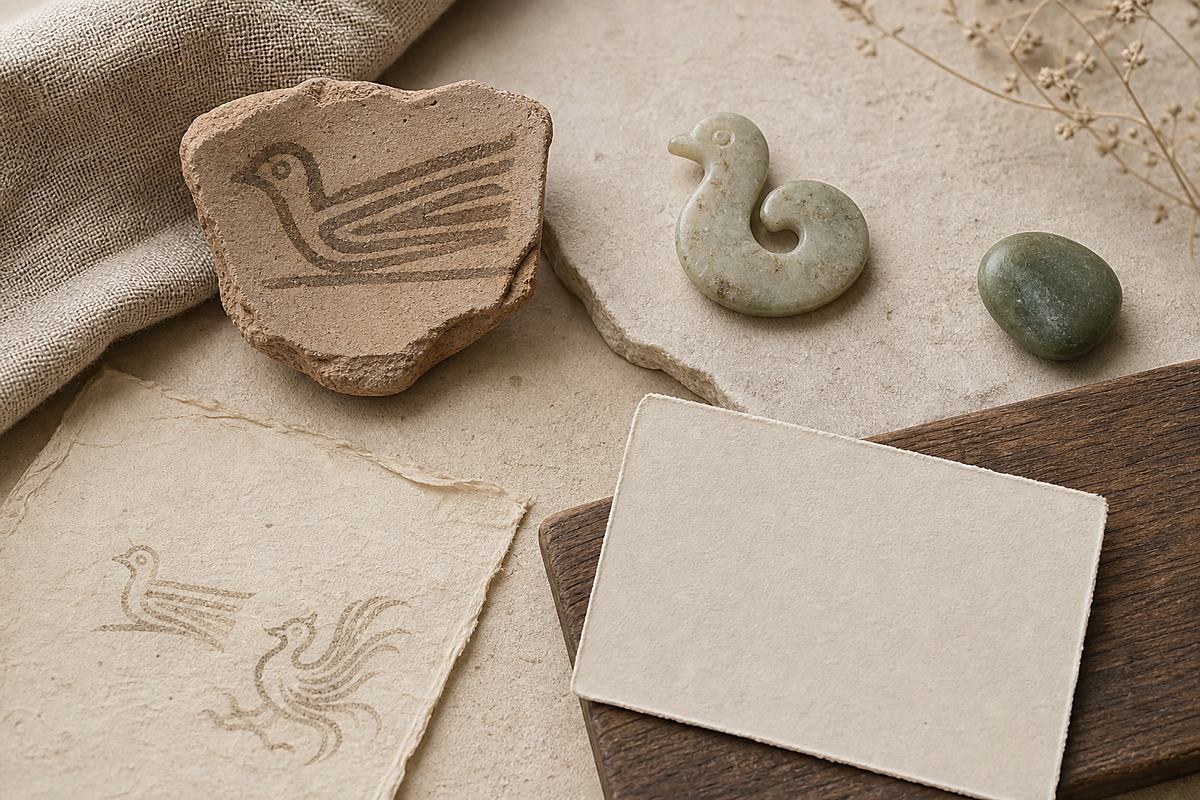
One of the deep roots often connected with phoenix imagery is the bird pattern from the Gaomiao site in Hunan, dated to about 7400 years ago. In this early layer, bird forms were tied to protection, harvest wishes, wind, fertility, and clan identity. Over time, bird worship, wind-spirit language, and clan totem imagination flowed into the later image of Fenghuang.
In southern Chu culture, the bird could appear wild, energetic, and wind-like. In central court culture, it became more orderly and ceremonial. This double background explains why Fenghuang can feel both alive and dignified: it carries ancient movement, but it is later shaped by ritual, rank, and cultivated beauty.
Qin-Han Order, Imperial Rank, and the Queenly Phoenix
During the Qin-Han period (秦汉时期), dragon (龙) and phoenix became more closely tied to centralized order. The dragon moved toward imperial masculinity and rulership; the phoenix increasingly carried queenly dignity, feminine nobility, and palace refinement. This is the background behind Fengguan Xiapei wedding attire (凤冠霞帔), phoenix robes, phoenix crowns, and palace patterns.
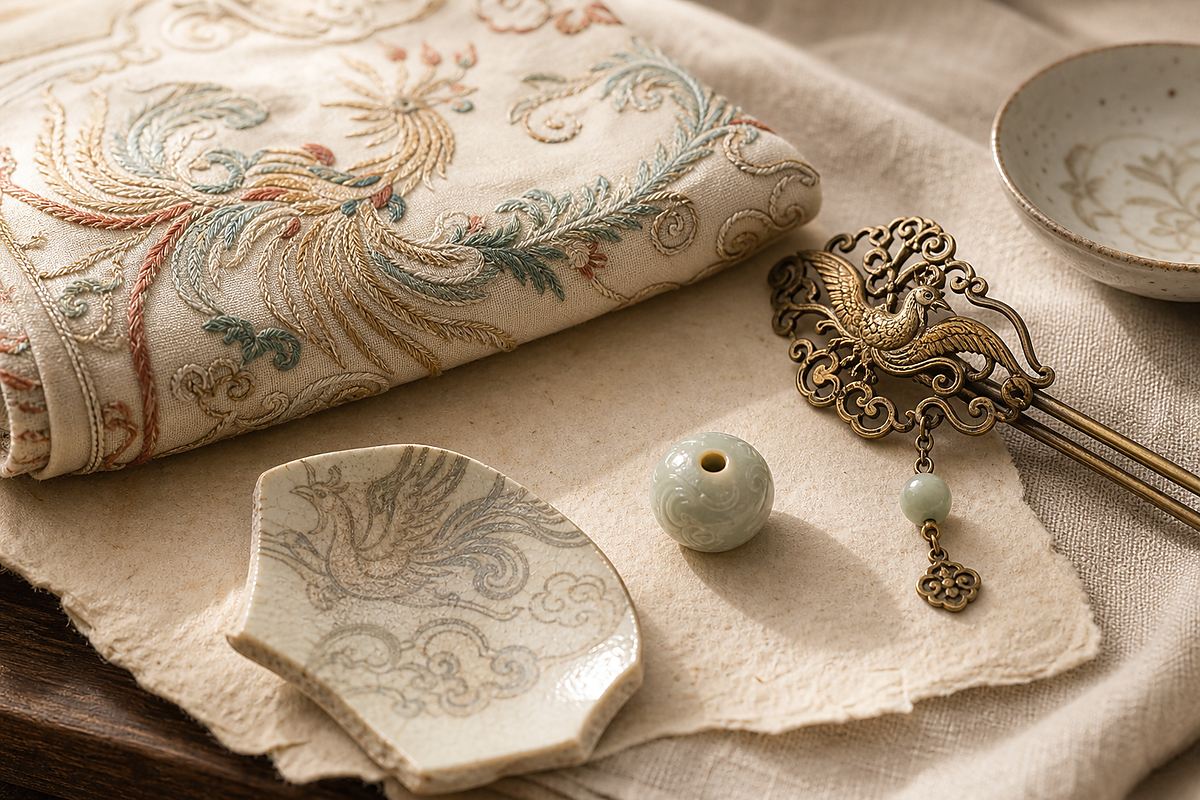
The phrase Dragon and Phoenix Bringing Auspiciousness (龙凤呈祥) expresses the pair as a complete auspicious order: dragon and phoenix together, yang and yin in balance, authority and grace, shared blessing and ceremonial harmony. For a focused explanation of the dragon side, read our guide to Eastern dragon meaning.
From Wei-Jin and Tang Elegance to Ming-Qing Ornament
After the Wei-Jin and Northern-Southern dynasties, Fenghuang increasingly absorbed the language of the five virtues (五德): virtue, righteousness, propriety, benevolence, and trust. In the Sui-Tang period, the image often became open, full, and flourishing, matching an age that loved richness of form. In the Song-Yuan period, phoenix designs became more delicate and restrained, especially in ceramics and flower-bird patterns.
By the Ming-Qing period (明清时期), the phoenix pattern had matured into a highly recognizable court and decorative symbol. It could be formal, symmetrical, ornate, and strongly associated with rank, ceremony, wedding blessing, and feminine dignity. Modern phoenix motifs inherit all of these layers, which is why the same bird can feel mythic, ethical, royal, romantic, and decorative at once.
Core Symbolic Meanings of Fenghuang
Auspicious Peace and a Flourishing Age
Fenghuang is one of the four sacred creatures (四灵), alongside the dragon, qilin, and tortoise in common symbolic groupings. Its appearance is read as a sign of auspicious order. The classical phrase Phoenix Comes with Ritual Music (凤凰来仪), associated with the idea of virtuous rule and ritual harmony, places the bird in a world where music, ethics, and government are aligned.

Folk sayings extend this meaning into images of light and arrival. Danfeng Chaoyang (丹凤朝阳), the red phoenix facing the morning sun, points toward brightness and rising fortune. Phoenix Perches on the Wutong Tree (凤凰栖梧) suggests noble recognition, a worthy place, and the meeting of high character with the right environment.
Imperial Dignity, Nobility, and Feminine Grace
Fenghuang became a language of dignity and rank. When paired with dragon symbolism, the dragon often represented the emperor while the phoenix represented the empress or queenly feminine presence. This history gives phoenix motifs a refined, elevated feeling in jewelry, textile, and ceremonial design.
In modern gift language, this noble quality is usually softened into elegance, confidence, inner strength, and graceful presence. A phoenix pendant or jade plaque can honor a woman, a bride, a mother, a graduate, or anyone entering a more dignified season of life.
The Five Virtues and High Character
The five virtues (五德) give Fenghuang a moral structure. Its many-colored body is often interpreted through virtue, righteousness, propriety, benevolence, and trust. This turns the bird from a beautiful creature into a model of cultivated character.
That is why Fenghuang can symbolize kindness, wisdom, loyalty, justice, courage, purity, and harmonious conduct. In Eastern symbolism, beauty becomes most powerful when it carries virtue. A phoenix motif therefore says more than “beautiful bird”; it says beauty joined with dignity and moral refinement.
Love, Marriage, and Yin-Yang Harmony
Fenghuang also belongs to love and marriage language. Feng Qiu Huang (凤求凰) evokes courtship and longing. Phoenix Flying Together (凤凰于飞) expresses a pair moving in harmony. In wedding contexts, phoenix imagery often appears with the dragon, peony, double happiness, cloud, or floral patterns to express union, prosperity, and shared blessing.
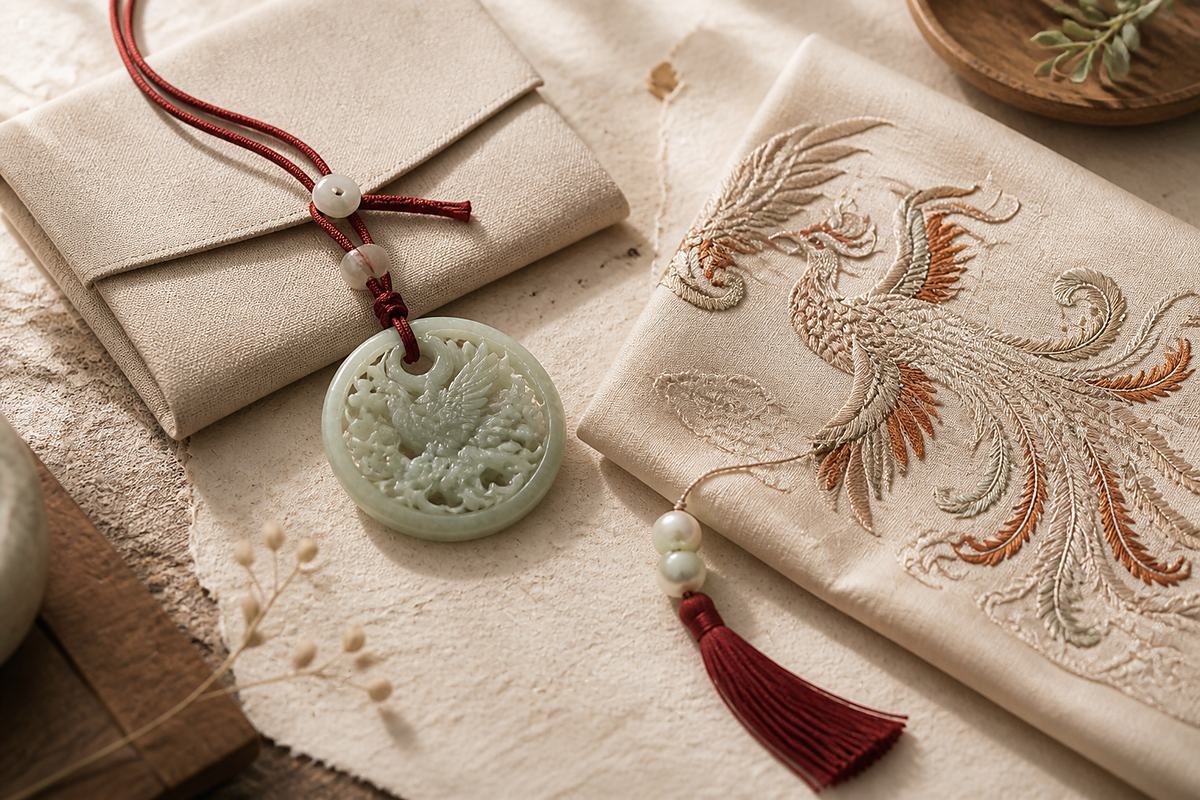
The key is pairing. A single phoenix can express personal grace and auspicious arrival. A dragon-and-phoenix composition shifts the meaning toward yin-yang harmony, bride-and-groom blessing, family continuity, and ceremonial joy.
Renewal, Resilience, and Phoenix Nirvana
Modern readers often connect phoenix with rebirth. In Eastern writing, phoenix nirvana (凤凰涅槃) became a powerful modern phrase for rising after hardship, especially through the influence of modern literary retellings that blended Eastern Fenghuang with Western phoenix rebirth imagery. It is now a natural way to speak about resilience, hope, and new life.
This renewal meaning works well for gifts after graduation, recovery from a difficult period, a career change, a new home, or a new stage of identity. It should be read as symbolic encouragement and emotional language: a graceful way to mark change, strength, and return to brightness.
Fenghuang vs Western Phoenix
Fenghuang and the Western phoenix share the English word “phoenix,” but they come from different symbolic systems. Fenghuang is the bird of auspicious virtue, Eastern order, court art, jade carving, textiles, and wedding language. The Western phoenix comes through Greek, Assyrian, Egyptian, Roman, Christian, and Renaissance traditions of solar fire, resurrection, and singularity.
| Comparison | Fenghuang (凤凰) | Western phoenix |
|---|---|---|
| Visual form | King of birds, richly colored, often imagined with rooster, swallow, serpent, tortoise, fish, and peacock-like features; about six chi in classical-style descriptions | Large eagle-like or heron-like firebird, often gold and red |
| Origin frame | Bird worship, wind-spirit language, clan totems, court ritual, ethics, and auspicious art | Blended from Assyrian rebirth birds and Egyptian solar-bird traditions, then reshaped by Greek and Roman writing |
| Main meaning | Virtue, peace, dignity, auspicious order, harmony, love, beauty, and refined blessing | Immortality, resurrection, fire, solar renewal, and unique individual brilliance |
| Time cycle | Not centered on a fixed burning cycle | Often linked with a 300-500 year or 500 year life cycle in later traditions |
| Modern overlap | Can include phoenix nirvana (凤凰涅槃) as renewal and resilience language | Strongly tied to rising from ashes and self-reinvention |
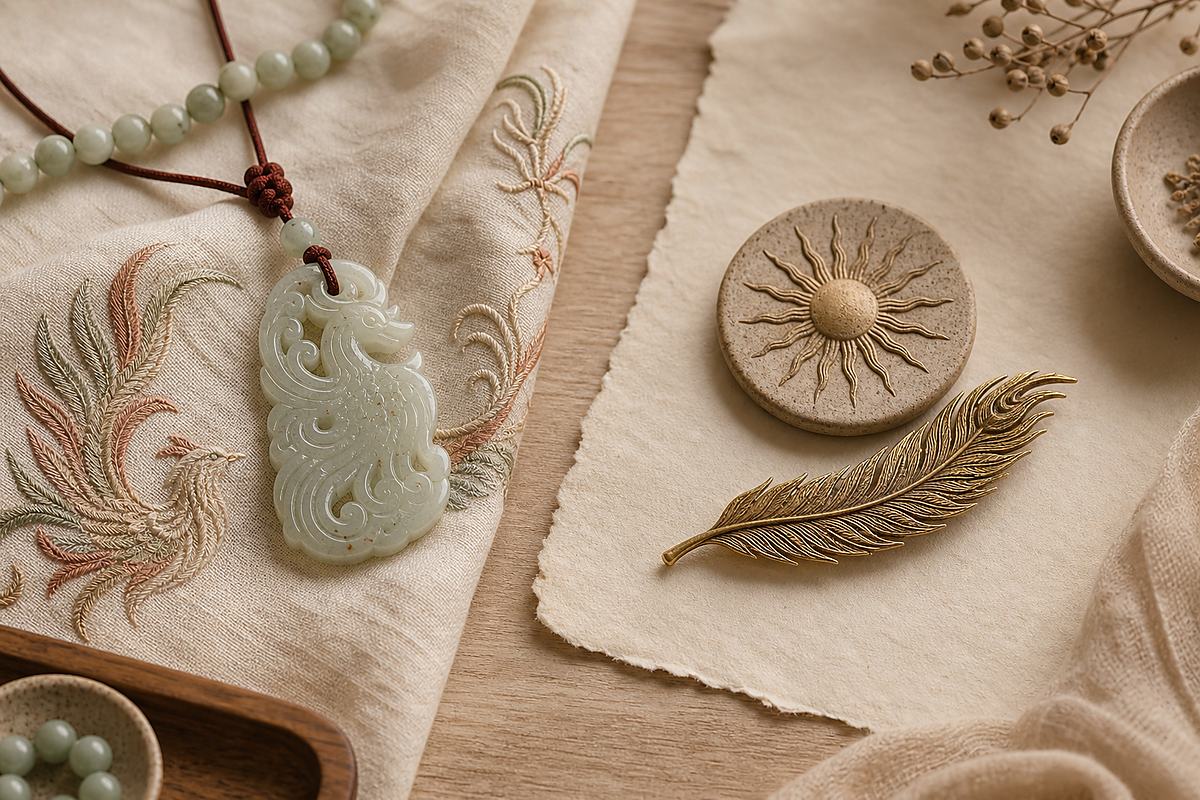
For Eastern Story readers, the safest approach is to use both names: Chinese phoenix for search clarity, and Fenghuang (凤凰) for cultural accuracy. The two-word explanation keeps the page easy to find while preserving the symbol’s real Eastern shape.
Phoenix in Jade Carving and Jewelry
Jade gives Fenghuang a calm and enduring material voice. In Eastern jade culture, jade is associated with refinement, warmth, virtue, dignity, and lasting beauty. When the phoenix appears in jade, the bird’s auspicious order joins jade’s moral texture. This is why a jade phoenix (玉凤) often feels quieter and more refined than a bright festival phoenix in textile or paper design.

Phoenix jade carving has deep roots. Early jade phoenix forms are known from ancient tomb discoveries such as Fu Hao-related Shang-period material, where the bird was already becoming an object of status, ritual, and technical skill. Later jade pendants, plaques, hair ornaments, and small carvings carried phoenix meaning into personal adornment and gifting.
In modern jewelry, Fenghuang can appear in jadeite, Hetian jade, gold, silver, enamel, gemstone inlay, and high-jewelry compositions. The meaning changes with material. Hetian jade makes the bird feel warm, restrained, and classical. Jadeite can emphasize brightness and elegance. Gold or enamel can make the bird more ceremonial. Crystal, red cord, or mixed-material pieces move the symbol closer to everyday blessing jewelry.
For the wider motif system around jade, see our guide to Chinese jade carving meanings. For the material background of jade itself, read jade meaning in Eastern culture.
- Single phoenix: noble beauty, renewal, virtue, and auspicious arrival.
- Double phoenix: paired harmony, affection, and graceful companionship.
- Phoenix with peony: wealth, beauty, celebration, and fullness of life.
- Phoenix with dragon: yin-yang balance, wedding blessing, shared auspiciousness, and ceremonial dignity.
- Phoenix with wutong tree: a worthy person meeting a worthy place; high character finding recognition.
Dragon and Phoenix: How the Meaning Changes
Dragon and phoenix began as distinct totemic and mythic images. Over time, their pairing became one of the most recognizable auspicious combinations in Eastern culture. Dragon (龙) carries strength, authority, cosmic power, rain, and imperial identity. Fenghuang (凤凰) carries elegance, virtue, harmony, and auspicious peace. Together they create Dragon and Phoenix Bringing Auspiciousness (龙凤呈祥).
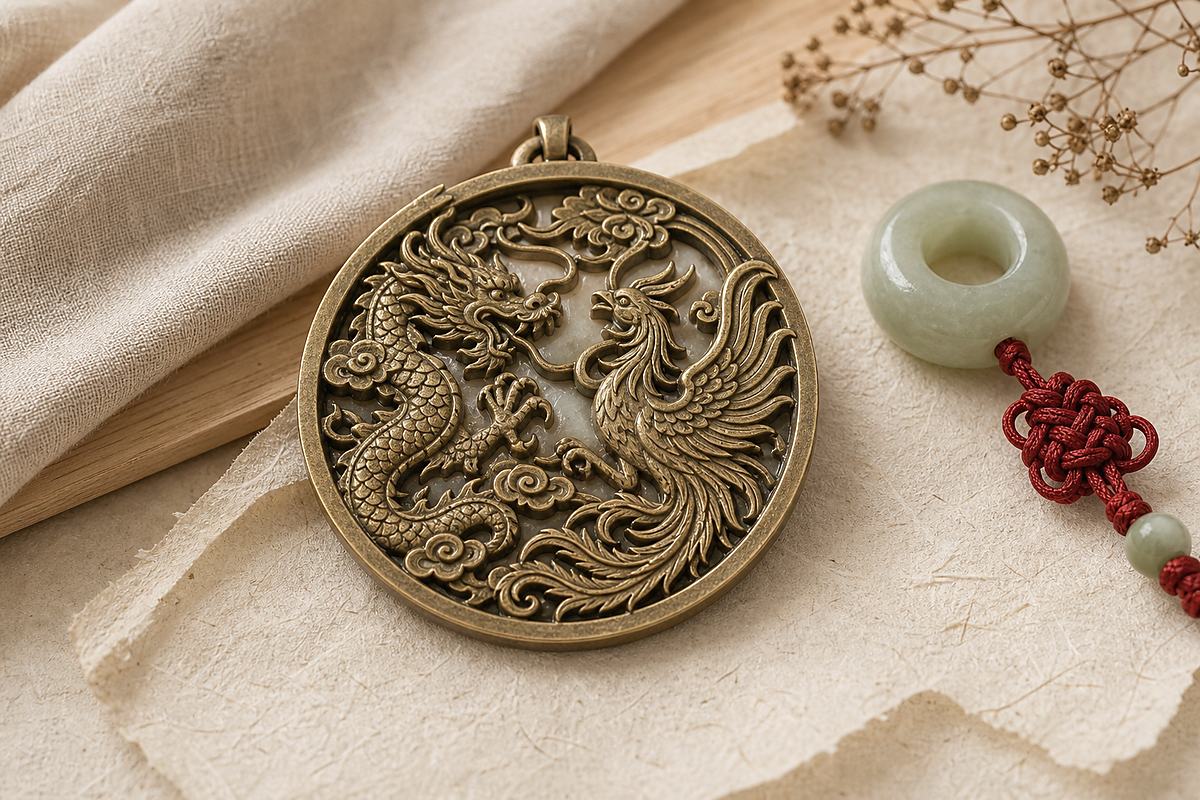
In early layers, dragon and phoenix could stand side by side as powerful sacred creatures. In the Qin-Han period, the pairing became tied to social and political order: dragon became strongly associated with the emperor, and phoenix with the empress or queenly feminine dignity. In modern settings, the pair is widely used for weddings, anniversaries, household blessing, and ceremonial gifts.
This page explains the phoenix itself. When a design shows both dragon and phoenix, read it as a paired symbol: union, balance, shared fortune, and harmonious order. That pairing deserves its own focused reading because the meaning is no longer only Fenghuang; it becomes a relationship between two sacred images.
Phoenix Gift Meaning and Wearing Meaning
A phoenix gift works best when the message is specific. It can express grace in a new season, noble confidence, family harmony, faithful affection, resilience after difficulty, or a wish for peaceful success. For a bride, Fenghuang can carry wedding elegance and queenly dignity. For a graduate or someone starting again, phoenix nirvana (凤凰涅槃) gives the gift a renewal meaning. For a mother, mentor, or respected woman, the bird can express wisdom, dignity, and quiet strength.

Wearing phoenix jewelry is also a personal symbolic practice. Many wearers treat it as a reminder of elegance, courage, virtue, and harmonious presence. Students may connect it with rising after effort and becoming known through talent. Professionals may use the image as a quiet sign of poise and ambition. Women often choose phoenix motifs for the blend of softness and strength; men can also wear Fenghuang when the design, material, and cultural message fit their style.
Eastern folk practice also gives phoenix ornaments blessing associations: good fortune, peace, noble support, flourishing work, sweet marriage, wisdom, long life, and protection. In modern Eastern Story language, these are best understood as symbolic wishes and gift meanings. Readers who like blessing jewelry can explore the Blessing collection or compare broader good luck bracelet meanings.
Phoenix Motif Evolution: How to Read the Pattern
Phoenix patterns changed as Eastern art changed. In the pre-Qin period, the form could be close to a bird shape and carried the will of the sacred. From the Shang to Western Zhou periods, rulers used bird and phoenix-like patterns in ritual and decorative objects, gradually moving from religious force toward ornament and rank.
During the Spring-Autumn and Warring States periods, phoenix decoration became more flowing and integrated with vessel shapes, cloud patterns, and plant designs. In the Qin-Han period, phoenix imagery expanded widely and became more varied. From the Wei-Jin period through Sui-Tang, Buddhist influence, metaphysical thought, and flourishing court taste shaped phoenix motifs into richer, more open forms.
In the Song-Yuan period, phoenix designs often became finer, more lyrical, and common in porcelain and flower patterns. By the Ming-Qing period (明清时期), the phoenix became mature, ornate, and courtly, with strong decorative rhythm and clear palace associations. Modern fashion, logos, jewelry, embroidery, and visual design still borrow from these older forms while simplifying the bird for contemporary taste.
| Motif | Chinese term | Meaning |
|---|---|---|
| Red phoenix facing the sun | Danfeng Chaoyang (丹凤朝阳) | Brightness, recognition, and a rising future |
| Phoenix on wutong | Phoenix Perches on the Wutong Tree (凤凰栖梧) | Noble character finding a worthy place |
| Phoenix seeking mate | Feng Qiu Huang (凤求凰) | Courtship, longing, and refined love |
| Paired phoenixes flying | Phoenix Flying Together (凤凰于飞) | Marriage harmony and shared movement |
| Birds honoring the phoenix | Birds Paying Homage to the Phoenix (百鸟朝凤) | Prestige, leadership, and honored arrival |
| Dragon and phoenix together | Dragon and Phoenix Bringing Auspiciousness (龙凤呈祥) | Wedding blessing, yin-yang balance, shared auspiciousness |
How to Choose a Phoenix Pendant, Bracelet, or Gift
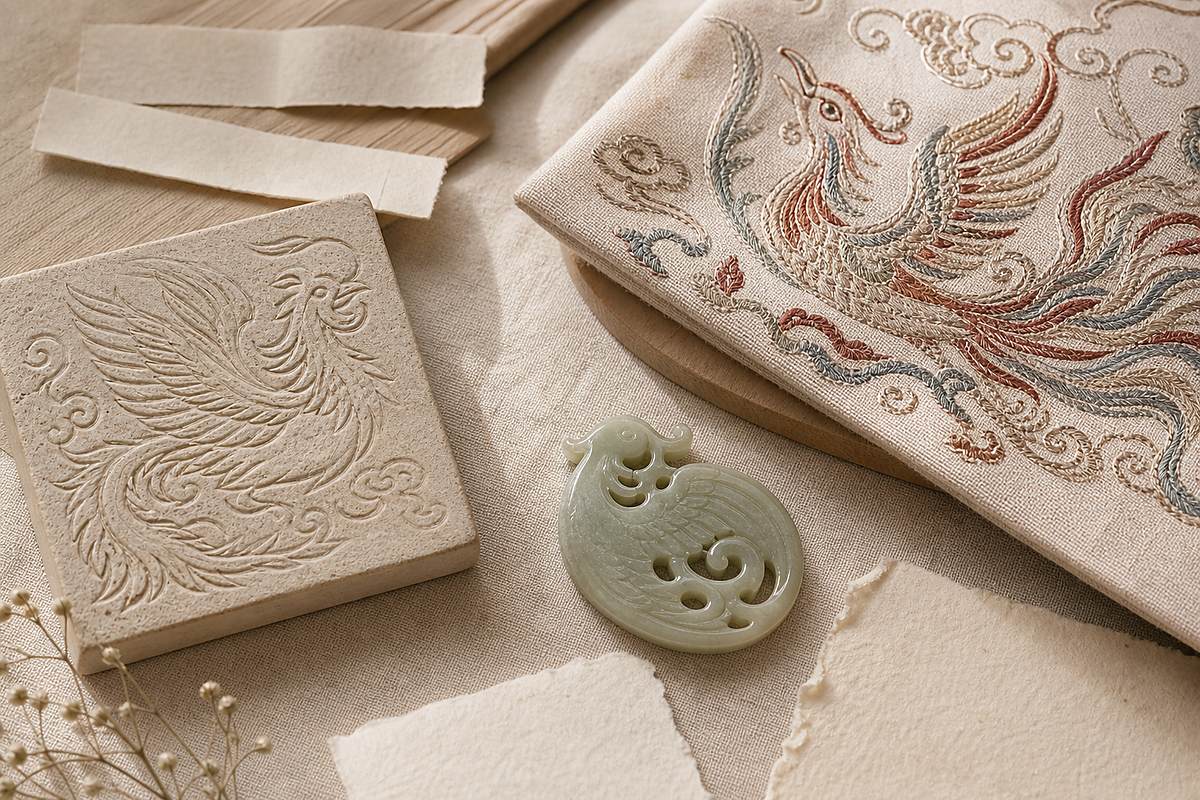
Start with the message. If the gift is for a wedding or anniversary, a dragon-and-phoenix motif or paired phoenix image is the clearest choice. If the gift is for personal growth, graduation, or a new beginning, a single phoenix in upward flight works beautifully. If the gift is for a person who values calm cultural depth, a jade phoenix pendant or subtle carved bracelet feels more refined than a large bright ornament.
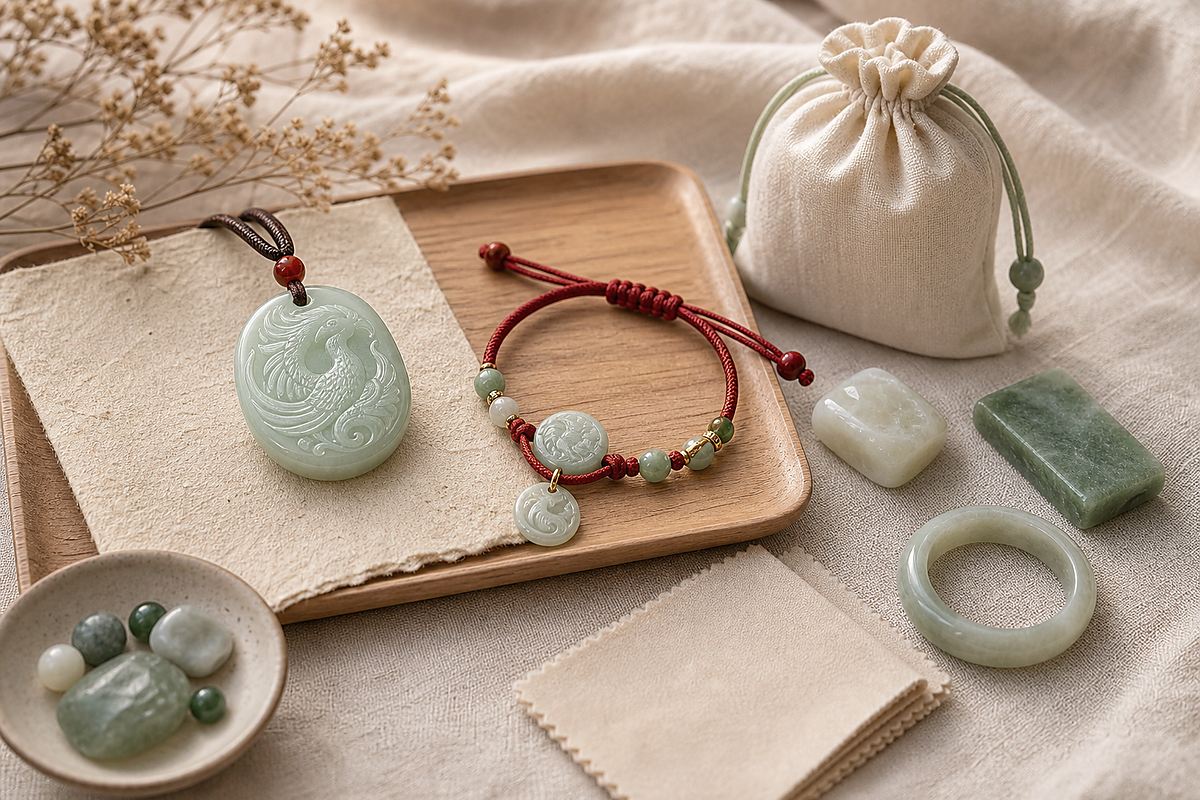
Then read the material. Hetian jade brings warmth, restraint, and classical dignity. Jadeite brings color, polish, and brightness. Gold and enamel feel ceremonial. Silver feels lighter and easier for daily wear. Red cord adds folk blessing language. Pearl and crystal soften the phoenix into elegance and emotional meaning. For daily jewelry care across jade, gemstone, cord, and metal pieces, use the Eastern Story care guide.
Finally, read the carving. A clear head, balanced wings, clean tail rhythm, and comfortable size matter more than overloaded detail. A phoenix with a flower feels different from a phoenix with a dragon. A flying phoenix feels different from a resting phoenix. The best piece is the one where form, material, and message point in the same direction.
Phoenix in Textiles, Porcelain, and Modern Design
Fenghuang is not limited to jewelry. In southern Eastern traditions, phoenix reverence appears in Miao, She, Dong, and other regional craft worlds, where bird imagery can carry ancestral memory, fertility wishes, protection, and festive beauty. In woven brocade, embroidery, silver ornament, and ceremonial clothing, the phoenix becomes a living pattern rather than a museum symbol.
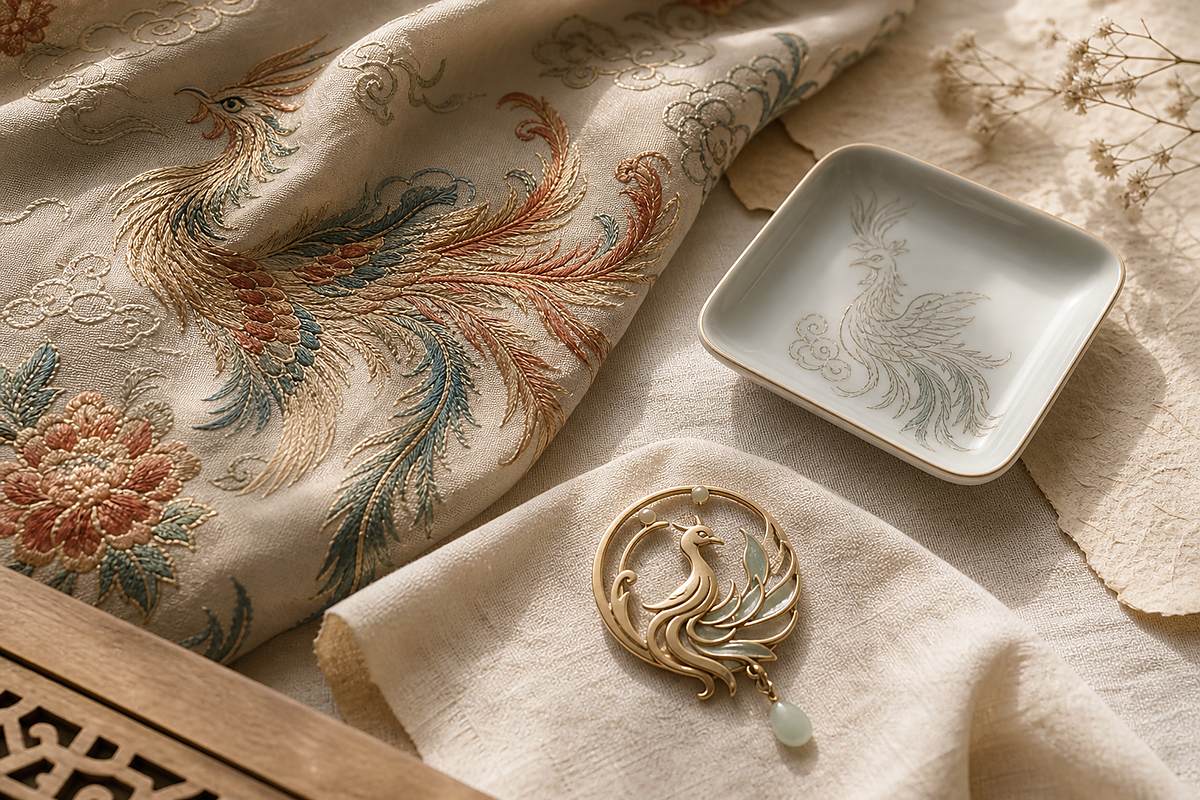
Porcelain also helped preserve phoenix language. A phoenix with peony can express beauty, wealth, and fullness. A paired phoenix can suggest harmony. A phoenix among clouds can feel more celestial and ceremonial. These patterns were not random decoration; they organized good wishes into visible order, so the object could carry blessing through daily life, celebration, or display.
Modern design continues this habit. A brand mark, pendant, brooch, embroidered jacket, wedding invitation, or jewelry collection may use Fenghuang for dignity, feminine power, triumph, and renewal. The strongest modern use keeps the bird graceful and specific: clear feather rhythm, balanced movement, and a design language that respects the phoenix as an Eastern cultural symbol rather than turning it into a generic fantasy firebird.
Frequently Asked Questions

Chinese phoenix meaning is richest when Fenghuang (凤凰) is read in its own Eastern context: an auspicious bird of virtue, noble beauty, harmony, peace, renewal, and refined blessing. In jade, jewelry, wedding imagery, and gifts, it offers a graceful way to carry cultural memory and personal intention.
To continue the symbol journey, explore Chinese jade carving meanings, read about the Eastern dragon, or browse the Eastern Story Blessing collection for meaningful jewelry and symbolic gifts.
Related Posts


2 Comments