
In Chinese culture, the lotus flower (莲花/荷花) means purity, noble character, Buddhist awakening, harmony, clean conduct, renewal, and refined beauty. Its meaning begins with a simple sight: a plant rooted in mud rises through water and opens a clean flower above the surface. That image made the lotus one of the clearest Eastern symbols for keeping an upright heart inside an imperfect world.
The lotus is not only a beautiful summer flower. It is a botanical plant, a classical literary image, a Confucian moral model, a Buddhist sacred motif, a folk blessing, a design pattern, and a modern jewelry form. This article follows those real reading situations: how to recognize the plant, how to separate lotus from water lily, why the lotus became the gentleman flower, how Buddhist and Confucian meanings differ, what lotus colors and gifts suggest, and how to read lotus motifs in art or jewelry.
Quick Answer: What Does the Lotus Mean?
The lotus means purity because it rises clean from muddy water; noble character because its straight stem and clear fragrance became a model for the cultivated person; Buddhist awakening because lotus seats and lotus blossoms express wisdom and rebirth; harmony because he, lian, and related sounds connect with peace, union, continuity, and joined hearts; and modern renewal because the flower turns difficult conditions into visible beauty.
- Most common meaning: purity, integrity, awakening, harmony, and renewal.
- Classical phrase: gentleman flower (花中君子), a moral image of upright conduct.
- Key text: Ai Lian Shuo (爱莲说), Zhou Dunyi's essay that made the lotus a lasting symbol of cultivated character.
- Gift reading: lotus gifts can express respect, calm, faithful love, blessing, and a wish to keep clarity through change.

Lotus Meaning at a Glance
| Meaning layer | What the lotus expresses | How readers usually see it |
|---|---|---|
| Botanical fact | A perennial aquatic plant with round raised leaves, large flowers, edible lotus root, lotus seeds, and a seed pod. | Plant guides, pond scenes, food culture, lotus vs water lily questions |
| Classical literature | A clean, fragrant flower used to describe integrity and elegant self-restraint. | Poetry, scholar writing, Ai Lian Shuo |
| Confucian moral culture | The cultivated person who stays upright, open-hearted, independent, and free from vulgar display. | Gentleman flower, clean conduct, study-room objects |
| Buddhist symbolism | Purity of mind, wisdom, compassion, lotus throne, rebirth, and awakening within the world. | Buddhist images, temple motifs, lotus seats, lotus colors |
| Folk blessing | Harmony, joined hearts, continuity, children, surplus, and repeated good fortune through sound play. | Bingdi lotus, lotus pod, lotus with fish, wedding motifs |
| Art and craft | Refined Eastern beauty in porcelain, embroidery, lanterns, cloisonne-inspired craft, mother-of-pearl, carving, and painting. | Objects, textiles, jewelry, museum motifs |
| Modern gifts and jewelry | Calm, renewal, meaningful beauty, elegant personal style, and symbolic daily wear. | Pendants, bracelets, rings, brooches, jade or enamel lotus |

What Is a Lotus Flower (莲花/荷花)?
Plant Features Behind the Symbolism
The lotus flower (莲花/荷花) is the same plant commonly called hehua or lianhua in everyday Eastern language. Botanically it is Nelumbo nucifera, a perennial aquatic herb in the lotus family. It grows in warm, sunny ponds and shallow water. Its leaves are usually full, round, and waxy; its flowers rise above the water; and after flowering it forms the familiar lotus seed pod.

Those physical traits explain why the lotus became such a useful symbol. Lotus root grows hidden in mud. The stalk rises straight through water. The leaf surface sheds water. The flower opens cleanly above the pond. The seed pod holds many lotus seeds. Eastern culture turned those details into a language for purity, uprightness, clear conduct, family continuity, and renewal.
Food, Seeds, Leaves, and Seasonal Life
The lotus is also part of daily life. Lotus root is eaten as a crisp vegetable, lotus seeds are used in sweets and soups, and lotus leaves have been used to wrap food such as rice and zongzi or to make tea. Traditional works such as Bencao Gangmu recorded lotus parts in historical food and herbal contexts. In this article, those uses remain cultural background; the main focus is symbolic meaning.
In many temperate East Asian growing regions, lotus usually blooms from June to September. Pink, white, and red are especially familiar colors. That summer season gives the lotus a strong emotional setting: water, heat, fragrance, broad leaves, quiet ponds, and a flower that looks calm even in the hottest months.
Lotus vs Water Lily: The Difference That Matters
Two Aquatic Flowers People Often Confuse
In English, lotus and water lily are often mixed together, but they are different plants. Lotus belongs to Nelumbo. Water lilies belong to Nymphaea. The distinction matters because Eastern lotus symbolism is built around the lotus plant's raised leaves, straight stems, lotus root, lotus seeds, and visible seed pod.
| Feature | Lotus | Water lily |
|---|---|---|
| Botanical group | Nelumbo nucifera, lotus family | Nymphaea, water lily family |
| Leaf shape | Round, shield-like leaves, usually without a deep V-shaped cleft | Leaves often have a clear V-shaped notch |
| Growth position | Leaves and flowers often rise above the water; mature stems can stand high above the surface | Leaves usually float on the water; flowers sit on or slightly above the surface |
| Flower and fruit | Large rounded petals; after flowering, the center forms a lotus pod with seeds | Often narrower petals; no familiar lotus pod structure |
| Rhizome and seeds | Lotus root and lotus seeds are culturally important and edible | Rhizomes are mainly discussed as ornamental plant structures |
| Common flower colors | Pink, white, red, and related tones | Wider ornamental range including purple, blue, yellow, orange, and white |

Why the Difference Changes the Meaning
Water lily has strong meanings in other cultures. In ancient Egypt, it could symbolize the sun and rebirth; in Western art, Monet's water lilies became a language of light, water, and dreamlike beauty. Eastern lotus symbolism usually points to a different set of images: upright stems, mud and purity, lotus pods and seeds, Buddhist lotus seats, and classical moral writing.
This is also why product descriptions and art labels should use lotus carefully. A raised flower with a seed pod, round shield-like leaves, or lotus root reference usually supports lotus symbolism; a floating flower with a notched leaf may belong closer to water lily imagery.
Names of the Lotus in Classical Language
Han Dan, Fu Qu, and Other Elegant Names
The lotus has many classical names because writers paid attention to its growth stage, shape, and mood. A lotus bud can be called Han dan (菡萏). A blooming lotus can be called Fu qu (芙蕖), and furong is another elegant literary name in many poetic contexts. Other names such as water zhi, water flower, pure guest, and pure friend emphasize its clean, refined presence.

These names are not only vocabulary. Han dan gives the feeling of a bud not yet fully open. Fu qu feels graceful and poetic. Pure friend turns the flower into a companion for moral self-reflection. When English readers see lotus as more than a single botanical label, the cultural richness becomes easier to follow.
Purity and the Gentleman Flower (花中君子)
Why Mud Makes the Lotus More Powerful
The lotus is called the gentleman flower (花中君子) because it became a model for cultivated character. It stands in mud without looking dirty, rises above water without becoming flashy, and carries fragrance without force. In Eastern moral language, those visible traits became a way to describe a person who remains clean, steady, and principled in a complicated world.

The famous idea of rising from mud without being stained is precise. Mud represents the ordinary world with pressure, desire, ambition, gossip, and compromise. The clean blossom represents a person who does not need to escape the world in order to keep dignity.
Straight Stem, Open Center, Clear Fragrance
The straight stem also matters. The lotus stalk is open within and straight outside. Classical writers read this as a sign of an open heart and upright conduct. The flower does not spread vines or branch outward in clinging ways, so it became a symbol of independence, restraint, and refusing to flatter power.
This is why a lotus motif can feel more serious than a decorative flower. It carries a standard of character: live in the world, do useful work, meet complicated people, and still keep the heart clean and the body upright.
Ai Lian Shuo (爱莲说): Why the Lotus Became a Moral Ideal
Zhou Dunyi's Four Lotus Virtues
Ai Lian Shuo (爱莲说), usually translated as On Loving the Lotus, was written by Zhou Dunyi in the Song dynasty. Its best-known line praises the lotus for emerging from mud without stain and being washed by clear water without becoming seductive. The essay gave the lotus four lasting qualities: purity in difficult surroundings, modest elegance, inner openness with outer uprightness, and fragrance that grows clearer from afar.
Lotus, Peony, and Chrysanthemum
Zhou Dunyi also contrasted three flowers. The chrysanthemum suggests withdrawal from the world, associated with reclusion. The peony suggests wealth and worldly admiration. The lotus becomes the middle path of engaged integrity: living among people, work, and responsibility while keeping an uncorrupted center.

Earlier literary roots also matter. Qu Yuan used lotus and fragrant plants as clothing imagery in Li Sao, creating a poetic language of purity and noble aspiration. Meng Haoran's line about seeing the pure lotus and knowing an unstained mind connects the flower with Buddhist and contemplative clarity. Together, these texts made lotus imagery both moral and spiritual.
Buddhist Lotus Meaning: Purity, Wisdom, and Rebirth
Lotus Throne, Lotus Bud, and Lotus Birth
In Buddhist symbolism, the lotus represents purity of mind, wisdom, compassion, rebirth, and awakening. Buddhas and bodhisattvas are often shown seated or standing on lotus thrones. The image says that awakening is cultivated inside the world people inhabit, just as the flower rises from mud and opens in clean air.

The lotus throne gives sacred presence a visible base: the awakened figure appears above the ordinary world while remaining connected to it. Lotus buds can suggest potential awakening. Open blossoms can suggest realized wisdom. Lotus seeds and the seed pod can suggest continuity, cause and result, and life held within a single form.
Buddhist Lotus Colors
Buddhist art also gives color nuance. A white lotus can express pure mind and complete awakening. A blue or qing lotus can suggest wisdom and deep meditation. A red lotus can express compassion and warm-hearted devotion. A pink lotus often carries a gentle sacred association with the Buddha and awakened beauty. A yellow or golden lotus can suggest dignity, merit, and balanced blessing.
Lotus language appears in temples, statues, murals, ritual objects, prayer beads, and texts. Dunhuang murals and ceiling patterns use layered lotus forms to create a visual world of purity and auspicious completion. Because Buddhist lotus imagery can be sacred, jewelry and gifts that use explicit Buddhist figures or ritual forms should be chosen with respect.
Harmony, Union, and Folk Blessings
He, Lian, and Auspicious Wordplay
The lotus is also a folk blessing symbol. Much of this comes from sound play. He can echo harmony (和) and union (合). Lian can echo continuous connection (连), repeated good fortune, and incorruptibility (廉). These sound associations allowed lotus imagery to express peace, cooperation, household harmony, joined hearts, and wishes that good things arrive again and again.
Bingdi Lotus and Lian Sheng Gui Zi
Bingdi lotus (并蒂莲), a twin lotus with two flowers on one stem or closely joined stems, is a classic image of marital harmony. It expresses two people sharing one root, growing together, and remaining united. In wedding language, it belongs with phrases about joined hearts and lasting partnership.

Lian Sheng Gui Zi (连生贵子) uses lotus, lotus pods, and many seeds to express wishes for children and family continuity. Lotus with fish can suggest surplus year after year through the familiar sound play of fish and abundance. Lotus with mandarin ducks, children, or pond scenes often moves from moral purity into household happiness.
Clean Governance and Upright Conduct
Lotus and Incorruptibility
Because lotus (莲) sounds like incorruptibility (廉), the flower became a symbol of clean governance and honest public conduct. The phrase often translated as pure lotus or incorruptible lotus expresses a wish that an official remains clear, upright, and free from improper attachment.

This clean-governance layer connects the lotus to desks, study rooms, seals, scholar objects, and office gifts. A lotus carving or painting can quietly say: keep a straight center, do not cling to power, and let conduct remain clean. It is a cultural symbol of professional integrity and personal discipline.
Love, Longing, and Paired Lotus Imagery
Lotus in Poetry and Relationship Gifts
Lotus also appears in love poetry and folk songs. Since lian can echo pity, affection, or tender attachment in older poetic sound play, lotus-picking scenes became a way to express longing, admiration, and romantic feeling. The pond, boat, leaf, flower, and fragrance together create a soft emotional world.

For couples, paired lotus blossoms, Bingdi lotus, lotus with mandarin ducks, or lotus pond scenes can express faithful affection, harmony, and two lives growing from the same root. This makes lotus imagery suitable for wedding objects, couple jewelry, anniversary gifts, and personal notes that emphasize shared growth rather than loud romance.
Lotus in Eastern Art, Crafts, and Objects
From Buddhist Art to Porcelain and Scholar Painting
In Eastern art, the lotus is both a flower and a visual philosophy. It can be sacred in Buddhist sculpture, refined in scholar painting, luxurious in porcelain, tender in embroidery, and warm in folk art. The same motif changes tone depending on material, era, and companion symbols.
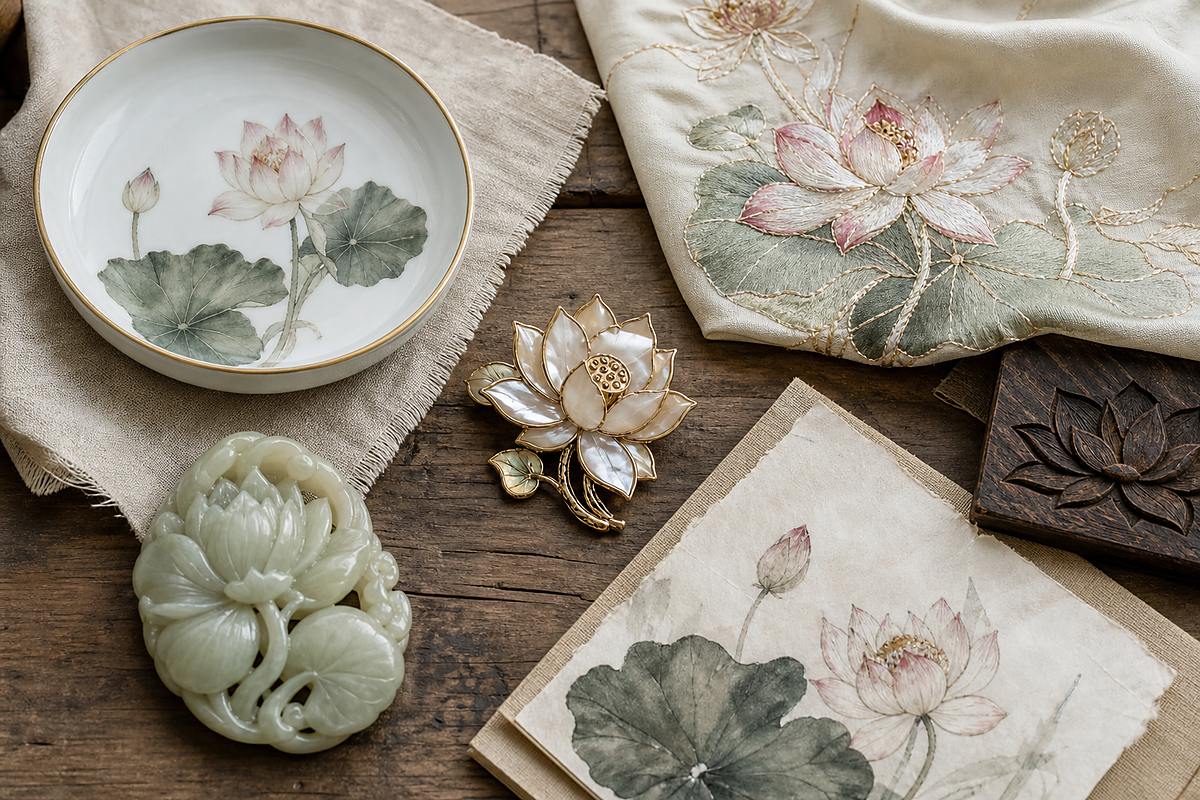
On ancient bronze and early ceramics, lotus petals can give a vessel sacred structure. With the spread of Buddhism, lotus forms appeared widely in stone caves, statues, temple ceilings, and celadon vessels. In Tang and Song aesthetics, lotus patterns became more natural, elegant, and worldly. In Yuan, Ming, and Qing decorative arts, scrolling lotus, broken-branch lotus, lotus with fish, lotus with ducks, and lotus with children became rich auspicious patterns.
Craft Motifs Readers Still See Today
Handmade lotus objects remain popular because the form is easy to recognize and emotionally clear. Cloisonne-inspired lotus craft uses fine metal lines and colored sand or enamel-like surfaces to make bright petal outlines. Lotus lanterns use bamboo, reed, silk, or paper to turn the flower into a blessing of light. Mother-of-pearl lotus brooches use shell glow to echo water and petal softness. Lotus embroidery and brocade use thread, shading, and stitch direction to show broad leaves, standing stems, and layered petals.
In porcelain, jade, wood, lacquer, textile, and metalwork, lotus should be read with the full object. A lotus throne is sacred. A lotus with fish is auspicious. A lotus with twin blossoms is marital. A single white lotus in ink painting is more contemplative. A lotus bracelet or pendant is often personal, wearable, and symbolic.
Lotus Color Meanings
Color Adds Emphasis, Not a Mechanical Code
| Lotus color | Common cultural reading | Best use in gifts or design |
|---|---|---|
| White lotus | Purity, clean mind, restraint, sacred clarity, loyal affection | Respectful gifts, meditation spaces, simple jewelry, teacher or elder gifts |
| Pink lotus | Gentle beauty, devotion, tender awakening, affection, summer softness | Friendship, love, graduation, warm personal notes |
| Red lotus | Compassion, courage, sincerity, warmth, vital feeling | Encouragement gifts, expressive jewelry, gratitude |
| Blue or qing lotus | Wisdom, meditation, clear seeing, spiritual depth | Buddhist-inspired art, quiet study objects, reflective gifts |
| Yellow or golden lotus | Brightness, dignity, blessing, balanced fortune, joyful energy | Festival objects, auspicious home decor, warm celebratory gifts |
| Green lotus | Peace, freshness, renewal, calm living, long life wishes | Home objects, tea spaces, wellness-adjacent symbolic design |
| Purple lotus | Mystery, sacred dignity, spiritual refinement | Decorative art and more formal symbolic objects |

A white lotus in a Buddhist statue, a white lotus in a love poem, and a white lotus in a modern pendant share purity but do not say exactly the same thing. Read color together with material, companion motif, and use.
Lotus Gifts: Who It Suits and What It Says
Gift Meaning by Recipient
A lotus gift suits people who value clarity, calm, elegance, moral strength, Buddhism, Eastern aesthetics, or meaningful design. It can be given to elders, teachers, partners, friends, colleagues, students, and people starting a new chapter. The message changes with form.
| Recipient | Lotus meaning to emphasize | Suitable form |
|---|---|---|
| Elder or teacher | Respect, clean character, quiet dignity, gratitude | Lotus tea set, embroidered piece, jade or silver lotus pendant, refined art object |
| Student or new graduate | Rising through difficulty, patient growth, future unfolding | Lotus bookmark, small desk object, lotus bracelet, handwritten card |
| Partner or spouse | Bingdi lotus, joined hearts, shared root, harmony | Paired lotus jewelry, twin-blossom motif, elegant flower note |
| Friend or colleague | Peace, good wishes, calm progress, repeated good fortune | Lotus ornament, lotus lantern, lotus-inspired stationery or brooch |
| Buddhist practitioner or temple-related occasion | Purity, wisdom, compassion, awakening | Respectful lotus motif without casual misuse of sacred figures |

Fresh Lotus Care and Gift Context
Fresh lotus flowers are beautiful but need care. A recipient should keep the stems well hydrated; for fresh lotus arrangements, a high water level near 4/5 of the vase and daily water changes help preserve the stems. A lotus gift can also be paired with a thoughtful note such as: 'May you keep your clarity through every season,' or 'For harmony, renewal, and a heart that stays bright.'
Cultural context matters. In many Eastern settings, lotus is sacred and auspicious. In some East Asian memorial contexts, lotus can also appear in funeral or afterlife symbolism. The occasion, color, form, and recipient background should guide the choice.
For everyday gifting, the safest lotus forms are usually floral rather than strongly ritual. A simple lotus pendant, embroidered lotus pouch, lotus tea cup, or lotus-pattern bookmark reads as calm and elegant. For a teacher, mentor, or elder, white lotus and restrained jade or porcelain forms emphasize respect and clean character. For a partner, paired lotus or Bingdi lotus gives the meaning of shared growth. For a friend starting a new chapter, a pink or pale lotus can speak of renewal without feeling overly formal.
Lotus Jewelry and Modern Design
Why Lotus Works Well in Jewelry
Lotus jewelry has become a strong modern design language because the flower has layered petals, a clear outline, symmetry, and deep symbolic memory. Designers can keep the meaning while simplifying the form for daily wear. A small lotus pendant can express renewal. A lotus ring can feel like an opening bloom. A lotus bracelet can keep the symbol close to the wrist without making the style heavy.
Materials, Craft, and Style Directions
Modern materials expand the motif. 18K rose gold and white gold can support more delicate petal structures than softer pure gold. Diamonds and micro-pave settings can create a dew-like shimmer on petals. Jade, Hetian jade, enamel, silver, titanium, peridot, mother-of-pearl, and carved gemstones can each give the lotus a different mood: warm, sacred, clean, bright, gentle, or contemporary.

Three design directions are especially common. Minimal lotus jewelry uses a simple petal outline or geometric flower. New Chinese style jewelry combines lotus with enamel, jade, garden lines, or quiet metalwork. High jewelry often places lotus in a broader natural story, using colored stones, layered petals, and water-inspired movement to express purity, rebirth, and timeless beauty.
A well-designed lotus piece usually chooses one clear symbolic center. A jade lotus pendant may emphasize purity and cultivated character. A silver lotus ring may emphasize calm daily renewal. A lotus with a seed pod can lean toward continuity and family blessing. A lotus with Buddhist imagery moves into a more sacred register. A lotus with fish, mandarin ducks, clouds, or Ruyi changes the reading again, so the best jewelry descriptions explain the motif rather than listing every possible blessing at once.
For readers exploring symbolic jewelry and blessing objects, Eastern Story's Blessing Shop gathers pieces around harmony, protection, love, clarity, renewal, and good wishes. Lotus symbolism fits that system naturally, especially when the design explains its motif and material with care.
How to Read a Lotus Motif
A Practical Way to Interpret the Object
A lotus motif should be read through five questions. First, is it botanically lotus or a stylized water flower? Second, is the context Buddhist, Confucian, folk, artistic, or modern fashion? Third, what companion symbols appear: fish, seed pod, mandarin ducks, children, crane, gourd, cloud, Ruyi, or Buddhist figures? Fourth, what material is used: jade, porcelain, textile, wood, metal, enamel, paper, or shell? Fifth, what is the occasion: wedding, birthday, study, temple, home decor, jewelry, or casual gift?
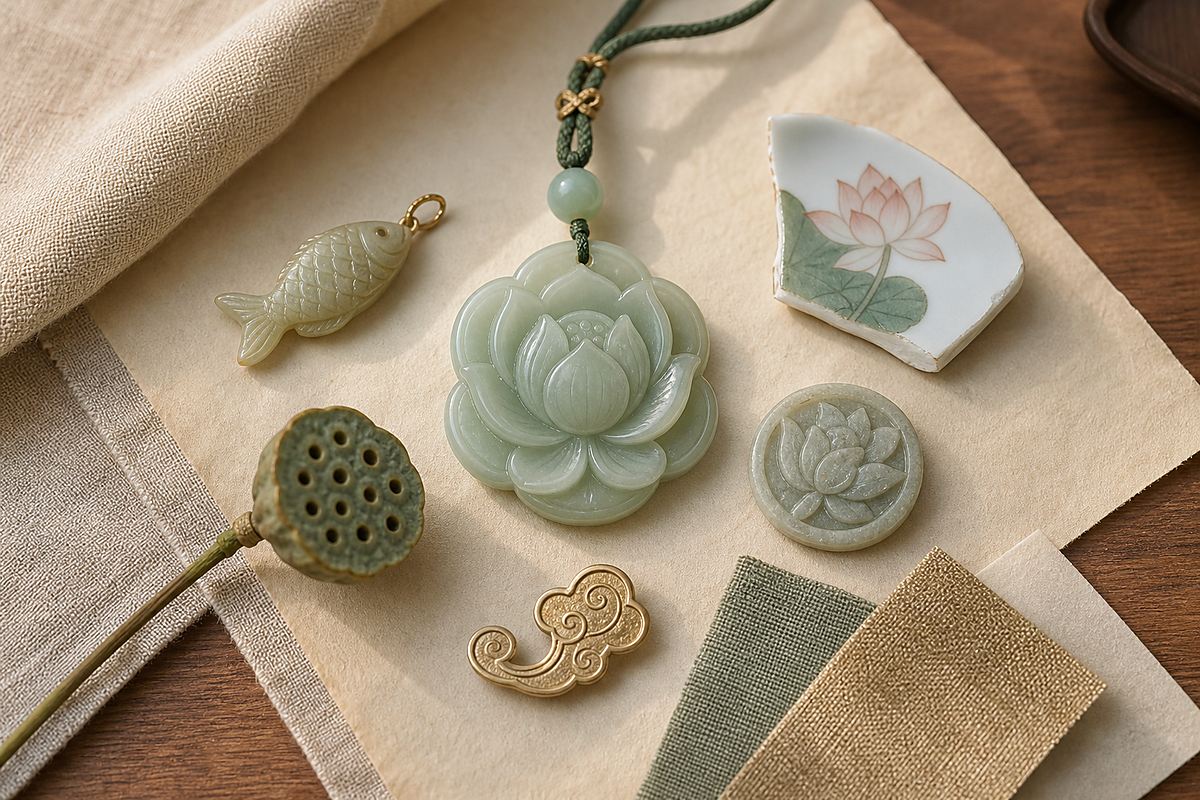
This reading method also makes internal connections natural. A lotus carved in jade can be read alongside Chinese jade carving meanings and jade meaning in Chinese culture. A lotus paired with longevity motifs belongs near Lingzhi meaning. A lotus surrounded by clouds can sit beside auspicious cloud meaning. A lotus gift or pendant can lead naturally to the Blessing Shop when the reader is looking for a symbolic object.
Frequently Asked Questions

For a next step, read Chinese jade carving meanings or browse symbolic objects in the Blessing Shop.
Related Posts


13 Comments