
Liangzhu jade cong motifs are human-and-animal faces, expressive eyes, and finely worked bands carved into ancient jade tubes. Their ordered lines give these small objects a remarkable presence. Today, that meeting of strength and delicacy can inspire a wish for a steady heart, a harmonious life, and the patience to make something beautiful.

Their story begins in the lower Yangtze region, where Liangzhu communities created an extraordinary jade tradition more than five thousand years ago. The most recognizable design is the deity-and-beast motif, shenren shoumian wen (神人兽面纹). A feather-crowned human figure and a large-eyed animal face appear together, sometimes in rich detail and sometimes reduced to a few confident lines. Understanding those variations makes the beauty of a cong easier to see.
Square outside, round within: the shape behind the motifs
A jade cong (玉琮) is a hollow tube, typically with a squared outer body surrounding a circular opening. Some are low and broad; others rise through a succession of decorated levels. The opening passes through the center, while the projecting corners give the carving a place to unfold across adjoining surfaces.

Look at a corner rather than only at a flat side. On many examples, one eye sits on each side of the angle, and the corner becomes the middle of the face. A photograph taken directly toward that corner brings the paired features together. A view of just one flat side may show halves of two different faces.
That relationship gives the object a quiet rhythm: square and circle, projection and hollow, a face appearing as the viewpoint changes. The shape feels composed without being static. It is easy to understand why a contemporary designer might choose it to carry a wish for balance: steadiness on the outside, openness within.
Levels, eyes, and striped bands
Museum descriptions often call the stacked decorative levels registers. Each is a horizontal zone of the design. Raised bars and narrow grooves help separate the faces, while parallel incised lines bring detail to the areas above the eyes.
These bands can suggest a headdress in a simplified human image. They also guide the eye around the object, giving a compact pattern room to breathe. The number of levels and the arrangement of human and animal features vary between cong; a tall example and a low one need to be read on their own terms.

Reading the deity-and-beast face
In a full composition, the upper figure wears a broad, featherlike crown. Below it, an animal face gathers attention through large eyes, a broad muzzle, and sharply defined teeth. Bent limbs and claws add to the image’s contained energy. The figures belong to one carefully joined composition, yet their individual features can still be followed.

The familiar name “Liangzhu sacred emblem,” or shenhui (神徽), is a modern way of describing this recurring image and its religious importance. Its commanding appearance and presence on ceremonial jade connect it with belief and authority. A crowned figure riding or controlling a supernatural beast is one interpretation of the image; the precise story told by Liangzhu people has not survived.
The eyes hold the design together
The eyes are often the first details a viewer recognizes. They may appear as rings, round pupils within larger outlines, or rounded triangular shapes. On a small surface, changing the line around an eye can change the whole expression: alert, solemn, or intensely watchful.

In simplified masks, paired eyes, a short nose or mouth bar, and bands above the face may carry almost the entire image. Such economy is part of their appeal. The motif remains legible even when much of the full figure has disappeared. For a modern wearer drawn to watchful imagery, those eyes can become a personal expression of care and protection.
Fine lines give the face its texture
The large features establish the expression; the small lines reward a closer look. A raised eye catches the light, while incised curls and parallel strokes lie quietly within the surrounding surface. Relief and line work together, so the image can feel both powerful from a distance and delicate nearby.
The pattern is especially compelling because so much is held within a small area. Instead of filling every space equally, the maker gives the face its own rhythm of dense detail and calmer surfaces. That sense of order is one of the most enduring sources of Liangzhu-inspired design.

The King of Cong: a small object with an immense presence
The celebrated King of Cong (玉琮王) was excavated in 1986 from tomb 12 at Fanshan, in present-day Zhejiang. Now in the Zhejiang Provincial Museum collection, it stands only 8.9 cm high but weighs approximately 6.5 kg. Its broad body gives it a presence quite different from a slender, many-tiered cong.
| Detail | King of Cong |
|---|---|
| Height | 8.9 cm |
| Weight | Approximately 6.5 kg |
| Inner diameter of the bore | 3.8 cm |
| Complete deity-and-beast images | 8, arranged as 2 in each of the 4 vertical face channels |
Its layout offers a particularly rewarding way to understand the motif. The complete images sit in the vertical channels at the centers of the four sides. Simplified images spread across the projecting corners. Both ways of presenting the face appear on the same object: the full composition draws the viewer inward, while the corner designs carry the rhythm around its body.

The contrast between this low, weighty cong and taller examples is striking. Shanghai Museum’s cong with human and flying-bird motifs measures 39.3 cm high and has 15 levels. Its repeated, simplified faces give it a rising cadence, with a bird motif near the upper rim. These are two different expressions of the same fascination with ordered form.
What the motifs meant in Liangzhu life
Liangzhu flourished in a landscape of rivers, rice fields, settlements, and elaborate waterworks. The archaeological ruins of Liangzhu City, dated by UNESCO to approximately 3300–2300 BCE, entered the World Heritage List in 2019. Jade belonged within this wider world of shared beliefs, skilled work, and social organization.

Cong and other finely made jades accompanied people in high-status burials. Their placement and the great effort devoted to them show how closely ceremony, identity, and precious objects were connected. The recurring sacred face gave visible form to that world. It carried a seriousness that can still be felt in the stillness of the material and the directness of its gaze.
Later Eastern traditions associated the cong with the earth and the bi disk with heaven. The phrase “round heaven, square earth” (天圆地方) also offers a familiar way to contemplate the cong’s geometry. These later associations are best understood alongside the earlier Liangzhu objects, whose exact religious teachings remain unrecorded.

For a person choosing a contemporary cong-inspired piece, the meeting of circle and square can carry a warm, present-day intention: to remain grounded while making room for change, to hold one’s center, or to welcome harmony into a new home or a new chapter. The ancient form gives that wish a beautiful shape.
Birds, curled lines, and the wider world of Liangzhu jade
Human-and-animal faces are the central motif of many cong, but Liangzhu jade has a wider visual vocabulary. Birds, curling lines, and animal heads appear on different forms, each bringing its own movement and character.
Birds in flight and birds on a platform
A small jade bird (玉鸟) from Fanshan, held by Liangzhu Museum, spreads its wings around a short-tailed body. The carving measures 4.36 cm long and 5.33 cm across the wings. Its compact outline carries the feeling of flight with very little excess detail.
A different design appears on some jade bi disks (玉璧): a standing bird above a stepped platform, often called “bird standing on a high platform” (鸟立高台). The image brings bird and structure into a single sign. Its original message remains open to interpretation, but the composition itself is clear enough to appreciate: a living form poised above a carefully arranged base.
In a contemporary gift, a bird-inspired outline can carry a wish for freedom, a hopeful departure, or the courage to begin. It is especially touching when given to someone moving away, starting a course of study, or finding a new direction.
Cloudlike curls and early animal heads
Small angular curls and rounded scrolls often enrich the spaces around the main features. The broader cloud-and-thunder pattern tradition (云雷纹) helps explain this language of curling lines, while individual Liangzhu examples retain their own arrangement and character. On a cong, the curls can sit within a bar or around an eye rather than becoming the main image.

Early Liangzhu ornaments also include animal-head designs commonly called dragon-head motifs (龙首纹). Their small heads follow the curves of bracelets and other ornaments. They add another way of thinking about jade design: an image can emerge from the shape of the object, making the edge, curve, and carved face feel inseparable.
The same sacred image on different objects
The jade yue (玉钺), a ceremonial axe, belongs to the world of authority and command. The famous example from Fanshan tomb 12 carries human-and-animal imagery as well as bird decoration. Its broad blade gives the motif a setting very different from the four corners of a cong.
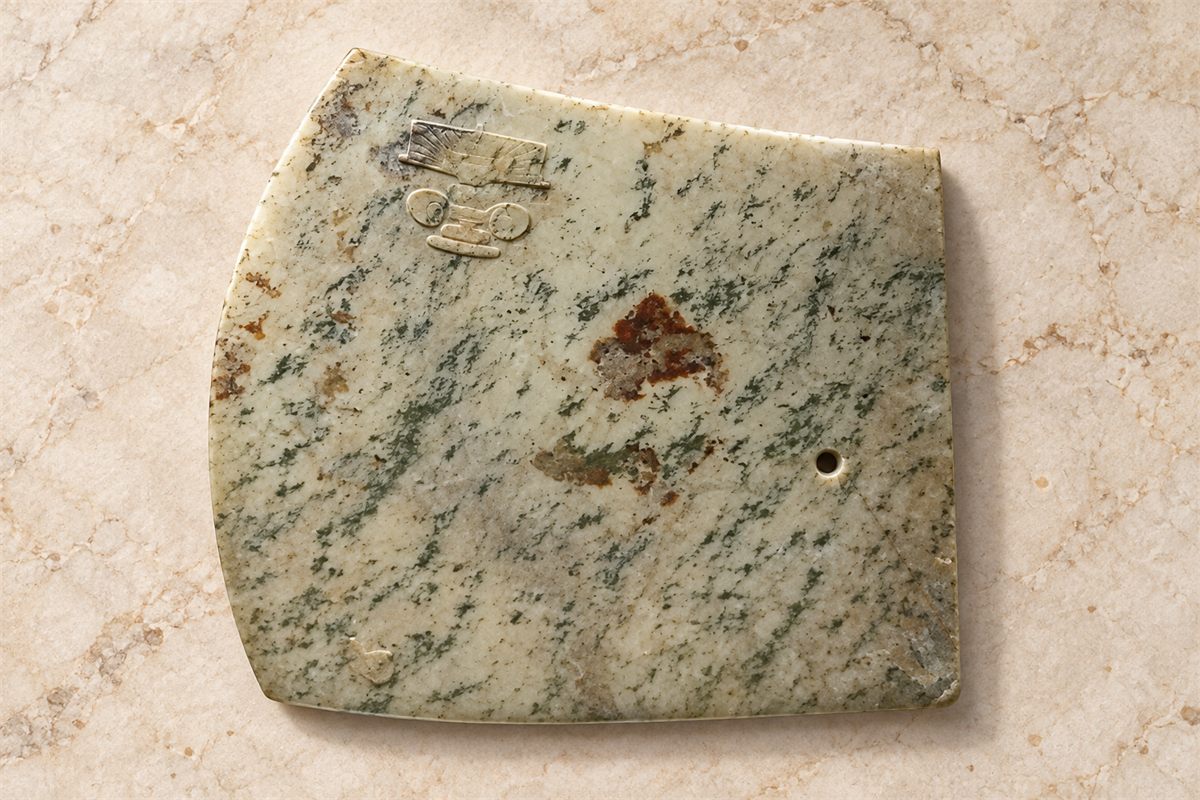
Curved jade huang ornaments (玉璜), plaques, and components of personal adornment show how the visual language could move closer to the body. Crown-shaped ornaments (玉冠状器) are often interpreted as comb backs. Three-pronged ornaments (三叉形器), found near the head in burials, are understood as elements of headwear. Their forms and attachment arrangements differ, giving the carved imagery different places within ceremonial dress.
Later taotie masks (饕餮纹) on bronze also use paired eyes and forceful animal features. They make an interesting visual comparison with Liangzhu faces, though each belongs to its own period and setting. Seeing them together reveals the lasting appeal of a face built from symmetry, concentrated detail, and a commanding gaze.
How patient work brought the motifs to life
Many Liangzhu jades are nephrite, a tough stone whose interlocking structure makes delicate work demanding. Nephrite measures about 6–6.5 on the Mohs hardness scale. Hardness describes resistance to scratching; the maker also had to work with the material’s toughness, thickness, and individual character.
Abrasive grains, known in jade working as jie yu sha (解玉砂), helped remove the stone a little at a time. Sawing, drilling, grinding, and polishing gradually produced a body ready for its finer details. The tools carried the abrasive; the repeated movement did much of the work.

From the opening to the smallest lines
The central bore is a good place to imagine that patience. On examples drilled from opposite ends, the two worked openings meet within the object. A slight change in the inner profile can preserve a trace of that meeting. Tubular drilling and solid drilling produced different kinds of holes, while finishing could soften the marks left behind.
Experiments help explain how cords, thin tools, or hollow drills could carry abrasive through the stone. Surviving cutting and drilling traces support the broader process, while the exact tool material and sequence need to be considered for each object.

Relief jade carving (浮雕玉雕) brings selected features forward by lowering the surrounding surface. Fine incised carving (阴刻) adds lines below the surface. Liangzhu makers combined these effects so that eyes, noses, and other features stood out against intricate detail.
The small decisions are particularly moving. On a Fanshan cong described by Liangzhu Museum, the bands contain 4–6 parallel lines and the circular eyes measure 3 mm across. These measurements belong to that particular object. They help make its scale tangible: a few millimeters were enough for a maker to establish an eye, a headdress, and the rhythm of a face.
Polishing completed the relationship between image and material. Light moves over the smooth body, pauses at a raised edge, and settles into a fine groove. Looking closely becomes a way of appreciating the hands and attention behind the finished piece.

Bringing Liangzhu inspiration into a meaningful gift
A modern design can draw on a single part of this visual world: the square-and-circle form, a pair of watchful eyes, an outspread bird, or a sequence of fine lines. A pendant can carry the geometry close to the heart. A small desk object can give a quiet corner of the home a sense of steadiness. A patterned bookmark can accompany someone through years of reading.
The design need not reproduce every ancient detail to carry a thoughtful connection. A carefully chosen outline may express the quality that speaks most clearly to the recipient. The square can suggest resolve; the circle, harmony and openness; the patient lines, care that is shown through attention.

For someone beginning a demanding project, a cong-inspired object can carry a wish for composure and perseverance. For a close friend, the watchful face can express “you are held in my thoughts.” For a household celebrating a new beginning, the meeting of round and square can welcome peace and a life lived in balance.

These are contemporary ways of carrying the story forward. Modern jewelry, museum reproductions, and archaeological objects each have their own identity. A newly made piece may use jade, metal, ceramic, or another material; its meaning comes through the design and the personal connection you give it. A museum-inspired item is an official museum product only when it is identified as such by the museum.
A simple message can make the gift especially personal: “May you keep a steady center and an open heart. May your days unfold in peace and harmony.” The blessing Ping An Ru Yi (平安如意)—peace, safety, and life unfolding as you wish—sits naturally beside that intention.
This warmth belongs to the wider story of jade’s meaning in Eastern culture: a treasured object can hold memory, affection, and a hope for the life ahead. Liangzhu-inspired geometry gives those feelings a distinctive, quietly powerful form.
Appreciating the surface and caring for modern pieces
Ancient jade can show changes in color, translucency, and surface texture after burial. The chalky appearance often called “chicken-bone white” (鸡骨白) belongs to that history of alteration. It should be distinguished from the original color of the material and from the gentle surface sheen of an object handled in daily life.
Enjoy museum objects through close looking, detailed photographs, and the institution’s displays. Conservation of archaeological jade belongs with professional conservators; leave cleaning, polishing, rubbing, and other surface treatment to them. Follow the museum’s own photography and viewing guidance.
For a modern piece, care follows its actual material, any treatment, and its setting, adhesive, or cord. A soft cloth is a useful starting point. Where the maker confirms that washing is suitable, clean gently with lukewarm water and a little mild soap, then dry carefully. Keep carved pieces apart from harder objects, avoid sharp knocks and high heat, and check the Eastern Story care guide for the construction you wear.

Frequently asked questions
The lasting gift of Liangzhu jade is the attention it invites: to a face, a line, a shape, and the meaning we choose to carry. Explore the Eastern Story blessing collection for objects that hold your own wishes for peace, connection, and a beautiful life.
Related Posts


