
The Buddhist treasure vase symbolizes blessings that remain full: prosperity, long life, wisdom, and the good fortune to share what we have. Called baoping (宝瓶) in Chinese and associated with the Tibetan bumpa, it is one of the Eight Auspicious Symbols. Its rounded body holds an inexhaustible treasury, expressing a generous hope: may life be well supported, may wisdom grow, and may the people we love enjoy peace.
There is something tender about choosing a vessel as a blessing. A vase gathers and holds; it makes room for what is precious. In Buddhist art, its treasures include the qualities that help a life flourish. In Eastern gift traditions, the sound of the word for vase also welcomes peace. Together, these meanings give a small pendant or a treasured object a story much larger than its size.

What the treasure vase means: abundance, wisdom, and long life
A treasure that stays full
The treasure vase is imagined as a vessel whose riches continue to flow without running out. Jewels and life-giving nectar make that abundance visible. It carries wishes for prosperity, nourishment, long life, and the favorable circumstances that allow people to grow. The image is especially moving because its fullness survives generosity: giving does not exhaust the source.

For someone beginning again, this can be a wish for enough support to move forward. For a family, it can mean a home with warmth to spare. For a person celebrating meaningful work, it can welcome prosperity that also benefits others. These are natural ways to carry the ancient image into a present-day relationship.
Fullness of merit and wisdom
The Eastern phrase fu hui yuan man (福慧圆满), fullness of blessings and wisdom, expresses the treasure vase’s deeper appeal. Buddhist merit grows through wholesome intentions and actions; wisdom helps us understand and respond with clarity. A life rich in both has something precious to offer beyond its possessions.
The vase therefore belongs comfortably beside wishes for learning, compassion, generosity, and a well-supported life. A shared lesson can continue helping someone long after the conversation ends. A kindness can make further kindness possible. These everyday experiences give us a gentle way to appreciate the image of inexhaustible treasure.

In one Tibetan explanation that relates the eight signs to the Buddha’s body, the vase corresponds to his throat and the inexhaustible treasure of the teachings. This adds a beautiful association with nourishing speech: words that guide, comfort, and help people find their way.
The nectar of long life
The sacred nectar called amrita (甘露) belongs to the vase’s religious imagery of life and awakening. Amitayus, the Buddha of Immeasurable Life (无量寿佛), is especially recognizable by the long-life vase held in his lap. In Himalayan art he commonly wears jewels and a crown, with both hands supporting the vessel in a meditation gesture.
Amitayus is closely connected with Amitabha, the Buddha of Infinite Light. The names emphasize life and light, while their familiar artistic appearances differ: Amitabha commonly wears monastic robes and holds a bowl. The long-life vase brings the wish for longevity into focus. As a birthday or family gift, its story can say, simply, ‘May we have many more good years together.’

The treasure vase among the Eight Auspicious Symbols
The Eight Auspicious Symbols, also called Ashtamangala or Bajixiang (八吉祥), bring several blessings into one composition. They appear in Himalayan Buddhist painting, temple decoration, textiles, and Eastern decorative arts. The treasure vase contributes the promise of fullness to a group that also celebrates protection, freedom, purity, and the flourishing of the teachings.
| Symbol | What to recognize | Traditional meaning |
|---|---|---|
| Treasure vase (宝瓶) | A full vessel, often with a jewel or foliage above it | Inexhaustible abundance, long life, and spiritual riches |
| Precious parasol (宝伞) | An umbrella-like canopy | Shelter and protection from suffering and obstacles |
| Pair of golden fish (双鱼) | Two fish, often facing one another | Freedom and fearlessness |
| Lotus (莲花) | An open flower | Purity and awakened qualities |
| Right-turning white conch (右旋白海螺) | A spiral shell | The far-reaching sound of the Dharma |
| Endless knot (盘长结) | An interlaced design without a visible beginning or end | Interconnection and the union of wisdom and compassion |
| Victory banner (胜利幢) | A ceremonial banner on a staff | Victory over obstacles to awakening |
| Dharma wheel (法轮) | A wheel, often shown with eight spokes | The Buddha’s teachings and their continuing presence |
Artists can arrange the signs individually, in repeated bands, or as an abundant combined design. On a bowl or textile, following each emblem is like reading a circle of good wishes. The wheel’s eight spokes can evoke the Noble Eightfold Path; the eight emblems as a group have their own symbolic meanings.
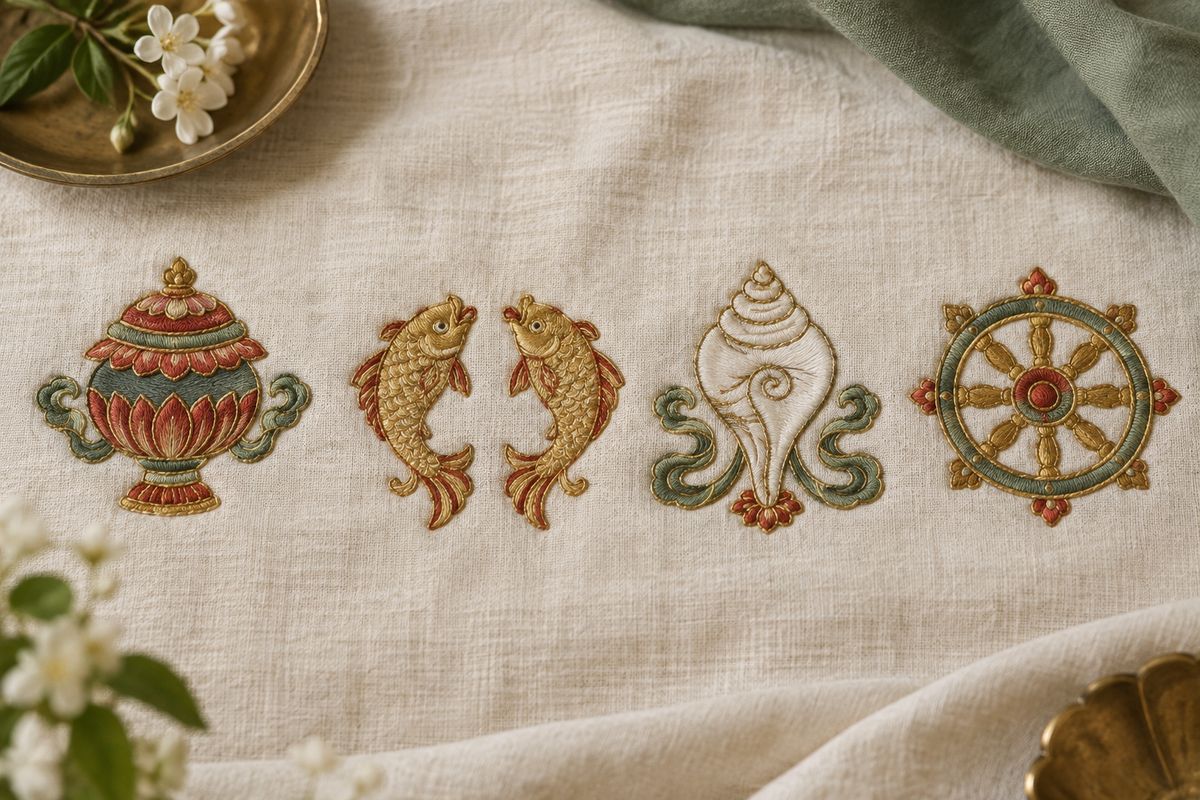
Recognizing a treasure vase in art
A treasure vase usually has a generous rounded body, a narrower neck, and a mouth or lid crowned with an auspicious ornament. Jewels, ribbons, lotus petals, and growing foliage can enrich the silhouette. Some images show a wish-fulfilling tree rising from the vessel. Others concentrate on a jewel above the lid, making the idea of precious contents immediately visible.

In thangka art, painted outlines and vivid details help distinguish the vase from its neighboring signs. On porcelain, a vase emblem may rise above a lotus blossom or appear among scrolling lotus stems (缠枝莲). On a small ornament, a maker may reduce the same image to a rounded outline and a jewel-shaped top.

The surrounding composition helps tell the story. A vase beside fish, a conch, and a wheel belongs to the Buddhist auspicious set. A vase carried by an elephant speaks through a different, familiar wish for peace. Peacock feathers appear in actual ritual vases and in related imagery, while a sculpted lid or painted jewel belongs to the particular object’s design. These details reward a closer look without requiring every vase to share one fixed shape.
Bumpa, kalasha, and the different kinds of sacred vase
Bumpa, also written bum pa, is a Tibetan word for a vase. Chinese renderings include 奔巴 and 贲巴. Kalasha (迦罗奢) is a Sanskrit vessel term found across South Asian religious traditions. The more specific Sanskrit name nidhighata is used for the treasure-vase emblem. These names connect a wide world of sacred vessels, whose particular roles are best understood through their forms and traditions.
| Name or form | Its setting | How it relates to the treasure vase |
|---|---|---|
| Treasure vase / baoping (宝瓶) | An auspicious emblem in Buddhist art | Expresses inexhaustible blessings and riches |
| Ritual bumpa / empowerment vase (灌顶瓶) | Vajrayana ceremonies, including empowerment and purification | A vessel used within a particular living ritual tradition |
| Long-life vase (长寿瓶) | Amitayus imagery and longevity practices | Emphasizes nectar and the wish for long life |
| Kundika / junchi (军持), and jingping (净瓶) | Water vessels and purity-vase imagery, including Guanyin’s attribute | Related sacred water imagery, with different vessel histories and shapes |
Water, offerings, and consecration
Ritual bumpas are used in Vajrayana offerings, purification, and empowerment. Bhutanese examples include vessels holding blessed water with saffron or medicinal ingredients, with peacock feathers fitted into a tube at the top. The outward grace of the vessel accompanies the ceremony’s aspirations toward purity and awakened qualities.

Other consecrated vases contain substances chosen for the particular practice, such as grains, fragrant ingredients, or precious materials. Their preparation belongs to the religious community and ceremony. A vessel used for pouring water, a sealed treasure vase, and a long-life vase held by a sacred figure each has its own role. People participating in a living tradition follow the guidance of its teachers and caretakers.
Guanyin’s purity vase and the kundika
The kundika, known in Chinese as junchi, began as a water vessel and became part of Buddhist daily life and imagery. Many examples have a long neck and a separate spout at the shoulder or body. Jingping means a purity vase or clean-water vessel; the term also appears in descriptions of Guanyin’s vase.

Guanyin (观音) is often shown with a vase and willow branch, bringing the vessel into a story of compassion and relieving suffering. In East Asian images, this attribute can resemble a slender flower vase. Recognizing that form alongside Amitayus’s long-life vase helps us appreciate the different expressions of care within Buddhist art.

Baoping and the wish for peace
In Mandarin, ping (瓶), ‘vase,’ sounds like ping (平), the word for peace or calm within ping’an (平安). This makes a vase a natural bearer of peaceful wishes. The Buddhist treasure vase and the everyday language of blessings meet especially warmly here: abundance is precious when the people sharing it are safe and well.
Ping an ru yi (平安如意) means a wish for peace and for things to go as hoped. A vase-shaped keepsake can accompany those words for a new home, a journey, a marriage, or a fresh start. ‘Baoping’ is written 宝瓶 for the vessel; playful references to ‘protecting peace’ draw on its sound and the wish it carries.

An elephant carrying peace
The motif tai ping you xiang (太平有象) shows an elephant carrying a vase, welcoming peaceful times. The National Palace Museum’s elephant-shaped zun makes this wordplay visible in a bronze vessel with a vase on its back. The pairing brings together an imposing animal and a gently held blessing, turning peace into something we can picture.
That image gives a thoughtful gift an expansive feeling: peace in a household, steadiness through change, and a world in which ordinary life can flourish. It is easy to see why a vessel can become a cherished companion rather than a passing decoration.

Treasure vase, hulu, and other auspicious treasures
A hulu gourd (葫芦) has two rounded lobes joined at a narrow waist. Its stories of blessing, protection, and longevity meet the treasure vase at the level of good wishes, while its plant form and folk and Daoist associations give it a distinct identity. A treasure vase is usually recognizable as a made vessel with one main body and a neck.

A treasure chest (宝箱) and a treasure bowl (聚宝盆) also offer inviting images of riches gathered together. Their shared theme of abundance makes them easy companions in modern design. The vase itself remains the vessel in the Buddhist Eight Auspicious Symbols.

Several traditional groups use the language of treasure. Understanding which group an artist is showing keeps the details enjoyable and clear:
| Group | What it contains | Its character |
|---|---|---|
| Eight Auspicious Symbols (八吉祥) | Vase, parasol, fish, lotus, conch, knot, banner, and wheel | A Buddhist group of favorable signs |
| Seven royal treasures (七王宝) | In a common Tibetan list: wheel, jewel, queen, minister, elephant, horse, and general | Emblems associated with a universal monarch |
| Buddhist Seven Treasures (佛教七宝) | Precious substances named in sutras, including gold and silver; the full lists depend on the text | Rich materials expressing the splendor of sacred worlds and offerings |
| Hidden Eight Immortals (暗八仙) | The Immortals’ attributes, including a gourd, fan, sword, flute, and flower basket | Daoist figures suggested through their recognizable objects |
| Miscellaneous treasures / zabao (杂宝) | Combinations of precious motifs such as ingots, coins, jewels, and paired lozenges | A flexible decorative vocabulary of good fortune |
These designs can share a place on richly decorated objects. The pleasure lies in discovering each story: one motif may welcome prosperity, another honor longevity, and another express spiritual fullness. A complete Buddhist set and a collection of other lucky objects each create their own rhythm of blessings.
Sacred vessels in ceramics and courtly art
The treasure vase’s story travels through many materials. Metalworkers shaped precious vessels; painters translated them into emblems; potters gave ritual forms new surfaces in porcelain. Gilding, colored enamel, and gemstone accents could make an offering feel radiant, while a quiet white glaze invited attention to the curve of a neck or a carved petal.

A Qianlong porcelain vase filled with auspicious imagery
The National Museum of China holds a yellow-ground famille-rose vase with scrolling lotus and the Eight Auspicious Symbols from the Qianlong reign. Its form resembles a small pagoda raised on a tall foot. The inside has a turquoise-green glaze, and a six-character Qianlong reign mark appears on the base. The bright ground and patterned surface give the blessings a festive, luminous setting.
This type of vessel is called a zangcao ping (藏草瓶), associated with the offering of auspicious grass or peacock feathers. Related forms with a projecting spout are called bumpa ewers. Looking at the shape as well as the painted symbols reveals how a sacred vessel could inspire both religious use and the art of an imperial workshop.
The quiet beauty of a Ding-ware purity vase
A different expression survives in the white-glazed dragon-head purity vase (白釉刻花龙首净瓶) at Dingzhou Museum. This Song-period vessel is 60.9 cm high and was excavated from the Jingzhi Temple pagoda foundation. Its dragon-head detail and carved decoration show the care lavished on Buddhist water vessels. It belongs to the history of the purity vase, bringing another form of sacred generosity into the ceramic tradition.
Famille rose (粉彩) uses painted enamels on glazed porcelain; cloisonné enamel (掐丝珐琅) uses metal partitions to contain colored enamel. They offer different ways of giving a vessel a richly patterned surface. On a treasure-vase design, flowers and precious colors can make the wish for a flourishing life feel immediate. The material and decoration belong to the individual work, alongside its shape and symbolic setting.

The Golden Urn has a particular historical role
The golden bumpa known as the Golden Urn (金奔巴瓶) was used for drawing lots in the recognition of reincarnate lamas. The Palace Museum’s Qianlong chronology records the instruction to establish urns at Lhasa’s Jokhang Temple and Beijing’s Yonghe Temple in 1793, the emperor’s 58th regnal year. This specific function distinguishes the Golden Urn from an offering vase or an auspicious vase emblem. It is one chapter in the much wider history of sacred vessels.
Carrying the treasure-vase blessing today
A modern treasure-vase pendant, bead, or small decorative object can carry a wish for blessings to remain plentiful. Some dzi beads include a vase motif, often called a treasure-vase dzi (宝瓶天珠). The image brings the vase’s fullness into something small enough to keep close, joining hopes for prosperity, protection, and a peaceful life.

Choose the story that feels close to the person receiving it. A housewarming gift can welcome a settled home. For someone studying or beginning new work, the vase can wish for growing wisdom and good opportunities. For a parent or grandparent, its long-life associations express the hope for more shared time. A wedding gift can carry the wish that love, patience, and the resources of a household will keep replenishing one another.
A handwritten note can make the meaning personal: ‘May your home be full of peace, your days rich in kindness, and your hopes find room to grow.’ Or keep the blessing short: ‘平安如意—peace, and wishes fulfilled.’

At home, a decorative vase or vase motif can sit near books, family photographs, or a place where people gather. Choose a clean, stable setting that lets you enjoy its shape and remember its story. A devotional vessel belongs in the setting and care of its own tradition. For jewelry, a recognizable outline and a comfortable, secure fit allow the meaning to accompany ordinary days.
The treasure vase offers a generous vision of a good life: enough to feel supported, wisdom to use it well, and blessings to share. Explore the Eastern Story Blessing collection for a meaningful object that speaks to the wish you want to carry or give.
Frequently Asked Questions
Related Posts


