
The Buddhist seven treasures are precious substances used in sutras to picture radiant Buddha realms, offerings, stupas, palaces, and sacred beauty. There is no single list shared by every scripture or translation. A clear starting point is the list in Kumārajīva’s Chinese translation of the Amitābha Sūtra: gold, silver, liuli, crystal, giant-clam shell, red pearl, and agate. Together, they carry wishes for clarity, wisdom, compassion, peace, abundance, and a life shaped by beautiful intentions.

In East Asian Buddhist vocabulary, the phrase is qibao (七宝), “seven treasures” or “seven precious things.” The number gathers a complete vision of splendor; the materials help readers feel that vision through color, light, rarity, and texture. People may contemplate, collect, wear, or give objects inspired by the seven treasures as meaningful companions—media through which they hope to welcome peace, virtue, harmony, and all-things-as-you-wish blessings into life.
What are the seven precious things in Buddhism?
For an approachable introduction, this guide follows the seven named in the Amitābha Sūtra translated into Chinese by Kumārajīva: gold (金), silver (银), liuli (琉璃), poli or crystal (颇梨), giant-clam shell (车磲), red pearl (赤珠), and agate (玛瑙). The sutra uses them to describe the jeweled ponds, stairways, and towers of the Pure Land.
This is one respected scriptural version, not a master key for every tradition. Ancient treasure names also resist simple modern labels. Liuli may be rendered as beryl, lapis-like blue stone, or another precious blue material depending on the text and translator; poli is commonly connected with a clear crystalline substance. A contemporary bracelet or decorative set should therefore state its actual materials instead of treating every ancient word as a fixed mineral species.

Why do Buddhist seven-treasure lists differ?
Buddhist scriptures traveled across languages, centuries, and regions. Translators worked with Sanskrit, Prakrit, Chinese, and Tibetan terms whose ranges did not always match later gemological categories. Communities also knew different rare materials through their own artistic and trade worlds. The result is a family of seven-treasure lists united by purpose rather than one universal inventory.

| Text or translation setting | Seven treasures in that setting | How the imagery is used |
|---|---|---|
| Amitābha Sūtra, Kumārajīva’s Chinese translation | Gold, silver, liuli, poli, giant-clam shell, red pearl, agate | Jeweled ponds, stairways, and towers in the Pure Land |
| Lotus Sūtra, Kumārajīva’s Chinese translation | Gold, silver, liuli, giant-clam shell, agate, pearl, meigui | Precious adornment, including the jeweled stupa |
| The Display of the Pure Land of Sukhāvatī, Tibetan translation | Gold, silver, beryl, crystal, rosy pearls, emerald, coral | Jeweled trees and the beauty of the Buddha realm |
These lists are best read in their own textual settings. The old term meigui (玫瑰), for example, names a precious material in the Chinese Lotus Sūtra; forcing it into one modern retail identity can create false certainty. Likewise, modern Tibetan-style jewelry may include turquoise, dzi beads, coral-colored material, or amber, but such a combination should not automatically be presented as the fixed scriptural seven treasures.
Buddhist treasures meaning: seven materials and the wishes they carry
The sutras use precious substances first to evoke sacred radiance. The meanings below are a warm cultural reading of their color, presence, and offering context—not a claim that every scripture assigns each material one permanent definition.
Gold: enduring light and noble intention
Gold brings the warmth of sunlight and the dignity of a treasured offering. In Buddhist images, manuscripts, reliquaries, and temple ornament, its brilliance marks what a community holds precious. Gold-inspired objects are chosen to welcome abundance, steadfast purpose, and a bright path through changing seasons of life.

Silver: clarity, calm, and peaceful reflection
Silver’s cool light recalls the moon and a quiet, reflective mind. It carries a wish for peaceful judgment, clean intention, and harmony. Given to someone beginning a new chapter, it can express the hope that calm understanding will remain close at hand.
Liuli: luminous wisdom and a spacious heart
Liuli is an ancient translated treasure name whose range is broader than one modern stone. Its blue or jewel-like radiance invites associations with vast sky, clear perception, and wisdom. Modern makers may interpret that visual language through glass, ceramic, lapis lazuli, or another clearly disclosed material.
Crystal or poli: transparency and sincere purpose
A clear crystalline treasure lets light pass through it, making clarity easy to feel rather than merely define. It is worn or kept to invite openhearted intention, insight, and a life less clouded by confusion. The ancient word should still be kept distinct from a precise modern mineral identification unless the object’s material is known.

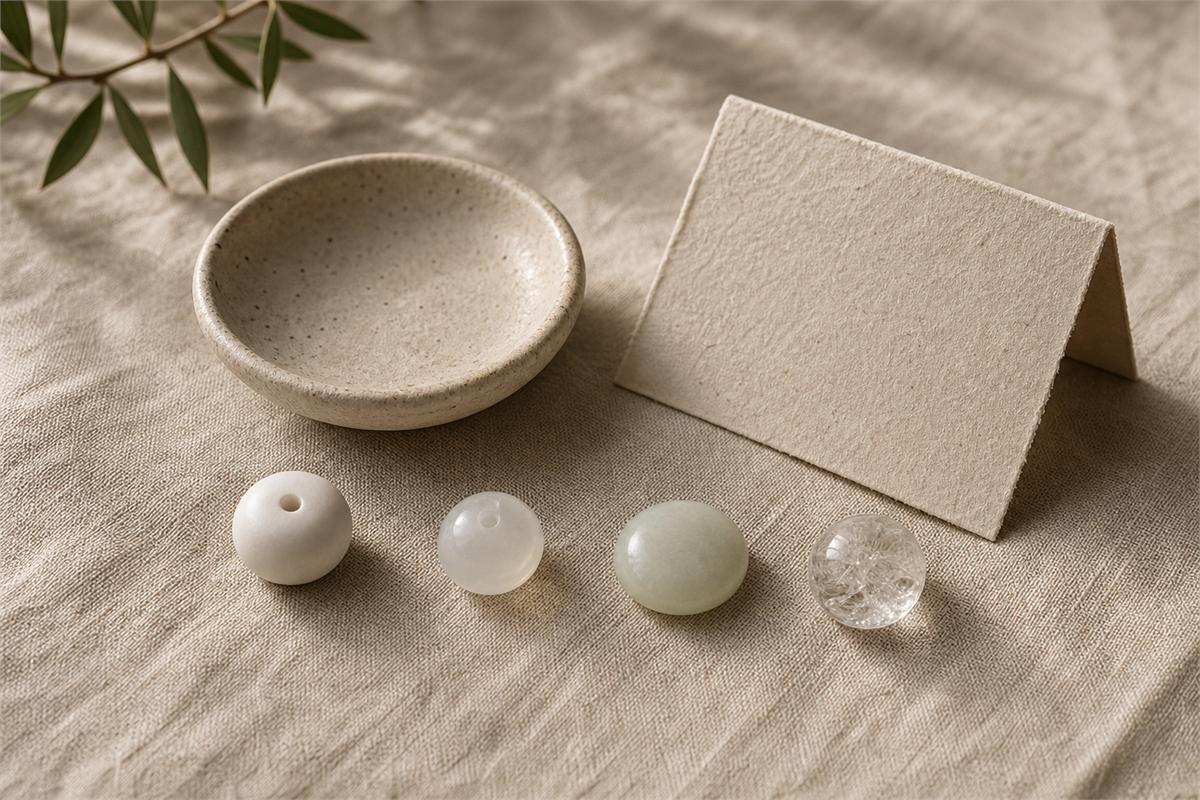
Giant-clam shell: purity remembered through compassionate choices
The pale shell traditionally evokes purity, spaciousness, and the serenity of a white lotus. Today, all giant clams in the family Tridacnidae are listed under CITES Appendix II, while national rules can be stricter. A compassionate modern interpretation favors legal, clearly sourced non-wild materials or shell-free alternatives such as ceramic, glass, white jade, or other stone.
Red pearl: warmth, vitality, and joyful connection
The translated expression “red pearl” belongs to an older treasure vocabulary and should not be reduced automatically to coral, ruby, or carnelian. As an image, its warm color carries a wish for vitality, joy, compassionate connection, and a heart ready to give.
Agate: steadiness, harmony, and wishes fulfilled
Agate is a banded variety of chalcedony, a microcrystalline quartz material. Its layered patterns suggest patience, balance, and beauty formed over time. Agate beads are often chosen to carry wishes for steady progress, harmonious relationships, and baishi ruyi (百事如意)—may every undertaking unfold as wished. Learn more in our guide to agate’s material and cultural meaning.


Seven treasures in Pure Land imagery
Pure Land descriptions turn inner beauty into a world a reader can see and hear: jeweled ponds, luminous trees, golden sand, harmonious music, lotus blossoms, and towers formed from precious substances. This splendor gives sensory form to a realm shaped by purity, peace, order, generosity, and awakened care.

This is why seven-treasure imagery remains emotionally powerful. A small object inspired by it can become a daily point of return—a reminder of the life one hopes to cultivate and the blessings one hopes to share. Lotus imagery carries a closely related wish for purity arising beautifully through difficulty; our lotus meaning guide explores that story in greater depth.
Seven material treasures and the seven inner treasures
Buddhist teachings also speak of seven inner treasures, often called the seven noble treasures or seven Dharma treasures: faith or confidence, ethical conduct, moral self-respect, moral regard for consequences, learning, generosity, and wisdom. These qualities can be shared without being depleted; generosity and wisdom grow through practice and relationship.

The inner list is related by the larger metaphor of “treasure,” but the tradition does not require a fixed one-to-one pairing between gold and one virtue, silver and another, and so on. The two teachings work beautifully side by side: the outer treasures make sacred value visible, while the inner treasures describe the qualities that make a life truly rich.
How to choose or wear seven-treasure-inspired objects today
- Begin with the wish. Choose for the peace, clarity, compassion, abundance, or life transition the object will accompany.
- Know which tradition inspires the design. A piece may follow a named sutra list or offer a modern artistic interpretation; both can be meaningful when described clearly.
- Read the material disclosure. Ancient liuli, red pearl, and meigui are not automatic modern mineral names. Contemporary glass, ceramic, quartz, jade, or colored stone can carry the visual story honestly.
- Let compassion guide sourcing. Avoid wild or unknown-origin giant-clam shell and coral. Regulations differ by species and country, so shell-free and coral-free alternatives are often the clearest choice.
- Wear sacred imagery with care. Keep it clean, store it respectfully, and choose a form that fits your daily life. Small beads and detachable parts should be kept away from infants and young children because they can be choking hazards.
A seven-treasure-inspired gift can mark a new home, a journey, recovery of confidence, a commitment to study, or a quiet wish for ping’an ruyi (平安如意)—peace and fulfillment. Explore more objects and stories created to carry good wishes in the Eastern Story Blessing collection.

Frequently asked questions
Related Posts


3 Comments