
He Shi Bi (和氏璧) is the legendary jade treasure that symbolizes hidden worth, integrity, courage, and the care we give to something entrusted to us. Named for Bian He, who recognized its beauty inside a rough stone, it later became the heart of Lin Xiangru’s famous mission to return the jade intact to Zhao. Its story carries a generous wish: may your true worth be seen, your word remain trustworthy, and what you cherish return safely.

A ruler once offered fifteen cities for this jade. Yet the people who make its story memorable are the man who saw value before anyone else and the envoy who kept his promise when power stood against him. For someone beginning a new chapter, celebrating hard-earned recognition, or thanking a faithful friend, He Shi Bi offers a deeply personal language of appreciation.
What does the name He Shi Bi mean?
He Shi Bi, also written Heshi Bi or Heshibi, means “Mr. He’s jade bi.” He shi (和氏) refers to the man associated with the treasure; bi (璧) names a circular jade disc with a central opening. The man is widely known as Bian He (卞和), from the ancient state of Chu.
The name belongs to a particular treasure in cultural memory. It carries the memory of a person’s insight and sincerity, giving the jade a human story as well as a beautiful form. The surviving tales tell us far more about that meaning than about the lost object’s appearance: its exact dimensions, color, and mineral identity remain unknown.

Bian He’s jade: when hidden worth is finally seen
The early account appears in the He Shi chapter of the Han Feizi (韩非子·和氏). It begins in the mountains of Chu, where a man called He finds a piece of unworked jade enclosed in stone. Later tradition associates the discovery with the Jing Mountains (荆山) in today’s Hubei. He recognizes a treasure in what others see as an ordinary rock and takes it to his ruler.

Three rulers and a treasure overlooked
In the account, King Li asks a jade worker to examine the stone. The answer is simply, “Stone.” Believing He has deceived him, the ruler orders a cruel punishment that costs him his left foot. When King Wu succeeds him, He presents the stone again. The judgment is repeated, and he loses his other foot. The story’s sorrow comes from the injustice of these judgments and the failure to recognize an honest person.
After King Wen takes the throne, He holds the stone and weeps at the foot of the mountain for three days and three nights. A messenger comes to ask why he grieves so deeply. His answer gives the story its lasting heart: he mourns that a precious jade has been called a stone and a truthful person has been called a deceiver.
The text’s words are “宝玉而题之以石,贞士而名之以诳”: precious jade labeled as stone, an upright person named a fraud. King Wen orders the rough stone worked, and the treasure within is revealed. It receives the name “He’s jade,” preserving the name of the person who first understood its worth.

The kindness within a difficult story
For anyone who has felt overlooked, Bian He’s jade can feel unexpectedly close. A quiet student, a patient craftsperson, or a friend whose efforts receive little attention may recognize something of their own experience in the rough stone. Their value already exists before praise arrives.
The Han Feizi uses the tale to show how difficult it can be for worthy counsel to receive a fair hearing. In everyday life, its gentler invitation is to look carefully, listen fairly, and make room for another person’s gifts. We can honor Bian He by becoming the person who recognizes someone else’s worth with care.

Returning the jade intact to Zhao: Lin Xiangru’s promise
The next great episode is told in Sima Qian’s Records of the Grand Historian, or Shiji, in the biography of Lian Po and Lin Xiangru (史记·廉颇蔺相如列传). By the reign of King Huiwen of Zhao, the famous jade from Chu belongs to Zhao. Its earlier journey between the two states is left unexplained in this account.
The offer of fifteen cities
King Zhaoxiang of Qin hears about the treasure and offers fifteen cities in exchange. Zhao faces a painful choice. Sending the jade risks losing it without receiving the cities; refusing a stronger neighbor risks provoking an attack. The episode is commonly placed around 283 BCE, during the reign of King Huiwen.
Miao Xian, a court official, recommends his retainer Lin Xiangru (蔺相如). Lin has already shown sound judgment by helping him through an earlier crisis. Now, before the king, Lin reasons that accepting the exchange puts responsibility on Qin to keep its word. If Zhao sends the jade and Qin withholds the cities, Qin will be the party that breaks the agreement.
Lin volunteers for the mission with a precise promise: “城入赵而璧留秦;城不入,臣请完璧归赵。” If the cities pass to Zhao, the jade will remain in Qin; if they do not, he will bring it back intact. He accepts responsibility for both the treasure and the trust placed in him.

A supposed flaw gives Lin a chance
At Qin’s court in Zhangtai, the king receives the jade with delight and passes it among the women and attendants around him. Lin sees that the promised cities are being forgotten. He steps forward and says that the jade has a flaw he would like to show the king. The king hands it back.

With the jade in his hands, Lin retreats to a pillar and challenges the king’s conduct. He reminds Qin that even ordinary friends should keep faith with one another. The encounter turns dangerous as Lin threatens to break the jade against the pillar at the cost of his own life. Alarmed at the prospect of losing the treasure, the king apologizes and orders a map brought out, pointing to fifteen cities.
Lin remains unconvinced. He needs time to protect the jade, and he finds that time in the formal respect Qin has failed to show.
Five days, a change of clothes, and a hidden return
Lin explains that Zhao’s king observed five days of ritual fasting before sending the treasure. He asks Qin’s king to do the same and to receive it with the solemn court ceremony called jiu bin (九宾礼). The king agrees to five days of preparation.
During this interval, Lin arranges for a member of his party to put on coarse clothing, conceal the jade, and take a small road back to Zhao. The attendant carries the treasure to safety while Lin stays behind to face Qin’s court. This detail matters: the jade returns before its envoy does.
After the five days, Lin appears at the formal audience and explains what he has done. He repeats the terms of the exchange: if Qin first transfers the fifteen cities, Zhao will send the jade. The king recognizes that killing Lin would neither recover the treasure nor improve relations. He completes the ceremony and allows Lin to return.
Zhao’s king rewards Lin with the rank of senior minister, shang dafu (上大夫). The account ends plainly: Qin never gives Zhao the cities, and Zhao never gives Qin the jade. The promise to safeguard it has been kept.

What does wan bi gui Zhao mean today?
Wan bi gui Zhao (完璧归赵) means returning something intact to its rightful owner. Literally, it recalls the whole jade returning to Zhao. In modern use, it can describe returning a borrowed book, a treasured keepsake, or something important that another person has trusted you to look after.
The phrase adds warmth to an ordinary act of returning. It says that the object was valued because its owner valued it. A family keepsake handed back after a journey, for example, carries more than its physical form: it carries the relief of knowing that someone took care.

The fifteen-city offer also gives the story its sense of being jia zhi lian cheng (价值连城), “worth a string of cities,” an expression for something extraordinarily precious. Fifteen is the proposed exchange in the story, rather than a completed sale. He Shi Bi has no known modern dollar price.
He Shi Bi meaning: talent, trust, and a steady heart
Talent deserves recognition
Bian He’s jade stands for ability that may be hidden behind modest appearances. As a personal reminder, it can accompany a first job, a creative project, or a season when progress is real but recognition is slow. As a gift, its message is especially tender: “I see what is precious in you.”
Classical writing also pairs He’s jade with the Pearl of the Marquis of Sui, Suihou Zhu (随侯珠), in expressions such as sui zhu he bi (随珠和璧). These two named treasures evoke exceptional value. Applied to a person, the image becomes praise for rare talent or fine character.

Integrity gives courage a purpose
Lin’s mission joins courage with judgment. He understands the imbalance of power, notices a broken promise, creates time, and protects the person who carries the jade home. The story gives integrity an active form: holding to what matters while finding a thoughtful way through difficulty.
This is part of the wider tradition of jade as an image of character. The five virtues of jade (玉有五德) offer a related language of kindness, right conduct, wisdom, courage, and integrity. He Shi Bi brings such qualities to life through people whose choices we can remember.

Strength also makes room for reconciliation
Lin’s later relationship with the general Lian Po (廉颇) adds another dimension. After Lin gains higher rank through a later diplomatic achievement, Lian Po resents him. Lin avoids a personal confrontation because he places Zhao’s welfare above their rivalry. When Lian Po understands this, he comes bearing thorn branches to ask forgiveness, the story known as fu jing qing zui (负荆请罪). They become close allies.
The same man who stood firm before Qin could make room for reconciliation at home. That combination gives the jade’s story an enduring balance: courage to protect a trust, humility to preserve a relationship, and care for something larger than pride.

Did He Shi Bi become the Heirloom Seal of the Realm?
Later tradition connects He Shi Bi with the Heirloom Seal of the Realm, Chuanguo Yuxi (传国玉玺), said to have been made for the First Emperor of Qin. In this telling, the treasured jade becomes an imperial seal and carries the authority of one dynasty into the next. This association gives He Shi Bi its later meaning of legitimate rule and continuity.
The famous eight-character inscription is “受命于天,既寿永昌,” commonly rendered “Having received the mandate from Heaven, may longevity and prosperity endure.” Traditional accounts associate the writing with Li Si. The words express a ruler’s hope that authority and good fortune will continue through generations. The wider meaning of jade seals also includes trust, identity, and the dignity of a personal mark.
The transformation from He’s jade into this seal belongs to later tradition; the early Bian He and Lin Xiangru accounts do not describe it. Other accounts name jade from Lantian as the seal’s material. With neither the original disc nor the Qin seal available for comparison, their physical connection remains an open question.

A lost treasure and the stories that followed
Qin captured Zhao’s capital, Handan, and its king in 228 BCE, and completed the conquest of the rival kingdoms in 221 BCE. These events form the setting for later stories that bring He Shi Bi into the First Emperor’s possession. The capture of Zhao alone does not trace the jade’s individual journey.
One famous seal story concerns the dowager empress Wang Zhengjun, who angrily throws down the Han dynastic seal when it is demanded for Wang Mang. Popular retellings add a chipped corner repaired with gold. That memorable image belongs to the seal’s lore; the long craft tradition of gold-inlaid jade (金镶玉) has its own history.
Later seal narratives follow it through competing rulers and dynasties. A dramatic final episode places the dynastic treasure with Li Congke at the destruction of the Later Tang court in Luoyang. The event falls in the third year of Qingtai, usually associated with 936 CE; Li’s death occurred in January 937. Accounts of the fire became closely tied to the seal’s disappearance, while its ultimate fate remained uncertain.
Stories also place He Shi Bi in the First Emperor’s tomb or imagine it lost during war. Its present location is unknown. The mystery leaves room for wonder, but the human part of the story is wonderfully clear: a treasure was recognized, entrusted, and protected, and those acts still speak to us.
A meaningful gift for recognition, gratitude, or a new beginning
A modern jade disc or a meaningful object chosen with this story in mind can carry a wish for someone’s worth to shine through. The occasion gives the gift its particular meaning:
- Graduation or a first opportunity: May your gifts find the people and places where they can flourish.
- A promotion or creative milestone: May the patience and integrity behind your work be seen.
- Thanks to a trusted friend: What I entrusted to you was safe in your care.
- A reunion or welcome home: May what is precious return safely, and may the next chapter bring peace.
- A keepsake for yourself: May I recognize my own worth and meet the road ahead with a steady heart.
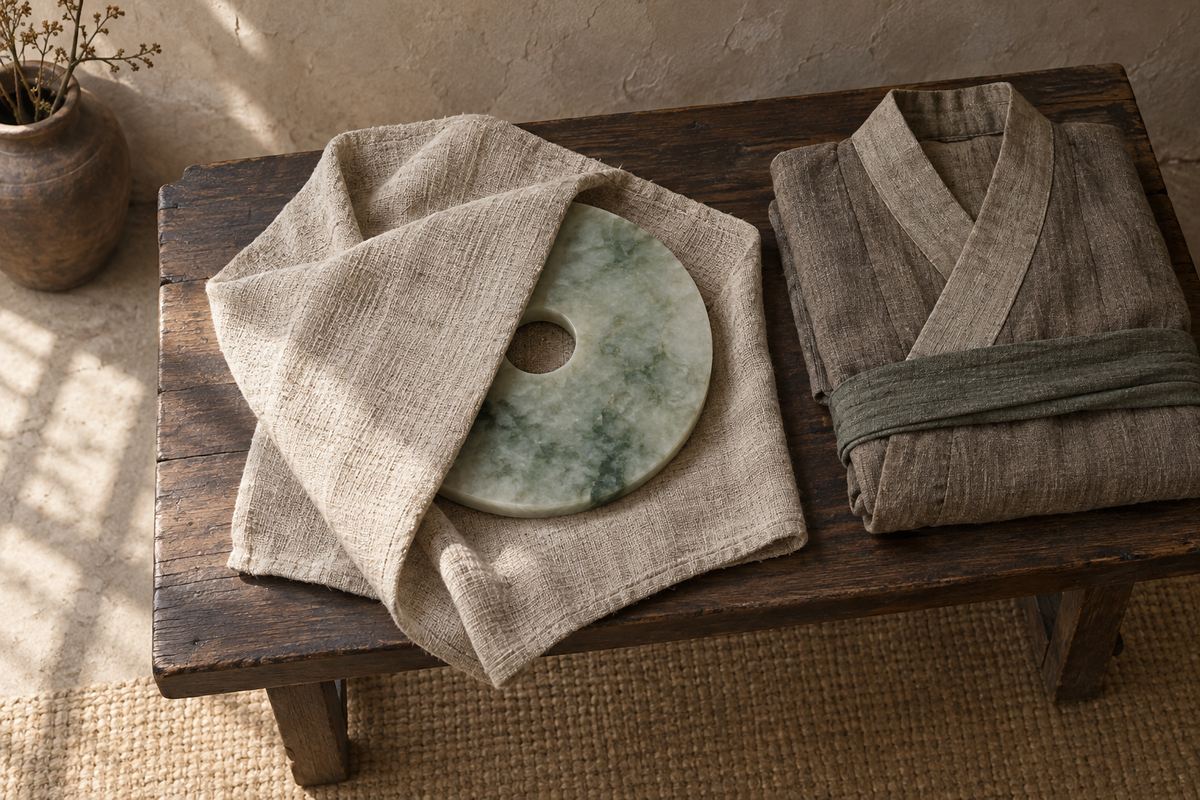
Let the design and the person’s own story guide the choice. A simple circular form may feel right for someone who loves quiet objects; a piece with a personal inscription may suit an important thank-you. He Shi Bi is a story name, so a modern piece can be described clearly by its actual material and by the cultural inspiration it carries.
A gift note can be as simple as: “May your true worth be seen, your courage stay gentle, and everything precious to you be held with care.” That wish preserves the warmth at the center of the legend. Explore the Eastern Story Blessing collection for an object that can carry your own message of appreciation, trust, or hope.

Frequently Asked Questions
Related Posts


