
A Tibetan stupa, commonly called a chorten, gives visible form to a wish for wisdom, compassion, peace, and awakening. Rising beside monasteries, roads, mountain passes, and homes, it can hold sacred deposits, remember a teacher or event, welcome prayer and pilgrimage, and gather a community around a shared hope for well-being. For travelers, its white silhouette may become a quiet invitation to slow down. For practitioners, it can be a living focus of devotion, merit, and aspiration.

The Tibetan term is written mchod rten and commonly romanized as chorten or chöten. Spellings vary, so no single English form represents every Tibetan-speaking region. The wider English word stupa comes through the ancient Indian Buddhist tradition. “Pagoda” belongs to the same broad architectural history, but it usually suggests East Asian tower forms and is less precise for a Tibetan chorten.
Why Tibetan stupas matter
A chorten matters because it brings teaching, memory, place, and action together. Its form evokes the awakened presence of the Buddha and the path toward awakening. Its sealed interior may preserve texts, images, relics, or other sacred deposits. Its surrounding path makes space for circumambulation, while its position in a village or landscape can hold generations of communal memory.
People approach stupas with many aspirations: to cultivate wisdom, remember compassion, welcome peace and harmony, dedicate goodness to loved ones, or carry a difficult season with steadiness. In Tibetan Buddhist life, walking around a chorten is believed to accumulate merit and support beneficial intentions. The stupa therefore stands as both a monument and a relationship—renewed whenever someone repairs it, makes an offering, walks its path, or pauses nearby with a sincere wish.

From an ancient Indian stupa to a Himalayan chorten
The stupa began in ancient South Asia as a burial and commemorative mound. Buddhist communities used stupas to enshrine relics connected with the Buddha and, later, revered teachers. As Buddhism traveled, the form developed through different materials, artistic languages, climates, and ritual traditions.
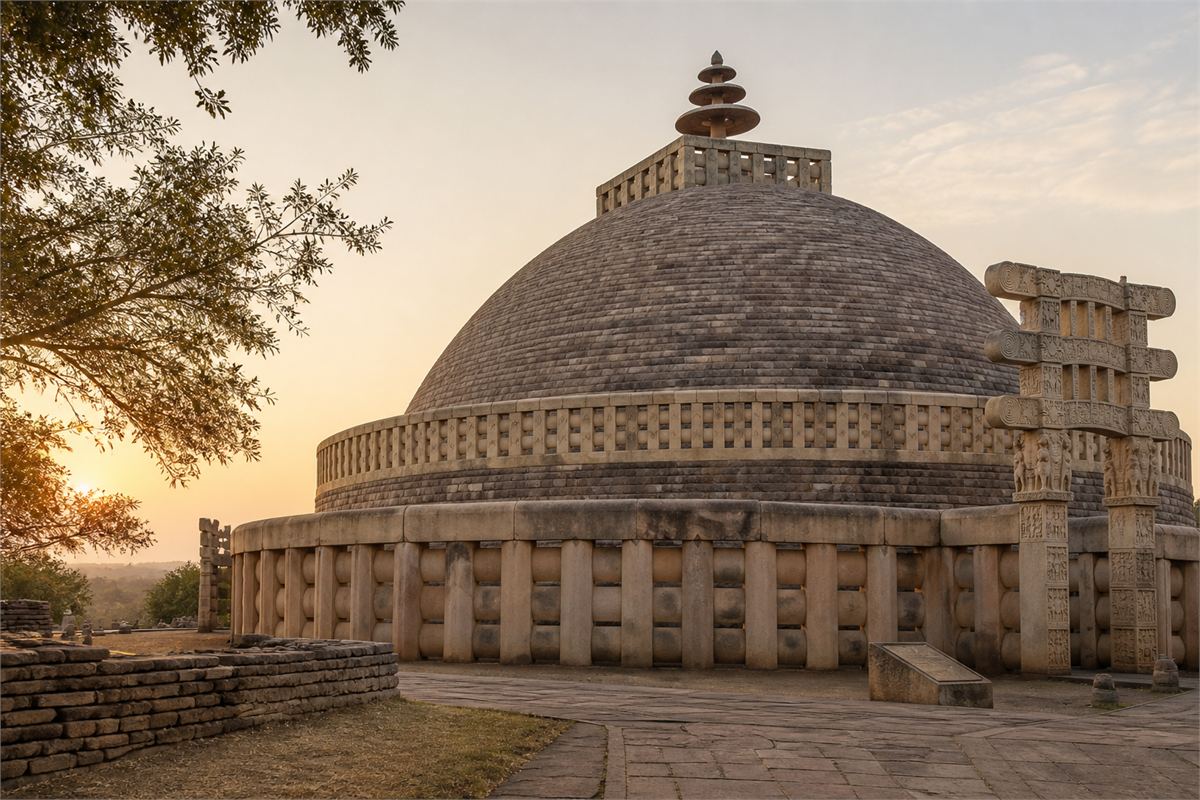
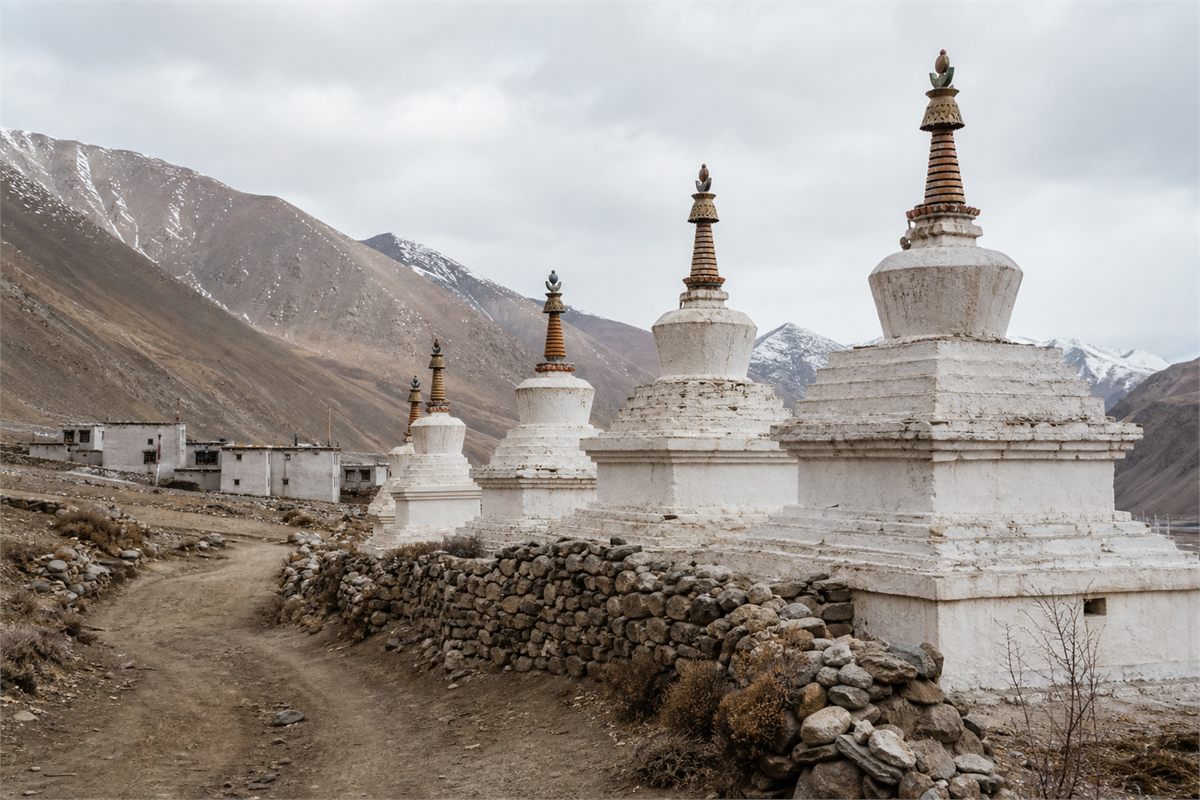
In Tibetan and Himalayan regions, chortens took many forms rather than one fixed design. Some are monumental structures; others stand in rows along a route, mark a monastery approach, hold a teacher’s memory, or appear as small metal altar objects. Tibetan styles grew from Indian Buddhist foundations through centuries of regional interpretation and exchange. It is therefore more accurate to speak of related Tibetan stupa traditions than a single unchanging “standard white tower.”
How to read the structure of a Tibetan stupa
Many Tibetan chortens share a recognizable upward rhythm: a stepped base, a rounded vase or dome, a smaller square section, a tapering spire, a parasol-like crown, and a finial that may include sun-and-moon forms. These names are useful for looking, but counts and symbolic explanations vary by lineage, design, region, and text.

| Typical part | What it looks like | A helpful way to understand it |
|---|---|---|
| Stepped base or throne | Square or many-sided terraces | A stable foundation and an ordered approach |
| Vase or dome (bumpa) | The rounded central volume | The gathered body of the reliquary and monument |
| Upper square section | A smaller transition above the dome | A bridge between the full body and rising spire |
| Rings or spire | A narrowing sequence that rises upward | Progress on the path; the exact count and interpretation depend on tradition |
| Parasol, sun, moon, and finial | The crowning elements | Dignity, shelter, wisdom, compassion, and culmination in different readings |
| Sealed interior | Usually invisible after completion | A sacred center prepared for the purpose of that particular stupa |
Some explanations connect the building’s geometry with earth, water, fire, wind, and space; others emphasize stages of practice or qualities of awakening. These are meaningful interpretive systems, but they should not be flattened into one universal code. Likewise, the “thirteen rings” seen on many examples should not automatically be called thirteen heavens or one fixed set of bodhisattva levels. The most reliable interpretation comes from the monastery, community, or tradition responsible for the structure.
The famous Buddha eyes at Boudhanath and Swayambhu belong to the Newar visual world of the Kathmandu Valley. They are striking features of those monuments, not a component that appears on every Tibetan white chorten. A painted eye, an opening, a niche, and an ornamental gateway are also different features and should not be treated as interchangeable.

The Eight Great Stupas and the story of the Buddha
Tibetan Buddhist traditions commonly present eight stupa forms that remember key moments in Shakyamuni Buddha’s life. English and Chinese translations vary, and individual monuments may adapt the details. The names below are widely used guideposts rather than a rigid naming system for every lineage.
| Common English name | Also called | Event remembered | Wish it can call to mind |
|---|---|---|---|
| Lotus Blossom Stupa | Heaped Lotuses or Birth Stupa | The Buddha’s birth at Lumbini | New beginnings, human potential, and a life opening with goodness |
| Enlightenment Stupa | Awakening or Bodhi Stupa | Awakening at Bodhgaya | Clarity, courage, and freedom from confusion |
| Many Auspicious Doors Stupa | Turning the Dharma Wheel or Many Gates Stupa | The first teaching at Sarnath | Wisdom shared generously and many doors into understanding |
| Great Miracle Stupa | Miracle Stupa | The miracles at Shravasti | Confidence in awakening and the transformation of obstacles |
| Descent Stupa | Descent from the Heaven of the Thirty-Three | The Buddha’s return after teaching his mother in a celestial realm | Gratitude, remembrance, and compassionate return |
| Reconciliation Stupa | Harmony or Reunion Stupa | The healing of division within the monastic community | Reconciliation, patient listening, and renewed harmony |
| Complete Victory Stupa | All-Victorious Stupa | The Buddha’s agreement to remain for a further period when requested | Perseverance, flourishing life, and the victory of beneficial purpose |
| Parinirvana Stupa | Nirvana Stupa | The Buddha’s passing at Kushinagara | Peace, completion, remembrance, and continuity of the teachings |
The eight forms tell a life story through architecture: birth, awakening, teaching, extraordinary activity, compassionate return, restored harmony, enduring purpose, and peaceful completion. They are not fixed prescriptions for pregnant people, students, older adults, or anyone facing a particular problem. A reader may instead meet them as a broad language of hope—wisdom for learning, harmony for relationships, peace for remembrance, and courage for a new chapter.

What may be inside a chorten
A stupa may contain Buddhist texts, dharani, small sacred images, miniature stupas, offerings, and—in some memorial contexts—relics or cremated remains connected with a revered teacher. Some structures have a prepared central axis. Others commemorate an event or embody teaching without containing human remains. The contents and their arrangement depend on the stupa’s purpose, lineage, institution, and local practice.
Consecration and the preparation of deposits belong to trained religious communities. They are not a home craft recipe. Visitors should not open a stupa or model, improvise sacred contents, handle relics, or attempt a ritual filling without guidance from the responsible monastery or tradition. Human remains, religious antiquities, protected animal materials, and cultural heritage objects also carry serious ethical and legal responsibilities.

Stupa, relic stupa, tsa tsa, and gau are not the same
| Object | What it is | Important distinction |
|---|---|---|
| Monumental chorten | A built stupa in a monastery, settlement, route, or landscape | Its design and deposits belong to a particular community and purpose |
| Memorial or relic stupa | A stupa associated with sacred relics or the memory of a teacher | Not every chorten is this type |
| Miniature stupa | A small model or sacred altar object in metal, clay, wood, or another material | It may be empty, ritually prepared, or made as a devotional image |
| Tsa tsa | A molded clay image, often depicting a deity or a small stupa | It has its own devotional history and is not simply another name for a model tower |
| Gau | A portable shrine or amulet box | It is not automatically a reliquary and need not contain remains |
| Mani stone or mani wall | Stone carved or painted with sacred text or imagery, often arranged in groups | It is not a stupa, even when it shares a pilgrimage landscape |
Museums preserve small Tibetan stupas that evoke the Buddha’s presence and teachings at altar scale. Their dignity comes from form, context, and intention, not size. A respectful modern keepsake can be a museum publication, architectural photograph, ordinary art print, or clearly modern model. Sacred deposits, consecrated objects, relics, antiquities, and objects bearing unknown texts deserve a different level of care and should not be treated as casual souvenirs.

How to walk around and visit a stupa respectfully
Circumambulation means moving around a sacred focus. In many Tibetan Buddhist places, people walk clockwise while keeping the chorten on their right. Other religious traditions and individual sites may follow different patterns, so the best visitor rule is simple: read the signs, observe the local flow, and follow the monastery or site manager’s guidance.

- Walk calmly and avoid blocking the circumambulation path.
- Do not climb the stupa, cross offerings, or step on prayer flags, mani stones, or sacred objects.
- Distinguish the stupa body from prayer wheels. Some prayer wheels are intended to be turned; follow their direction and local instructions.
- Keep voices, music, and phone use quiet around people who are praying or prostrating.
- Ask before photographing a person, ritual, interior, or restricted area. A greeting or bow is not permission.
- Avoid flash when it may disturb worship or damage sensitive interiors.
- Follow site-specific rules for shoes, clothing, offerings, lamps, incense, and access.
There is no universal visitor requirement to complete 1, 3, 7, or 108 rounds, recite a mantra, carry beads, turn a prayer wheel, prostrate, or perform a dedication. These are meaningful practices for those who follow them, not a tourist performance. A visitor may simply walk gently, make room for practitioners, and hold a wish for peace, health, harmony, or the well-being of loved ones. Repeated steps often create a personal sense of quiet and reflection without needing a medical explanation.

Stupas as landscape, memory, and community
A chorten can mark a monastery approach, village edge, route, pass, river crossing, or remembered life. Seen from a distance, a white stupa may feel like a spiritual landmark: a sign of human presence, care, and a place where wishes have been carried across generations.

Its life continues through communal action. Craftspeople build and repair it; families and donors support it; religious specialists care for its sacred purpose; local people whitewash surfaces, maintain the path, make offerings, and gather on important days. The chorten holds memory because people continue to meet around it. In that sense, its wisdom is not locked inside stone—it lives through compassion, generosity, and shared responsibility.

Places that reveal different stupa traditions
Representative sites are most useful when they show variety rather than compete through “largest” or “highest” claims.
- Boudhanath and Swayambhu, Kathmandu Valley: both belong to the UNESCO-listed Kathmandu Valley monument zones. Their white hemispheres, gilded upper structures, and Buddha eyes express the distinctive Newar heritage of Nepal. UNESCO describes Boudhanath as the largest stupa in Nepal and Swayambhu as the valley’s oldest Buddhist monument.
- Gyantse Kumbum: this monumental Many Auspicious Doors chorten shows how a stupa can also become an extraordinary multi-level architectural and artistic world. Its many chapels make it an exceptional case, not the model for every chorten.
- Miaoying Temple White Stupa, Beijing: the Yuan-period white stupa is associated with the Nepalese artist and architect Arniko and shows the movement of Himalayan Buddhist architectural knowledge into imperial China.
- Eight stupas at Kumbum Monastery, Qinghai: a row of white stupas offers a clear way to see the Eight Great Stupas as a connected narrative of the Buddha’s life.
Opening hours, photography rules, routes, and fees can change. Check the responsible site or local authority before traveling instead of relying on a general cultural guide.

Keeping the meaning close in everyday life
A photograph, book, contemporary model, or stupa-inspired piece can become a gentle reminder of wisdom and compassion. Place religious imagery in a clean, considered space; avoid putting it on the floor or in a location treated carelessly. Do not open a sealed model, invent a filling practice, or reproduce an unfamiliar mantra merely as decoration.

The most meaningful object is one connected to a true personal story: a journey remembered, a loved one held in thought, a wish for restored harmony, or a new beginning welcomed with clarity. It can serve as a medium through which people hope to bring about peace, health, virtue, longevity, wisdom, or a specific good outcome in life.
To understand the wider setting, read Eastern Story’s introduction to Tibetan Buddhism. The prayer wheel guide explains an important but distinct devotional object, while the Buddhist enlightenment guide explores the aspiration expressed by the stupa’s upward form. You can also browse the Eastern blessing collection for meaningful objects chosen to carry care, peace, and good wishes.
Frequently Asked Questions
Related Posts


