
A Hainan huanghuali bracelet is a bead bracelet made or marketed as the fragrant heartwood of Dalbergia odorifera, the species most closely associated with Hainan Huanghuali (海南黄花梨). A sound choice begins with material identity, then looks at heartwood proportion, color, grain continuity, bead shape, drilling, repairs, finish, fit, and seller disclosure. Scent, weight, sinking, grain, pores, or a supposed glow cannot settle species, origin, age, or naturalness by themselves.
This Hainan huanghuali bracelet guide explains the wood before the symbolism. It covers the names used in the market, heartwood and sapwood, familiar grain descriptions, round and shaped beads, practical buying observations, substitutes and surface treatments, realistic USD market tiers, wearing, hand play, and care. Its focus is visual wood character and workmanship, keeping it distinct from scent-led agarwood and sandalwood bracelets.
What is Hainan huanghuali?
In careful botanical usage, Hainan huanghuali normally refers to Dalbergia odorifera, a tree in the legume family whose native range includes Hainan and parts of southeastern China. The Chinese name jiangxiang huangtan (降香黄檀) points to its fragrant wood, while “huanghuali” is the better-known historical and market name. The species was formally published under its current botanical name in 1963, but the material culture attached to huanghuali is much older.
Huanghuali became especially important in Ming- and Qing-period furniture and fine woodwork. Its strength, workable structure, warm color, and animated figure allowed craftspeople to create restrained forms in which joinery and natural grain did much of the visual work. That history helps explain why a small bracelet can evoke connoisseurship and classical craft, but it does not mean every bead strand was once imperial material or carries a uniform historical pedigree.

Heartwood, sapwood, color, and scent
The valued portion is primarily heartwood, the inner wood formed as a tree matures. It may appear honey brown, golden brown, orange-red, reddish brown, purple-brown, or nearly dark brown, often with deeper streaks. Sapwood is the younger outer zone and is generally paler. A bead can include different proportions of the two, and color also changes with lighting, moisture, oxidation, cut direction, polishing, and surface treatment.
Freshly exposed or gently warmed wood may carry a light, sweet-spicy fragrance associated with the Chinese name jiangxiang. Finished beads can smell faint, intermittent, or nearly neutral. A short smell check may reveal added perfume or a strong surface odor, yet aroma intensity is not a ranking system. It varies with the wood, exposed surface, storage, finish, temperature, and the observer.

Market names are not botanical grades
Retail language often compresses a complicated wood trade into a few memorable names. “Vietnamese huanghuali,” “Laos huanghuali,” and “Myanmar rosewood” may refer to different Dalbergia species, other genera, or shifting regional trade categories. A Chinese product name alone cannot make these materials the same species as D. odorifera, nor does a country label create a fixed quality ladder. Descriptions of Vietnamese material as universally sour-smelling, or Laos material as uniformly harsh and inferior, turn variable observations into unreliable rules.

The labels youli (油梨), kangli (糠梨), and ziyouli (紫油梨), as well as “black meat,” “red meat,” and “yellow meat,” are market or local classifications rather than standardized botanical grades. They can be useful when two sellers share the same vocabulary, but they should not be read as equations. Western material is not automatically dense and stable, eastern material is not automatically light or crack-prone, and a purple-toned bead need not show strong purple fluorescence. Density, moisture, heartwood proportion, cut, finish, and individual tree growth all affect what the eye and hand perceive.

How grain patterns form—and what their names mean
Huanghuali is famous for figure created where growth, fiber direction, knots, crotches, burls, and the angle of the cut interact. Dealers and collectors use vivid names such as ghost face or ghost eye (鬼脸/鬼眼), paired eyes (对眼), tiger stripe, mountain-and-water, ripple, butterfly, X pattern, burl figure, sesame dots, and crab-leg lines. These names describe an appearance; they are not one universal value scale.

| Market description | What may create the look | How to use the term |
|---|---|---|
| Ghost face, ghost eye, paired eyes | Curved grain around a knot or localized growth feature, revealed by the cut | Compare continuity around each bead rather than treating the name as proof of origin |
| Tiger stripe, mountain-and-water, ripple | Alternating fiber direction, color bands, and a tangential or angled surface | Judge balance across the strand and visibility in natural light |
| Butterfly or X pattern | Mirrored or crossing figure created by grain orientation and bead turning | Notice whether the pattern follows the wood around the curve |
| Burl figure, sesame dots, crab-leg lines | Irregular growth, knots, vessel features, or dense changes in fiber direction | Inspect for fills and structural weakness near complex areas |
Dramatic figure can be beautiful without carrying a promise of collectibility or future value. Full burl, paired-eye, and ghost-face descriptions do not independently establish Hainan origin. Look for printing, transfers, joined shells, compressed composites, resin-filled areas, and manipulated surfaces, but do not condemn a strand merely because its pattern looks orderly or repeats. Turning neighboring blanks from one board can naturally produce related motifs.

Bead shapes, sizes, and bracelet construction
Round beads are the familiar choice: they show grain from changing angles and roll easily against the wrist. Barrel beads create longer viewing surfaces; abacus beads sit flatter and make a more architectural rhythm. “Old-style” beads usually have softened barrel-like profiles whose exact proportions vary by maker. A listing may also describe apple-round, drum, carved, or irregular beads. These are design choices, not automatic price grades.
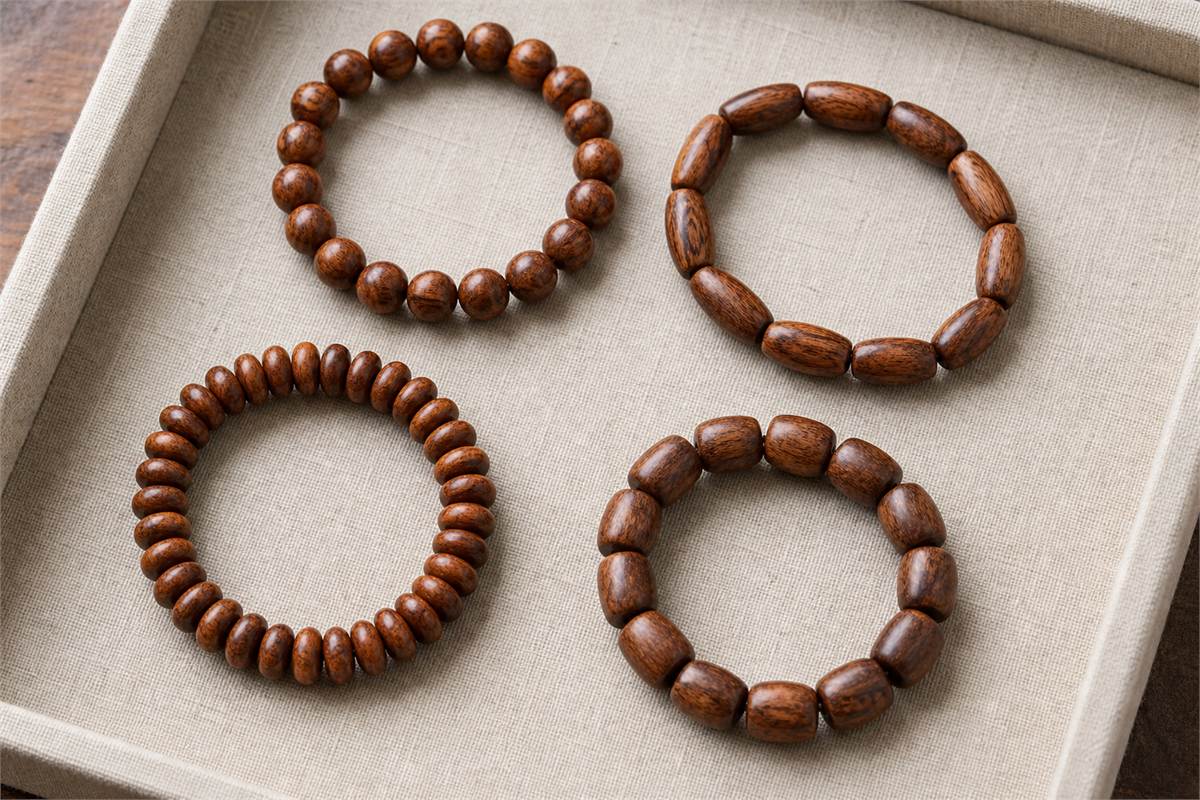
Diameter changes the visual weight and the amount of raw material lost during turning. Common listings use millimeters, while larger round beads may be described as 1.5 or 2.0 centimeters. A 13 × 14 mm old-style bead is often marketed through the number 1314, a modern Chinese sound association with yisheng yishi (一生一世), “for a lifetime.” That makes it an appealing romantic gift design, not a mandatory or “golden” size.

- Confirm bead diameter, number of beads, inner circumference, and intended fit.
- Check whether the strand uses elastic, woven cord, a clasp, spacers, or a pendant.
- Look for centered holes, clean rims, consistent roundness, and adequate cord thickness.
- Ask for the total weight only as a construction fact, not a species verdict.
A 2.0 cm single-wrap bracelet has no universal “correct” weight. Bead count, hole diameter, moisture, density, heartwood and sapwood proportion, repairs, spacers, and accessories all change the total. Figures such as 50–55 g, or claims that more than 60 g must be another wood, are not dependable rules. Likewise, a strand that sinks in water does not separate Hainan huanghuali from a material sold as zitanliu.
How to inspect a bracelet before buying
Start with non-destructive observation. View the whole strand and individual beads in indirect natural light. Turn several beads to see whether figure continues around the curved surface. Examine drill holes, visible pores or vessel openings, color transitions, repair lines, glue residue, and the edge of any coating. Check roundness, bead-to-bead matching, cord material, fit, and the seller’s description of wood, finish, repair, and origin.

Smell the strand briefly at room temperature rather than chasing fragrance through heat or abrasion. Compare the recorded bead size with a ruler or caliper and confirm the measured total weight. These observations can reveal inconsistencies and help compare two listings, but aroma, heaviness, sinking, so-called fluorescence, dramatic grain, or visible pores cannot stand alone as a species, location, age, or naturalness test.
Substitutes, composites, and surface treatments
Zitanliu (紫檀柳) is a commercial nickname that may be applied to more than one wood. Vietnamese-origin huanghuali-type material, Myanmar rosewood labels, and other reddish or figured woods also appear beside Hainan huanghuali in the market. None can be separated reliably by a single smell or weight shortcut.
Common interventions include dye, added oil, oil soaking, heavy wax, thick clear coating, resin or glue filling, repairs, joined components, compressed wood, printed figure, and beads made from another species. A finish is not automatically deceptive—light wax may be openly used in woodcraft—but undisclosed treatment changes appearance, care, and price comparison. Inspect junctions around complex figure, the rims of holes, unusually glossy low areas, and color collecting in pores. Do not use burning, hot needles, knives, alcohol wiping, or soaking to investigate a finished bracelet.

Hainan huanghuali bracelet price tiers in USD
The following figures organize market tiers described in bracelet sales material; they are not an official price schedule. Two overlapping retail grids use different labels for similar merchandise, so the middle ranges should be read together rather than added into a false ladder. Asking prices can move with lawful source, raw-stock size, heartwood proportion, color and grain matching, material loss, bead diameter, workmanship, repair, finish, and market conditions.

| Market tier described | USD range | How to interpret it |
|---|---|---|
| Entry listings | $500–$2,000 | Often presented with quieter straight, tiger-stripe, or landscape-like figure; construction and disclosure still matter more than the tier name |
| Mid-market pattern-focused listings | $2,000–$8,000 | Listings may emphasize ripple or localized eye-like figure and strand matching |
| Overlapping mid-to-high grid | $3,000–$10,000 | A second market description overlaps the previous range and often stresses clear figure, darker color, or mature-looking stock |
| Premium asking tier | $8,000–$30,000 | Frequently marketed through strong matching, dramatic figure, larger beads, lower visible repair, and higher material loss |
| Collector-marketed threshold | $10,000+ | An overlapping label used for purple-brown material or scarce-looking figure; it is not a botanical category |
| Exceptional asking tier | $30,000+ | Reserved in the source market grid for especially dramatic burl or paired-eye presentations and large material demands |
Price does not transform a market description into a material fact, and a named pattern does not create an investment outcome. Compare what is actually disclosed: bead count and diameter, total weight, heartwood appearance, matching, repairs, coating, cord, and workmanship. Large beads can cost more because they require larger clean blanks and create more waste, but size alone does not decide value.
Meaning, history, and modern gift stories
A Hainan huanghuali bracelet can express respect for classical furniture, fine joinery, patient craftsmanship, and the beauty of natural variation. Warm color and restrained polish suit gifts for a parent, mentor, partner, collector, tea lover, or someone drawn to understated Eastern design. The 13 × 14 mm “1314” format can add a contemporary “for a lifetime” message when that wordplay suits the relationship.

Modern sales language sometimes calls the wood “gold among woods,” a “wealth wood,” or a protective object. Ghost-face grain is also occasionally tied to warding-off stories. These phrases work best as market lore, folk wishes, or gift narration—not as a claim about what the bracelet will do. The material’s historical and aesthetic story is already substantial without promises about luck, health, sleep, anxiety, career, study, or physical well-being.
Huanghuali vs agarwood, sandalwood, and other wood bracelets
| Bracelet material | Main source of interest | Buying emphasis |
|---|---|---|
| Hainan huanghuali | Dalbergia odorifera, flowing figure, color, classical furniture and craft associations | Precise material wording, grain continuity, heartwood appearance, construction, repair, and finish |
| Agarwood | Resin formation within wood and its complex aromatic character | Resin distribution, scent profile, material form, treatment, and intended use |
| Sandalwood | Aromatic heartwood from Santalum species and devotional or scent traditions | Species wording, heartwood, fragrance, bead construction, and surface treatment |
| Other wood beads | Color, carving, symbolism, affordability, or general wearability | Exact wood name, stable construction, disclosed finish, and fit |
Choose huanghuali when visible wood character and furniture-craft history lead the decision. Choose agarwood when resinous aroma is central, and sandalwood when a softer heartwood fragrance or mala context is central. Keeping those questions separate makes it easier to compare the materials without treating every fragrant or figured wood bracelet as interchangeable.

How to wear and style a huanghuali bracelet
Wear the bracelet on the hand that offers the best combination of comfort and lower collision risk. The non-dominant wrist often contacts fewer doors, desks, tools, and hard watch cases, but work habits differ. Modern sayings about “left receives, right releases,” right-hand removal of negative energy, ritual cleansing, or breakage absorbing misfortune have no single traditional rule behind them. Treat them as optional contemporary folklore and choose by daily movement.

For a fuller hand-by-hand decision, use Eastern Story’s left-or-right wrist guide. Although written around bangles, its practical questions—dominant hand, watch position, work surface, impact, and fit—also help with wood-bead strands.
Huanghuali pairs naturally with linen, dark cotton, wool, tea-brown leather, muted jade, or one restrained metal detail. Leave space between wood beads and a hard watch case so they do not knock together. Round 15–20 mm beads make a strong statement, while smaller rounds, barrel beads, abacus beads, and 13 × 14 mm old-style beads sit more easily in layered styling. Shape and size change presence and wearability, not the species or intrinsic grade.
Hand play and daily care
“Hand play,” or panwan (盘玩), simply means handling and rotating the beads as a tactile hobby. Clean, dry hands and gentle contact are enough. There is no need for a rigid schedule of cotton gloves, three days on and two days off, or a promised “glass-bottom” surface. Color and sheen may change with handling, oxidation, wear, and the original finish, but every strand ages differently.

- Avoid prolonged immersion, trapped sweat, perfume, skincare products, and household cleaners.
- Keep the strand away from strong sun, extreme heat, heating vents, and rapid humidity changes.
- Remove it for swimming, showering, strenuous exercise, and impact-prone work.
- Wipe lightly with a dry, soft, odor-free cloth; let it dry completely before storage.
- Store it separately from harder stones, metal edges, and strongly scented materials.
- Do not add oil or a heavy wax layer on your own; these can darken the surface, trap residue, and obscure grain.
If elastic loosens, cord frays, a hole rim chips, or a filled area changes, stop wearing the bracelet until the construction is repaired. Care is less about forcing a dramatic patina and more about keeping the beads dry, clean, structurally secure, and visually honest.
Responsible sourcing and long-term perspective
Dalbergia woods face conservation and trade pressure, and Dalbergia odorifera is included in the CITES Appendix II genus listing. Buyers should favor lawful, clearly described material and responsible use, while avoiding stories that romanticize illegal logging, smuggling, or cutting historic furniture into beads. Reclaimed and old-stock claims also deserve careful context because an attractive story is not the same as a transparent chain of ownership.

The most satisfying bracelet is not necessarily the darkest, heaviest, loudest, or most expensive. It is the one whose material description, visual evidence, finish, construction, price, and intended use agree. That combination respects both the wearer and the long cultural life of huanghuali.
Hainan Huanghuali Bracelet FAQ
Related Posts


