
Bracelet bead count meaning depends on context. In a Buddhist mala, the count may support recitation and carry a tradition-specific interpretation. In a Feng Shui bracelet sold for everyday wear, a number may instead come from Chinese wordplay, folk symbolism, or modern product storytelling. For fit, however, the practical rule comes first: measure your wrist, choose the actual bead size and components, and test the finished strand before treating any count as fixed.
A bead count can express a wish, preserve a religious association, or act as a personal reminder. It is not a predictor of wealth, health, protection, relationships, examinations, or career results. This guide separates Buddhist counting traditions from folk numerology and modern marketing, then shows how to calculate a comfortable bracelet.
Start with wrist size, not a lucky number
Bead count is not an independent bracelet size. Two strands with the same number of beads can fit very differently because bead diameter, bead shape, drilling, knotting, spacers, charms, clasps, and cord tension all change the usable circumference.
A practical way to estimate the count
- Measure the wrist at the point where the bracelet will sit. Keep the tape close to the skin without compressing it.
- Add a comfort allowance. About 1–2 cm, or enough room for one finger, is a useful starting point for many round-bead bracelets, but adjust it for personal preference and the design.
- Use the bead’s actual measured diameter, not only the advertised nominal size. Account for spacers, knots, a focal bead, charms, a clasp, or an adjustable section.
- Divide the target inner circumference by the approximate effective pitch of one bead to obtain a starting count.
- Make a test strand and try it on. Round beads sit differently from flat discs, barrels, nuggets, or oval beads, so a calculation is an estimate rather than a finished answer.
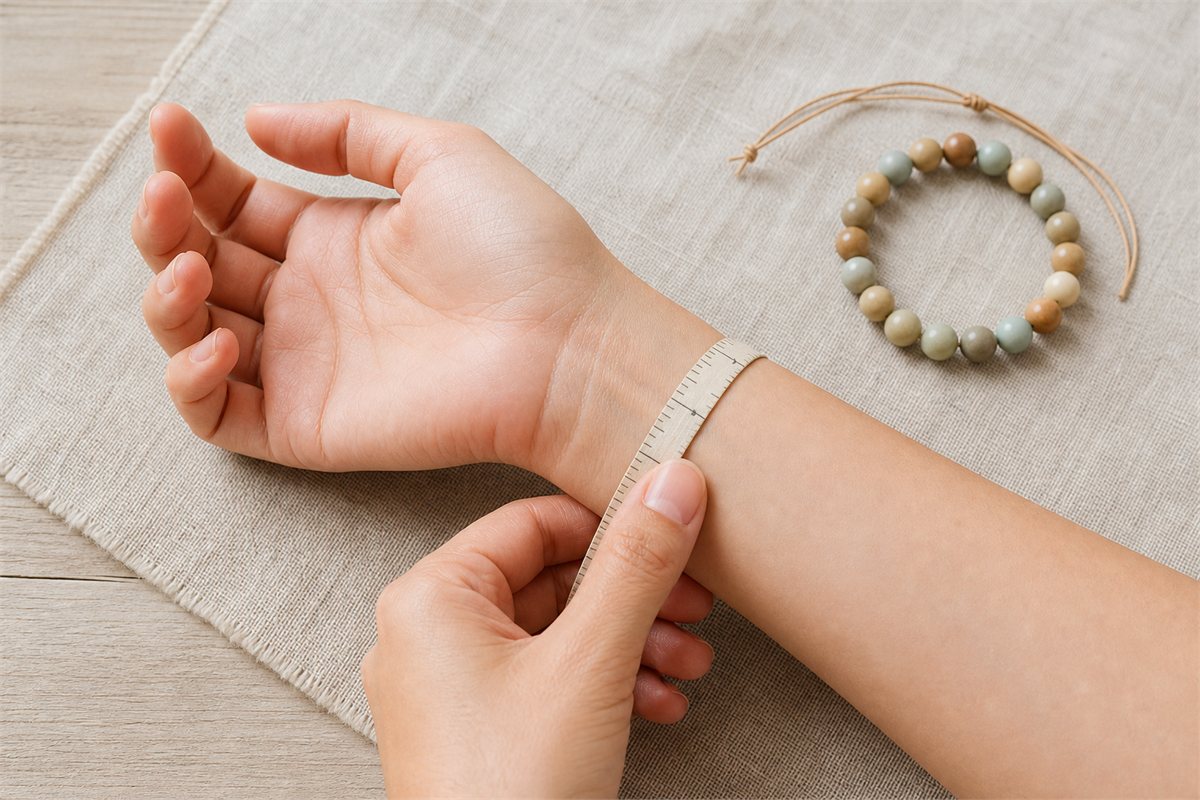
For example, 9 large beads, 18 medium beads, and 27 small beads can produce similar overall lengths. If 9 beads are about 18 mm each, 18 beads are about 9 mm each, or 27 beads are about 6 mm each, the simple bead-only total is roughly 162 mm in every case. Real bracelets will differ because holes, curvature, gaps, cord, and fittings change how the strand closes around the wrist.

A comfortable bracelet should move without sliding off or striking objects constantly. Excessive tightness can leave pressure marks or cause numbness and discomfort; excessive looseness increases the chance of loss and impact damage. Remove the bracelet if numbness, swelling, skin-color change, or pain persists, and seek appropriate help when needed. For hand choice and collision risk, see our left-or-right wrist guide: dominant-hand use, comfort, and daily activity are more useful than a universal energy rule.
Where bracelet bead-count meanings come from
Online bead-count charts often place several unrelated systems in one list. A clearer reading separates four sources:

- Buddhist prayer-bead practice: malas or prayer beads are counting tools for recitations, names, mantras, breaths, or other practices. Counts and construction vary across schools and regions.
- Doctrinal interpretation: a tradition may connect a count with a Buddhist list such as the Eighteen Realms. These explanations are meaningful within their setting but are not specifications for every bracelet.
- Chinese language and folk symbolism: a number may be valued for sound, visual balance, calendrical association, or popular numerology.
- Modern jewelry marketing: sellers frequently attach prosperity, romance, protection, or personality claims to a convenient product count. These are contemporary narratives unless a clear tradition and source are identified.
The same number can belong to more than one category. Eight, for example, may be used in Buddhist explanations of the Noble Eightfold Path, while modern Chinese-language jewelry often emphasizes its sound association with fa (发), “to prosper.” Those are different ideas and should not be blended into one ancient Feng Shui rule.

Common bead counts and careful interpretations
| Count | Source category | A careful way to understand it |
|---|---|---|
| 1 | Design and modern symbolism | A single focal or “turning” bead can represent unity, simplicity, or a chosen intention. It is usually a design statement, not a standard mala. |
| 3 | Buddhist and broader folk symbolism | In Buddhist language, three can recall the Three Jewels: Buddha, Dharma, and Sangha. Other Eastern explanations use heaven, earth, and humanity. Context determines which reading applies. |
| 6 | Buddhist lists and modern wordplay | Six may recall the six sense faculties in Buddhist teaching. The phrase liu liu da shun (六六大顺), “everything proceeds smoothly,” is a popular Chinese blessing rather than a universal religious bead rule. |
| 7 | Folk, cosmological, or product symbolism | Seven is sometimes connected with the Big Dipper or other regional symbolic systems. A seven-bead bracelet is more often a compact design or modern symbolic piece than a standard Buddhist count. |
| 8 | Wordplay, Buddhist reference, or modern marketing | Eight may evoke fa (发), prosperity, in Chinese wordplay, or the Noble Eightfold Path in a Buddhist setting. Neither reading assigns a guaranteed result to a bracelet. |
| 9 | Imperial, cosmological, and popular symbolism | Nine has associations with completeness, high yang symbolism, and the sound of jiu (久), “long-lasting.” Jewelry use is usually symbolic rather than a single Taoist or Feng Shui requirement. |
| 10 | Modern idiom and design | Ten is often marketed through shi quan shi mei (十全十美), “complete and perfect in every respect.” Treat this as an idiomatic blessing and modern design meaning, not an ancient uniform rule. |
| 12 | Buddhist doctrine, calendar, or zodiac | Twelve can refer to the twelve links of dependent origination in Buddhism, or to months and zodiac cycles in secular symbolism. A seller should state which framework is intended. |
| 14 | Specific Buddhist interpretations | Some East Asian Buddhist explanations connect fourteen with Guanyin’s Fourteen Fearlessnesses. This is a particular religious interpretation, not a general Feng Shui bracelet standard. |
| 18 | Buddhist practice and doctrine | Eighteen-bead malas are documented as shortened prayer-bead forms. In Buddhist explanation, eighteen commonly relates to the Eighteen Realms—the six faculties, six objects, and six consciousnesses. Calling every 18-bead bracelet an “Eighteen Arhats” bracelet oversimplifies the tradition. |
| 21 | Practice-specific or modern interpretation | Twenty-one appears in some Buddhist practices and prostration counters. Claims about a single universal set of “21 stages” vary by tradition and should be identified rather than presented as a general rule. |
| 27 | Buddhist counting structure | Twenty-seven is one quarter of 108 and is used in shorter malas or as a division within a full strand. Interpretations involving groups of Buddhist sages occur in some traditions, but the counting function is the more dependable general explanation. |
| 36 | Shortened counting strand and later symbolism | Thirty-six is one third of 108 and can support repeated rounds. Lists of “36 protective deities” or fixed benefits are tradition-specific or commercial explanations, not a universal meaning. |
| 54 | Buddhist counting structure | Fifty-four is half of 108. Some East Asian interpretations associate it with stages on the bodhisattva path, but the exact list depends on the doctrinal system. |
| 108 | Widely established Buddhist mala count | A full 108-bead strand is common in Buddhist practice and is often associated with the many afflictions or causes of negative karma. Several traditional explanations exist; no single multiplication formula needs to be treated as the sole authority. |
| 1080 | Rare extended ritual count | Strands or counts of 1,080 appear in some religious explanations and large-scale practice contexts. They are extremely unusual for an ordinary wrist bracelet and do not indicate a wearer’s rank or identity. |

Numbers such as 16, 19, or 41 also appear in online sales charts, but their promised effects are usually weakly sourced or assembled from modern numerology. A complete-looking table is less useful than a shorter explanation that names its cultural level honestly.

Buddhist mala structure is not one universal format
A full mala may include a larger terminal bead, dividers, counters, cords, tassels, or other fittings, but terminology and arrangement vary by Buddhist school, region, lineage, and practice. Some strands divide 108 counting beads into groups of 27; other traditions use different visual and functional structures. The terminal bead, separators, and counters may not be included in the recitation count.

That variation matters when buying. Ask whether the listed number means counting beads only or includes the focal bead, spacers, and decorative parts. If the object uses a Buddha head, scripture, the Six-Syllable Mantra, Guanyin imagery, or a count explicitly tied to religious practice, approach it as more than an “activation” accessory. A mala used for recitation has a different purpose from a fashion bracelet inspired by its appearance.

Modern Feng Shui rules: custom, preference, and sales language
“Wear odd, not even,” “men wear even and women wear odd,” “left in, right out,” and “replace what your Five Elements chart lacks” are common modern folk or commercial sayings. They do not form one consistent system, and they have no scientific basis as rules about energy entering or leaving the body. The same is true of claims that another person must never touch a bracelet, a broken strand absorbed disaster, a bracelet must be removed in hospitals or cemeteries, or wearing both wrists disrupts a field.
These ideas may be mentioned as personal customs, family habits, or product stories. For daily wear, choose the wrist that reduces impact, accommodates writing and work, and feels comfortable. A count can be a symbolic reminder of patience, commitment, gratitude, or a wish for prosperity; practical choices and personal actions determine what follows.

Choose the design after you choose the fit
Elastic, cord, clasp, and adjustable structures
Elastic strands are easy to put on, but thick cord and tight holes can make large beads sit farther apart. Knotted cord adds length between beads. Metal clasps, extender chains, and adjustable sliding knots change both circumference and weight distribution. Flat spacers may add little length but still alter the way rigid beads turn around the wrist.

What to check before buying
- Does the actual bead count match the listing, and what components are included in that count?
- What are the measured bead diameter, inner bracelet circumference, and recommended wrist range?
- Are the beads round and evenly drilled, with smooth hole edges and suitable spacing?
- Is the bracelet’s total weight comfortable for the intended use?
- Is the elastic, cord, knot, clasp, or adjustable section appropriate for the bead weight?
- Do metal components contain materials that may irritate the wearer?
- Are treatments, dyes, coatings, composites, and material names clearly disclosed?
- Can the size be adjusted, restrung, or returned if the fit differs from the listing?
Do not use coolness, a tingling “energy” sensation, or bead count as a test of material identity. Price is driven by the disclosed material, bead diameter, matched color and pattern, roundness, polish, drilling, carving, spacers, findings, cord or clasp quality, labor, and overall finish. Because the supplied price references were not clear and specific enough to apply consistently, this guide avoids a forced price table.
Material-aware care and safety
Care should follow the material, not a fixed cleansing ritual. Wipe most finished beads with a soft cloth, avoid impact and unsuitable chemicals, and store pieces separately so harder materials and metal fittings do not scratch softer ones. Extreme heat and sudden temperature changes can damage many stones, coatings, adhesives, and cords. See the jewelry care guide and material guide for broader handling principles.
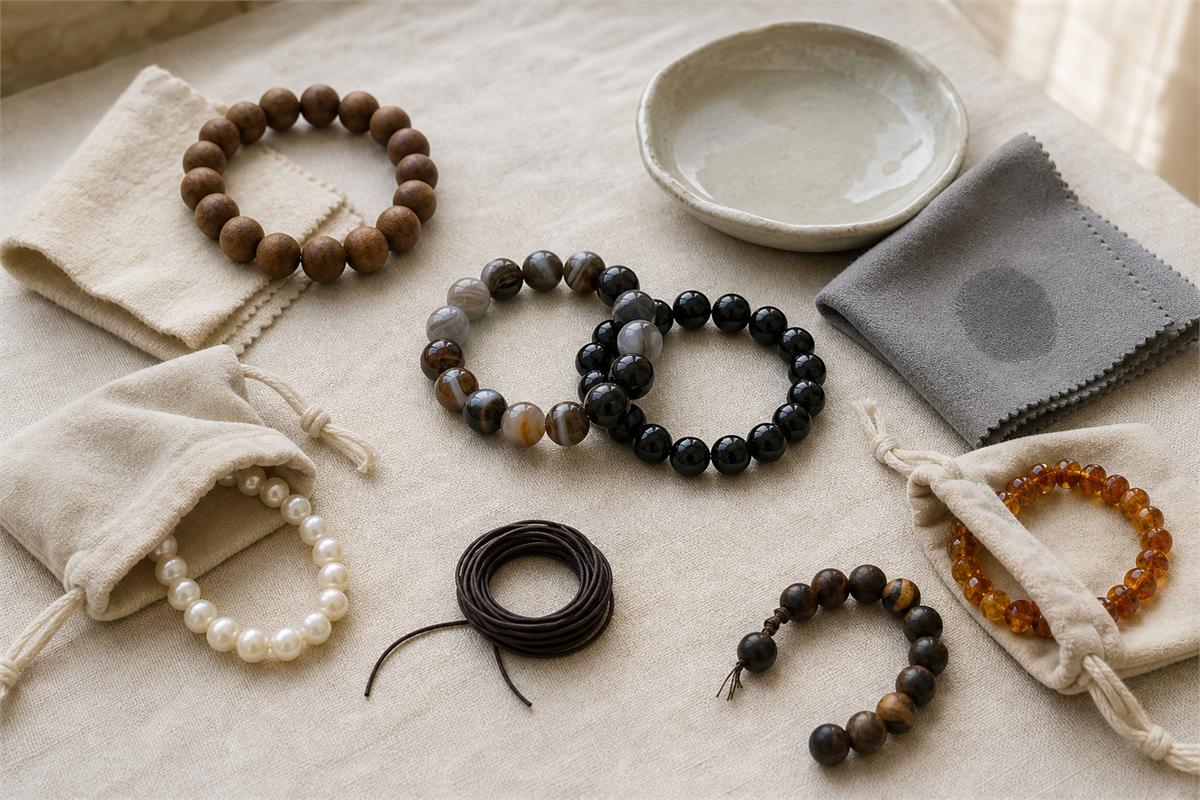
- Wood and bodhi seeds: avoid soaking and prolonged dampness; wipe gently and allow the strand to dry naturally.
- Crystal, jade, agate, and obsidian: protect from hard knocks and use cleaning appropriate to the specific stone and any treatment.
- Pearls and amber: keep away from abrasive surfaces, harsh cleaners, heat, and prolonged contact with cosmetics.
- Dyed, glued, coated, or composite beads: minimize water and solvents because finishes and adhesives may change.
- Metal components: keep dry when appropriate and watch for skin irritation or corrosion.
- Cinnabar or zhusha (朱砂): cinnabar contains mercury sulfide. Do not grind, sand, heat, or place it in the mouth, and use particular caution with jewelry intended for children.
Replace elastic or cord when it shows fraying, looseness, loss of elasticity, damaged knots, or abrasion at bead holes. Wear patterns are more useful than a rigid two-, three-, four-, or six-month schedule.
A clear way to choose your bead count
First decide whether the bracelet is a religious counting tool, a culturally inspired symbolic object, or an everyday jewelry design. Then measure the wrist, select the material and actual bead size, calculate a starting count, and test the assembled strand. If a traditional number fits comfortably and its context matters to you, keep it. If it creates a poor fit, use a different bead size, a wrap format, an adjustable closure, or a different count.

For readers exploring symbolic jewelry as a personal reminder or gift, the Eastern Story Blessing collection offers another path: begin with the story and intended expression, then choose a construction that is comfortable enough to wear in real life.
Frequently Asked Questions
Related Posts


