Crystal glass is decorative glass; quartz is a crystalline mineral. They can both be beautifully clear, but they are different materials. Crystal glass has a disordered, amorphous structure, while quartz has a repeating atomic arrangement. Quartz glass, also called fused silica or fused quartz, is another material: high-purity silica in glass form, without the crystal structure of quartz.
A bright pendant, a carefully chosen bracelet, or a glass ornament can become part of a personal story. Understanding its material lets you appreciate the maker’s work and care for something you hope to keep. The word “crystal” alone is not enough to tell you whether an object is mineral quartz, decorative glass, or a technical silica glass.

Crystal glass vs quartz: the names at a glance
| Material name | What it actually is | Where you commonly meet it |
|---|---|---|
| Crystal glass | Manufactured amorphous glass with a formula chosen for decorative clarity, brilliance, and working qualities; may contain lead or use a lead-free formula. | Faceted beads, ornaments, chandeliers, and stemware. |
| Natural quartz crystal | Naturally formed crystalline silicon dioxide, SiO₂. Colorless transparent quartz is traditionally called rock crystal. | Jewelry, carvings, crystal specimens, and mineral collections. |
| Synthetic quartz crystal | Laboratory-grown crystalline SiO₂, commonly grown hydrothermally. It is quartz, with a different growth origin. | Electronic and optical components, and some gemstones. |
| Ordinary soda-lime glass | Silica-based amorphous glass made with ingredients including soda and lime. | Bottles, windows, everyday glassware, and beads. |
| Quartz glass / fused silica | High-purity amorphous SiO₂; fused quartz generally starts with natural silica, while synthetic fused silica uses chemical precursors. | Specialist optical components, semiconductor equipment, and laboratory parts. |
Glassmaking names describe a material and a craft tradition; they do not turn glass into a mineral crystal. Equally, “synthetic quartz” describes a grown crystal, not melted glass. For the wider relationship between natural stones, grown crystals, and imitations, explore our natural crystal and artificial crystal guide.

What is crystal glass made of?
Crystal glass is usually a silica-based glass whose other ingredients adjust how it bends light, disperses color, flows when hot, and responds to shaping and cutting. Traditional lead crystal contains lead oxide. Lead-free formulas can use other ingredients, including oxides of barium, zinc, and potassium. The exact recipe varies between manufacturers.
The material remains amorphous: it has no repeating crystal lattice extending through the glass. “Crystal” in this setting describes a glassmaking category or trade name. It does not mean that quartz crystals have grown inside a drinking glass.

What does 24% lead crystal mean?
Under the European Union’s crystal-glass naming rules in Directive 69/493/EEC, the category “lead crystal 24%” requires at least 24% lead oxide (PbO) by mass and a density of at least 2.90 g/cm³. “Full lead crystal 30%” requires at least 30% PbO and a density of at least 3.00 g/cm³. These are specific regional category requirements, not the composition of every object sold internationally as crystal glass.
Lead-free crystal can have excellent brilliance and precision cutting. Its weight, scratch resistance, and resistance to impact depend on the actual composition, design, and manufacture. The words “lead-free” alone do not establish that a glass is lighter, tougher, or suitable for every use.
Is Swarovski crystal natural quartz?
Swarovski crystal is manufactured crystal glass, not natural rock crystal. Its sparkle comes from the material, precise cutting, and, where used, surface effects. The brand’s 2026 Components Collection describes its current crystals as having no intentionally added lead, with lead content of 40 parts per million or lower—equivalent to 0.004%. That current specification should not be applied retrospectively to every vintage item, or to every other component of a finished piece of jewelry.

What makes natural quartz a crystal?
Quartz is silicon dioxide with an ordered crystal structure. At ordinary temperatures it belongs to the trigonal crystal system, although its familiar natural habit is a six-sided prism ending in pointed faces. A cut bead has lost that outer form; a carved glass point can imitate it. Shape and internal crystal structure are different things.

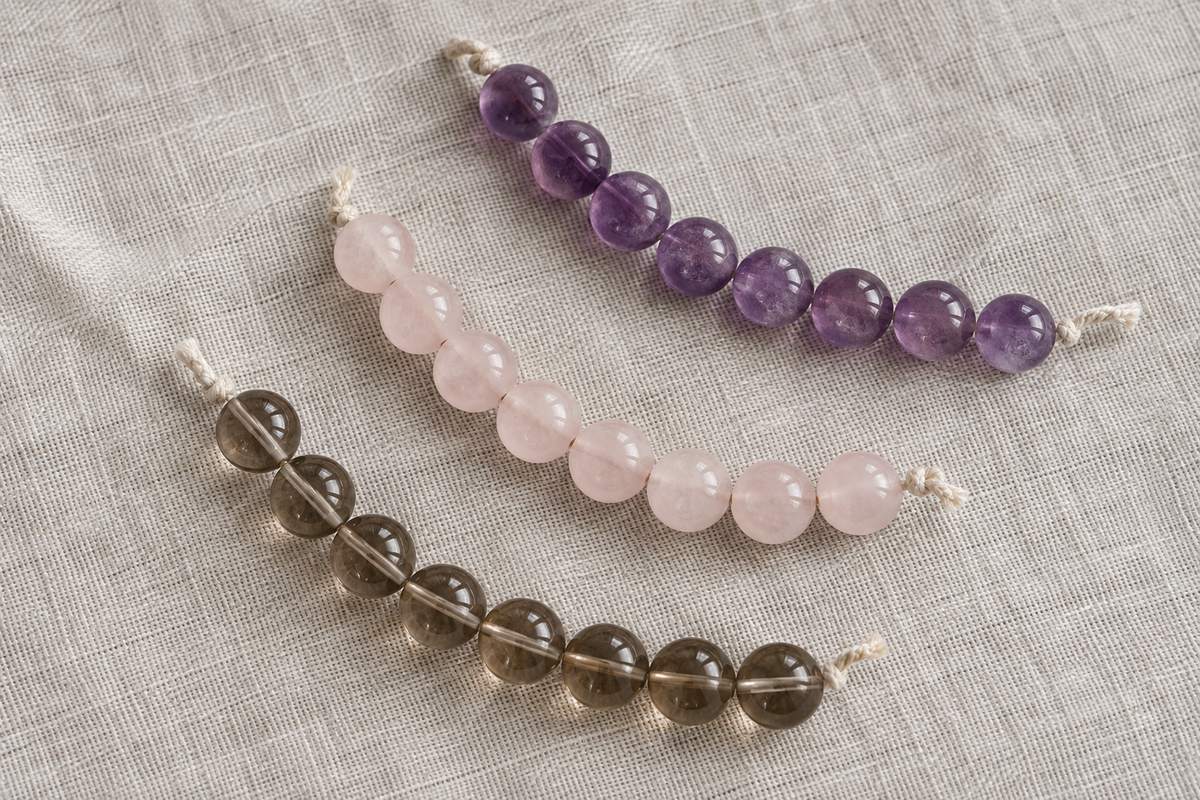
Clear quartz is the colorless variety. Purple quartz gives amethyst bracelets their familiar color. Other varieties include yellow citrine, pink rose quartz, smoky quartz, and quartz containing visible mineral inclusions. Some crystals are clear to the eye; others contain clouds, fractures, color zoning, or mineral needles. Transparency is an appearance, not a separate mineral species or proof of natural growth.
The quartz family also includes finely crystalline materials. Chalcedony is composed of extremely small crystals; agate is especially associated with banded chalcedony, while jasper is generally opaque and colored by other material. Quartz-rich rocks and ornamental aggregates need their own names rather than being described as perfect single crystals.
Different inclusions and textures can create striking effects. Rutilated quartz contains rutile needles, while the moving band of light in tiger eye comes from its fibrous structure. These natural patterns offer much of the appeal of quartz jewelry, but an attractive pattern by itself does not establish origin or treatment.

Sparkle, refraction, and the limits of a double image
Refraction is the bending of light as it enters a material. Dispersion is the separation of different colors of light, which contributes to the rainbow flashes often called fire. Luster describes how a surface reflects light. Quartz commonly has a vitreous, or glass-like, luster; this is why “glassy” is not a reliable synonym for imitation.

Quartz has typical refractive indices of about 1.544 and 1.553. Their difference, approximately 0.009, is its birefringence. It is not a refractive index of 0.009. Quartz also has relatively low gemological dispersion, about 0.013 on the conventional B–G wavelength comparison, so it generally shows less rainbow fire than highly dispersive gem materials.
Birefringence means that light can experience two refractive indices depending on its polarization and direction through the crystal. Both natural and synthetic quartz share this property. In everyday jewelry the effect can be subtle, and looking through a bead at printed words is unreliable: orientation, thickness, curved surfaces, and reflections all affect what you see. An absent double image does not rule out quartz, and a doubled-looking letter does not establish natural origin.
Unstressed, homogeneous glass is optically isotropic rather than inherently birefringent like quartz. Stress in glass can nevertheless produce optical effects under polarized light. A simple “four light, four dark” rule is therefore not a complete identification method for a finished object.
Cut crystal glass can give lively flashes because its formula and facets work together. More facets do not automatically make a better piece: angles, symmetry, polish, lighting, foils, and coatings matter. Descriptions such as soft, lively, cool, or brilliant can convey what you enjoy looking at, but they cannot tell you the material’s identity.

Hardness, weight, and why both materials can feel cool
Quartz has a Mohs hardness of 7. Many everyday and decorative glasses are softer, but “glass” covers too many formulas for a single hardness number to describe them all. Heraeus lists 5.5–6.5 for its quartz-glass base materials. Hardness means resistance to scratching, not resistance to being dropped: quartz and glass can both chip, especially around edges and drilled holes.

| Material or reference category | Density | What that means in your hand |
|---|---|---|
| Quartz crystal | About 2.65 g/cm³ | A useful material property, but bead size, drilling, and other components change a bracelet’s weight. |
| Typical soda-lime float glass | About 2.50 g/cm³ | Only moderately less dense than quartz; not enough to identify a small object by feel. |
| Heraeus fused-quartz / fused-silica base materials | About 2.20 g/cm³ | Lower density than crystalline quartz despite sharing SiO₂ chemistry. |
| EU lead-crystal 24% category | At least 2.90 g/cm³ | Can be heavier than an equal volume of quartz; glass is not always the lighter material. |
A cool sensation comes from heat leaving your skin. It depends on more than thermal conductivity: starting temperature, contact area, size, heat capacity, and how long you hold the object all matter. Quartz, ordinary glass, and crystal glass can all feel cool in the same room. None remains cool indefinitely simply because it is natural.
Crystalline quartz transfers heat more readily than fused silica. For scale, Crystran lists quartz-crystal conductivity of about 6.2 and 10.7 W/(m·K) in different crystal directions at 323 K (about 50°C); Heraeus lists quartz glass at about 1.38 W/(m·K) at 20°C. Those reference conditions differ, but the figures make clear why quartz glass should not be assigned crystalline quartz’s thermal behavior. Touch cannot measure these values.
A ringing tone is also shaped by the whole object: its dimensions, wall thickness, suspension, and any damage. A wineglass, solid carving, and drilled bead cannot be compared by a universal ringing-versus-dull rule. Knocking beads together risks damaging the very edges you want to preserve.

Quartz glass: useful heat resistance, with specific limits
Quartz glass is prized for low thermal expansion. Heraeus gives a mean expansion coefficient of about 0.51 × 10⁻⁶ K⁻¹ over 0–100°C for its listed base materials. The small change in size with temperature helps explain its usefulness in demanding thermal applications. It does not make every silica-glass object suitable for direct flame or sudden cooling.
Glass softens across a range rather than having one simple crystal melting point. A quoted value such as 1,730°C should never be read as a universal safe-use temperature for quartz glass. Manufacturer data are grade-specific: Heraeus lists softening temperatures of 1,710°C for electrically fused quartz, 1,660°C for flame-fused quartz, and 1,600°C for its listed fused-silica category. Its corresponding continuous working-temperature figures are much lower: 1,160°C, 1,110°C, and 950°C.
Purity, hydroxyl content, manufacturing route, surface condition, and the use environment affect performance. For an actual technical part, the maker’s grade and operating instructions take precedence over the word “quartz.” Natural quartz jewelry is not laboratory glassware and should be protected from abrupt temperature changes.

Where each material belongs
Jewelry, ornaments, and glass craft
Quartz offers mineral color, geological character, and a wide range of inclusions and textures. Crystal glass offers controlled color, repeatable shapes, precise facets, and the expressive possibilities of glassmaking. Either can be chosen for a personal keepsake or a thoughtful gift. Fine glass deserves appreciation for its own artistry; it does not need to pretend to be a mined gemstone.
For another expression of glass in Eastern jewelry, liuli bracelets (琉璃) bring color and light into objects chosen to carry blessings. Liuli is a glass-art tradition and retail term, not a single universal lead content or chemical formula.

Electronics, optics, and high-purity silica
Crystalline quartz is piezoelectric: mechanical stress and electrical response are connected in its crystal structure. Precisely cut quartz resonators, commonly made from synthetic quartz, provide stable timing in watches and electronic devices. This is different from the mechanical role of a bearing, and it is not a property of ordinary fused-silica glass.
High-purity silica glass is used in semiconductor processing components, optical fibers, and specialist windows or lenses. Suitable grades transmit selected ultraviolet, visible, or infrared wavelengths; transmission depends on wavelength, purity, and thickness. Optical glass is a much broader engineering family, with formulas designed for particular refractive and dispersion requirements. It is not a low-grade substitute that is always outperformed by fused silica.
Quartz countertops and quartzite
An engineered quartz countertop combines mineral particles with binders and pigments. Natural quartzite is a rock made mainly of interlocking quartz grains. Neither is a single quartz crystal, and neither should be confused with decorative crystal glass or fused silica. A countertop’s performance depends on the complete material, support, fabrication, and installation, so the hardness of quartz alone cannot establish the strength of a slab.
What labels and visible details can tell you
A useful description names the material plainly: natural quartz, synthetic quartz, lead crystal glass, lead-free crystal glass, or fused silica. For jewelry, it should also identify relevant coatings, dyes, fillings, backing, and other components. “Austrian crystal,” “crystal bead,” and “melted crystal” need that extra material detail. The last phrase is a trade description, not proof that the object is high-purity fused silica.
If quartz is melted and cooled into an amorphous state, the result is glass rather than hydrothermally grown quartz. Hydrothermal synthetic quartz grows as a crystal from solution. It can share natural quartz’s chemistry, hardness, density, and optical properties, so those properties alone cannot distinguish their growth origins.
Under magnification, flow marks, mold seams, bubbles, wear, inclusions, and fractures may help you understand how something was made. They need context. A bubble in glass is different from a gas bubble inside a fluid inclusion in natural quartz; a very clean natural crystal is possible, and a synthetic crystal can contain inclusions. A pointed outline or flawless appearance does not settle the question.
Crackle quartz is quartz with a conspicuous network of fractures, often enhanced and sometimes dyed. Color concentrated along cracks can be a sign of treatment, but the appearance is not a complete material diagnosis. Use the stated treatment information to guide gentle care; solvent rubbing, scratching, acids, and heat shocks can damage stones, coatings, adhesives, and settings.

Price also reflects many things beyond material: size, color, cut, rarity, workmanship, and the maker. There is no dependable dollar cutoff at which a clear bead becomes glass or a natural stone becomes valuable. Choose a piece whose description is clear and whose appearance, story, and craftsmanship appeal to you.
Using crystal glass for food and drink
For everyday food and drink, choose lead-free tableware intended for that purpose. Lead can migrate from lead crystal into its contents; more acidic foods and drinks, and longer contact, increase transfer. Health Canada advises using lead-free tableware especially for infants, children, and pregnant people, and storing food and drink in lead-free containers.
If you use lead crystal, Health Canada recommends occasional serving rather than storage. Wine, fruit juice, and other acidic drinks should not be left in a lead-crystal decanter or glass for extended periods. Brief serving involves less contact than overnight storage, but it is not a promise of zero lead transfer. Decorative ornaments and jewelry components should not be repurposed as drinking vessels.

Keeping the surface clear and the object beautiful
Jewelry and decorative pieces
Begin with the requirements of the whole piece. A plain quartz stone, a glued glass pendant, a coated bead, and a bracelet on elastic need different handling. Wipe gently with a soft cloth; use mild soapy water only where the stone, setting, finish, and stringing permit it, then dry thoroughly. Avoid long soaking of glued or strung pieces.

Protect faceted edges and bead holes from impacts. Store pieces separately so harder stones do not rub softer surfaces. Keep perfume and cleaning products away from coatings and adhesive settings. Avoid steam cleaning quartz jewelry, and leave ultrasonic cleaning of fractured, treated, glued, or mixed-material pieces to the maker’s specific guidance. Amethyst and some other colored quartz can be affected by excessive heat or prolonged strong light. Our jewelry care guide explains care for mixed materials.

Drinkware and cloudy glass
For crystal drinkware, follow the maker’s instructions. A mild detergent, soft sponge, and gentle handwashing are appropriate for many pieces, including lead crystal; abrasive pads can scratch the surface. Keep cold glasses away from boiling water and sudden temperature changes. Only use a dishwasher when the maker allows it.
Cloudiness has several possible causes. Mineral deposits or detergent residue may sit on the surface. Chemical corrosion or etching can change the surface itself and may leave permanent haze. Some unstable historic glass develops fine cracking and weathering known as crizzling.

Devitrification specifically means crystals forming from glass. It is different from ordinary deposits and surface corrosion. A glass turning cloudy during household use should not automatically be described as crystallizing, and it has not become natural rock crystal. Avoid aggressive polishing of fragile or historic pieces; choose care appropriate to the actual cause and object.
Choosing a piece you will enjoy keeping
The clearest difference is structural: quartz is crystalline, while crystal glass and fused silica are amorphous. From there, each material has its own appeal. You may love the quiet inclusions of quartz, the precision sparkle of cut glass, or the luminous color of a glass artist’s work.
For a gift, pair that appeal with a story that feels personal—a celebration, a new beginning, or a wish for peace. Explore the Eastern Story blessing collection for pieces chosen to carry meaning, and let the individual material description guide their care.

Frequently Asked Questions
Related Posts