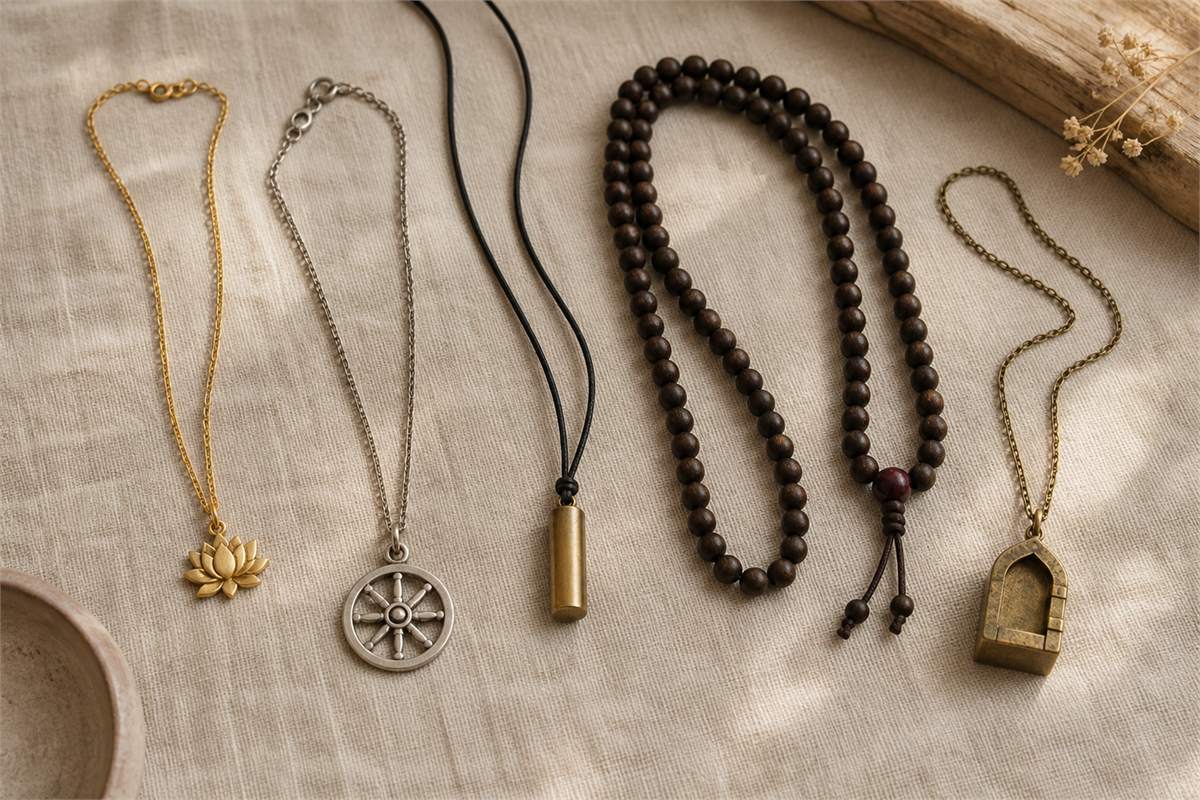
A Buddhist necklace is a necklace that carries a Buddhist image, symbol, sacred text, prayer-bead structure, or an object inspired by Buddhist art. It may be devotional, cultural, or personal, but those roles are not interchangeable. A lotus pendant can hold a wish for clarity and renewal; a Buddha or bodhisattva image can recall compassion, wisdom, courage, or a particular vow; and a mala is a counted strand used in practice rather than an ordinary necklace with spiritual styling.
The most meaningful choice begins with knowing what the piece actually depicts. Accurate identification protects the story carried by the necklace and helps the wearer choose with warmth and respect. For many people, it becomes a quiet daily reminder to meet life with a clearer mind, a kinder heart, and the intention of ping'an ruyi (平安如意)—peace, safety, and the hope that life unfolds as wished.
What counts as a Buddhist necklace?
| Type | How to recognize it | What it may carry |
|---|---|---|
| Buddhist-symbol necklace | Lotus, Dharma wheel, endless knot, Eight Auspicious Symbols, or another recognized emblem | A concise visual reminder of teachings, interdependence, awakening, or auspicious wishes |
| Buddha or bodhisattva pendant | A named figure identified through posture, hand gesture, crown, seat, and attributes | Devotion or remembrance of qualities such as compassion, wisdom, joy, and courage |
| Mantra or text pendant | Legible Sanskrit, Tibetan, Chinese, Siddham, or another script | Sacred words associated with a particular figure, teaching, or practice |
| Prayer beads or hanging mala | A counted strand made for recitation, sometimes with markers or a distinct junction bead | A practical aid for counting and a companion to practice |
| Vajra, stupa, prayer-wheel, or mandala-inspired pendant | A specific ritual, architectural, or diagrammatic form | A connection to a particular Buddhist visual or practice tradition |
| Modern Buddhist-inspired jewelry | A simplified motif made primarily as contemporary jewelry | A personal reminder or cultural expression when the design is described accurately |
Not every pendant is a ritual implement, and not every string of beads is a mala. A miniature prayer-wheel shape may be a fixed jewelry design rather than a working wheel. A circular geometric pendant is not automatically a mandala. These distinctions do not reduce emotional meaning; they let the wearer understand the object without borrowing a religious identity it does not have.
Buddha and bodhisattva pendants: identify the figure first
“Buddha necklace” is often used as a broad retail label, yet a pendant may depict Shakyamuni, Amitabha, a bodhisattva such as Guanyin, Green Tara, Budai, or another Buddhist figure. Their identities and stories are not interchangeable. Shakyamuni is the historical Buddha; Amitabha is associated with Infinite Light and the Pure Land traditions; Guanyin is the East Asian expression of Avalokiteshvara, long connected with compassion. Budai—the round-bellied, smiling monk familiar in East Asian art—is not simply another portrait of the historical Buddha.
Look for the whole iconographic pattern: hand gestures, seated or standing posture, crown, robes, lotus seat, held objects, accompanying figures, and inscription. A modern “baby Buddha” design is a contemporary commercial style, not a fixed category found across Buddhist traditions. If the seller cannot name the figure or provide clear front, side, and back photographs, choose a well-rendered symbol instead of relying on an uncertain sacred image.

People choose image pendants for many sincere reasons: to remember compassion before speaking, to invite calm during a demanding season, to honor a family tradition, or to carry a wish for wisdom and safe passage. There is no Buddhist teaching behind the commercial saying “men wear Guanyin, women wear Buddha.” Choose according to faith background, personal aspiration, aesthetic connection, and accurate representation—not gender.
Common Buddhist symbols and the wishes they carry
A symbol necklace can feel quieter than a figure pendant while still carrying a rich story. Meanings depend on the exact image and tradition, so a small, clearly recognized group is more useful than a catalog of vague “lucky” emblems.
Lotus
The lotus is widely associated with purity, awakening, and the possibility of rising beautifully through difficult conditions. A lotus necklace may accompany renewal, self-respect, or a new chapter. Buddhist lotus imagery should be distinguished from later literary and folk meanings in East Asia, where lotus imagery can also carry wishes connected with harmony, love, and family. Our lotus meaning guide explores those cultural layers in greater depth.

Dharma wheel
The Dharma wheel, or Dharmacakra, evokes Buddhist teaching and the path placed into motion. An eight-spoked Dharma wheel is commonly connected with the Noble Eightfold Path, but not every decorative wheel has eight spokes or carries that exact explanation. Count the spokes and inspect the design before using the more specific meaning. As a necklace, a clear Dharma wheel can be chosen as a reminder to bring understanding, conduct, and attention into daily life.

Endless knot and the Eight Auspicious Symbols
In Tibetan and Himalayan Buddhist contexts, the endless knot belongs to a set known as the Eight Auspicious Symbols: parasol, pair of golden fish, treasure vase, lotus, white conch, endless knot, victory banner, and Dharma wheel. The endless knot is often understood through interdependence, causes and conditions, and the joining of wisdom with compassion. Its woven structure should not be described as two swastikas, nor turned into a universal promise of eternal romance.

The pair of golden fish belongs to this same religious set. In that context it is often linked with freedom and fearlessness, like fish moving through water. The Chinese blessing “year after year, may there be abundance,” which plays on the sound of fish, belongs to a separate folk-symbolic tradition. Both stories can be beautiful, but they should not be merged into one invented Buddhist meaning.
Vajra, stupa, and prayer-wheel forms
A vajra is an important ritual object and symbol with histories in both Indian religion and Buddhism; within Vajrayana it is associated with adamantine clarity and powerful method. Its one-, three-, five-, nine-pronged, and crossed forms should not be assigned one universal chart of benefits. Readers who want the object rather than a necklace overview can use our guide to vajra meaning in Buddhism.
A stupa pendant refers to sacred Buddhist architecture, but stupa forms and layered interpretations vary by tradition. A hollow pendant should not be filled at home as though it were a simple keepsake compartment; religious consecration or enshrinement belongs with qualified guidance. Likewise, a pendant shaped like a prayer wheel is not automatically a functioning wheel. The history, contents, and use of an actual wheel are covered separately in What Is a Prayer Wheel?

The Buddhist swastika in modern settings
The ancient swastika appears in several Asian religions and remains visible in Buddhist art and maps marking temples. Direction, form, reading, and use vary across regions and traditions; a seller should not reduce that complexity to a rigid left-versus-right rule. In much of the modern West, the form can be confused with Nazi imagery, so consider the exact design, local setting, and how it may be understood before choosing it as visible jewelry. This is a symbol that needs context, not casual trend styling.
Mantra necklaces: readable words before decorative styling
A mantra pendant may use Sanskrit, Tibetan, Siddham, Chinese, or another writing system. Ask for a sharp close-up, the script name, a transcription, the full phrase, and the reading direction. Tiny engraving, mirrored artwork, or decorative compression can change or remove letters. If the inscription cannot be checked, choose a non-text symbol rather than repeating an uncertain translation.

Oṃ Maṇi Padme Hūṃ is closely associated with Avalokiteshvara and compassion, but it should not be treated as a generic label for every Tibetan-looking pendant. Our dedicated guide explains the meaning and context of Oṃ Maṇi Padme Hūṃ. Metal color or gemstone choice can add a personal design layer, yet it does not rewrite the words or assign each syllable a universal commercial power.
Is a Buddhist necklace the same as prayer beads?
No. A mala is a counted strand used for recitation in Buddhist and other Indian religious traditions. Counts such as 108, 54, 27, or other numbers appear in different practices, but an ordinary necklace does not become a religious mala simply because it has a particular number of beads. Junction beads, markers, counters, tassels, and methods of handling also vary; there is no single cross-tradition rule that makes every “guru bead” represent the Buddha, every string the Dharma, and every smaller bead the Sangha.

If you want a practice strand, ask which tradition and practice informed its count and construction. If you want a wearable necklace, judge fit, weight, clasp, and comfort as jewelry. A strand may serve both roles when that is consistent with the wearer’s tradition, but avoid giving yourself a universal bead-turning ritual from a product listing. For actual practice, see how to meditate with mala beads; for counted structure, visit the 108 mala beads guide.
How to choose a Buddhist necklace thoughtfully
- Name the object. Decide whether it is a symbol, named figure, text pendant, mala, amulet case, or modern inspired design.
- Match it to a wish or relationship. Compassion, wisdom, courage, clarity, remembrance, and peace create a more personal choice than a generic list of promised results.
- Check visual accuracy. Inspect faces, hands, held objects, wheel spokes, knot structure, letters, and front-to-back orientation.
- Ask what the materials really are. Distinguish solid gold karat, 925 sterling silver, stainless steel, brass, plated metal, jadeite, nephrite, turquoise, lapis lazuli, agate, obsidian, and composite materials.
- Inspect the necklace as an object. Look at the bail, jump rings, solder points, clasp, prongs, sharp edges, cord knots, and how the pendant’s weight is supported.
- Respect the religious setting. If the necklace is blessed, consecrated, or intended for practice, follow the temple, lineage, or teacher connected with it.
For a gift, learn whether the recipient welcomes sacred imagery and whether a subtle symbol would feel more comfortable than a deity image or mantra. Include a short, accurate note about the wish you are sending: compassion during change, wisdom for a new responsibility, courage through uncertainty, or ping'an ruyi (平安如意) for a loved one beginning a journey. The necklace can then carry a story without assigning belief on another person’s behalf.

Chain length, fit, and wearing safety
Fit is personal rather than gendered. Measure the neck and compare that number with the finished chain length, pendant drop, and the neckline you plan to wear. A short chain keeps a small pendant close and steady; a longer chain gives a larger piece room but allows more swing. Check that the bail is large enough for the chain, the pendant hangs upright, the back is smooth against skin, and the chain is strong enough for the pendant’s weight.

Remove a necklace before swimming, bathing, strenuous sport, sleep, or work around moving machinery. This protects both the wearer and the piece. Necklaces with cords, heavy pendants, sharp points, breakable beads, or small detachable parts are not a default gift for children; they can create strangulation or swallowing hazards. If metal causes itching, redness, or swelling, stop wearing it and check the base metal, plating, and manufacturer’s material disclosure.

Materials that deserve extra attention
Material names should be specific. “Gold” may mean 14K, 18K, 22K, or plating over another metal; “silver” should distinguish sterling silver from silver-colored alloy or silver plate. Plating can wear with friction and exposure. Jadeite and nephrite are both jade but are different minerals. Turquoise, lapis lazuli, agate, obsidian, amber, wood, and seeds have different structures and care needs. A trade name alone is not enough to predict durability, skin comfort, or treatment.

Items sold as cinnabar may be carved lacquer, a composite, or material containing mercury sulfide. Do not grind, heat, soak, or allow powder from a damaged piece to be inhaled or swallowed. Stop wearing it if it cracks, sheds powder, develops an unusual odor, or irritates skin, and keep it away from children. Coral, ivory, giant clam shell, animal bone, agarwood, sandalwood, and some other wildlife or plant materials can raise ethical and cross-border trade questions. Check the scientific species, legal origin, and current rules for the countries involved before purchase or travel; a poetic market name is not enough.

The Buddhist Seven Treasures also should not be turned into one universal shopping list. Different texts and traditions name different precious substances. A modern necklace made from agate, amber, or another familiar material can carry beauty and blessing without claiming to reproduce the only authentic set.
Respectful wear and material-specific care
Respectful care can be simple and gentle: keep sacred imagery clean, avoid stepping on or deliberately defacing it, and store the necklace where it will not be crushed or tangled. Buddhist communities do not share one universal rule about bathrooms, bedrooms, kitchens, alcohol, another person touching the piece, or a pendant always remaining above a particular point on the body. When a necklace belongs to a specific devotional setting, follow that community’s guidance rather than an online taboo list.

There is no universal cleaning ritual either. Put perfume, lotion, and household cleaners on before wearing jewelry, and avoid long soaking unless the maker confirms it is safe. Wipe metal gently with a soft cloth. Keep plated surfaces away from abrasive polish; keep porous turquoise and many organic materials away from chemicals; protect carved stone from impact; and keep wood, seeds, elastic, and woven cord from repeated saturation. Use the maker’s instructions for mixed-material pieces because the most delicate component sets the care method.

A necklace as a daily reminder and a meaningful gift
A Buddhist cultural necklace can become a quiet companion: a lotus touched before beginning again, a Dharma wheel that recalls a considered path, an image of compassion worn close during caregiving, or a mantra that returns attention to kind speech and steady action. These objects carry wishes—a medium through which people hope to bring about health, virtue, longevity, peace, or a specific outcome in life. Their warmth grows when the image is accurate, the story is understood, and the choice reflects a real relationship or life moment.

Begin with the symbol, figure, or words that genuinely speak to you. Then choose a design that is respectful, comfortable, safe, and transparent about its materials. To continue exploring meaningful objects for peace and good wishes, visit the Eastern Story Blessing collection.

Frequently Asked Questions
Related Posts


