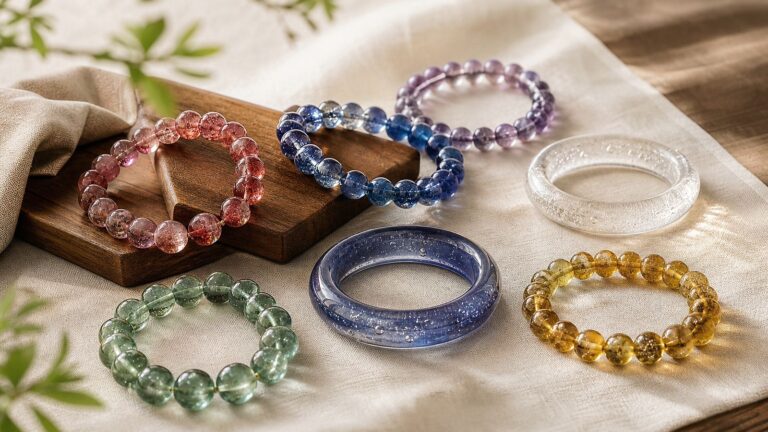
To wear a Buddha bracelet respectfully, first identify whether it carries a Buddha or bodhisattva image, prayer beads, a mantra, or simply a Buddhist-inspired design. Then choose the wrist that gives you a safe, comfortable fit and protects the piece from knocks. Buddhism has no single left-or-right wrist rule shared by every temple and tradition. If the bracelet came from a teacher, temple, or practice community, let their specific guidance lead.
A well-chosen bracelet can carry a quiet wish for compassion, clarity, patience, and kind action. It may become a small companion through ordinary days: something you notice before a difficult conversation, during a new beginning, or when offering another person a wish for peace and fulfillment. Respect begins with knowing what you are wearing and caring for it calmly.

What is a Buddha bracelet?
“Buddha bracelet” is a broad commercial phrase, not the name of one standardized Buddhist object. In an East Asian context, Buddha may be written Fo (佛), meaning an awakened one. A listing using the phrase could describe four very different things:
| Type | What to look for | What respectful wear means |
|---|---|---|
| Buddha- or bodhisattva-image jewelry | A named figure, face, posture, hand gesture, crown, lotus, or other attribute | Confirm the identity and avoid careless, mocking, or sexualized use of a sacred image |
| Buddhist prayer beads or mala | A counted strand that may include a principal bead, markers, counters, or a tassel | Follow the method of the tradition in which the beads are actually used |
| Mantra or sacred-text bracelet | Readable Chinese, Sanskrit, Tibetan, or another script | Check that the text is accurate, complete, and presented with care |
| Buddhist-inspired fashion bracelet, bangle, or cuff | Beads, lotus motifs, abstract symbols, or a commercial “Zen” description without a practice function | Enjoy it as cultural jewelry while describing its inspiration accurately |
A decorative strand does not become a mala simply because it has round beads, and an ordinary bracelet does not become a sacred implement because a seller uses the word “Buddhist.” Traditional malas may use 108 beads or other counts, but bead number and structure vary with tradition and purpose. Our guide to meditating with mala beads carries the practice-specific questions so this page can remain focused on wearing.

Look closely at the focal element too. A guru or principal bead, a stupa-shaped finishing bead, and a Buddha-image charm are different components; none should be casually translated as “the Buddha’s head.” When a bracelet has no documented tradition, do not invent a universal rule that a finishing bead must point in one direction.
Identify the image or inscription before wearing it
Shakyamuni Buddha, Amitabha Buddha, Budai, Guanyin, Manjushri, and other figures are not interchangeable. Posture, hand gestures, held objects, dress, crown, and surrounding symbols may help identify a figure, but small commercial carvings often simplify those details. A smiling, round-bellied Budai should not automatically be labeled the historical Buddha, and a modern “baby Buddha” carving is a contemporary design rather than a fixed figure with one traditional meaning.
If a seller names a figure, compare the listing with a reliable museum, temple, or Buddhist source. For example, a design specifically presented as Amitabha should agree with recognizable Amitabha imagery; the separate Amitabha Buddha guide explains that identity without turning this wearing guide into an iconography catalogue. If the figure remains unclear, choose a well-documented design or a non-figurative lotus or bead bracelet instead.

Text deserves the same care. A Heart Sutra bracelet and a six-syllable mantra bracelet carry different words, histories, and devotional settings. Clear product photographs should let you inspect every visible character. If a sacred inscription cannot be read or traced to a dependable source, a design without text is a more thoughtful choice. For detailed checks, see the guides to the Heart Sutra bracelet and Oṃ Maṇi Padme Hūṃ.
Which hand should you wear a Buddha bracelet on?
Wear it on the wrist that is comfortable, secure, and appropriate for the bracelet’s actual use. Buddhist communities do not share one doctrine assigning spiritual functions to the left and right wrists. Let the bracelet’s origin, your daily activity, and any guidance from its tradition shape the choice.
Your less-active wrist may protect a delicate carving from desks, tools, and doorframes. The other wrist may feel better beside a watch or during daily work. A practice mala may be handled in the way taught by its specific tradition. A cord tied during a temple ceremony may come with local instructions. These situations are different, and it is respectful to keep them different.

When should you change wrists?
Change sides if you notice rubbing, swelling, numbness, a rash, repeated impact, or unusual cord wear. The wish carried by the bracelet does not depend on tolerating pain. If the skin becomes painful, cold, pale, blue, or increasingly numb, remove the bracelet promptly. When it cannot be removed safely, seek professional help rather than forcing it over the hand.
How should a Buddha bracelet fit?
A good fit stays secure without compressing the wrist. Measure with a flexible tape at the place where you plan to wear the piece, keep the tape close without pulling tight, and record the actual wrist circumference. Then use the maker’s finished inner-circumference or inner-diameter chart for that exact design. Bead size, bead count, cord thickness, clasp construction, and elasticity can all change the space available inside.

| Construction | Measurement that matters | Fit check |
|---|---|---|
| Clasp bracelet | Wrist circumference plus the intended comfort allowance | The clasp closes without pinching and the bracelet cannot slide off the hand |
| Elastic bead bracelet | Finished inner circumference, bead diameter, bead count, and stretch | It passes over the hand without extreme stretching and rests without deep marks |
| Non-stretch slip-on strand | The widest part of the hand as well as the wrist | The strand passes the knuckles safely and still sits comfortably at the wrist |
| Rigid bangle | Accurate inner diameter or inner circumference and the hand’s pass-through size | It clears the widest knuckle area without soap, lotion, plastic, or force |
| Cuff | Inner dimensions, opening size, material flexibility, and the maker’s size guide | It enters as designed and does not press nerves or distort the metal |
Do not rely on a universal bangle formula to promise a fit. If joints swell or hand shape makes removal difficult, choose an adjustable or clasped design and check the return policy before wearing. Bead diameter is an aesthetic and tactile choice: larger beads feel heavier and take more inner space, while smaller beads create a quieter line.

Wear sacred imagery with calm, practical respect
Different Buddhist communities may hold different views about placing sacred images on clothing or the body. Some accept carefully worn images; others prefer images to remain on shrines or in elevated settings. There is no single rule that can speak for every temple, lineage, teacher, and practitioner. If you regard the bracelet as a faith object, ask the community connected to it. If you wear it as cultural jewelry, learn the image, keep it clean, and avoid designs that trivialize it.
- Remove the bracelet for activities where it may catch, strike a surface, become contaminated, or cause injury.
- Keep sacred images and texts away from places where they are likely to be stepped on, crushed, or soiled.
- Place the bracelet in a clean pouch, lined box, or stable place when it is not worn.
- Do not use Buddha imagery for mockery, sexualized styling, or shock value.
- If a spiritually significant piece breaks, collect its parts and ask its community for guidance when that relationship matters to you.
Daily life need not become a source of fear. A hospital visit, difficult emotion, ordinary bathroom use, sleep, or another person briefly touching a bracelet does not create one universal spiritual crisis. Remove or store the piece when cleanliness, safety, comfort, or the customs of your own community make that sensible.

Let the bracelet carry a compassionate daily intention
A Buddha bracelet is often chosen as a reminder of compassion, clear attention, patience, courage, or generous conduct. It can carry a wish for 平安如意 (píng ān rú yì)—peace and the hope that life unfolds according to one’s good wishes. These hopes give the object emotional presence without turning it into a prescription for health, wealth, or a guaranteed outcome.
You might lightly touch one bead before answering a difficult message, pause for a natural breath, or remember one kind action you want to take that day. Keep the habit gentle and personal. A decorative bracelet is not automatically a set of prayer beads, and a quiet reflection cue is not a substitute for a tradition’s meditation instruction or for health care.

Choose materials for meaning, comfort, and honest care
Material can deepen a bracelet’s story, but it also changes weight, touch, wear, and care. Ask for a precise description: “wood,” “jade,” “silver,” or “cinnabar” is not specific enough to understand what the piece is made from.

| Material | What to clarify | Everyday care |
|---|---|---|
| Wood | Exact wood name; sandalwood, rosewood, agarwood, and nanmu are not interchangeable | Use a soft dry cloth; avoid soaking, harsh cleaners, and rapid heat or humidity changes |
| Seeds and nuts | Market name and actual plant source; not every “Bodhi seed” comes from the Bodhi tree | Keep away from long soaking and inspect natural pits, cord holes, and cracking |
| Jadeite or nephrite | Which jade it is and whether the focal piece has thin carving or vulnerable drill holes | Protect from impact and chemicals; wipe gently after wear |
| Quartz, agate, obsidian, or turquoise | Exact stone and any treatment, coating, or composite construction | Follow stone-specific guidance; turquoise and coated surfaces need different care from quartz |
| Gold, sterling silver, brass, steel, or plating | Metal fineness or alloy, plating, clasp, solder, and known skin sensitivities | Keep away from perfumes and cleaners; use a method suitable for that metal and finish |
| Glass, resin, shell, or composite | Honest material label, construction, colorants, and small-part safety | Avoid heat, impact, and chemicals unless the maker specifically confirms compatibility |
“Bodhi” is especially easy to misunderstand in the marketplace. It is a Buddhist term connected with awakening, while many beads sold under the name come from different seeds, nuts, or palms. The Bodhi meaning and bead guide keeps those ideas and materials distinct.

Some materials need an extra safety or conservation decision. Cinnabar is mercury sulfide; do not buy loose powder for jewelry, heat it, soak it for a drink, sand it, or let children mouth it. Stop wearing a piece that cracks, sheds powder, or develops a failing surface. Giant-clam shell and agarwood-producing species are subject to international wildlife-trade controls, and local import rules can be stricter. Before buying or carrying them across a border, check the species, origin, current CITES listing, and the rules of both countries. Avoid ivory, coral, bone, shell, or rare wood with an unclear source, and consider plant-based or mineral alternatives that align with your ethical values.

Claims about the Buddhist “seven treasures” also vary by scripture and tradition. Crystal, silver, shell, or another material should not be presented as the one fixed list for all Buddhism. Readers who want that history can explore the separate guide to the Buddhist seven treasures.

Check construction before everyday wear
- Run a fingertip gently around carved images, bead holes, prongs, solder joints, and charm edges to find burrs or sharp points.
- Check clasps, jump rings, knots, cord covers, and elastic for gaps, whitening, fraying, or loss of spring.
- Keep heavy charms from repeatedly striking softer beads or a watch case.
- Watch for redness or itching around metal parts, especially when an alloy or plating is unknown.
- Keep small beads, detachable charms, and broken components away from young children and anyone likely to mouth them.
Mixed-material designs should be cared for according to their most delicate component. Remove a bracelet before vigorous exercise, mechanical work, prolonged immersion, or contact with perfume and household cleaners. A soft dry cloth is a safe starting point for many pieces, but wood, turquoise, silver, gold, brass, plating, elastic, and stone treatments do not share one universal cleaning method. Follow the maker’s material-specific directions.

Can a non-Buddhist wear a Buddha bracelet?
There is no single prohibition that covers every Buddhist community, but appropriateness depends on the image, inscription, local context, and way it is worn. A non-Buddhist can approach the piece by learning its identity, listening when a community explains its boundaries, and choosing a design that expresses genuine respect rather than costume or status.
You do not need to claim a religious role. Let the bracelet accompany a sincere quality you value—compassion in a demanding season, patience while learning, or courage during change. If uncertainty remains around a specific sacred object, ask someone from the tradition connected with it before wearing it.

How to give a Buddha bracelet respectfully
Begin with the recipient, not a supposed formula for luck. Ask whether they are comfortable wearing sacred imagery and whether a bracelet fits their beliefs, style, work, and daily routine. Choose the correct size, an accurately identified image or text, a clearly described material, smooth construction, and a practical return option.
A short gift message can share the wish without prescribing belief: “May this be a daily reminder of compassion and clear purpose,” or “Wishing you 平安如意—peace, safety, and fulfillment in the season ahead.” The gift then becomes an invitation to meaning, not a claim that you can decide another person’s spiritual practice.

A respectful bracelet begins with understanding
Learning how to wear a Buddha bracelet is less about memorizing a fixed wrist rule and more about building a thoughtful relationship with the object. Know whether it is image jewelry, a mala, a text bracelet, or a modern design. Confirm the figure or words, choose a safe fit, care for each material honestly, and follow the guidance of a living tradition when the piece belongs to one. Worn this way, the bracelet can remain a warm daily carrier of compassion, clarity, and a wish for a beautiful life.

Frequently Asked Questions
Related Posts