
In modern chakra and crystal culture, amethyst is most often associated with both the third-eye chakra, Ajna, and the crown chakra, Sahasrara. Its violet color carries wishes for calm, clear seeing, wisdom, intuition, self-reflection, protection, and spiritual growth. The third eye speaks to inward insight; the crown opens the story toward meaning, connection, and a wider view of life.
That makes amethyst a gentle companion for moments when you want to pause, listen more closely, and move forward with intention. It may be worn, kept near a journal, held during meditation, or given to someone beginning a new chapter. The stone does not need one rigid role: choose the meaning that meets your life today.

What is amethyst?
Amethyst is the purple variety of quartz. Its color ranges from pale lilac to deep violet and may appear uneven or zoned within a crystal. The familiar Chinese name zishuijing (紫水晶) means “purple crystal,” a simple name that captures the color at the heart of its modern symbolism.

As a real mineral and a meaningful object, amethyst can be appreciated in two ways at once. Its quartz structure, color, cut, polish, setting, and care belong to the material story. Its associations with serenity, insight, and spiritual perspective belong to the cultural and personal story. Together they make a piece feel less like decoration and more like a quiet reminder you can return to.
For larger natural forms and display ideas, the amethyst geode meaning guide explores how clusters and geodes become focal points for reflection, beauty, and welcome within a room.
Why amethyst is linked to the third eye and crown chakras
Ajna and Sahasrara belong to Indian religious and yogic traditions and later became central to the widely known seven-chakra model. In contemporary crystal practice, colors are often used to create memorable connections: indigo and deep violet are associated with the brow center, while violet, white, or clear tones are associated with the crown. Amethyst naturally sits across that violet spectrum, so many practitioners choose it for either center or for a practice that moves from insight toward a wider perspective.

| Amethyst chakra | Meaning in modern practice | A wish it can carry | Everyday companion |
|---|---|---|---|
| Third eye — Ajna | Intuition, discernment, imagination, and inward attention | “May I see clearly and trust thoughtful insight.” | Journaling, study, creative reflection, or a quiet pause before a decision |
| Crown — Sahasrara | Wisdom, spiritual connection, humility, and spacious awareness | “May I meet life with perspective and an open heart.” | Meditation, prayer, gratitude, contemplative reading, or marking a new chapter |
| Third eye and crown together | Insight joined with meaning | “May inner wisdom guide the next grounded step.” | A short practice that ends with one practical intention |
These associations are part of spiritual and cultural practice rather than anatomy or medical diagnosis. They offer a language for reflection: a person may choose amethyst to invite calm, clarity, energy, protection, or wisdom without turning ordinary emotions or health concerns into a claim that a chakra is “blocked.”
Third-eye chakra meaning: insight, intuition, and self-reflection
The third-eye chakra is commonly described at the brow and associated with inner vision. With amethyst, its meaning is less about predicting the future than learning to notice: What pattern keeps returning? Which value matters here? What becomes visible when the noise settles?

Amethyst is chosen in this context as a “wisdom stone” and a companion for thoughtful attention. A student may keep a small stone near a notebook as a cue to begin with purpose. A creator may touch an amethyst ring before sketching. Someone facing change may hold a smooth palm stone while writing down what they know, what they feel, and what remains uncertain. The object carries a wish for clear seeing while the person gives that wish form through reflection and action.
The same meaning can make amethyst a warm gift for a graduation, a new role, a creative beginning, or a crossroads. It says: may you listen inwardly, meet complexity with patience, and grow into your own wisdom.
Crown chakra meaning: wisdom, connection, and a wider view
Sahasrara is often pictured as a thousand-petaled lotus at or above the crown of the head. In modern chakra culture, it represents spiritual orientation, unity, humility, and connection with something larger than the individual self. Amethyst’s violet color fits this language of quiet elevation and thoughtful wonder.

A crown-focused amethyst practice may accompany gratitude, prayer, contemplative reading, or meditation. The intention is not dramatic escape; it is the spaciousness to remember what matters and to place one difficult moment within a larger life. A cluster on a stable shelf can shape a reflective corner, while a pendant or bracelet can carry that larger perspective into ordinary routines.
As a gift, crown-chakra amethyst can honor spiritual study, recovery of hope, a meaningful anniversary, or the courage to begin again. It carries a wish for peace, protection, harmony, and a life guided by wisdom—an intimate form of wishing someone ping’an ruyi (平安如意), peace and fulfillment in the path ahead.
How to wear, keep, or give amethyst
There is no single required hand, finger, or distance from a chakra. Different contemporary practices have different habits, and a meaningful choice can begin with comfort, design, activity, and personal preference.
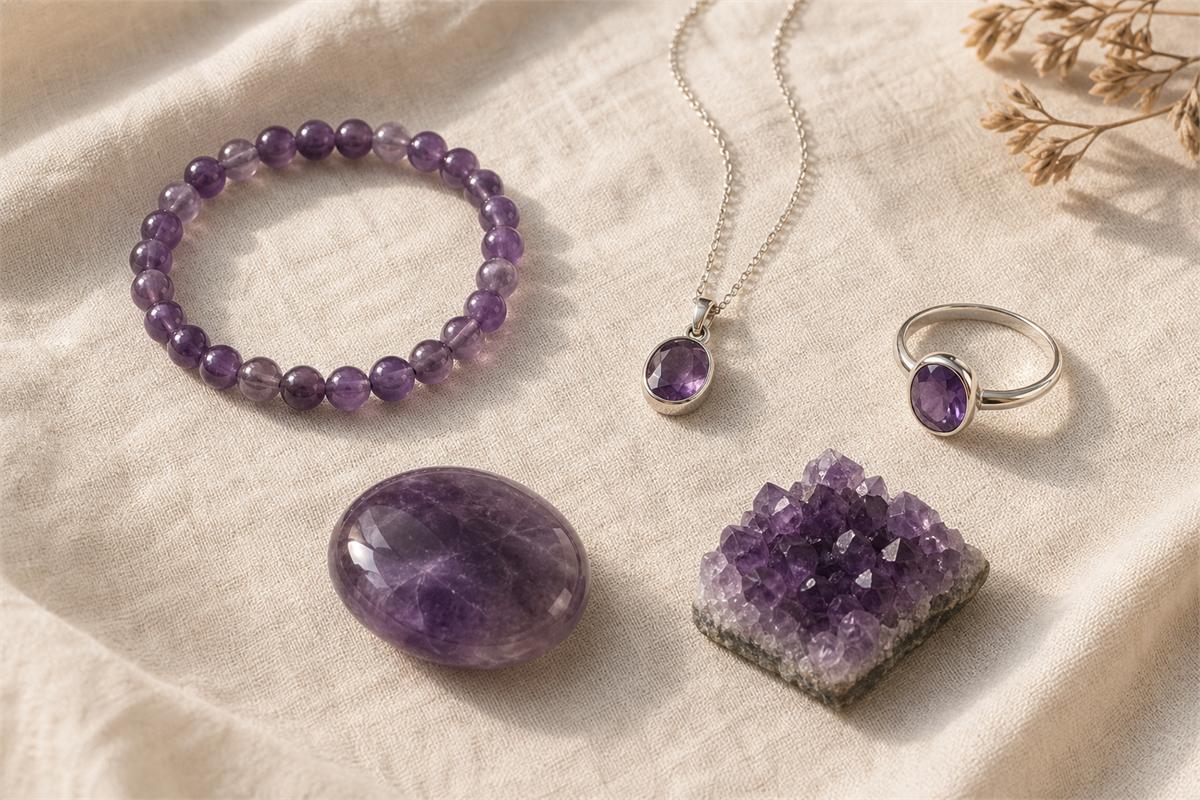
- Bracelet: easy to see during study, work, travel, or a daily transition. Choose a fit that moves comfortably without catching. The amethyst bracelet meaning guide offers more detail on symbolism, bead style, and everyday wear.
- Pendant or necklace: keeps violet close to the body and can feel especially personal when worn beneath or above clothing.
- Ring: becomes a frequent visual cue for an intention such as “pause and see clearly.” Protect raised settings during hands-on tasks.
- Palm stone: suits journaling, breathing practice, or a quiet moment at a desk. Choose a smooth shape that rests naturally in the hand.
- Cluster or geode: brings color and presence to a stable shelf, reading corner, or meditation space where it will not be knocked over.
For gifting, begin with the person’s story rather than a fixed “type.” Amethyst can accompany someone studying, creating, changing direction, deepening a personal practice, or simply making more room for quiet. The best form is the one they will enjoy seeing and keeping close.

A safe five-minute amethyst reflection ritual
This simple five-minute ritual uses breath, color, intention, and reflection. Sit in a stable, comfortable position. Hold the amethyst loosely or place it on a secure surface in view; there is no need to press a hard stone against the brow or balance it on the head.

- Minute 1 — arrive: let your breathing stay natural and notice the support beneath you.
- Minute 2 — observe violet: look softly at the stone’s color, zoning, light, and texture, then close your eyes if that feels comfortable.
- Minutes 3–4 — set an intention: choose one phrase: “May I see clearly,” “May wisdom guide me,” or “May I meet this moment with spaciousness.” Let thoughts come and go without treating them as predictions.
- Minute 5 — return: open your eyes, name one thing you appreciate, and write one grounded next step.
If you become dizzy or noticeably uncomfortable, stop, open your eyes, and return to normal breathing. If you use fragrance or incense as part of a personal ritual, keep the space ventilated and consider allergies, children, pets, and fire safety; the amethyst practice works perfectly well without smoke or flame.
Amethyst care for jewelry and display pieces
Amethyst deserves practical care as well as personal ritual. Prolonged strong sunlight and excessive heat can fade or alter its violet color. Avoid sudden temperature changes, hard impacts, steam, and harsh household chemicals. Remove amethyst jewelry before bathing, swimming, strenuous exercise, or work that may strike or snag the piece.

For physical cleaning, a soft cloth and mild soapy water are a gentle starting point when the setting, metal, cord, elastic, and any mixed materials allow it. Do not apply one cleaning method to every design: a strung bracelet, plated pendant, and solid loose stone have different needs. Dry the piece carefully and store it away from harder gems and direct light.

Moonlight, sound, a crystal cluster, or a few quiet words may be included as a personal renewal ritual. They are choices, not required maintenance. Smoke and running water also deserve care: smoke can irritate people and animals, while water may weaken stringing or affect metal and mixed materials. The crystal cleansing guide separates reflective rituals from the physical cleaning a piece actually needs.
Choose the meaning that belongs to your moment
Choose third-eye amethyst when your wish centers on insight, discernment, imagination, or self-trust. Choose crown-chakra amethyst when you want to welcome spiritual perspective, gratitude, connection, or a wider view. Choose both when the journey is from inward listening to a wise next step.

Whether worn as jewelry, held during reflection, displayed in a quiet corner, or given with love, amethyst can become a medium through which people hope to bring about calm, clarity, protection, wisdom, and a more harmonious life. Explore more violet symbolism in the guide to purple crystals in Feng Shui, or discover meaningful companions in the Blessing collection.
Frequently Asked Questions
Related Posts


One Comment