
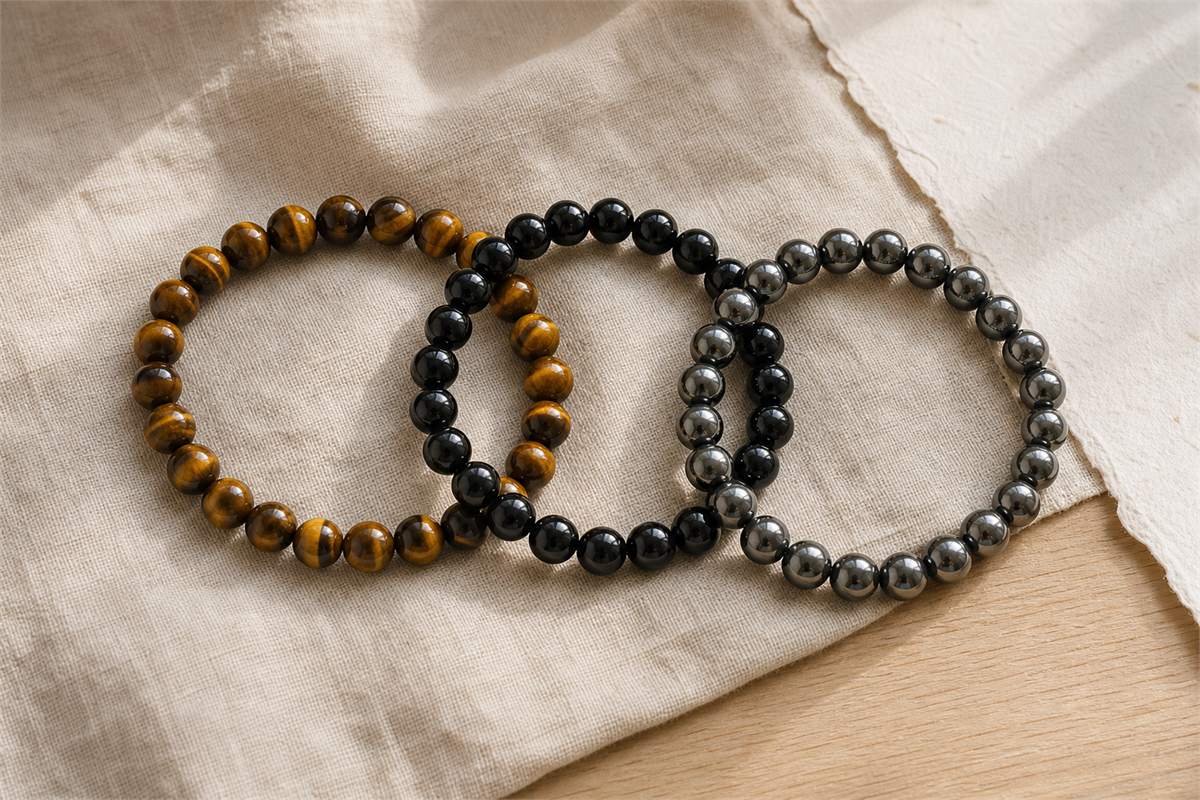
A triple protection bracelet is a three-part design most commonly made with tiger’s eye, black obsidian, and hematite. Together, the stones carry a wish for courageous action, clear personal boundaries, and steady progress. Some bracelets arrange the materials in repeating groups, while others use three separate strands or circles. In either form, the idea is the same: three distinct layers of meaning brought together as one quiet companion.
People often choose this bracelet at a turning point—a new role, a difficult decision, a period of travel, or a season that calls for greater clarity. Its dark metallic tones feel composed and grounded, while the golden movement of tiger’s eye brings warmth. Worn or given with intention, the bracelet carries a hope for protection, courage, harmony, good fortune, and a life moving toward greater steadiness.
What are the three stones in a triple protection bracelet?
| Material | What it is | Wish it carries |
|---|---|---|
| Tiger’s eye | A chatoyant quartz material with golden-brown bands | Courage, discernment, confidence, and purposeful action |
| Black obsidian | Natural volcanic glass, usually polished to a deep black sheen | Protection, truth, clear boundaries, and release from distraction |
| Hematite | Iron oxide (Fe₂O₃) with a steel-gray to black metallic appearance | Stability, presence, focus, and grounded progress |
The classic trio is popular because each material has its own visual voice. Tiger’s eye catches light, obsidian holds a deep reflective darkness, and hematite adds cool metallic weight. The contrast makes the bracelet easy to read as a three-part story: see the path, protect what matters, and move forward with steady intention.

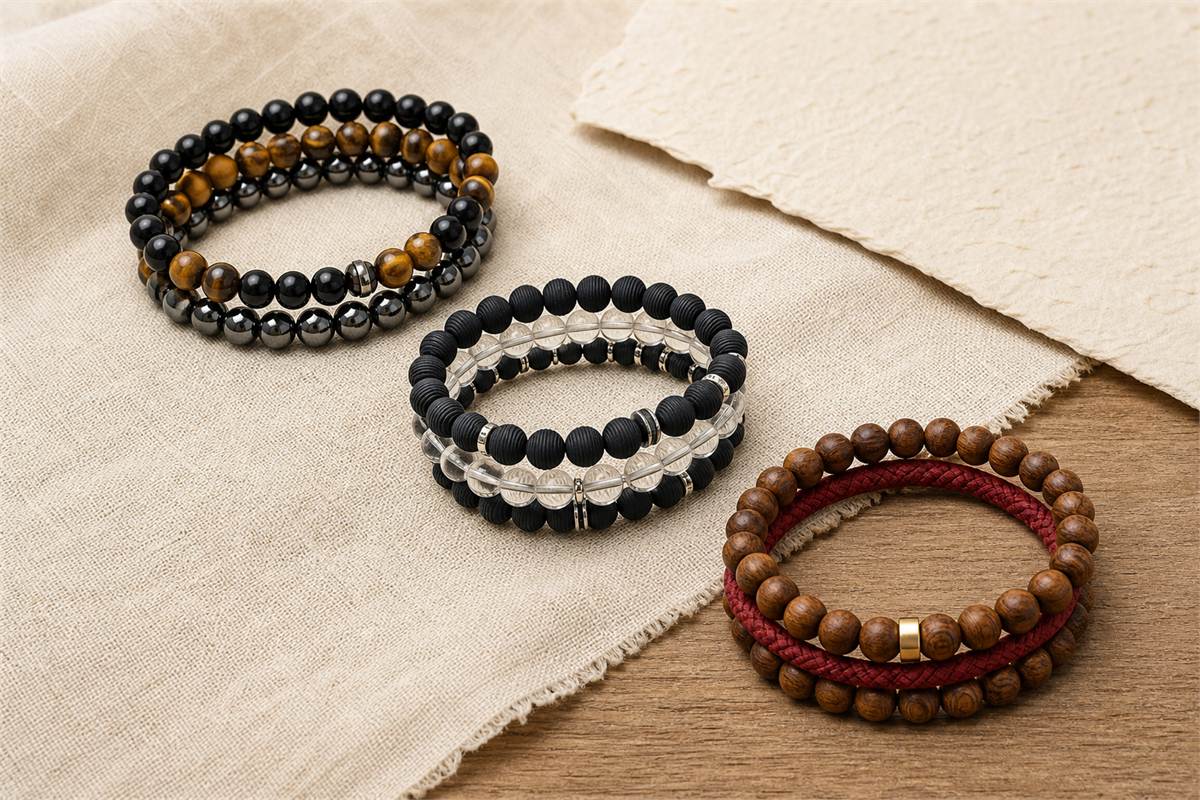
“Triple protection” is a modern jewelry name rather than one ancient, universal formula. That leaves room for personal design while making the actual material list important. A bracelet made with black tourmaline, clear quartz, citrine, wood, red cord, or metal accents can carry a beautiful three-layer wish, but it tells a different story from the tiger’s eye–obsidian–hematite combination.
The meaning of the three layers
Tiger’s eye: courage with a clear direction
Tiger’s eye is a quartz material known for chatoyancy, the narrow band of light that seems to travel across a polished bead as it turns. That moving line resembles an attentive eye, so the stone is often worn to invite clear judgment, confidence, and courage that remains aware of its surroundings.
Within the trio, tiger’s eye is the moment of looking ahead. Its gold and brown tones carry the warmth of possibility: the courage to begin, the patience to choose well, and the determination to follow a meaningful path. It suits a wish for success that grows from discernment and consistent action rather than haste.
Black obsidian: protection and clear boundaries
Black obsidian is natural volcanic glass formed when silica-rich molten material cools quickly. Its dark, reflective surface has made it a compelling protective material in many modern symbolic practices. In a triple protection bracelet, it carries the wish to preserve calm, recognize what deserves attention, and hold a clear boundary around one’s time, values, and relationships.
Its meaning is especially resonant during change. A boundary can be gentle as well as strong: space to think before answering, permission to protect rest, or the confidence to say yes only to what feels aligned. Read more about what obsidian is and the meanings it carries.
Hematite: weight, presence, and steady progress
Hematite is iron oxide, Fe₂O₃. Its density is about 5.26 g/cm³, so natural hematite can feel noticeably weightier than many similarly sized quartz beads. Its Mohs hardness is commonly about 5.5–6.5, yet polished beads can still chip when struck and finishes or coatings can vary. These physical qualities give hematite a sense of substance that naturally supports its symbolism of stability and grounded presence.
Hematite is the closing note of the trio: bringing a wish down into everyday life. It can represent keeping one promise, finishing one important task, or returning to what is steady when the day feels scattered. Its metallic rhythm also gives the bracelet a quiet, contemporary character.
Why the three stones feel harmonious together
The bracelet’s meaning comes from relationship, not repetition. Tiger’s eye offers forward vision; obsidian defines the space in which that vision can be protected; hematite gives it weight and continuity. Together they express a wish—a medium through which people hope to bring about wealth, health, virtue, longevity, or a specific outcome in life.
That three-part rhythm can be interpreted in many personal ways:
- Protection, courage, and clarity for a new beginning.
- Good fortune, wise choices, and steady work for a career or creative goal.
- Boundaries, harmony, and companionship during a changing relationship or life stage.
- Presence, confidence, and abundance as a daily intention for a beautiful life.
Some people choose the bracelet for themselves as a private marker of growth. Others give it before a journey, graduation, move, new venture, or demanding season. The gift becomes more meaningful when the giver names the three wishes it carries for that particular person.

Can a triple protection bracelet use different materials?
Yes. “Triple” may describe three materials, three strands, or three circles of intention. Black tourmaline may be chosen for protective symbolism; clear quartz for clarity; citrine for abundance and optimism; wood beads for warmth and a connection to nature; red cord for blessing and vitality; and silver or gold-toned details for light, celebration, and continuity.
Each material should keep its own identity. Obsidian is volcanic glass, tiger’s eye is quartz-based, hematite is iron oxide, black tourmaline is a distinct mineral group, and wood and metal require their own care. A thoughtful design does not need every component to be called a crystal. Its harmony can come from color, texture, structure, and a well-chosen set of wishes.
Culturally specific designs also deserve their own names and stories. For example, Tri Datu belongs to a Balinese Hindu context in which red, white, and black threads carry religious and communal meaning. It should be understood within that tradition, not treated as a generic name for any three-stone bracelet.
Which wrist should you wear it on?
You can wear a triple protection bracelet on either wrist. In a familiar folk-wearing context, the left side may be associated with welcoming blessings and support, while the right may be associated with expressing courage and carrying intentions into action. These are warm ways to frame a personal ritual, not fixed rules.
Let comfort, your dominant hand, and the day’s activities guide you. If a bracelet taps against a keyboard, watch, desk edge, or tool, move it to the other wrist. You might also choose the wrist that makes the bracelet easiest to notice when you want a reminder to pause, speak clearly, or return to your intention.

How to choose a bracelet that feels right
Begin with the story you want to carry. Protection may mean preserving peace; courage may mean making one honest decision; abundance may mean welcoming enough time, support, and opportunity to live well. Once the wish is clear, practical details help the bracelet become an easy companion.
- Material list: Look for specific stone, wood, cord, and metal names so you know the design’s real composition.
- Structure: Decide whether you prefer one mixed strand, three coordinated strands, or a wrapped three-circle design.
- Bead size and weight: Larger beads and natural hematite can create a more substantial wrist feel; smaller beads usually feel quieter and lighter.
- Fit: Check the inner circumference against your wrist and allow enough ease for comfort without constant sliding.
- Stringing: Inspect elastic or cord for fraying, thinning, exposed knots, or uneven tension.
- Finish: Bead holes should feel smooth, and metal edges or spacers should not catch skin or clothing.
- Gift context: Choose colors and textures that match the recipient’s taste, then share the three wishes behind your choice.
The most meaningful bracelet is one whose materials, comfort, and story belong together. A simple combination worn often can carry more emotional presence than an elaborate design that does not feel personal.

A daily ritual for protection, courage, and clarity
When you put the bracelet on, name three intentions for the day. They might be “protect my peace, choose with courage, and finish with care,” or “welcome good fortune, keep clear boundaries, and move in harmony.” Touching or seeing the three materials later can bring you back to that quiet promise.

This small practice lets the bracelet accompany real moments: preparing for a conversation, beginning focused work, traveling somewhere unfamiliar, or celebrating a new chapter. In this way, it becomes wearable blessing language—an object chosen to welcome protection, luck, prosperity, harmony, and the strength to build a beautiful life.
If these wishes speak to you, explore the Eastern Story Blessing collection and choose the meaning that feels closest to the life moment you want to honor.
How to care for mixed materials
Care for the bracelet according to its most sensitive component. Wipe it with a dry, soft, lint-free cloth after wear. Keep it away from prolonged soaking, perfume, household cleaners, high heat, and hard impacts. Hematite-containing pieces are best kept dry over time, while obsidian can chip and elastic or cord can weaken when repeatedly stretched or wetted.

Store the bracelet separately so metallic or harder components do not rub against polished beads. Check the line, knot, bead holes, coatings, and metal edges from time to time, and restring the piece when the elastic becomes loose or the cord shows wear. For broader mixed-material guidance, visit the Eastern Story jewelry care guide.
Frequently Asked Questions
Related Posts


