
Nine Peaches and Five Bats (九桃五蝠) is an auspicious motif built from two countable images: nine peaches and five bats. The peaches carry longevity and flourishing-life wishes; the bats are visual puns because bat, fu (蝠), sounds like blessing, fu (福). Modern sellers often call the design “Nine Peaches and Five Blessings” (九桃五福), but that phrase describes its meaning rather than its literal picture. If a work does not clearly show both nine peaches and five bats, a broader name such as peach-and-bat motif is more accurate.
Nine Peaches and Five Bats at a Glance
| Element | What is pictured | How it is read |
|---|---|---|
| Nine peaches | Fruit, blossoms, leaves, and connected branches | Longevity, ripening life, abundance, and birthday wishes |
| Five bats | Five identifiable bats, often painted red | The Five Blessings through the fu (蝠/福) homophone |
| The full composition | Nine peaches and five bats sharing one design | A layered wish joining longevity with a complete pattern of well-being |
The count matters when naming the motif. A peach branch with several bats may be catalogued simply as a peach-and-bat design (桃蝠纹). A central longevity character surrounded by five bats is Five Bats Holding Longevity (五福捧寿). Peaches and bats together can also express “blessing and longevity complete” (福寿双全).

Why Peaches and Bats Appear Together
Peaches: longevity expressed through fruit and season
The peach, tao (桃), became one of the most legible longevity images in Chinese art. A branch can hold blossom, leaf, unripe fruit, and fully colored fruit at once, allowing the artist to compress growth, maturity, and continuity into a single scene. Mythic peaches associated with the Queen Mother of the West strengthened this long-life vocabulary, but the nine-peach motif is not a retelling of the entire myth. Its main work is visual: ripe fruit makes a wish for long life visible.

Bats: the image is 蝠, the intended blessing is 福
The bat is auspicious here because of sound. The words for bat (蝠) and blessing or good fortune (福) are both pronounced fu. This is a rebus, not a claim that the animal and the abstract blessing are the same thing. Five pictured bats can therefore stand for the Five Blessings (五福). Red bats are especially common in decorative arts; color can intensify the celebratory effect, but the sound-based pun remains the essential device.
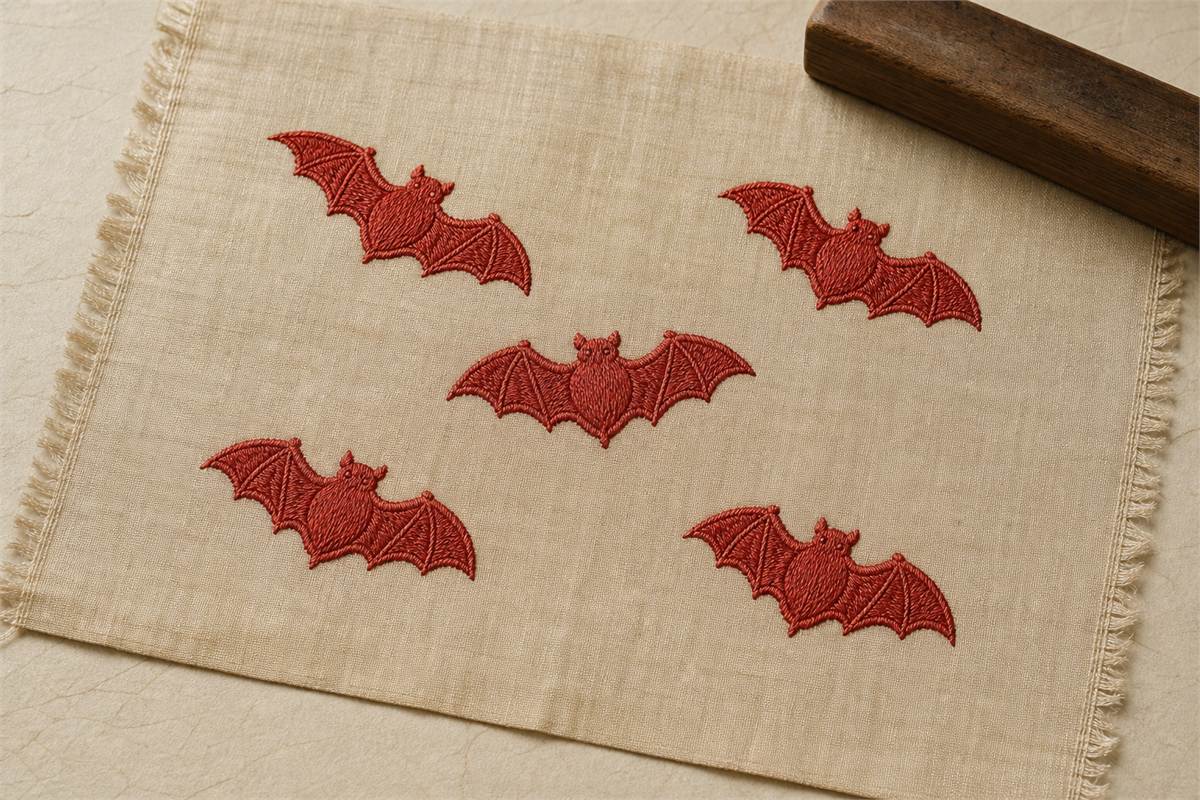
Together, peach and bat form compact blessing language. The fruit contributes longevity; the bats contribute fu. That combination explains why peach-and-bat designs suit birthday vessels, presentation pieces, household decoration, textiles, and modern gift packaging without requiring every example to have been made for an emperor.
The Five Blessings in the Hongfan
The classical reference is the “Hongfan” (洪范) chapter of the Book of Documents (《尚书》). Its transmitted wording lists: “一曰寿,二曰富,三曰康宁,四曰攸好德,五曰考终命.” A careful English explanation is:
- Shou (寿): longevity.
- Fu (富): material sufficiency or wealth.
- Kangning (康宁): health, ease, and peaceful well-being.
- You hao de (攸好德): a disposition that loves or practices virtue.
- Kao zhong ming (考终命): completing one’s allotted life and reaching its natural end.
Modern summaries sometimes reduce the fourth item to “virtue” and the fifth to “a good death.” Those shortcuts miss the verbal force of loving virtue and the idea of completing one’s life course. In the decorative motif, five bats allude to this textual group through the fu pun. They express a wish; they serve as a medium through which people hope to attain wealth, health, virtue, longevity, or a specific outcome in life.

Related Motifs That Should Not Be Renamed Nine Peaches and Five Bats
| Motif name | Recognition clue | Main reading |
|---|---|---|
| Nine Peaches and Five Bats (九桃五蝠) | Nine peaches and five bats are both visible | Longevity joined with the Five Blessings |
| Peach-and-bat motif (桃蝠纹) | Peaches and bats, with no necessary fixed count | Blessing and longevity |
| Five Bats Holding Longevity (五福捧寿) | Five bats encircle or support a central Shou character | The Five Blessings gathered around longevity |
| Blessing and Longevity Complete (福寿双全) | Bat plus peach, Shou character, or another longevity emblem | A paired wish for blessing and long life |
| Shou character with five bats | Written Shou is the center; bats form the surrounding frame | A character-led form of Five Bats Holding Longevity |
Cataloguing should follow what can actually be seen. A fruit partly hidden by a leaf may still be countable from a complete branch, but a damaged, cropped, or crowded image should not be forced into a fixed-number name. The same caution applies to bats folded around a rim or repeated on an object’s reverse.

Qing Porcelain and the “Eight in Yongzheng, Nine in Qianlong” Saying
Peach-and-bat porcelain became especially admired in Qing courtly production, where naturalistic branches could be coordinated with new overglaze enamel palettes. Collectors often repeat the shorthand “eight in Yongzheng, nine in Qianlong” (雍八乾九). It describes a noticed tendency among certain peach-decorated wares.

A Palace Museum example makes the limitation clear. Its Yongzheng-period famille-rose dish with an over-the-rim peach branch carries nine peaches—six inside and three outside—along with several red bats. Another Palace Museum object, a Yongzheng blue-and-white dish, also shows nine peaches, but pairs them with cranes and clouds rather than five bats. These documented objects are enough to disprove any claim that Yongzheng decoration was restricted to eight peaches.
Later wares, revival pieces, private-kiln products, and modern reproductions vary further. Peach count alone cannot establish reign, kiln, court use, date, or origin. Reign marks also require contextual study: an inscription must be considered with body, glaze, enamels, drawing, firing, form, wear, repair, and documented provenance.
How the Composition Moves Across a Vessel
Over-the-rim and over-the-wall branches
An over-the-rim branch, often called guozhi (过枝) or “over-the-wall” in English descriptions, connects decoration across two surfaces. On a dish or bowl, a trunk may begin inside, climb the wall, cross the lip, and continue on the exterior; flowers, leaves, and fruit remain parts of the same plant. The term describes that visible continuity. It does not mean every all-around design, every motif wrapping 360 degrees, or decoration that merely extends from a body toward a foot.

Counting without losing the design
A skilled composition distributes the nine fruit by scale, color, and overlap. Larger peaches may anchor the central view while smaller or paler fruit turn around the side. Bats occupy open intervals, redirect the eye, and keep the branch from feeling static. On a bottle or vase, count must include all sides; on a dish, it may require checking both interior and exterior.

Famille Rose, Enamel Colors, and Other Ceramic Terms
Famille rose is the conventional Western-market term for a Qing overglaze enamel palette rich in opaque pinks; Chinese museum catalogues commonly use fencai (粉彩). The Metropolitan Museum of Art’s Yongzheng-period dish with peaches and bats (object 1997.1.11) is catalogued as Jingdezhen porcelain painted in overglaze polychrome enamels. Its record notes the use of pink enamel to model ripening peaches. That description is more precise than automatically calling every refined peach-and-bat object falangcai (珐琅彩).

Fencai, falangcai, and wucai are related to enamel decoration but are not interchangeable labels. Wucai generally names an earlier polychrome system with a different palette and visual effect. Falangcai is tied to specific enamelled wares and court-workshop contexts. Techniques such as an opaque white component, graduated washes, stippling, and layered coloring are useful observations only when they match the object being discussed; none is a universal shortcut for dating or attribution.
Verified Museum Objects and What They Show
- Palace Museum, Yongzheng period: the large fencai over-branch peach dish has nine peaches divided across the interior and exterior, several red bats, and a six-character Yongzheng mark. It demonstrates both connected over-the-rim composition and the failure of a rigid eight-peach rule.
- Metropolitan Museum of Art, Yongzheng period: the peach-and-bat dish, object 1997.1.11, is an early eighteenth-century Jingdezhen porcelain painted with overglaze polychrome enamels. Its modelling of pink ripening fruit is a secure example of period technique without requiring the object to be renamed as a fixed nine-and-five design.
- British Museum, Qing dynasty: bowl PDF.524 is moulded in the form of five bats. The museum explicitly interprets the five bats as a visual pun for the Five Blessings. It is an excellent comparison for the bat count, although it contains no nine peaches.
These examples also show why object names must remain specific. One establishes a nine-peach composition, one documents peach-and-bat enamel painting, and one isolates the five-bat rebus. They illuminate the full motif without turning every related work into the same design.

Beyond Porcelain: Other Media and Modern Design
The same visual vocabulary can move into woven or embroidered textiles, painting, carved lacquer, jade, wood, and metalwork. Different media solve the design differently: embroidery can separate five bats around a central peach spray; lacquer can build fruit and bats in relief; jade carving may use openwork and colored skin; metalwork can repeat bats as pierced borders; painting can let the branch travel freely across space. Not every related object fixes the count at nine and five, so “peach-and-bat” remains the safer general description unless all elements are present.

Contemporary designers use the motif on tea ware, stationery, packaging, scarves, jewelry, and home objects. A successful adaptation keeps the rebus readable: peaches should remain distinguishable from generic round fruit, bats should not become unrecognizable wing shapes, and a product marketed as Nine Peaches and Five Bats should permit the viewer to find the promised numbers.

Gift Meaning Without Turning Symbolism into a Promise
Nine Peaches and Five Bats is appropriate for birthdays, Lunar New Year, family celebrations, and gifts that emphasize a full, flourishing life. Its strongest gift language is a wish: may the recipient enjoy longevity, sufficiency, peace, virtue, and a life brought to a natural completion. A short note explaining 蝠/福 helps recipients understand why bats belong in a celebratory design.

Choose the object for the person’s taste and use rather than rank. A small dish, textile, print, or wearable detail can carry the same cultural message as a formal display piece. For a broader selection of symbolic gifts organized by meaning, explore the Eastern Story Blessing collection.
How to Examine a Nine-Peach and Five-Bat Object
- Verify the count: locate nine peaches and five bats across every decorated surface. Note fruit hidden by leaves, but do not invent missing forms.
- Follow the branch: check whether trunk, twigs, leaves, blossoms, and fruit connect convincingly. For over-the-rim work, confirm that the design actually continues across the lip.
- Study the drawing: compare repeated bats, leaf turns, fruit outlines, veins, stems, and changes in brush pressure. Mechanical repetition may indicate transfer decoration, but repetition alone does not settle quality or date.
- Observe color and surface: look for controlled tonal transitions, enamel wear, pooling, scratches, glaze texture, firing flaws, and later retouching in relation to the whole object.
- Check form and construction: assess proportion, foot, rim, weight, wall thickness, joins, and how decoration responds to the shape.
- Record condition: note chips, hairlines, restoration, overpainting, abrasion, replaced mounts, and stains. For items intended for food or drink, confirm that the maker describes them as suitable for that use.
- Keep the record: dimensions, clear photographs, purchase history, prior collection labels, receipts, and restoration notes make later comparison more useful.
No single clue—peach number, tonal washing, kiln claim, reign mark, or confident brushwork—can determine date, kiln, or maker by itself. A responsible description separates what is visible from what is attributed.

Common Misreadings

- “Five blessings” means five 福 characters. In this motif, the five pictured objects are bats (蝠); their sound points to blessings (福).
- Every peach-and-bat design is Nine Peaches and Five Bats. The fixed name requires both counts to be visible.
- Yongzheng always used eight peaches and Qianlong always used nine. Museum-held Yongzheng objects with nine peaches show why this collector’s shorthand is not a rule.
- Nine peaches automatically mean the “Nine-Five Supreme” or imperial sovereignty. Nine can evoke fullness, long duration through word association, a high numeral, and—in some traditions—imperial symbolism. The precise meaning depends on the object and evidence; nine peaches do not automatically encode the phrase 九五之尊.
- All examples were royal emblems. Certain documented Qing pieces have courtly or imperial contexts, but later and non-court production cannot be projected backward into a universal palace regulation.
- Any wraparound branch is “over-the-wall.” The defining feature is connected growth across distinct surfaces, commonly the inside, rim, and outside of a vessel.
Frequently Asked Questions
Related Posts


One Comment