Green strawberry quartz is a market name for a fresh green, inclusion-rich quartz look—not one consistently defined mineral variety. Depending on the seller and the piece, the name may describe transparent single-crystal quartz with green flakes, aventurine quartz or quartzite with reflective mica, dyed crackle quartz, glass, or an assembled material. The name is still useful: it describes the mint-green color and seed-like sparkle that draw people to the stone. A thoughtful choice simply pairs that beautiful name with a clear description of the material.
In the Chinese crystal market, green strawberry crystal, Lü Caomei Jing (绿草莓晶), carries a feeling of young leaves after rain. People choose it to welcome growth, harmony, courage, affection, friendship, clarity, and prosperity. Its many small flashes can feel like a hopeful reminder that a beautiful life is often made through quiet choices repeated over time.

What is green strawberry quartz?
Quartz has the chemical formula SiO₂. In its single-crystal form, it has a Mohs hardness of 7, a relative density around 2.65–2.66, vitreous luster, and a naturally brittle structure. Yet a finished piece sold as green strawberry quartz may be a quartz crystal, a polycrystalline quartzite, or another material altogether. That difference changes the way its inclusions, transparency, sparkle, and treatments should be described.
Some transparent pieces contain green platelets, dots, clouds, or fine threads identified in the trade as fuchsite, chlorite, or another mineral. Other pieces have a granular quartzite body filled with reflective mica and are more accurately described as aventurine quartz. The visible effect matters, but the variable market name does not establish one universal mineral recipe.

Green strawberry quartz, aventurine, and nearby names
| Market or material name | What creates the look | What you may see |
|---|---|---|
| Green included quartz | Green flakes, dots, threads, or clouds inside single-crystal quartz | Clearer zones around inclusions; scattered internal depth |
| Green aventurine quartz or quartzite | Polycrystalline quartz with reflective platelets, often green mica such as fuchsite | A granular or softly translucent body with moving flashes |
| Green phantom quartz | Inclusions captured along earlier crystal-growth surfaces | Layered outlines, mountains, veils, or geometric growth scenes |
| Pink or red strawberry quartz | Market term commonly associated with single-crystal quartz containing red hematite; goethite and other iron-rich inclusions also occur in strawberry-quartz contexts | Pink-to-red striped, flaky, needle-like, or speckled inclusions |
| Dyed crackle quartz | Fractures produced or emphasized before color enters the fissure network | Strong color following cracks rather than distinct mineral platelets |
| Glass, resin, or composite | Manufactured or assembled components | A designed green-and-sparkling look whose value comes from honest material disclosure and workmanship |
This is why green strawberry quartz is not automatically identical to green aventurine, yet many retail examples do fall within the aventurine family. Aventurine is especially recognizable by aventurescence: bright reflections from many flat mineral interfaces as the stone turns. For a warmer jewelry-focused view of aventurine’s growth and relationship symbolism, visit Eastern Story’s green aventurine pairing guide.
Green phantom quartz is different because its inclusions trace stages of crystal growth rather than simply forming a field of scattered “seeds.” The green phantom quartz guide explores those layered inner landscapes. Pink and red strawberry quartz belongs to a different inclusion and color context; the shared fruit-like name does not make the materials interchangeable.

Why the inclusions and sparkle feel so alive
The most appealing pieces create movement without becoming loud. A mint or grass-green body may hold sparse silver-green flakes, dense points of light, translucent clear zones, or a fine shimmering field. Rotate the piece beneath one neutral light source and notice whether the flashes seem to rise from different depths. In aventurine-style material, that lively motion is the heart of the visual experience.

More sparkle is not an automatic grade. Dense platelets can create a strong glitter but reduce transparency; sparse inclusions can leave more space and make each “seed” easier to see. A softly clouded bracelet may feel calm and botanical, while a transparent pendant with a few suspended green flakes can feel like a tiny garden. The best appearance is the one whose color, depth, and rhythm match the story you want to carry.
How to choose with confidence and clear disclosure
Begin with the whole object rather than a single “natural-looking” clue. Color intensity, irregular seed patterns, bubbles, cool touch, weight, ultraviolet response, and price can all offer limited observations, but none can settle mineral identity, treatment, origin, or value by itself. A bright green can be natural, treated, coated, or manufactured; an irregular pattern can occur in more than one material.

- Ask what the seller means by the name. Is it single-crystal quartz, aventurine quartz, quartzite, dyed quartz, glass, resin, or a composite?
- Ask what creates the green and the sparkle. A named inclusion is more informative than “strawberry seeds,” while an honest “unknown green mineral inclusions” is clearer than an invented certainty.
- Ask about treatment and construction. Dye, filling, coating, deliberate crackling, adhesive, plating, elastic, and assembled layers have different identities and care needs.
- Request photographs of the exact piece. Neutral-light front, side, drill-hole, edge, and rotation views help reveal depth, surface wear, open fractures, and workmanship.
- Check the finished design. Smooth drill holes, secure cord, protected edges, comfortable fit, and metal components without sharp contact matter as much as the stone name.
Color concentrated along a connected fracture network can be consistent with dyed crackle quartz, but the observation should lead to a disclosure question rather than an instant verdict. Rounded voids can occur in glass, yet one bubble-like feature is not a complete identification. The same careful approach applies to smooth “perfect” beads and visibly included ones. Eastern Story’s natural, synthetic, glass, and treated crystal guide explains why multiple observations belong together.
Skip scratch tests, hot needles, flame, acids, alcohol rubbing, and long soaking experiments. They can damage polish, color, filler, thread, glue, or plating while leaving the most important question unanswered. A seller’s precise material and treatment statement is more useful for an everyday purchase.

What does green strawberry quartz mean?
Green strawberry quartz meaning begins with color: spring leaves, mint, gardens, and the feeling of life moving again. In modern crystal culture, it is chosen to invite gentle energy, courage, emotional openness, harmonious relationships, friendship, good fortune, and prosperity. The scattered “seeds” add a distinctive idea—small intentions can be planted, tended, and allowed to grow.
It can accompany a new course of study, a creative restart, a move into a first home, a friendship entering a new season, or a relationship that deserves patient care. It also makes a kind gift after a period of change. A note might say, “May every small beginning find room to grow,” or “May tenderness and courage stay beside you.” The stone becomes a medium through which people hope to welcome love, health, harmony, abundance, and a more beautiful chapter of life.

Five Elements and heart-chakra language
In modern Five Elements color styling, green is often placed with Wood and used to express spring, growth, flexibility, and renewal. Heart-chakra language comes from a different modern spiritual framework, where green is associated with compassion, connection, and an open heart. These are two separate ways of giving color meaning. Let the one that resonates become part of your personal story.
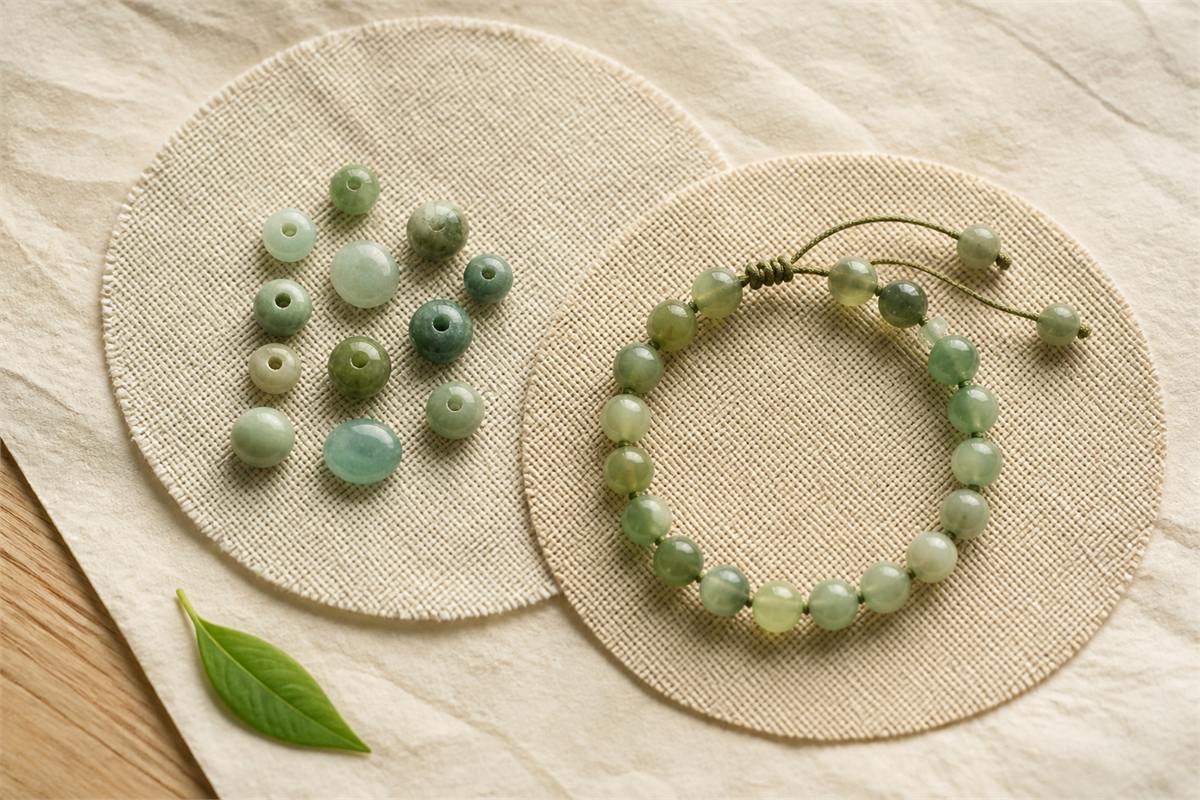
There is also no compulsory left- or right-wrist rule. Choose the wrist that fits your movement, watch, work, comfort, and personal ritual. Meaning becomes stronger when it is connected to a real wish rather than a rigid formula.
Price: compare the object, not one universal grade chart
Current listings show how widely the trade name is used. On August 17, 2026, examples included 6 mm loose-bead strands around $7.20, a 13 mm faceted strand around $23.95, a 6 mm loose strand listed at $54.99 before a sale discount, a simple 10 mm bracelet at $15.88, other bead bracelets around $27–$30, and a branded 10 mm design at $458. These are different objects from different sellers—not mineral quality grades.
The observed span—from $7.20 loose strands to a $458 designed bracelet—shows why a single three-tier chart would be misleading. Loose strands, plain elastic bracelets, 14 mm beads, metal components, limited designs, and artisan work carry different cost structures. A higher price may reflect branding and design as much as the quartz itself.

| Object being priced | Details that change the price | Questions that keep the comparison fair |
|---|---|---|
| Loose bead strand | Length, bead count, diameter, faceting, matching, drill quality | Is this one strand, one bead, or a multi-strand pack? |
| Simple bracelet | Wrist size, bead diameter, bead count, elastic, matching | Does the photo show the exact bracelet and its inner circumference? |
| Designed jewelry | Metal, clasp, pearls or other stones, maker time, originality, finishing | How much of the price belongs to materials, design, and workmanship? |
| Included single-crystal quartz | Transparency, inclusion scene, cutting, condition, setting | Is the listing describing a single crystal rather than aventurine quartzite? |
| Treated, glass, resin, or composite piece | Disclosure, stability, construction, visual design, craftsmanship | Is every material and treatment described clearly? |
Locality can enrich a piece’s story when it is accurately disclosed, but it is not a universal quality rank. Appearance, condition, material identity, treatment disclosure, bead size, jewelry construction, and workmanship remain the clearest parts of the purchase.

Styling green strawberry quartz with a personal story
White quartz creates a clean, airy contrast; moonstone adds a quiet glow; pearls bring softness; and agarwood or other dark wood beads give mint green an earthy frame. These are aesthetic conversations rather than formulas for multiplying effects. For a minimalist commute, let one pale green bracelet stand alone. For a new-Eastern look, combine green with cream fabric, warm wood, a small pearl, or restrained gold-tone details.

Mixed designs need practical space. Quartz can scratch softer pearls or some polished wood finishes, while sharp metal spacer edges can wear cord and chip bead holes. Use knots, protective caps, or gentler separators where needed, and avoid a tight stack that forces hard beads against one another. Choose by the wish and relationship: a new beginning, loyal friendship, loving partnership, or creative courage.

How to clean and care for it
For routine care, wipe the piece with a clean soft cloth. When the material, treatment, setting, cord, and metal parts all allow moisture, use a lightly damp cloth or a brief wash with mild soap, then remove residue and dry the piece completely. Plain intact quartz can tolerate more than a dyed, filled, coated, glued, or heavily fractured bead, so the most sensitive component sets the rule.

- Avoid sharp impact, hard rubbing, and storage beside harder gems.
- Keep it away from high heat and sudden temperature change.
- Avoid steam and ultrasonic cleaning, especially for fractured, included, filled, dyed, coated, glued, or strung pieces.
- Keep perfume, chlorine, strong cleaners, and household chemicals away from elastic, thread, plating, glue, dye, coating, and filler.
- Do not soak a finished bracelet; water can remain around drill holes, weaken some cords, and affect metal components.
- Store it dry in a soft pouch or divided box, with space between pieces.
If moonlight or a quiet resting place is meaningful to you, it can be a personal ritual of reconnection rather than a material-care requirement. Physical cleaning remains simple and material-led. The Eastern Story Care Guide offers a wider routine for mixed-material jewelry.

A green blessing for what comes next
The charm of green strawberry quartz lies in both its openness and its mystery. The market name may cover more than one material, yet the feeling remains recognizable: cool green color, seeds of light, and the promise of growth. Choose a piece whose identity is described clearly, whose construction suits your life, and whose inner landscape speaks to the future you want to nurture.
Worn for a fresh beginning, given for friendship, or kept as a companion through change, it carries a wish for tenderness with courage and prosperity with patience. To continue that journey through meaningful objects, explore the Eastern Story Blessing collection.
Frequently Asked Questions
Related Posts