
The cloud-and-thunder pattern, commonly called Yunleiwen (云雷纹), is a family of tightly organized spiral, hooked, and meandering designs best known from ancient Chinese decorative art. It is especially important on Shang and early Zhou bronzes, where small repeated units often form a dense background beneath larger animal motifs. The label is useful, but it is not a rule that every curve is “cloud,” every squared turn is “thunder,” or every example combines two fixed symbols.
Museum catalogues, archaeological reports, and art-historical traditions do not always name closely related designs in exactly the same way. Identification therefore depends on shape, repetition, date, medium, placement, and the vocabulary used by the source describing a particular object. This guide treats Yunleiwen as a visual and historical category, not as a universal code with one meaning for every period.
Cloud-and-thunder pattern at a glance
| Feature | Useful description | Important limit |
|---|---|---|
| Basic form | Repeated spirals, hooks, squared turns, or continuous meanders | No single outline defines every Yunleiwen example |
| Best-known context | Background or ground pattern on Shang and early Zhou bronze vessels | Not every bronze uses it, and it can also be a border or principal band |
| Visual role | Creates density, rhythm, contrast, and layers beneath larger motifs | Visual effect does not by itself prove a specific ritual meaning |
| Common English terms | Cloud-and-thunder pattern, cloud-thunder motif, or leiwen in narrower usage | Translations and catalogue terms vary |
| Modern use | Jewelry, textiles, furniture, architecture, cultural products, and packaging | Modern symbolism should not be projected backward as ancient intent |
For a quick visual test, look for a repeated system rather than one isolated spiral. Yunleiwen usually gains its character from compact units fitted together across a band or field. The eye follows turns, pauses, and returns; the rhythm can feel continuous even when the pattern is divided by flanges, borders, or larger figures.
How to recognize Yunleiwen
Start with line structure
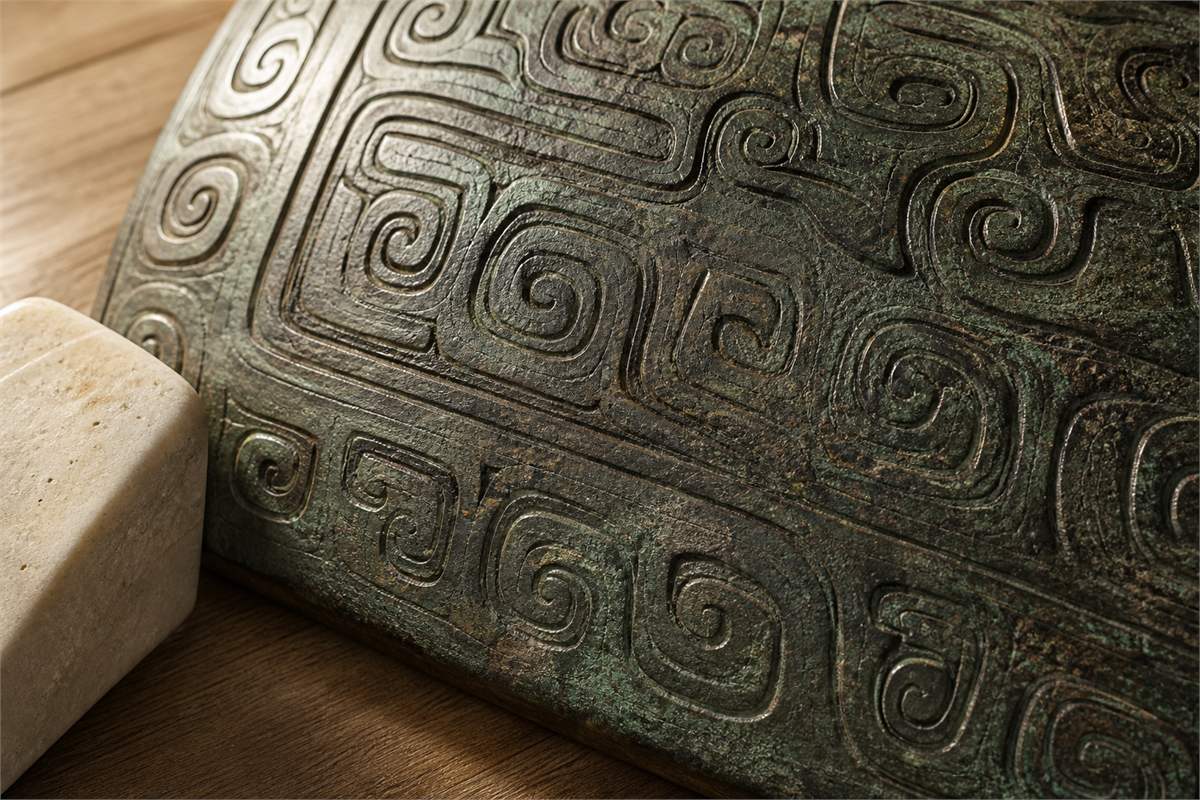
Typical examples use narrow lines that turn inward or around a center. Some are angular and squared; others are more rounded. Units may face the same direction, reverse direction, interlock, or fill the spaces around a larger image. On a worn bronze, the small ground pattern can be harder to see than the raised animal form above it, so changing the angle of light often reveals the organization.
Then examine repetition and placement
A single spiral on a modern pendant is not enough to establish a historical label. Ask whether the line repeats as a band, covers a background field, frames a panel, or interacts with another motif. On many famous ritual bronzes, the small scrolls sit behind a larger beast mask, dragon, bird, or other zoomorphic design. Elsewhere, related geometric turns become an independent border.
- Look for deliberate, repeated turns rather than random curls.
- Notice whether the units are rounded, squared, hooked, or linked.
- Separate the small background pattern from the larger subject above it.
- Check the object’s date and medium before applying a catalogue term.
- When attribution is uncertain, describe the visible geometry first.
Yunleiwen and related patterns: a practical comparison
| Term | Typical visual tendency | How it differs |
|---|---|---|
| Yunleiwen (云雷纹) | Compact spirals, hooks, or meanders; often a dense field | A broad historical label whose use varies by object and scholarly tradition |
| Leiwen (雷纹) | Often used in English for squared spiral or “thunder” scroll backgrounds | Can be narrower than Yunleiwen; not every squared meander should be assigned this name automatically |
| Huiwen (回纹) | Continuous key, fret, or meander pattern with repeated returns | Common in later decorative borders; resemblance does not prove direct one-line descent |
| Juan yunwen (卷云纹) | Rolling or curled cloud forms | Usually emphasizes curling cloud shapes rather than a dense bronze-style ground |
| Yunqiwen (云气纹) | Flowing cloud-and-vapor formations, often more open and mobile | Associated with different periods and pictorial conventions |
| Ruyi cloud (如意云纹) | Rounded, lobed heads recalling the ruyi form | Frequently used in later auspicious design and should not be treated as ancient Yunleiwen by default |
| Swastika or wan pattern (卍字纹) | Repeated hooked cross units or lattices | A distinct sign and pattern family despite occasional geometric similarity |
These categories can overlap visually at their edges, particularly when modern designers simplify historical references. A precise description can say “a squared meander inspired by bronze-age leiwen” without claiming that a contemporary border is a faithful copy of one excavated motif.

Archaeological context without a false origin story
Spirals, whorls, hooks, and geometric returns appeared in multiple Neolithic pottery and jade traditions. They are important visual background for understanding later pattern-making, but similarity alone does not make every early spiral the “first Yunleiwen.” Nor does it establish a straight evolutionary path from one site or vessel to Shang bronze decoration.
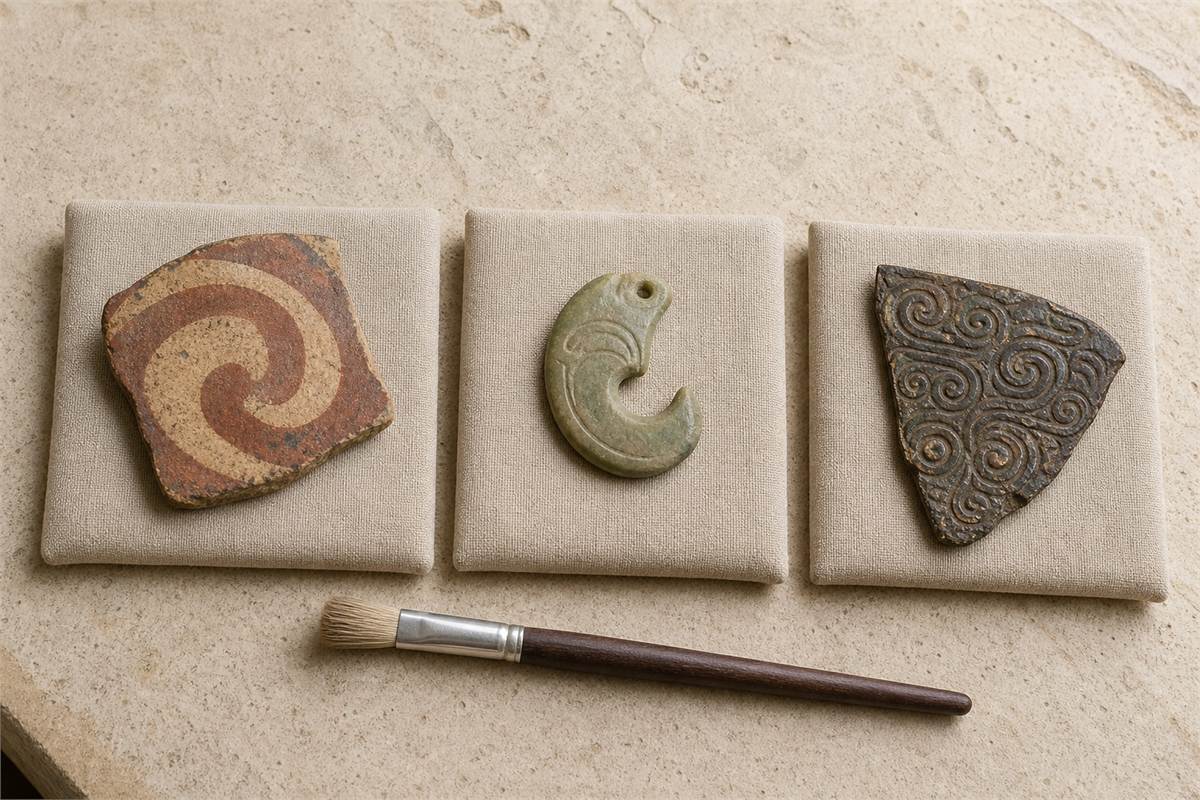
Claims about a particular site, date, or earliest example require a securely identified excavated object and a reliable publication. General guides often repeat names such as Majiayao, Sanxingcun in Jintan, or the Lower Xiajiadian culture without showing that the cited object is classified consistently as Yunleiwen. A careful overview can acknowledge earlier geometric traditions while avoiding a fragile “first appearance” claim.
The strongest art-historical context is the mature bronze tradition of the Shang and Zhou periods. This does not mean the motif suddenly appeared without antecedents. It means that bronze vessels provide abundant, highly structured, and widely studied examples in which small spirals and meanders have a clear compositional role.
Yunleiwen on Shang and Zhou bronzes
On many Shang and early Western Zhou ritual bronzes, fine spiral grounds create a low, dense layer beneath more prominent motifs such as beast masks, kui dragons, birds, or other animal forms. The contrast can be read through line, relief, scale, and density: small repeated turns recede visually, while larger eyes, horns, bodies, or ridges command attention. The result is a richly articulated surface rather than a flat sheet of ornament.

The early Western Zhou Li Gui (利簋), in the National Museum of China, offers a well-documented example. Its belly and square base use cloud-and-thunder pattern as a ground beneath larger beast-mask decoration, while a kui-dragon band appears around the foot. This is useful evidence for layered composition, not proof that every bronze followed the same formula.

Bronze vessels were made in different workshops, regions, dates, and types, and their decorative programs vary substantially. Some surfaces are densely patterned; others are comparatively open. Yunleiwen may be prominent, secondary, transformed, or absent. Calling it a universal background—or a single supreme background pattern—obscures the diversity of ancient bronzes.
How casting and composition work together
Many early Chinese bronzes were produced with piece-mold casting. In simplified terms, makers formed a model, took sectional clay molds from it, prepared a core for the vessel’s hollow interior, and reassembled the fired mold sections for casting. Decoration could be carved or impressed into mold surfaces, allowing exceptionally crisp and intricate designs. Mold divisions, vessel form, flanges, and decorative panels were part of an integrated production problem.

This technical background helps explain why a tiny repeating ground cannot be studied only as a detached symbol. Its scale had to suit the mold and the larger motif; its rhythm had to continue around curved walls or stop at structural divisions; its relief had to remain legible after casting. “Background” does not mean unimportant. It describes one layer in a planned surface hierarchy.
What happened after the Bronze Age?
Later Chinese decorative arts continued to favor continuous lines, spirals, cloud forms, and geometric borders. These appear across bronze mirrors, lacquer, ceramics, textiles, architecture, furniture, carving, and metalwork. Yet later huiwen, curled-cloud patterns, yunqi vapor forms, and ruyi clouds developed within their own periods, media, and design needs.
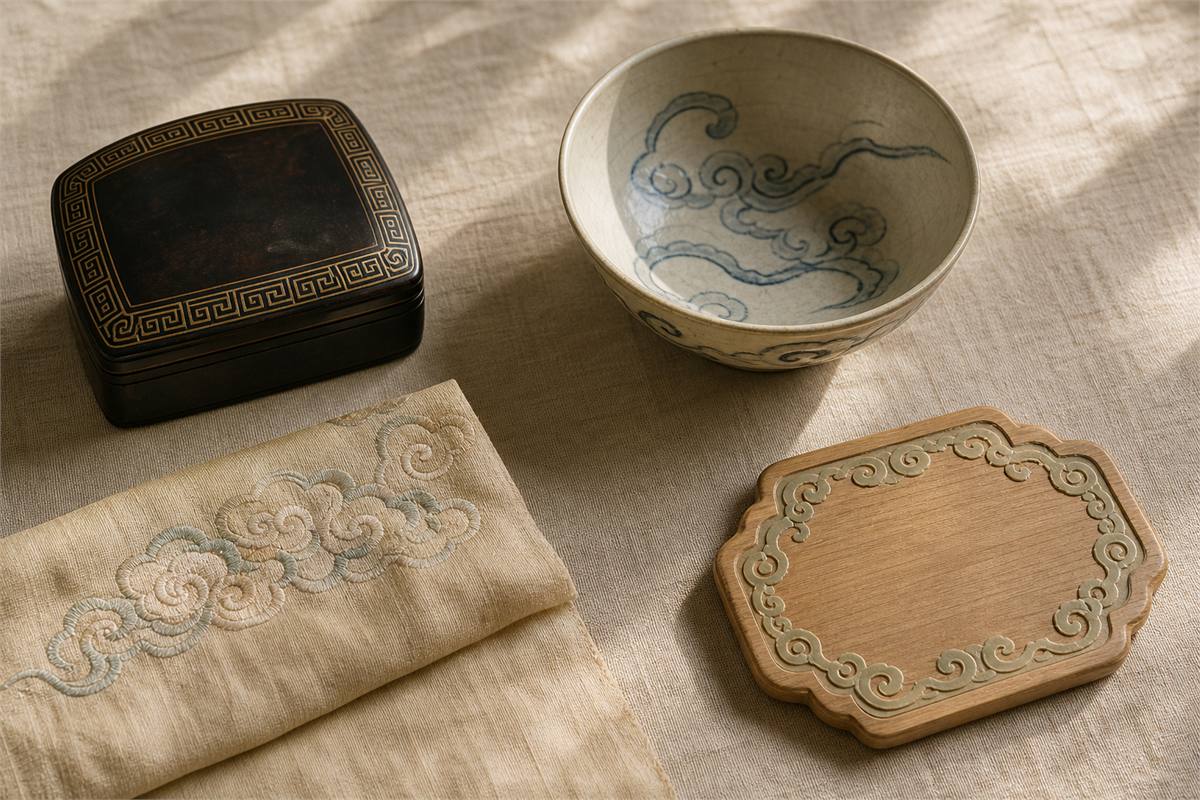
It is more accurate to speak of related visual traditions than a single inevitable evolution. Designers repeatedly found new uses for turning lines and continuous borders. Some later works consciously revived archaic bronze styles; others belong to different cloud imagery or geometric grammar. Similarity may show quotation, adaptation, shared design logic, or simply the broad usefulness of repeat patterns.
How cultural interpretations change over time
Modern explanations often associate cloud-and-thunder designs with rain, renewal, continuity, cyclical movement, authority, ritual order, or auspicious weather. These readings can be meaningful in later folklore, gift language, museum interpretation, or contemporary design. They should not be presented as one fixed message shared by every maker and viewer from the Neolithic period onward.

Likewise, ideas such as “round heaven and square earth,” complementary yin and yang, the Five Elements, celestial motion, or communication between heaven and the human world are interpretive frameworks, not automatic translations of a spiral. They become useful only when a specific text, object, period, or documented design concept supports them. A square turn on a bronze does not by itself prove an ancient maker intended “earth,” just as a rounded turn does not independently prove “heaven.”
For contemporary gifts, the pattern can express a wish for steady progress, continuity, or harmony through its repeating rhythm. This is a modern cultural message rather than a measurable power. The strongest storytelling identifies who is using the interpretation, in what context, and why the visual form suits it.
Modern design applications
Jewelry, jade carving, and metalwork
On rings, pendants, bangles, earrings, clasps, and beads, a small repeated border can bring texture without competing with the material. Deep relief creates stronger shadow and an archaic effect; shallow engraving feels quieter and may be easier to wear daily. Jade carving depends on clean edges and sensible depth, while metalwork can use engraving, casting, chasing, openwork, enamel, or contrasting finishes. Readers comparing jade pieces may also find the guide to jade in Eastern culture useful.

Textiles and clothing
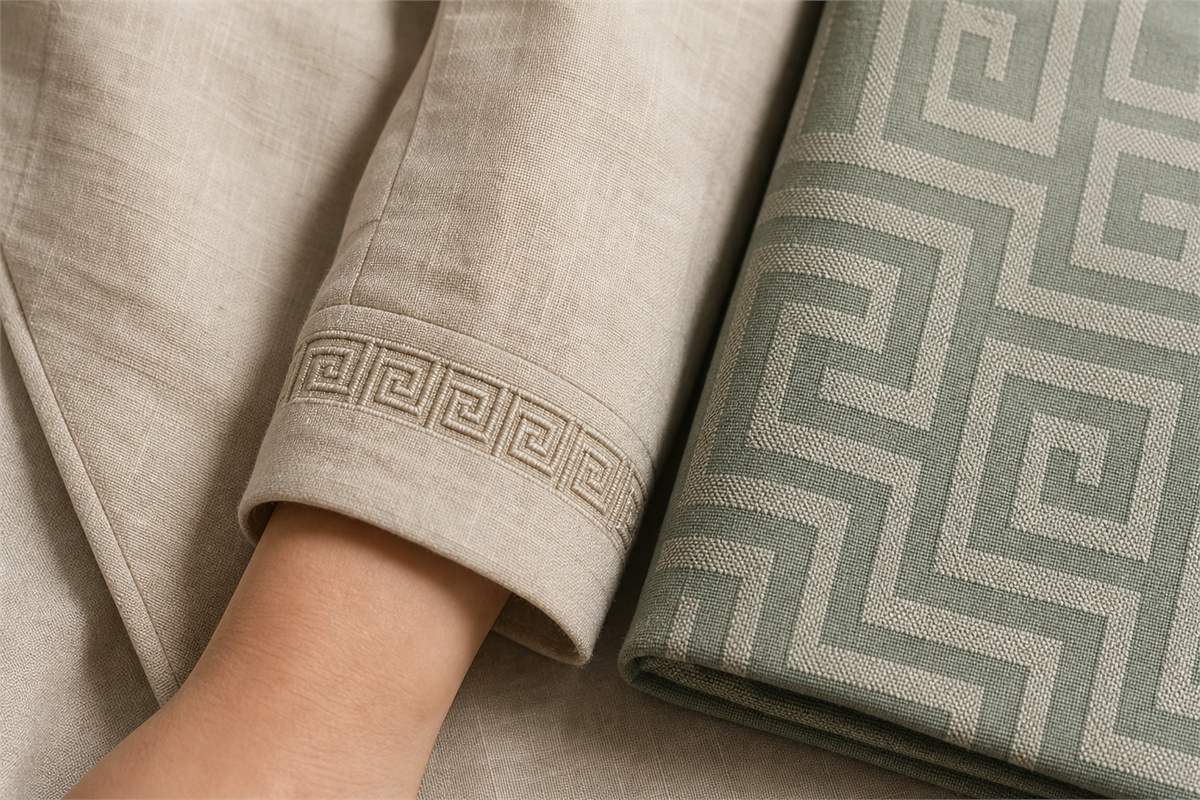
Woven, embroidered, printed, or quilted versions can function as hems, cuffs, collars, narrow bands, or all-over fields. Scale determines the effect. Large high-contrast repeats become graphic statements; small tone-on-tone repeats supply texture. A design need not be assigned by gender, age, or profession. Proportion, color, fabric weight, and the wearer’s preference are more useful guides.
Furniture, architecture, and interiors
Geometric turns adapt naturally to screens, rails, carved panels, metal grilles, ceramic borders, rugs, and upholstery. In a room, repetition can unify edges and transitions. The main practical questions are scale, viewing distance, dust-catching depth, structural strength in openwork, and whether the motif complements the building or furniture rather than becoming surface clutter.

Cultural products and packaging
A narrow Yunleiwen-inspired frame works well in embossed paper, foil, molded pulp, printed cartons, labels, and reusable boxes. Designers should state whether they copied a documented historical source, adapted a general bronze-age vocabulary, or created a new geometric repeat. That distinction respects the source and gives customers better information than a vague claim of “ancient symbolism.”

How to appreciate and choose a Yunleiwen design
- Line clarity: turns should remain readable at the intended scale.
- Rhythm: repeated units should feel deliberate, with sensible spacing and alignment.
- Depth consistency: carving, casting, embossing, or printing should not fade unpredictably across the field.
- Edges and corners: inspect burrs, chips, rough recesses, and blurred junctions.
- Material durability: very fine openwork or deep undercutting may be vulnerable in daily use.
- Comfort: jewelry edges, ring interiors, clasp areas, and raised details should not scratch or catch.
- Composition: the pattern should support the central material or motif rather than obscure it.
- Cultural explanation: prefer specific information about the source, medium, and adaptation over sweeping promises.
Price alone cannot establish design quality or historical accuracy, and meaningful ranges vary too widely by material and craft to generalize. Evaluate the actual object: material, construction, finish, repeat accuracy, comfort, and the clarity of its cultural description. For contemporary symbolic pieces, browse the Eastern Story Blessing collection with these visual checks in mind.

Common mistakes when describing the pattern
- Defining Yunleiwen as one fixed combination in which every round part is cloud and every square part is thunder.
- Calling all spirals, key patterns, ruyi clouds, or vapor forms Yunleiwen.
- Claiming that the lines directly reproduce airflow, lightning, or thunder echoes without evidence.
- Turning earlier Neolithic spirals into a proven “first example” or a straight evolutionary chain.
- Assuming every Shang or Zhou bronze uses the pattern.
- Reading a dense ground pattern as automatic proof of one mysterious sacrificial meaning.
- Presenting later auspicious interpretations as the motif’s universal ancient definition.
- Assigning styles mechanically by gender, age, profession, or supposed personal element.
The better approach is simple: describe what is visible, locate it on the object, identify the date and medium when known, and then explain the interpretation appropriate to that context. Yunleiwen becomes more interesting—not less—when its variations and uncertainties remain visible.

Frequently Asked Questions
Related Posts


One Comment