
Xiwangmu (西王母), the Queen Mother of the West, is an ancient and many-layered divine figure whose identities differ across early mythology, Han-period immortality beliefs, Daoist texts, popular religion, literature, and art. She is associated with the western regions, mythic mountains, the Jade Pond, long life, divine authority, and—in later traditions—the peaches of immortality. No single portrait or story defines her for every period.
That distinction matters. The formidable being described in parts of the Classic of Mountains and Seas is not simply an early sketch of the elegant celestial queen in later paintings. The traditions overlap, borrow, and coexist, but they do not form one neat biography. This guide follows the evidence layer by layer.

Xiwangmu at a glance
| Source or tradition | Approximate context | How Xiwangmu appears |
|---|---|---|
| Classic of Mountains and Seas | Early material compiled over time | A powerful western being with human and animal features, distinctive head ornament, and dangerous divine functions; other passages connect her with three blue-green birds. |
| Tale of King Mu, Son of Heaven | Warring States-era text in its received form | A more human, dignified host who feasts and exchanges songs with King Mu of Zhou beside the Jade Pond. |
| Han-period art and belief | Especially the late Western Han and Eastern Han | A major figure in immortality and celestial imagery, often surrounded by a changing group of attendants, animals, and cosmic emblems. |
| Daoist texts and ritual traditions | Developing across the medieval period and later | A high goddess, source or leader of female transcendents in some systems, sometimes paired with Dongwanggong in cosmological arrangements. |
| Medieval tales and later literature | Six Dynasties through Ming and later | Bestower of peaches or transcendence, ruler of a celestial court, and host of the famous peach banquet in fiction. |
| Living religion and modern culture | Regional and contemporary | Wangmu Niangniang, a focus of temple devotion, festivals, visual art, drama, tourism, and new interpretations of feminine authority. |
Names and identities: Xiwangmu, Wangmu, and Wangmu Niangniang
Xiwangmu is the pinyin reading of 西王母, conventionally translated as “Queen Mother of the West.” Later titles include Wangmu (王母), Wangmu Niangniang (王母娘娘), Yaochi Jinmu (瑶池金母), and forms containing Jinmu or “Golden Mother.” These names are related, but their theological weight depends on the date, community, and text using them.

In popular storytelling, “the Queen Mother” may mean the commanding matriarch of a familiar celestial court. In a Daoist scripture, a title may place her within a specific cosmology. In an early mythographic passage, neither that court nor the later title system should be assumed. Treating every name as interchangeable erases the history that makes Xiwangmu so compelling.
The early Xiwangmu in the Classic of Mountains and Seas
One famous passage in the Western Mountains Classic places Xiwangmu on Jade Mountain. Her form is “like a human,” yet she has a leopard’s tail, tiger’s teeth, disheveled hair, and a sheng (胜), a type of head ornament. She is also described as skilled at whistling or howling. The line “司天之厉及五残” connects her with severe or calamitous forces, but its exact interpretation is difficult. It should not be expanded into a confident modern job description listing every plague, execution, or natural disaster.

Other sections of the same composite work differ. The Great Wilderness West describes her more briefly, while the Within the Seas North says that three blue-green birds provide food for her. These passages show why “the original Xiwangmu” is a misleading phrase: even early textual witnesses preserve more than one configuration.
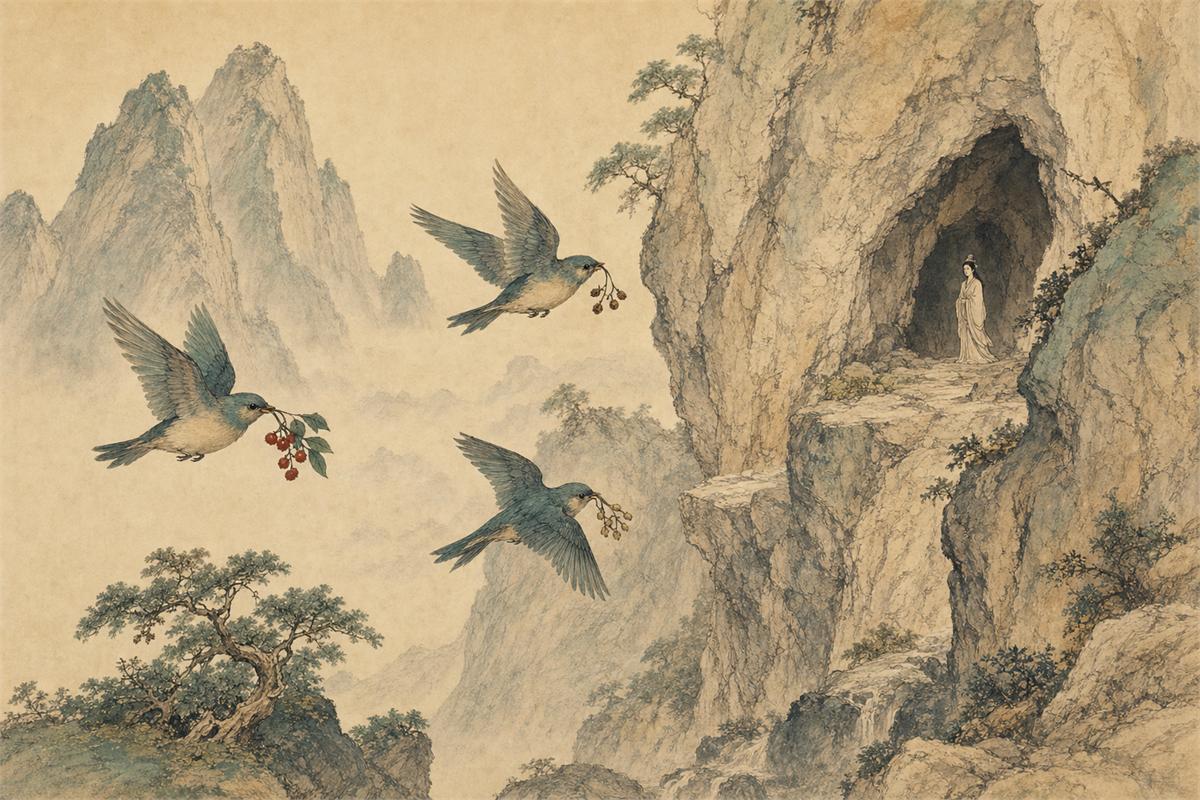
Modern theories have called her a fierce demon, tribal queen, priestess, shaman, or totemic deity. Such proposals may illuminate aspects of the imagery, but they are interpretations rather than explicit statements in the ancient text. Her hybrid body can instead be read cautiously as one way early mythography marks beings who occupy powerful spaces beyond the ordinary human world.
King Mu of Zhou and the humanized western host
The Tale of King Mu, Son of Heaven (Mu Tianzi Zhuan, 穆天子传) presents a strikingly different encounter. King Mu journeys west, offers ritual gifts, and holds a banquet with Xiwangmu beside Yaochi, the Jade Pond. They exchange songs in a ceremonious scene. Xiwangmu begins with the memorable words “White clouds are in the sky; the mountains rise between,” before reflecting on distance and the king’s possible return.

Here she is more human in speech and social bearing, but the text does not require us to call her the queen of a clearly defined “Kunlun kingdom.” Nor does it turn the meeting into a verified diplomatic mission, a thirty-thousand-li expedition, a transfer of governing advice, or a romance across time. Later readers can find longing in the songs; “cross-temporal love story” is a modern retelling, not the text’s settled genre.
Xiwangmu in Han-period art and immortality belief
During the Han period, Xiwangmu became prominent in visual programs concerned with transcendence, the afterlife, cosmic order, and access to an immortal realm. She appears on tomb reliefs, carved stones, bronze mirrors, clay objects, and money trees. The historical change is important, but it was neither instant nor uniform across the empire.
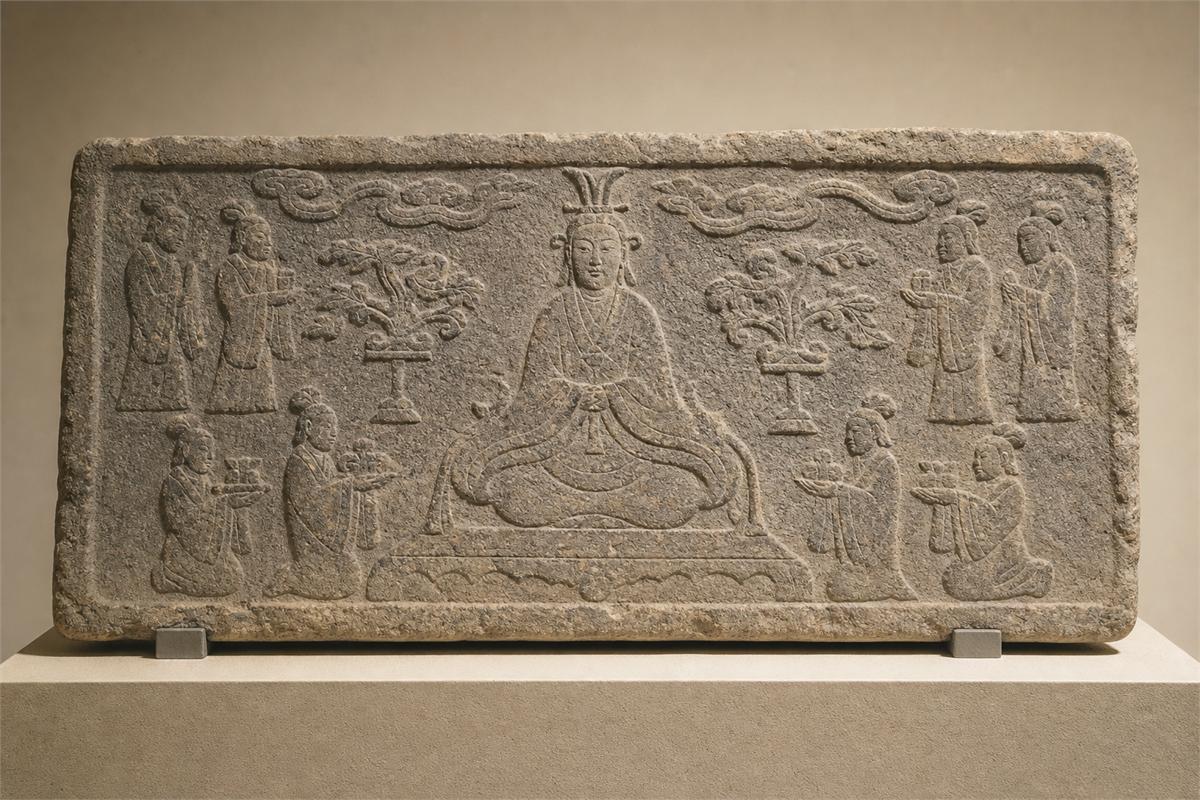
Han images may place her with Dongwanggong (东王公), the King Father of the East, especially in balanced east–west compositions. Other companions can include hares or jade rabbits preparing the drug of immortality, toads, three-legged crows, nine-tailed foxes, winged immortals, attendants, dragons, tigers, and birds. The combination varies by region, object type, date, and workshop. A three-legged crow may carry solar meaning in one composition; a blue-green bird associated with Xiwangmu belongs to another textual and visual chain.

Some artworks use flanking dragons and tigers or throne-like architectural frames, but “Xiwangmu always sits on a dragon-and-tiger throne” is too broad. Likewise, birds in funerary imagery cannot all be assigned the single task of escorting souls. The safer reading considers the entire composition and its archaeological setting.
Daoist adoption and the rise of a celestial matriarch
Daoist communities did not inherit one frozen Xiwangmu. Medieval revelations, hagiographies, encyclopedic compilations, temple traditions, and later scriptures placed her in different divine hierarchies. In some texts she embodies the essence or primordial qi of supreme yin; in others she governs Kunlun, transmits teachings, or stands as an origin and leader of female transcendents. Later honorifics such as Jinmu Yuanjun (金母元君) belong to these developed religious worlds, not to the vocabulary of pre-imperial myth.

Pairing Xiwangmu with Dongwanggong also needs a boundary. In parts of Han imagery and later Daoist thought, the two express west and east, yin and yang, or complementary administrations of immortals. That does not make them a universally fixed married couple, nor does it establish one orthodox Daoist account accepted in every lineage.

Kunlun and Yaochi: mythic geography, not one tourist map
Kunlun (昆仑) is both a powerful name in mythic geography and the modern name of a real mountain system. The two should be connected with care, not equated. Early and medieval sources imagine Kunlun in different ways: as a remote western height, cosmic axis, divine enclosure, or many-tiered realm. Features such as the ninefold walls of Zengcheng, Weak Water, encircling fire, the guardian Luwu, and the beast Kaiming come from particular textual passages and do not form one universally shared “map of Xiwangmu’s palace.”

Yaochi (瑶池), commonly translated as the Jade Pond, likewise changes by source. It is the banquet location in the Tale of King Mu; later religion and literature develop it as part of Xiwangmu’s celestial domain. The Journey to the West setting is a Ming novel’s literary heaven, not a direct description of the landscape in every earlier classic.

Real sites in the Kunlun range, the Tianshan region, Qinghai, and elsewhere have been identified in local legend or tourism as Yaochi or Xiwangmu landscapes. These associations can be culturally meaningful, but none can be declared the single “most authentic prototype” without turning layered sacred geography into a modern location claim.
Peaches of immortality: symbol, medieval tale, and Ming fiction
The peach had long-standing associations with vitality, longevity, seasonal renewal, and protection before the most famous peach-banquet stories took shape. By the Han, Wei, and Six Dynasties periods, Xiwangmu was increasingly linked with immortality foods, medicines, and peach-giving narratives. These strands made the peach one of her most enduring emblems.

The Inner Biography of Emperor Wu of Han (Han Wudi Neizhuan, 汉武帝内传) tells of Xiwangmu visiting the emperor and presenting peaches. It is a later, textually complex work with religious and marvel-tale features; its four peaches and dialogue about planting their pits belong to sacred literature, not to a court chronicle of a verified historical event.
The most precise orchard arithmetic comes from the Ming novel Journey to the West. Its fictional garden contains 3,600 peach trees in three groups of 1,200. The fruit ripens after 3,000, 6,000, or 9,000 years, with increasingly extravagant benefits. Sun Wukong’s theft of peaches and disruption of the banquet are brilliant novel episodes—not a universal Daoist doctrine about an orchard that operates on a yearly schedule.
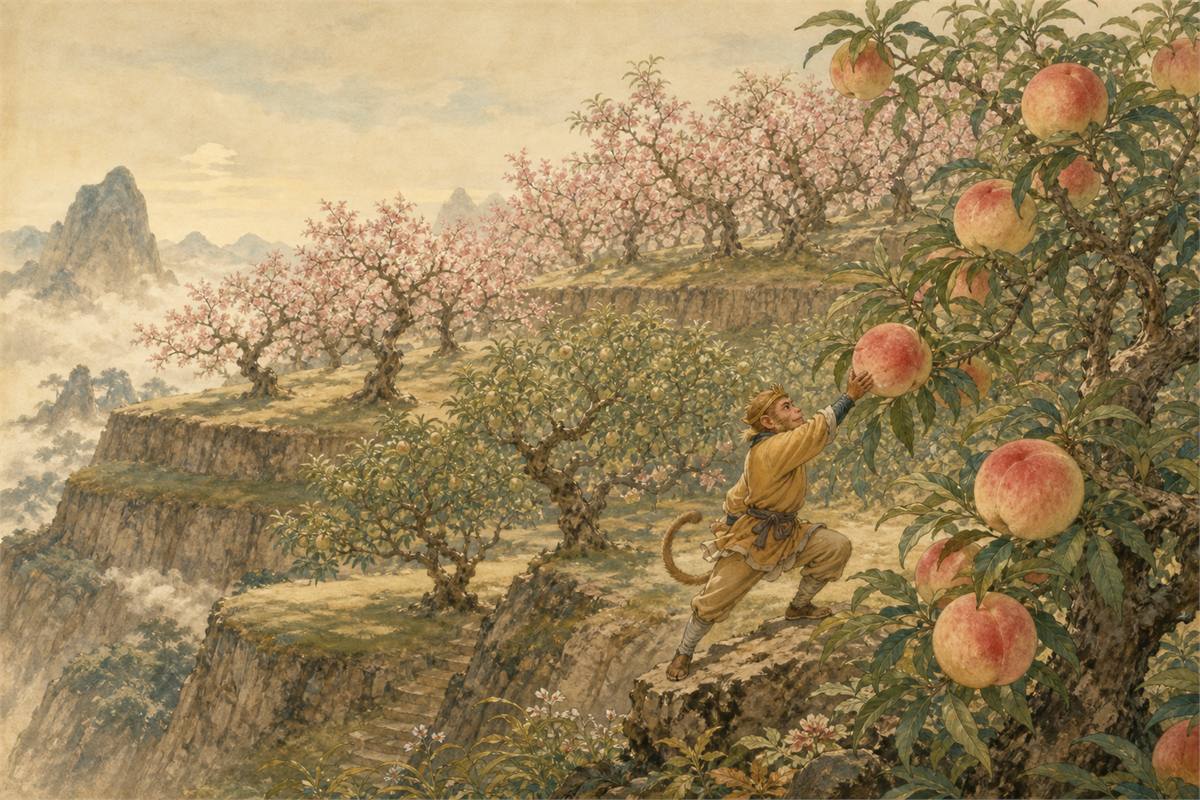
In this guide, the peach matters because it helps explain Xiwangmu’s authority over an imagined economy of long life, access, and celestial hospitality. As an independent motif, it can also carry a broader birthday or longevity meaning without depicting Xiwangmu herself.
Three blue-green birds, phoenixes, and cloud vehicles
Sanqingniao: the three birds who serve Xiwangmu
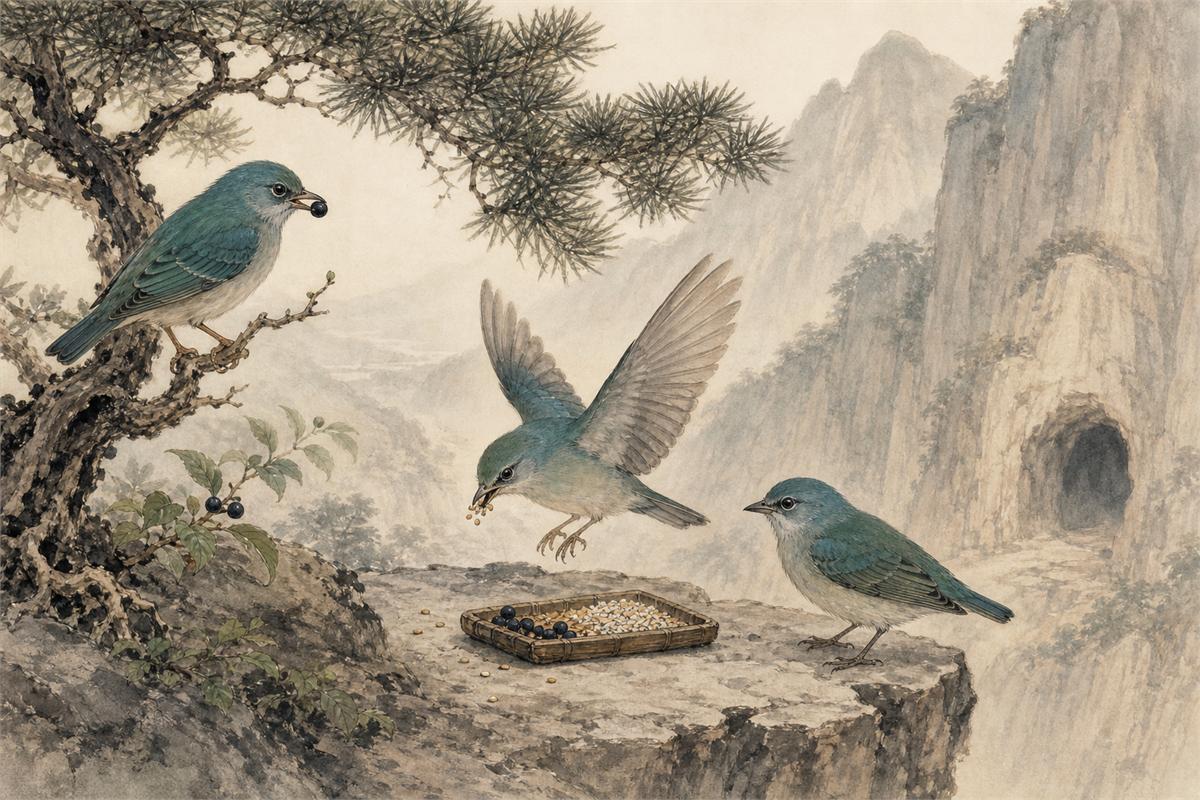
The three blue-green birds, Sanqingniao (三青鸟), are among Xiwangmu’s oldest companions. The Classic of Mountains and Seas says that three birds provide food for her. Later poetry and storytelling transform the blue bird into a messenger announcing the goddess’s approach or carrying news across distance. This later messenger can be called a qingniao or, in some traditions, a qingluan (青鸾), but the three early birds, the later blue-bird messenger, and the phoenix are not automatically the same creature.

Fenghuang and phoenix imagery
Fenghuang (凤凰) imagery contributes courtly brilliance and auspicious dignity in later art. Birds may appear on a crown, robe, screen, vehicle, or surrounding landscape. Yet a phoenix is not Xiwangmu’s exclusive mount, and a bird beside her should not be identified without visual context. Claims about “five primordial phoenixes,” “nine phoenix children,” or a phoenix becoming a human vehicle belong to separate and inconsistent lore.

Clouds, cloud carriages, and splendid travel
Clouds signal celestial space and movement throughout later poetry, Daoist writing, painting, murals, opera, and fiction. Purple clouds, cloud carriages, dragon teams, and richly patterned vehicles appear in particular works, not as one standard set of Xiwangmu’s “ten magic treasures.” When reading an artwork, it is better to identify the period and medium than to force every vehicle into a single mythic specification.

Is Xiwangmu the Jade Emperor’s wife?
Usually, no. Early sources do not present Xiwangmu as the wife of the Jade Emperor, and classical Daoist traditions generally treat them as independent divine powers with different histories. Some popular dramas, television adaptations, children’s retellings, or local traditions may place “Wangmu Niangniang” in a family-like heavenly court, which encourages the modern assumption.

It is also too simple to assign this idea one starting date or blame a single novel. Popular pantheons developed through centuries of temple practice, performance, storytelling, prints, and household religion. In Journey to the West, the Jade Emperor and Queen Mother both occupy the celestial administration, but the novel does not need them to be husband and wife for its plot to work.
Xiwangmu in painting, murals, festivals, and modern culture
Across later art, Xiwangmu can appear as a majestic crowned deity, an immortal host, or a central figure surrounded by female transcendents and celestial attendants. The great Chaoyuan Tu murals at Yongle Palace are major works of Daoist art, not a single normative portrait that fixes her appearance for every tradition. Cave murals and tomb art require the same caution: identifications depend on attributes, inscriptions, placement, and comparison with related images.

Living worship is regional rather than nationally uniform. The third day of the third lunar month is widely observed as Xiwangmu’s sacred birthday in some temple networks, while other dates and pilgrimage customs appear in particular local communities. A date in a temple calendar should be described as that community’s observance, not as one festival celebrated identically everywhere.

Modern fiction, games, film, tourism, feminist scholarship, and visual design continue to reinterpret her. Reading Xiwangmu as a symbol of women’s authority, independence, or resistance can be a productive contemporary analysis. It should remain recognizable as a modern reading rather than a claim that ancient communities shared one idea of an “unregulated creator goddess.”
How to identify which Xiwangmu tradition you are reading
- Name the source. “Ancient legend says” is less useful than identifying the Classic of Mountains and Seas, a Han tomb image, a Daoist scripture, or a Ming novel.
- Check the date and genre. Mythography, funerary art, revealed scripture, marvel tale, drama, and tourism copy answer different questions.
- Separate symbols that accumulated later. The early three blue-green birds are not automatically phoenixes; the peach banquet is not identical in every period.
- Keep geography layered. Mythic Kunlun and real mountains may inspire one another without being the same map.
- Treat divine functions as beliefs. Long life, safe passage, fertility, disaster-averting power, and leadership of female immortals belong to particular religious or symbolic contexts, not measurable promises.
- Read the whole image. A peach alone signifies longevity; a phoenix alone may signify auspicious virtue. Xiwangmu is identified through a constellation of attributes and context.

Xiwangmu’s lasting power comes from this plurality. She can be a dangerous guardian of the western margins, a poetic host, a focus of Han hopes for transcendence, a Daoist matriarch, and a beloved figure of later storytelling without becoming one fixed, steadily “upgraded” character. Readers interested in the wider symbolic world can continue through the Eastern Story mythology and culture guides or browse the Blessing collection.
Frequently Asked Questions
Related Posts


