
The Chou Earthly Branch (丑, chǒu) is the second of the twelve Earthly Branches Di Zhi (地支). It follows Zi (子) and precedes Yin (寅). Traditional correspondence tables connect it with the Ox, the 1:00–3:00 a.m. double hour, late winter, yin earth, and a precise compass sector centered on 30°. Chou is a calendar and ordering sign first; the Ox is its best-known animal partner.
That distinction answers the central search question. “Chou Earthly Branch meaning” is not the same topic as a complete Ox zodiac guide. This page explains how to pronounce and read 丑, how Chou hour and Chou month work, where its direction sits, which ideas belong to later astrology, and how Ox and Chou references can be translated into accurate jewelry and gift design.
How to Pronounce and Read Chou (丑)
In Mandarin, 丑 is pronounced chǒu, with a third tone. The spelling “Chou” is a familiar English rendering, although pinyin normally includes the tone mark when pronunciation matters. In an Earthly Branch table, 丑 means the second branch or the second position in a repeating twelve-part sequence.

Modern simplified Chinese also uses 丑 in everyday words relating to ugliness, but this is a separate lexical history. In traditional writing, the adjective “ugly” was written 醜, while the branch was 丑. The simplified script later uses 丑 for both. A calendar label, birth-chart notation, date, hour, or zodiac inscription therefore should not be translated as “ugly.” It should be read as Chou, the second Earthly Branch.
Early explanations of the graph connect it with a hand-like form and with ideas such as binding or turning. These interpretations are useful for understanding how historical commentators read the character, but they are not a single settled story about its origin. The secure historical function is clearer: 丑 appears as one of the fixed branch signs used in ordered calendrical cycles.

Chou at a Glance

| Category | Chou correspondence | What it means |
|---|---|---|
| Order | 2nd of 12 | After Zi (子), before Yin (寅) |
| Mandarin | 丑, chǒu | Third-tone pronunciation |
| Zodiac animal | Ox Niu (牛) | Animal image paired with the branch |
| Double hour | 1:00–3:00 a.m. | A two-hour traditional time division |
| Branch month | About Minor Cold to Start of Spring | A solar-term month in late winter |
| Season | Late winter | The last of the three winter branches |
| Five Phase classification | Yin Earth | A traditional correlative category |
| 24-direction compass | 30° sector center | Between Gui at 15° and Gen at 45° |
The same branch can label a year, month, day, or hour. A Chou year, Chou month, Chou day, and Chou hour are four different scales, not four names for the same date. When paired with one of the ten Heavenly Stems Tian Gan (天干), Chou also forms entries in the sixty-part stem–branch cycle, such as Yi-Chou (乙丑) or Xin-Chou (辛丑).

What Is Chou Hour?
Chou hour (丑时) is the traditional double hour from approximately 1:00 a.m. to 3:00 a.m. A day divided among twelve branches gives each branch a two-hour span: Zi covers about 11:00 p.m.–1:00 a.m., Chou follows from 1:00–3:00 a.m., and Yin continues from 3:00–5:00 a.m.

Older time names also associate this part of the night with jiming (鸡鸣), “cockcrow.” That label describes a traditional phase of the night rather than a universal alarm set by every rooster. Historical timekeeping varied by place, season, and method, so the modern clock range is a practical standardized correspondence.

A popular explanation says the Ox was assigned to Chou because cattle quietly ate or ruminated during these hours before farm work. It is a memorable folk story and fits the animal’s agricultural image. It should not be presented as the proven historical origin of the branch–animal pairing. The Earthly Branch signs were used in calendrical cycles before the familiar zodiac-animal explanations were fully established.
Chou Month, the Lunar Twelfth Month, and Winter
“Chou month” can cause confusion because two calendar ideas are often compressed into one sentence. In branch-based calendrical and later astrology systems, the Chou month is a solar-term month. It begins around Minor Cold Xiaohan (小寒), usually in early January, and ends at Start of Spring Lichun (立春), usually in early February. Exact Gregorian dates vary by year.

The lunar twelfth month is different: a lunar month begins at a new moon. It is commonly associated with Chou and often overlaps the same late-winter period, but its beginning and end are set by lunar-calendar rules. Consequently, “Chou month” and “the twelfth lunar month” are related traditional labels, not permanently identical date ranges.

Within the seasonal grouping of the branches, Hai (亥), Zi (子), and Chou (丑) form the three winter positions. Chou closes that sequence just before Yin (寅) opens the spring group. Images of frozen soil, dark fields, storage, waiting, and gradual preparation come from this late-winter placement. They are cultural metaphors, not claims that a written character controls the weather or a person’s body.
Chou Direction: A Precise Sector, Not the Whole Northeast
In the traditional 24-direction compass, the Chou direction is centered on 30° when north is 0°. It sits between Gui (癸) at 15° and the Gen trigram direction (艮) at 45°. Yin (寅) follows at 60°.

This makes “northeast” a useful broad description, but not a precise equivalence. Chou is one sector within the northeastern quarter; it is not the entire northeast and it is not identical to Gen. Gen occupies its own 45° position in the 24-direction system. Keeping these labels separate prevents a common error in diagrams, inscriptions, and design briefs.

The direction correspondence is especially relevant when a pendant or rotating calendar disc uses all twelve branches or the full 24 mountains. For an Ox charm with no compass function, adding a random northeast arrow would create visual noise rather than cultural accuracy.
Why Chou Is Linked With the Ox
The Ox Niu (牛) is the zodiac animal paired with Chou. The branch and animal are closely connected, but they are not interchangeable. Chou is an abstract calendrical sign used for order and time. The Ox supplies a recognizable living image that carries agricultural and cultural associations.

Across Eastern art and folk culture, cattle can evoke farming, food production, endurance, patient strength, and the household hope for a stable agricultural life. Ox-herding imagery also developed distinct Buddhist and artistic meanings. Those histories are broader than the zodiac, which is why an ox in a painting or carving should not automatically be identified as “Chou.” Context matters.
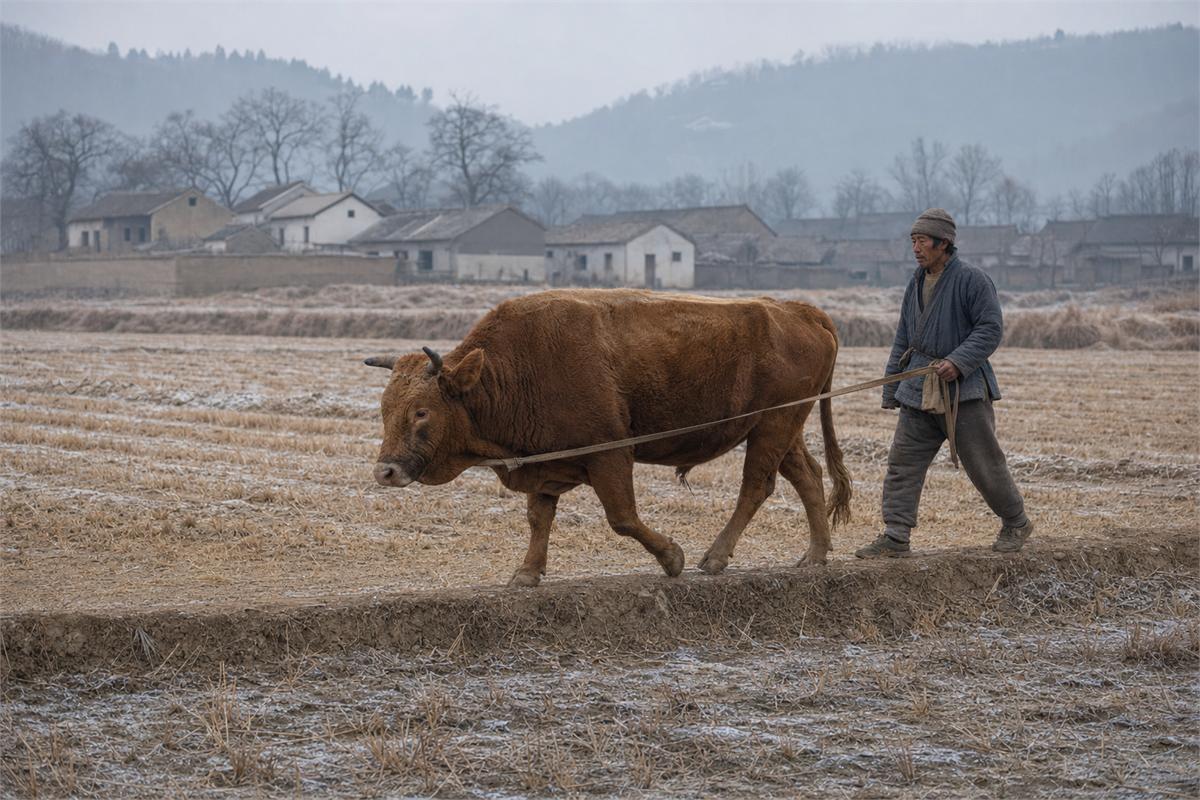
Modern zodiac writing often describes Ox people as steady, loyal, responsible, patient, or stubborn. These are folk personality summaries used in stories, horoscopes, and gift language. They are not scientific assessments of anyone born in an Ox year or during Chou hour. For a thoughtful gift, it is better to connect the motif with qualities the recipient values than to assign a fixed personality.
The modern popular “zodiac guardian” or benmingfo (本命佛) system often pairs Ox and Tiger signs with Akasagarbha Bodhisattva, known in Chinese as Xukongzang Pusa (虚空藏菩萨). This is a contemporary devotional and jewelry pairing culture, not a core Buddhist doctrine that promises supernatural protection. A respectful design should identify the figure accurately and avoid mixing bodhisattva imagery with unrelated talismans merely for decoration.
Yin Earth, Hidden Stems, and Branch Relationships
Traditional Five Phase tables classify Chou as yin earth. Later bazi and fortune-calculation schools elaborate this as damp, cold, or frozen earth because of Chou’s late-winter position. The same systems describe Chou as containing the hidden stems Ji (己), Gui (癸), and Xin (辛), and sometimes call it a “metal storehouse” or “metal tomb.”

These are technical categories inside later metaphysical interpretation rather than measurable forces, geological descriptions, or rules of biology. Used carefully, they explain why an astrology chart, almanac, or traditional design note may connect Chou with earth, winter moisture, and metal. For jewelry, they work as cultural context and visual language; material choices still rest on color, durability, craft, and care.
| Later astrology term | Branches involved | How to read it here |
|---|---|---|
| Six Harmony | Zi–Chou (子丑合) | A pairing category in later metaphysics |
| Three Harmony | Si–You–Chou (巳酉丑) | A three-branch metal grouping |
| Winter directional combination | Hai–Zi–Chou (亥子丑) | A winter/water grouping in some systems |
| Clash | Chou–Wei (丑未冲) | An interpretive opposition category |
| Punishment | Chou–Xu, often discussed with Wei (丑戌刑) | A chart relationship term |
| Harm | Chou–Wu (丑午害) | Another later chart relationship term |

These classifications are reasons to label a chart correctly, not reasons to avoid Sheep, Horse, or Dog jewelry. Motifs can be chosen for family ties, aesthetic preference, a favorite story, or the recipient’s own zodiac identity. A symbolic gift becomes more meaningful when it reflects the person, not a fear-based list of prohibited animals.

Ox Symbolism in Jewelry and Gift Design
Chou-inspired jewelry works best when the design decides what it is communicating. A branch-character pendant emphasizes calendar identity and discretion. An Ox silhouette emphasizes the zodiac animal. A full rotating branch wheel explains a system. Combining all three can work, but only when each layer remains legible.

| Design approach | Visual idea | Accuracy check |
|---|---|---|
| Ox silhouette | Low head, broad shoulder, balanced stance | Keep the animal readable at jewelry scale |
| Horn curve | One continuous arc or mirrored pair | Avoid turning it into an unrelated crescent symbol |
| Geometric structure | Square frame with controlled curves | Use geometry as design language, not a magical formula |
| Winter-earth palette | Ochre, taupe, deep brown, ink, muted silver | Describe color and finish, not promised effects |
| Character design | 丑 or 牛 in an accurate script style | Have a knowledgeable reader verify every stroke |
| Branch wheel | Twelve ordered signs around a disc | Preserve the correct Zi-to-Hai sequence |
Material choices should follow observable properties and construction. Gold and silver provide workable precious-metal surfaces for engraving and relief. Stainless steel offers strength and lower-maintenance daily wear. Nephrite can give a soft luster and tactile carved surface; onyx and dark agate offer strong contrast for pale metal. Enamel can make the branch character readable without relying on a large stone.

Durability depends on thickness, joints, stone setting, chain weight, and finish. A projecting horn tip can catch on clothing, so a rounded or enclosed horn curve is often more wearable. Matte finishes make broad Ox forms feel quiet and sculptural, while polished edges can clarify the silhouette. Clean according to the actual material: use a soft cloth for routine wiping, keep delicate stones and adhesives away from harsh chemicals, and remove pieces before activities likely to bend, scratch, or strike them.

Calligraphy and ancient-form references demand particular care. Do not improvise a “seal script” or “oracle-bone style” character by stretching modern strokes until they look archaic. Start from a reliable historical form, name the script accurately, and verify the final engraving after every simplification. Avoid mixing Chou, an Ox head, Buddhist implements, bagua lines, and symbols from unrelated cultures in one motif unless the design has a clearly researched reason.
As a gift, an Ox or Chou piece can express appreciation for patience, sustained effort, dependability, family continuity, or a meaningful birth-year connection. Readers looking for the wider animal cycle can continue with the Chinese zodiac symbols guide. For the traditional phase language behind yin earth, see the Five Elements guide. The Blessing collection offers a broader path into symbolic gifts.
Common Chou Misreadings

- Chou means “ugly” here. In a branch context, 丑 is the second calendrical sign; the everyday adjective is a different use shaped by script simplification.
- Chou and Ox are identical. Chou is the branch; Ox Niu (牛) is its zodiac animal correspondence.
- Chou month always equals lunar month twelve. The solar-term branch month and the lunar month commonly correspond, but their boundaries are calculated differently.
- Chou is the whole northeast or the Gen trigram. In the 24-direction system, Chou centers on 30° and Gen on 45°.
- Ox rumination proves the historical origin. It is a popular explanatory story, not a settled origin account.
- Hidden stems and clashes are natural laws. They are categories used by later metaphysical schools.
- A Chou jewel needs “lucky” stones. A successful piece needs accurate symbolism, suitable materials, sound construction, and a clear gift purpose.
Frequently Asked Questions
Related Posts


