
A Benmingnian bracelet is a zodiac-year bracelet worn as a cultural symbol of care, celebration, and personal resolve during one’s Benmingnian (本命年). Red cord is the best-known form, but gold, silver, jade, Nanhong agate, cinnabar-style beads, natural stone, and zodiac motifs also appear. It is jewelry and a meaningful ritual object—not a device that can prevent misfortune or change a person’s fate.
Choose one by starting with fit, skin comfort, cord construction, hardware, and daily routine. Then decide how much red color and zodiac symbolism the wearer actually wants. This guide focuses on the bracelet itself; for the broader twelve-year custom, begin with what Benmingnian means.
What Is a Benmingnian Bracelet?
Benmingnian is the year governed by the same zodiac animal as a person’s birth year. Because the zodiac repeats in a twelve-animal cycle, it normally returns every 12 years. A person born in a Horse year, for example, encounters another Horse year at roughly ages 12, 24, 36, and so on. The exact boundary is not simply January 1: the Chinese calendar year begins at Lunar New Year, while some astrology systems use Lichun, the “Start of Spring” solar term. Families and traditions may therefore identify the starting point differently.

In modern folk practice, the bracelet marks this recurring year in a visible, personal way. Red suggests festivity, warmth, and good wishes; a zodiac charm identifies the birth sign; a bead or knot may represent continuity or family care. These meanings explain why the bracelet is often given by a parent, partner, relative, or friend, although buying one for yourself is also common.
Benmingnian is also discussed alongside “meeting Tai Sui” in some folk and astrology traditions. That language varies by region and school and should not be turned into fear-based shopping. A bracelet cannot guarantee safety, wealth, romance, career progress, or relief from anxiety. Its honest value lies in craftsmanship, cultural connection, aesthetic pleasure, and the wearer’s own sense of occasion.
Why Red String Is the Classic Form
Red has a long association with celebration and auspicious occasions in Chinese culture, especially weddings and New Year festivities. A red-string bracelet translates that broad color language into something light, affordable, and easy to wear. The cord can be plain, braided, knotted, or combined with one central bead or charm. For a deeper look at the wider symbol beyond the zodiac year, see red string bracelet meaning.

Red is traditional, but it is not compulsory. Someone who rarely wears bright colors may prefer dark red, burgundy, a red accent knot, or a neutral bracelet with one small red detail. The cultural connection remains understandable without forcing the wearer into a color or style they dislike.
Common Materials and What to Check
| Form or material | Visible and practical qualities | What to inspect |
|---|---|---|
| Braided red cord | Light, flexible, easy to adjust | Even braid, secure knots, colorfastness, soft cord ends |
| Gold or gold alloy | Warm color and strong gift presence | Purity mark, smooth edges, weight, solder joints, soft parts that may scratch |
| Sterling silver | Cool tone, detailed casting, moderate price | 925 mark, tarnish, plating condition, clasp movement |
| Jade | Dense feel, translucent to opaque color, excellent toughness | Chips at drill holes, surface coatings, bead-to-bead rubbing |
| Nanhong agate | Warm red-orange color and stone texture | Cracks, dye bleeding, sharp drill holes, bead matching |
| Cinnabar-style or cinnabar-containing beads | Deep red color, often molded or carved | Surface damage, powder, exposed core, clear material disclosure |
| Other natural stone | Wide range of colors, patterns, and weights | Hardness differences, coatings, porous surfaces, drill-hole wear |
| Zodiac or auspicious motif | Personal identity and recognizable symbolism | Correct animal, snag-free edges, secure bail or connector |
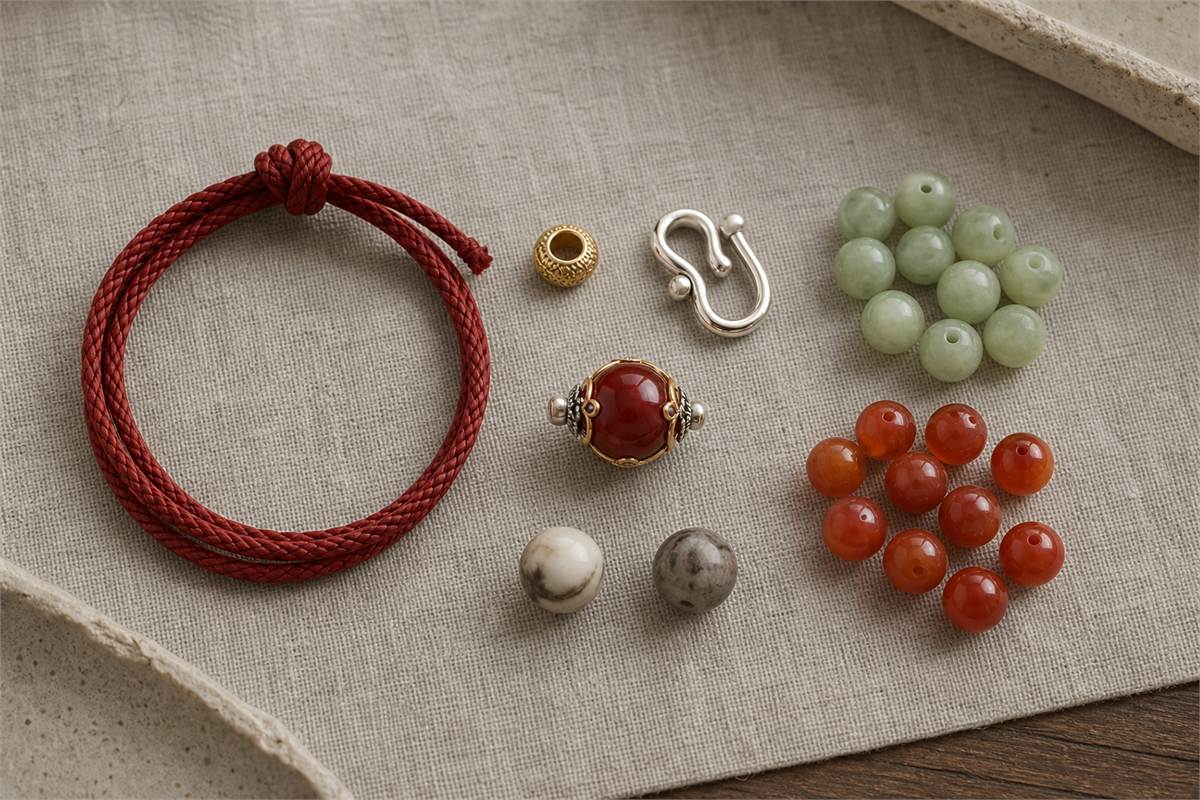
Gold, silver, and plated components
24K gold is rich in color but comparatively soft, so small beads and charms can collect scratches or deform under pressure. 14K and 18K gold are harder alloys that suit clasps and detailed components. Sterling silver can tarnish and may be rhodium plated for a brighter surface. Gold-plated pieces depend on the base metal, plating thickness, sweat exposure, and friction; worn edges will usually show first around holes, clasps, and raised motifs.

Check every metal edge with a fingertip. A zodiac charm should not scratch the wrist, catch knitwear, or cut the cord where it passes through a bail. If the wearer has sensitive skin, ask what metal touches the skin rather than relying on a vague “gold color” description.
Jade, agate, and other stone beads
Jadeite measures about 6.5–7 and nephrite about 6–6.5 on the Mohs scale. Both are notably tough, yet polished surfaces and drilled holes can still be scratched or chipped. Warm soapy water and a soft cloth are the safest general cleaning method when treatments or coatings are unknown. Red agate and other stones also need smooth drill holes; a rough hole can saw through cord long before the bead itself looks worn.

Cinnabar safety boundaries
Cinnabar is mercury sulfide, and the word is also used loosely in the market for red resin, lacquer-like, or composite beads. Treat any cinnabar-containing jewelry as a finished decorative object: do not put it in the mouth, grind it, sand it, drill it, heat it, or burn it. Keep it away from children who may chew beads. Stop wearing a piece if it cracks, sheds powder, or exposes a damaged core; place it in a sealed bag and follow local household hazardous-waste guidance when appropriate.

Design, Cord, Clasp, and Size
The bracelet’s structure matters more than the number of beads. Cotton cord feels soft and breathable but absorbs water and sweat. Nylon or polyester cord is often more abrasion resistant and dries faster, although stiff or heat-sealed ends can irritate skin. Silk cord has a refined sheen but benefits from gentler wear. Elastic is easy to put on, yet repeated stretching, oils, and heat gradually weaken it.
For a beaded design, the spacer should support rather than dominate the main bead. One useful visual relationship is a spacer about 3–4 mm smaller than the main bead: a 10 mm bead can pair with a 6–7 mm spacer, while a 6 mm bead can pair with a 3–4 mm spacer. This is a design guideline, not a cultural rule. Confirm that the spacer edges do not rub through the cord.

Measure the wrist close to the skin, then add ease according to bead size and preferred movement. Flat cord needs less extra room than large round beads because beads reduce the bracelet’s internal circumference. An adjustable sliding knot should move firmly without collapsing under light tension. Lobster clasps and spring rings should close completely; magnetic clasps are convenient but can release when pulled and may be unsuitable around certain medical devices.

- Look for a smooth interior with no exposed wire, glue, or sharp crimps.
- Pull gently at every connector and knot before first wear.
- Check that dangling charms cannot catch tools, handles, or clothing.
- Choose the lightest construction that still feels substantial enough for the wearer.
- For daily typing, childcare, cooking, or sports, favor a low-profile design.
How to Choose a Benmingnian Bracelet
Start with the wearer, not an astrology shopping chart. A zodiac charm may match the person’s birth animal, but it does not have to. Some people like the direct identity of their own animal; others prefer a knot, round bead, coin-inspired form, cloud, lotus, gourd, or abstract geometric motif. Traditional systems of zodiac combinations and clashes exist, but they are interpretive frameworks—not evidence that a person must wear one animal or avoid another.
Likewise, Five Elements color matching, “missing element” advice, Benming Buddha pairings, and annual Tai Sui lists belong to particular religious or astrology contexts. They should not be presented as automatic product prescriptions. If the recipient follows a specific family or spiritual tradition, ask what that tradition prefers. Otherwise, fit, materials, workmanship, and the recipient’s taste are better guides.
| Wearer or situation | Practical choice | Avoid |
|---|---|---|
| Minimal dresser | Thin burgundy cord or one small metal bead | Large clusters and long dangles |
| Frequent handwashing | Quick-drying synthetic cord or removable bracelet | Absorbent cord worn while wet |
| Sensitive skin | Known skin-contact metal and soft cord | Unspecified alloy, rough plating, exposed wire |
| Active work | Low-profile knot, secure clasp, non-dominant wrist | Loose fit and snag-prone charms |
| Formal gift | Refined metal, jade, or stone accent with a written note | Overloaded symbolism the recipient does not follow |
| Child | Age-appropriate, supervised item only | Small detachable beads, long cord, bells, magnetic parts |

Which Wrist Should You Wear It On?
There is no universal wrist rule. “Left receives, right releases” and “men left, women right” are familiar sayings in some modern folk or metaphysical discussions, but they are not nationwide requirements. Many wearers simply choose the non-dominant wrist because it receives fewer knocks and creates less friction while writing, cooking, or using tools.
If a family tradition names a wrist, following it can make the ritual more personal. If it does not, choose the side that feels safer. Switch wrists when an injury, watch, uniform, or work task makes that sensible. The bracelet’s cultural meaning is not lost because comfort takes priority.

When to Start Wearing It
Common starting points include New Year’s Eve, Lunar New Year’s Day, or Lichun. These dates reflect different household customs and calendar systems. Lunar New Year begins the Chinese calendar year; Lichun is a solar term used as a year boundary in some astrology conventions and can arrive on a different date. Neither creates a single compulsory start time for every wearer.

Some people put the bracelet on before the holiday, on a birthday, or whenever the gift is received. It also does not have to remain on continuously for an entire year. Remove it for activities that could soak, crush, contaminate, or snag it. A practical ritual can accommodate work, hygiene, medical needs, sleep comfort, and material care.
Giving a Zodiac-Year Bracelet as a Gift
A bracelet from an elder is valued in some families because it expresses intergenerational care, but an elder is not the only appropriate giver. Partners, siblings, friends, children, and the wearer themselves can all choose one. What matters is the relationship and the message attached to the gift.

Keep the message warm without promising an outcome: “A small red thread for your zodiac year,” “A reminder that I’m thinking of you,” or “For courage, care, and good moments in the year ahead.” Explore Eastern Story’s Blessing collection for designs centered on symbolic gifting.
For children, jewelry safety outweighs symbolism. Small beads, bells, magnets, and charms can be choking hazards. Long or strong cord can catch and create a strangulation or circulation risk. Do not use an adult bracelet as an unsupervised infant or toddler accessory. Choose an age-appropriate product, keep the fit loose enough for circulation but not so loose that it catches, and inspect it frequently under adult supervision.

Cleaning, Storage, and Replacement
Follow the least aggressive care method required by the most delicate component. Wipe the bracelet after sweat, remove it before swimming or using household chemicals, and let damp cord dry fully in moving air away from direct heat. Use a soft cloth for metal and stone. For mixed or coated materials, use a barely damp cloth rather than soaking. Eastern Story’s jewelry care guide covers general storage and cleaning habits.

- Store the bracelet dry and flat in a soft pouch, away from harder jewelry.
- Keep silver separately to reduce scratching and slow tarnish exposure.
- Do not use bleach, acids, abrasive powder, steam, or ultrasonic cleaning on an unknown mixed-material piece.
- Replace cord when it becomes fuzzy, thin, stiff, faded at stress points, or loose at a knot.
- Repair a valuable charm or bead through a competent jeweler or restringing service.
A broken cord usually means that friction, moisture, tension, or age has weakened it. Some folk stories interpret breakage as the bracelet having absorbed misfortune, but that is symbolism rather than a material diagnosis. Save reusable components, repair the piece, recycle eligible metal, or wrap sharp parts before responsible disposal. Do not burn an old cord, especially when its fibers, dyes, coatings, adhesives, or bead composition are unknown.

A Practical Buying Checklist
- Confirm which zodiac-year boundary the wearer or family follows.
- Choose red as a preference, not a compulsory rule.
- Measure the wrist and account for bead diameter.
- Identify every skin-contact metal and surface coating.
- Inspect cord, drill holes, knots, crimps, clasp closure, and charm edges.
- Match water resistance and care needs to the wearer’s routine.
- Avoid small detachable parts for young children.
- Use zodiac and auspicious motifs as cultural design, not a promised result.
- Include a note that explains the relationship and occasion.
- Plan how the bracelet will be cleaned, repaired, stored, or replaced.
Respecting Tradition Without Fear Marketing
A thoughtful Benmingnian bracelet guide can describe red as celebratory, a knot as continuity, jade as an important jewelry material, and a zodiac animal as identity without claiming that the object controls events. It can also acknowledge Tai Sui, wrist customs, gift traditions, and calendar differences without turning them into threats.
That distinction protects the tradition rather than diminishing it. The bracelet becomes a wearable expression of family care and cultural memory, while the wearer remains free to choose a design that is comfortable, well made, and personally meaningful. For the broader animal system behind the birth year, visit the guide to Chinese zodiac symbols.

Frequently Asked Questions
Related Posts



0 Comments