
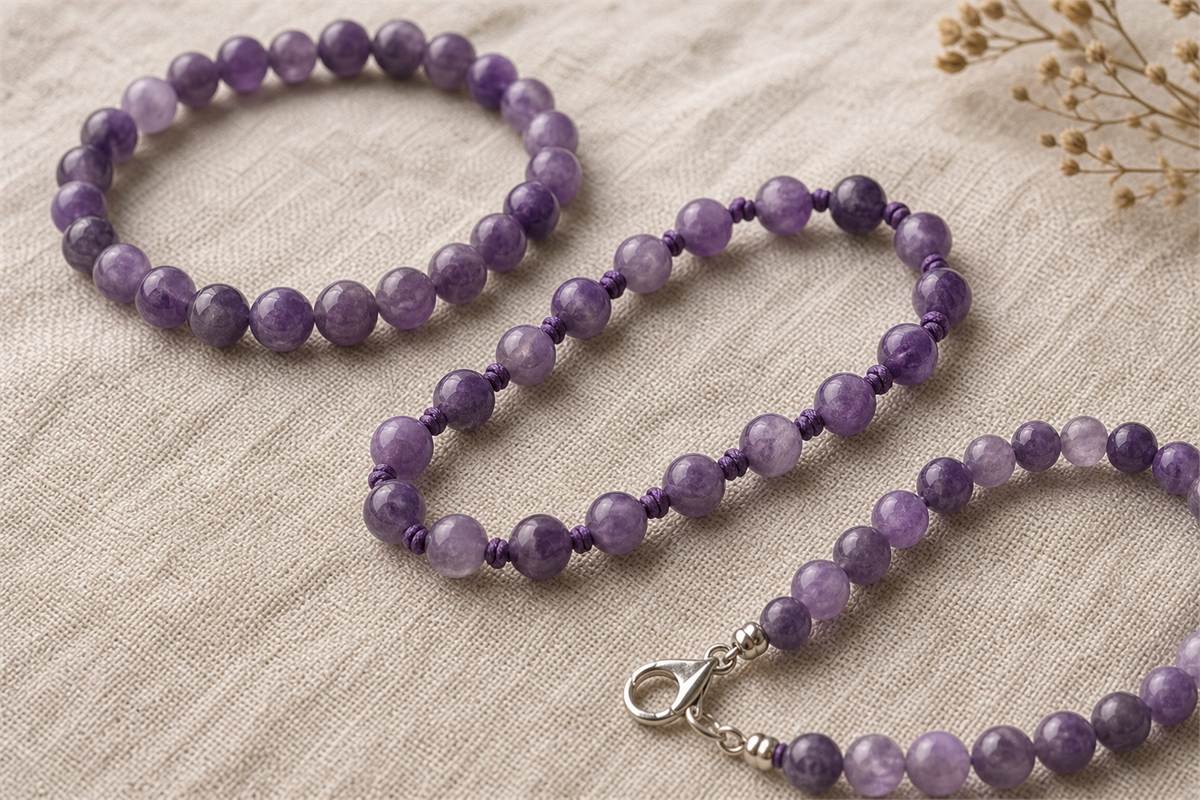
An amethyst bracelet is a strand of purple quartz beads or polished amethyst components worn around the wrist. Its best-known meanings come from the stone’s long association with clear-headedness, purple royal and religious jewelry, and its modern role as February’s birthstone. When choosing one, separate symbolism from material facts: judge the bracelet by disclosed identity and treatments, color, transparency, polish, fractures, bead matching, construction, and fit.
This amethyst bracelet guide explains what the stone is, why purple varies, how quality is evaluated, what natural and synthetic amethyst mean, which buying checks matter, and how to clean and store a bead bracelet without relying on destructive home tests or fixed spiritual rules.
Amethyst Bracelet at a Glance
- Material: amethyst is the purple variety of quartz, composed mainly of silicon dioxide (SiO₂).
- Meaning: historical ideas of sobriety and clear-headedness, purple associations with religious and royal jewelry, February birthstone identity, and modern gift symbolism.
- Quality: material disclosure, attractive color and brightness, transparency, limited surface-reaching fractures, smooth polish, clean drill holes, matched beads, and reliable stringing.
- Authenticity: natural, synthetic, treated, glass, resin, dyed material, and assembled products are different categories; appearance alone may not settle the question.
- Fit: measure the actual wearing wrist, confirm the bracelet’s finished inner circumference or usable length, and allow for bead diameter and hardware.
- Care: use gentle soap and water only when the entire bracelet construction can tolerate it; avoid high heat, thermal shock, prolonged intense light, harsh chemicals, impact, and abrasive cleaners.
What Is an Amethyst Bracelet?
Most amethyst bracelets are made from drilled round beads threaded on elastic cord or a knotted string. Others use faceted beads, irregular nuggets, cabochons, metal links, or a clasp. This page focuses on flexible bead bracelets, not a rigid closed bangle. A bangle is sized by its opening and inner diameter; a flexible bracelet is chosen by wrist circumference, finished length, bead size, and preferred ease.

The bracelet form adds practical questions that a loose-gem guide does not answer. A beautiful bead can still make a poor bracelet if its drill hole is chipped, its polish is uneven, its elastic is weak, or the finished circle pinches the wrist. Amethyst bracelet quality therefore combines the gemstone with the whole construction.
Amethyst Bracelet Meaning: History, Birthstone, and Modern Symbolism
From Greek word history to royal and religious jewelry
The name amethyst comes from the ancient Greek amethystos, commonly translated as “not drunk” or “not intoxicated.” Greek and later Roman lore connected the wine-colored gem with sobriety and clear-headedness. That is a historical belief attached to the name and color, not a physical effect of wearing the stone.

Deep purple also carried status in European religious and court jewelry. Fine amethyst appeared in bishops’ rings, religious objects, crown jewels, and royal collections. These uses help explain why modern jewelry descriptions still reach for words such as dignity, composure, refinement, and wisdom when describing the stone.
February birthstone and gift meaning
Amethyst is the modern February birthstone and is also associated with the sixth and seventeenth wedding anniversaries. A February birthstone bracelet can therefore mark a birthday, anniversary, graduation, or personal milestone without requiring a spiritual explanation. The gift can simply express thoughtfulness, steadiness, loyalty, or appreciation for the recipient’s connection to purple.

Labels such as “wisdom stone,” “love guardian stone,” or “social stone” are common in contemporary crystal retail. They are not universal ancient titles shared across cultures. A more accurate modern interpretation is that many people choose amethyst as a personal symbol of reflection, calm style, self-possession, or a clear new chapter.
What Amethyst Is Made Of
Amethyst is purple quartz. Its primary chemical composition is silicon dioxide, SiO₂. The purple color is linked to iron-related defect centers in the quartz structure and natural ionizing radiation during geological formation. Describing the color as simply “iron and manganese in the stone” is misleading; manganese is not the standard explanation for amethyst’s purple.

Quartz rates about 7 on the Mohs hardness scale. Hardness describes resistance to scratching, not immunity to impact. A bead can still chip at the drill hole, break along a fracture, or be damaged by a hard blow. That distinction matters in a bracelet, where beads repeatedly touch desks, doors, watches, and other jewelry.
Amethyst Colors and Color Zoning
Amethyst ranges from pale lilac through bluish purple and reddish purple to very deep violet. Natural crystals often show angular zones or bands of lighter and darker color. Bead cutting can distribute those zones in different ways, so one bead may look evenly purple while another shows a visible patch, stripe, or gradient.

Color in photographs depends on more than the stone. Daylight, warm indoor lighting, phone white balance, filters, background color, bead diameter, surface polish, and whether the bead is front-lit or backlit can all change its appearance. Larger beads may look darker because light travels through more material. Ask for the same bracelet in indirect daylight and neutral indoor light, with a neutral background and no color filter.

| Color feature | What it can mean visually | What it cannot prove |
|---|---|---|
| Pale lilac or lavender | Light, airy appearance; inclusions and zoning may be easier to see | Low quality or synthetic origin |
| Saturated purple or reddish purple | Strong color may be preferred when brightness remains lively | Automatic top grade or a specific mine |
| Very dark purple | Bold color in bright light | Higher value if the beads look black or dull in ordinary light |
| Visible zoning | Natural-looking variation or a deliberate design feature | Natural origin by itself |
| Even color | Careful matching or uniform material | Synthetic, dyed, or fake material by itself |
Trade Names vs Gemological Grades
Names such as “royal purple,” “imperial purple,” “grape purple,” “aubergine,” “lavender,” “dream amethyst,” and “sky mirror” are trade or aesthetic descriptions. They can help a seller communicate a look, but they are not a unified international grading system. Likewise, A, AA, AAA, “high grade,” and “collector grade” are seller-created tiers unless the seller defines exactly which observable properties each tier represents.

Translate every label into something visible and checkable: hue, tone, saturation, brightness, zoning, transparency, inclusions, fractures, polish, bead diameter, matching, and construction. “Royal purple” should not end the conversation; it should prompt clear photos and a written material description.
Amethyst Sources and Why Origin Is Not Quality
Important amethyst sources include Brazil, Uruguay, Zambia, and Bolivia, among many other localities. Brazil is a major producer, Uruguay is known for amethyst-bearing geodes and strongly colored material, Zambia produces significant African material, and Bolivia’s Anahí mine is especially famous for ametrine, quartz containing both amethyst and citrine color zones.

These source descriptions do not create a ranking. Uruguay is not automatically “the best,” Brazil is not limited to beginner quality, Zambia does not guarantee a star effect, and pale Bolivian quartz is not a separate gem variety called “sky mirror.” Fine and ordinary material can come from the same country or even the same deposit.
Country of origin usually cannot be determined from color or a photograph. Accept a locality claim only when the seller has reliable chain-of-custody information or an appropriate laboratory conclusion. For most buyers, visible quality, accurate material disclosure, construction, and price transparency matter more than a romantic mine story.
How to Evaluate Amethyst Bracelet Quality
Color, brightness, transparency, and internal features
Strong reddish purple and purple with good brightness are widely preferred in the gem trade, but “darker” is not an unlimited advantage. Overly dark beads can look black in normal rooms. Gray or brown modifiers may reduce visual appeal, while a lighter transparent bracelet can be more attractive than a darker cloudy one. Compare bracelets in the lighting where they will actually be worn.

Natural amethyst can be eye-clean. It can also contain color zoning, mineral inclusions, fluid inclusions, clouds, or healed and open fractures. None of those features is a universal “natural ID card.” Judge whether visible fractures reach the surface or drill hole, because they can affect durability. A clean bead is not suspicious merely because it is clean, and an included bead is not automatically genuine or high quality.
Shape, polish, drill holes, and matching
Roll the bracelet or examine a slow video. Round beads should turn without obvious flat spots or wobble unless an organic shape is intentional. Look for a bright, even polish rather than dull patches, pits, heavy scratches, or chipped rims. Drill holes should be centered enough for the strand to sit evenly, with no sharp edges cutting the cord.

A well-matched bracelet usually has consistent bead diameter and a deliberate color rhythm. Perfect uniformity is not required. Natural zoning can create a beautiful gradient, and noticeably different beads do not automatically prove that the bracelet is dyed or “pieced together.” What matters is whether the variation looks intentional and whether the listing shows the exact strand.
Cord, knots, clasps, and metal parts
For elastic bracelets, inspect the line at the knot and between beads. It should not be visibly frayed, flattened, discolored, or stretched. A covered knot may look neater, but glue around the knot changes how the bracelet should be cleaned. For clasped strands, check the clasp action, crimping, jump rings, wire, and whether metal spacers have sharp edges. Ask for the metal type when allergies or plating wear are concerns.
| Quality question | Useful evidence | Warning sign |
|---|---|---|
| What is the material? | Clear natural/synthetic/treatment disclosure and a report when appropriate | Only mystical, origin, or grade language |
| How does it look? | Neutral-light photos, video, side light, and a view of the exact strand | Heavy filters, only backlit images, or a sample bracelet |
| Will it last? | Smooth drill holes, limited surface-reaching fractures, sound cord and hardware | Chipped holes, open cracks, weak elastic, or sharp spacers |
| Will it fit? | Finished inner circumference or usable length plus bead diameter | Only “small/medium/large” with no measurements |
| Can it be returned? | Written policy for the seller’s location and platform | Verbal promises that do not appear in the order terms |
Natural, Synthetic, Glass, and Treated Material
Natural amethyst formed geologically. Synthetic amethyst is laboratory-grown quartz with essentially the same chemical composition and physical properties as natural amethyst. It is not glass, but it must be disclosed as synthetic or laboratory-grown rather than sold as natural.
Glass and resin are simulants: materials made to resemble amethyst without being quartz. Other purple materials may be dyed, coated, fracture-filled, glued, or assembled from more than one component. The important buying issue is not whether every modified material is casually called “fake,” but whether its identity and treatment are described accurately.

Heat is the best-known treatment associated with amethyst. Depending on the material and conditions, heating can lighten very dark purple, remove some unwanted brownish appearance, or change amethyst toward yellow, brown, green, or colorless quartz. Excessive heat can remove color. Irradiation and combined processes can also alter color in quartz. Ask the seller to state natural or synthetic origin and any known treatment; do not assume that every purple bead is untreated simply because the listing says “genuine.”

| Category | What it is | What the seller should disclose |
|---|---|---|
| Natural amethyst | Geologically formed purple quartz | Natural identity and any detectable or known treatment |
| Synthetic amethyst | Laboratory-grown purple quartz | Synthetic or laboratory-grown origin |
| Glass or resin imitation | Non-quartz material resembling amethyst | The actual material name, such as glass or resin |
| Dyed, coated, filled, or assembled material | Material altered at the surface, in fractures, or by joining components | The treatment or composite construction and any special care |
For a broader explanation of natural, synthetic, and artificial crystal terminology, see Eastern Story’s natural crystal vs artificial crystal guide.
What Home Tests Cannot Prove
Cool touch, slow warming, weight in the hand, knocking sound, price, color uniformity, cloudiness, or a few internal marks cannot independently identify amethyst. Glass can contain bubbles, but natural gemstones can contain fluid inclusions with gas phases; a round bubble is a clue to record, not a final verdict. Synthetic amethyst can be clean or show growth features, while natural amethyst can also be extremely clean.

A loupe can help document zoning, fractures, drill-hole chips, dye concentration, possible bubbles, seed remnants, or growth structures. Interpretation requires training. Statements such as “parallel lines mean synthetic” or “triangular water ripples prove natural” oversimplify features that laboratories assess in orientation and together with other evidence.
Do not scratch glass, burn the cord, strike beads together, soak the bracelet in chemicals, or rub the drill hole with alcohol as an authenticity test. Those actions can damage dye, coating, glue, elastic, plating, or the stone itself without producing a reliable conclusion. For a valuable or disputed bracelet, a qualified gem laboratory can combine microscopy, refractive index, polarized light, spectroscopy, and other appropriate methods. Eastern Story’s real crystal guide explains why identification uses multiple lines of evidence.
How to Read a Gem Report
A report is useful only if it belongs to the bracelet or submitted sample and if the issuing laboratory has relevant competence. Check the institution’s name, current credentials, report number, online verification route, photograph, weight, measurements, material conclusion, natural or synthetic origin, detectable treatment comments, date, and any limitations. Compare the report photograph, bead count, dimensions, and weight with the actual item.

An identification report is not automatically a quality grade, appraisal, geographic-origin opinion, or promise of resale value. Laboratories and national systems also differ. For a report issued in China, a CMA mark—where applicable to that testing activity—is an institutional qualification mark, not a gemstone variety or quality tier. NGTC, GIA, GIC, and other names should not be treated as interchangeable labels; verify the exact issuing body, report scope, and validation portal.
For an expensive purchase, ask whether every bead, a representative sample, or only one loose stone was tested. If the bracelet contains multiple materials, metal findings, filled fractures, or glued components, confirm which parts the conclusion covers.
Choosing Bead Size, Bracelet Fit, and Construction
Measure the wearing wrist
- Wrap a flexible measuring tape around the wrist where the bracelet will sit. Keep it snug against the skin without compressing it.
- Measure the actual wearing wrist; left and right wrists can differ slightly.
- Decide whether you prefer a close, comfortable, or loose fit.
- Ask for the bracelet’s finished inner circumference or usable clasped length, not only a flat cord measurement.
- Confirm bead diameter, bead count, spacer size, clasp length, and whether the elastic can be restrung to size.
A fixed “add this many centimeters” rule is unreliable across all bracelets. Large round beads occupy more interior space and can make the same nominal length feel tighter than small beads. Metal spacers, charms, knots, and thick elastic also affect fit. Use the seller’s finished measurements and a returnable sizing process. For a detailed measuring workflow, continue to the published crystal bracelet size guide.

Bead diameter changes more than appearance
Six-millimeter beads usually look light and layer easily. Eight-millimeter beads create a balanced everyday presence. Ten-millimeter and larger beads show more color zoning and feel heavier and bolder. These are visual examples, not gender rules. Choose by wrist scale, weight tolerance, clothing, activity, and the look you want.

Elastic, cord, wire, or clasp
Elastic is convenient but gradually fatigues. Knotted cord can isolate beads and limit loss if one section fails, but knots add length and absorb dirt. Beading wire with a clasp offers a tailored fit and can support heavier designs, while metal links and settings require inspection for loose joints. Choose construction based on convenience, repairability, skin sensitivity, and how often the bracelet will be worn.

Buying Online: Photos, Video, Disclosure, and Returns
Ask whether the listing shows the exact bracelet. Request still photographs and a slow video in indirect daylight and neutral indoor light, plus side light or backlight that reveals zoning, clarity, and fractures. A wrist photo helps with scale, but only when the wearer’s wrist measurement and bead diameter are stated. Avoid judging color from one saturated close-up.

- Confirm natural, synthetic, glass, resin, or other material identity.
- Ask about heating, irradiation, dye, coating, filling, glue, assembly, and other known treatment.
- Request bead diameter, bead count, finished inner circumference or usable length, and total weight.
- Ask for close views of drill holes, open fractures, chipped edges, the knot, clasp, crimps, and metal marks.
- Confirm cord or wire type, metal composition, plating, repair options, and whether resizing changes the price.
- Verify the report number and that the pictured item matches it.
- Read the written return, shipping, damage, resizing, and authenticity terms for the seller’s location, platform, and applicable law.
Do not assume “nationwide reinspection,” triple compensation, free return shipping, or a fixed return period applies everywhere. Save the listing, disclosures, photographs, report, invoice, and written policy as part of the purchase record.
Styling and Safe Stacking
Amethyst works naturally with silver, restrained gold accents, cream, charcoal, navy, denim, and muted green. A single pale strand can feel minimal, while a saturated larger-bead bracelet becomes the focal point. For a modern Eastern-inspired look, use quiet materials and one clear color story rather than stacking unrelated religious objects or symbolic charms without context.

Stacking is a wear problem as well as a style choice. Quartz can scratch pearls and other softer materials during repeated direct rubbing. Diamonds, corundum, and some harder gem surfaces can scratch amethyst. A protruding metal edge may chip a bead even when the metal itself is not harder than quartz. Leave space between vulnerable pieces, use a soft spacer bracelet, or wear them on different wrists.

Choose the left or right wrist by comfort, dominant-hand activity, watch placement, and the risk of hitting hard surfaces. Remove the bracelet for sleep, vigorous exercise, housework, swimming, and sauna use to reduce pressure, impact, loss, cord fatigue, plating wear, and exposure to heat or chemicals.
How to Clean an Amethyst Bracelet
Care for the whole bracelet according to its most sensitive component. Stable, untreated amethyst without delicate attachments can usually be cleaned with warm water, a small amount of mild non-abrasive soap, and a soft cloth or very soft brush. Clean briefly, rinse away residue, and dry the beads, drill holes, cord, and metal parts completely.

If the bracelet has open fractures, filling, dye, coating, glue, elastic, pearls, porous accent beads, or complex plated hardware, avoid soaking and follow the seller’s or jeweler’s instructions. A damp soft cloth may be safer than immersion. Water does not normally harm intact quartz during brief cleaning, but it can affect cord, glue, plating, filler, and mixed materials.
Do not use toothpaste, abrasive powders, bleach, strong acids or alkalis, household solvents, or alcohol as routine cleaner or authenticity test. Ultrasonic cleaning may be acceptable for some intact, untreated amethyst jewelry, but the risk depends on fractures, filling, dye, glue, settings, elastic, and other components. Steam and high heat are poor choices for an assembled bead bracelet. The general Eastern Story Care Guide can help you plan care around mixed materials and hardware.
Light, Heat, Storage, and Restringing
Avoid high heat, steam, sudden temperature changes, and long exposure to intense light. Some amethyst can fade under prolonged strong light, and heat can alter or remove color. This is not the same as saying that brief ordinary sunlight always turns a bracelet white, yellow, or into ametrine. Store the bracelet away from a hot window, heater, car dashboard, or strong display lamp.
Use a soft pouch or divided jewelry box. Keep amethyst away from diamonds, sapphire, ruby, and other harder surfaces that can scratch it. Also prevent the amethyst from rubbing against pearls, amber, soft glass coatings, and other materials it can scratch. Metal is not one single hardness category, so inspect actual edges and settings rather than assuming every metal object is harder than quartz.

Inspect elastic or cord according to use, not a fixed calendar. Restring when you see fuzzing, flattening, discoloration, a moving knot, looseness, stretching, or loss of elasticity. Replace damaged crimps, jump rings, and clasps before they fail. Photograph the original bead order and count before repair, especially when the bracelet has graduated color or sentimental meaning.

Moonlight, crystal clusters, salt, smoke, sound, and similar “cleansing” practices are personal rituals rather than physical cleaning methods. They do not remove skin oil or repair cord, and water, salt, ash, smoke residue, and light exposure can affect other bracelet components.
Modern Crystal Lore vs Evidence
Modern crystal-healing systems sometimes connect amethyst with the brow or crown chakra, energy clearing, sleep, anxiety relief, focus, intuition, or protection. These ideas belong to contemporary spiritual practice and personal symbolism rather than established gemology or clinical care. Wear the bracelet for beauty, memory, ritual, or a chosen reminder, and use qualified health support for anxiety, insomnia, or other medical concerns.

Choose the Bracelet, Not the Claim
A good amethyst bracelet does not need an invented mine story, a mystical guarantee, or an undefined “collector” label. Choose the piece whose material is honestly described, whose color works in real light, whose beads and construction are sound, and whose fit makes you want to wear it. If you enjoy the symbolism, let it remain specific and personal: a February birthday, a clear new chapter, a memory of someone, or simply an appreciation for purple quartz.

For the larger crystal form, read the amethyst geode guide. You can also compare jewelry materials in the Material Guide or browse symbolic pieces in the Blessing collection.
Frequently Asked Questions
Related Posts


