
Ma’at was both an ancient Egyptian goddess and the name of a foundational principle: truth, right order, justice, balance, and the proper state of relationships among gods, the king, society, individuals, and the cosmos. “Egyptian goddess of truth and justice” is a useful short answer, but it is incomplete. Ma’at could describe what is right, the conduct that sustains it, the goddess who personified it, and the small divine image presented in temple ritual.
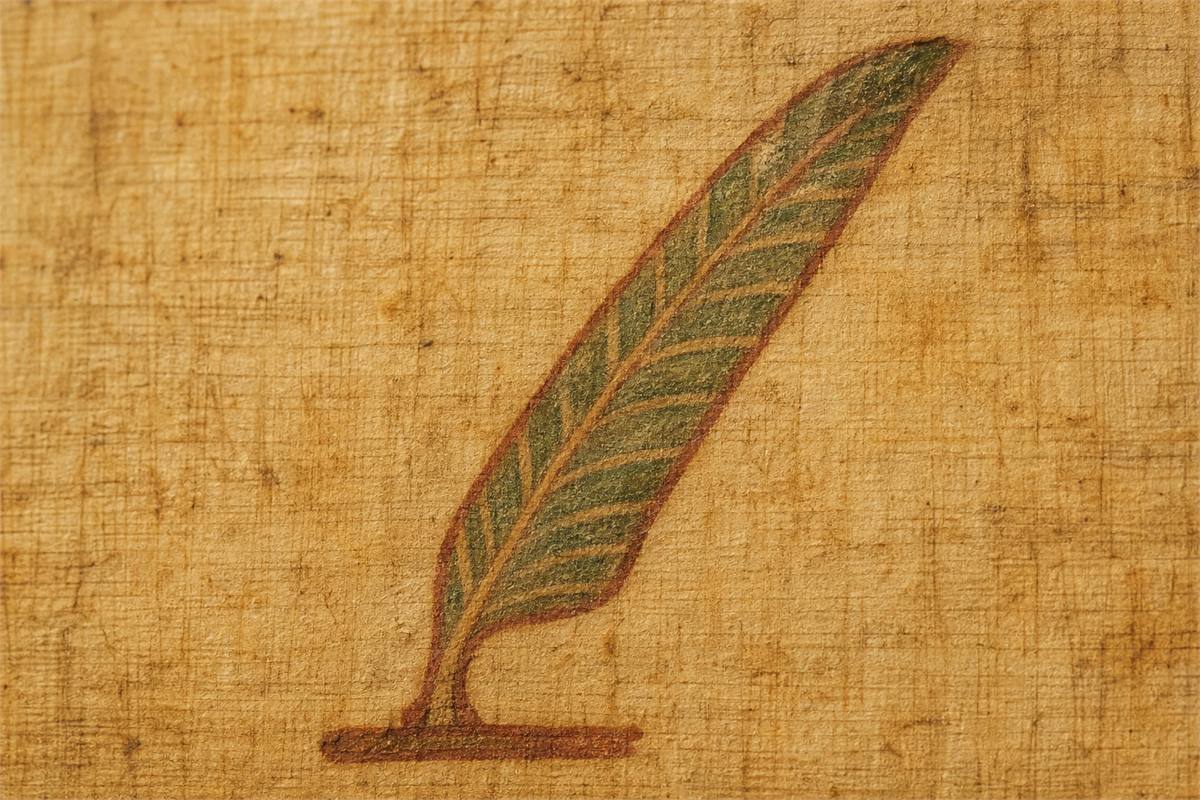
The familiar Ma’at symbol is a tall feather worn on the goddess’s head. In funerary judgment scenes, a heart may be weighed against that feather or against a small figure of Ma’at. The image turns an ethical and religious judgment into a visible balance; it is not an ancient claim that guilt had a measurable physical weight.

What Is Ma’at?
- Egyptian term: commonly transliterated mꜣꜥt.
- Modern spellings: Ma’at, Maat, and less often Ma’at.
- Meaning range: truth, what is right, justice, order, balance, and proper conduct, depending on context.
- Divine form: a goddess, usually a woman wearing a single tall feather.
- Opposing category: isfet, a range of disorder, wrongdoing, falsehood, violence, or injustice.
- Funerary role: the standard against which the deceased’s heart was judged in famous New Kingdom and later images.
How to Pronounce and Write Ma’at
In modern English, Ma’at is commonly pronounced in two syllables, approximately mah-AHT or MAH-uht. English dictionaries and speakers vary. Neither version should be presented as the one certain pronunciation used in every period of ancient Egypt.
Egyptologists transliterate the consonants as mꜣꜥt. Hieroglyphic writing normally omitted vowels, and the spoken language changed across more than three millennia, so the precise pharaonic vocalization cannot be reconstructed from the modern spelling alone. The apostrophe in Ma’at is a readable convention for consonants represented more precisely by ꜣ and ꜥ; it is not a pause mark copied from an ancient alphabet.
Ma’at and Maat refer to the same Egyptian term. Ma’at is unrelated to Mafate, the name used for HOKA trail-running shoes.
Ma’at as Concept and Goddess
The concept: what is right and properly ordered
The Ma’at meaning changes slightly with genre. In a moral text it can concern truthful speech, fair dealing, restraint, or conduct appropriate to one’s role. In kingship it can describe the right order the ruler is expected to establish. In temple ritual it can be presented to a god as the concentrated symbol of correct worship and an ordered cosmos. In funerary literature it becomes the standard by which the deceased claims to have lived and is judged.
Translations such as “truth,” “justice,” and “order” are therefore useful but partial. Ma’at was not simply a pharaonic version of modern democracy, constitutional rule of law, karma, scientific natural law, or psychological balance. Those comparisons can help a modern discussion begin, but each comes from a different historical system.
The goddess: a personification with an active cultic role
Ma’at was also a goddess who could appear in myths, hymns, temple scenes, small statues, and funerary images. Calling her a personification does not make her merely an illustration. Egyptian religious thought regularly gave concepts divine form, allowing the same name to operate as an idea, a deity, a ritual offering, and a principle of action.

| Use of Ma’at | What it means in context |
|---|---|
| Abstract noun | Truth, rightness, justice, order, or the proper condition of things. |
| Goddess | The female deity who embodies and makes that right order visible. |
| Conduct | Truthful, fair, restrained, and socially responsible action appropriate to a text’s setting. |
| Royal program | The king’s duty to establish Ma’at and drive back disorder. |
| Ritual offering | A small image of the goddess or the concept presented to a deity in temple liturgy. |
| Funerary standard | The feather or goddess figure used in the weighing of the heart. |
Ma’at and Isfet
Egyptian texts often define Ma’at against isfet. Depending on the passage, isfet may be translated as disorder, wrongdoing, injustice, violence, falsehood, or what disrupts proper relations. It is a moral and cosmic category, not a single fixed evil god with one biography.
This opposition helped ancient authors describe an ordered world that required continuing work. Kings fought enemies and performed cult in the language of repelling isfet; officials praised fair judgment; individuals claimed truthful conduct; ritual texts removed what was wrong and brought what was right. The pair is dynamic, but ancient sources do not support a simple formula in which one private mistake automatically caused a flood, famine, or return to pre-creation nothingness.
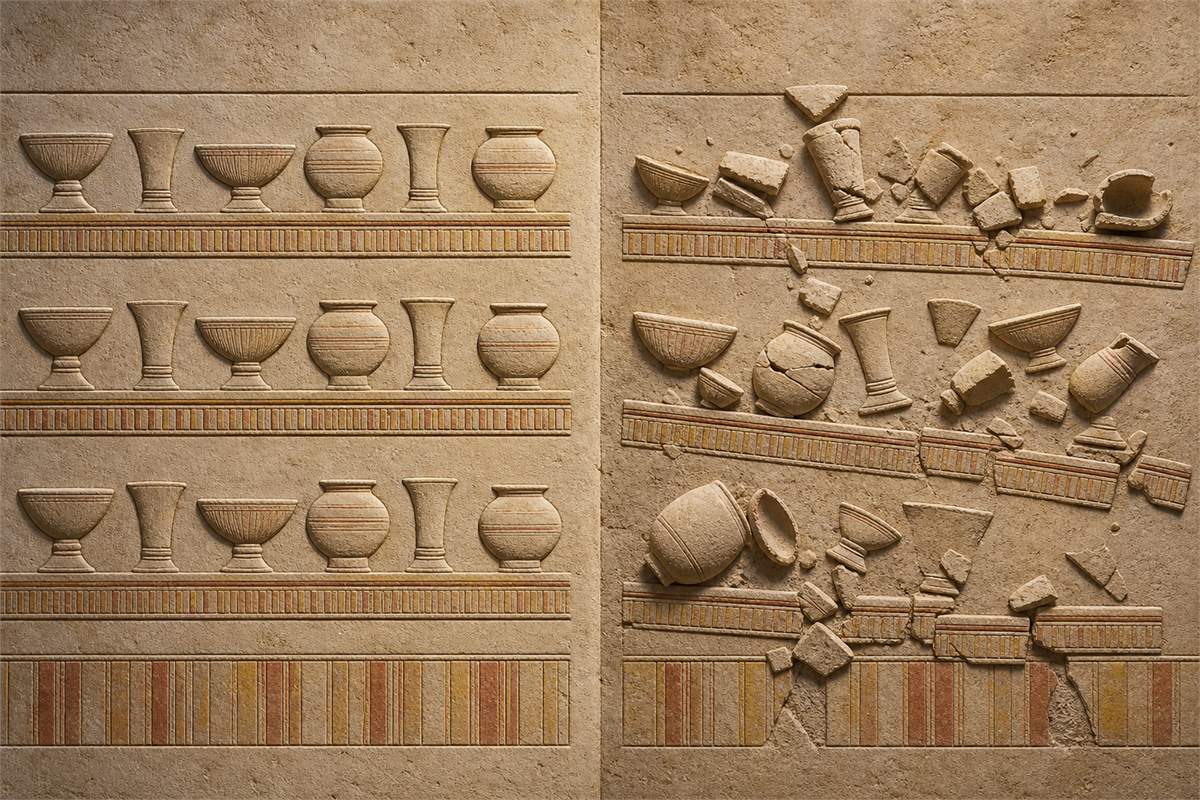
How Ma’at Was Depicted
Woman, feather, ankh, and scepter
Ma’at is most readily recognized as a woman wearing one tall feather. She may sit, crouch, kneel, or stand, and some images give her an ankh or a scepter. A surviving figure can lose its feather while retaining the socket that once held it, which is why inscriptions, find context, and museum cataloguing matter as much as a modern visual guess.
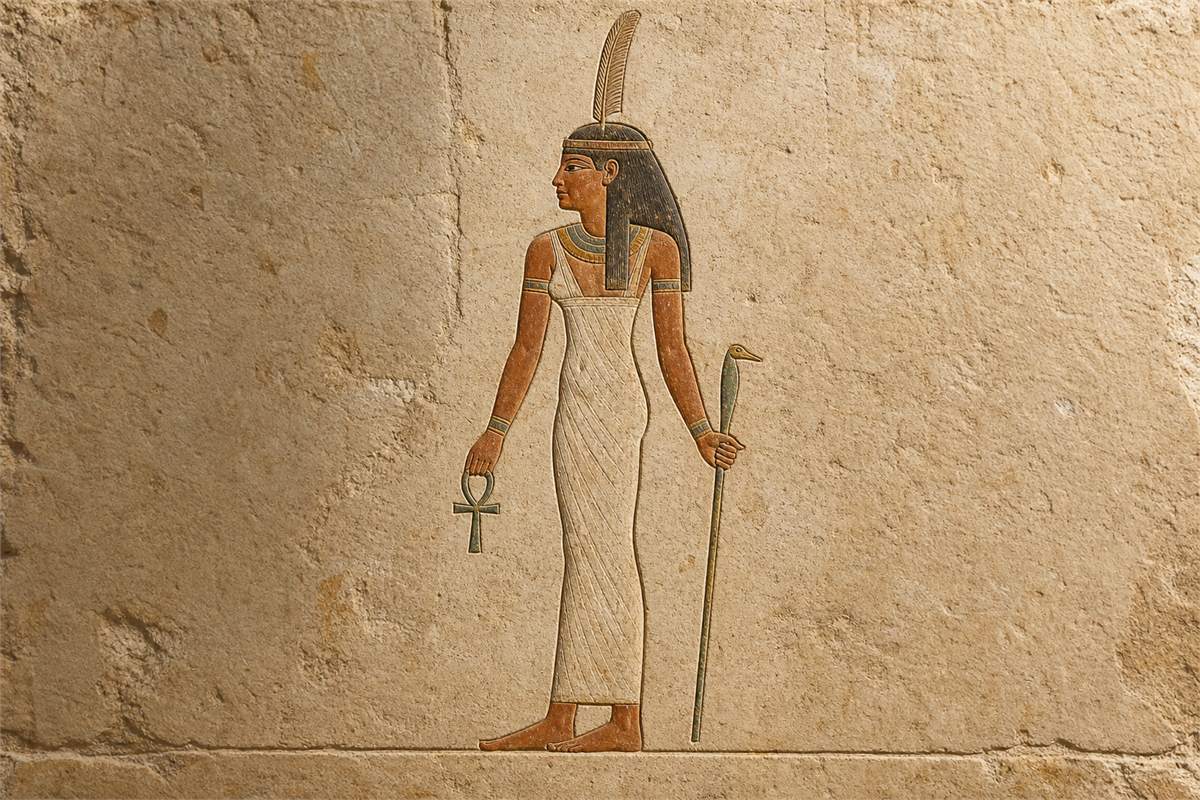
Winged depictions exist in particular funerary and solar compositions, but wings are not her universal or most diagnostic feature. In late coffins and mummy covers, a winged goddess can also be Nut, Isis, Nephthys, or another protective figure; the feather, label, surrounding text, and object context must identify her.
The feather as image and hieroglyph
Museum and Egyptological descriptions commonly call Ma’at’s headdress an ostrich plume. The feather sign could write or evoke Ma’at, and in judgment scenes it could stand for the goddess and her principle. Preserved paintings show different colors and states of fading, so “a white feather” should not be treated as the one required ancient form. Modern explanations that derive its meaning solely from being light, straight, or pure are poetic additions unless a particular ancient text makes that connection.
In the weighing of the heart, the counterweight may be the single feather, as in the Book of the Dead of Hunefer, or a small seated or squatting figure of Ma’at, as in other papyri and tomb scenes. Both image types communicate judgment according to Ma’at.
Ma’at in Solar Theology and Changing Divine Relationships
Ancient theological traditions place Ma’at especially close to the sun god Ra or Re. Scholarly summaries describe her as his daughter and as an essential aspect of the sun god; ritual texts also present Ma’at to Ra and describe divine life as sustained by what is right. In this framework, sunrise, royal rule, temple service, and cosmic continuity belong to the same religious vision of order.
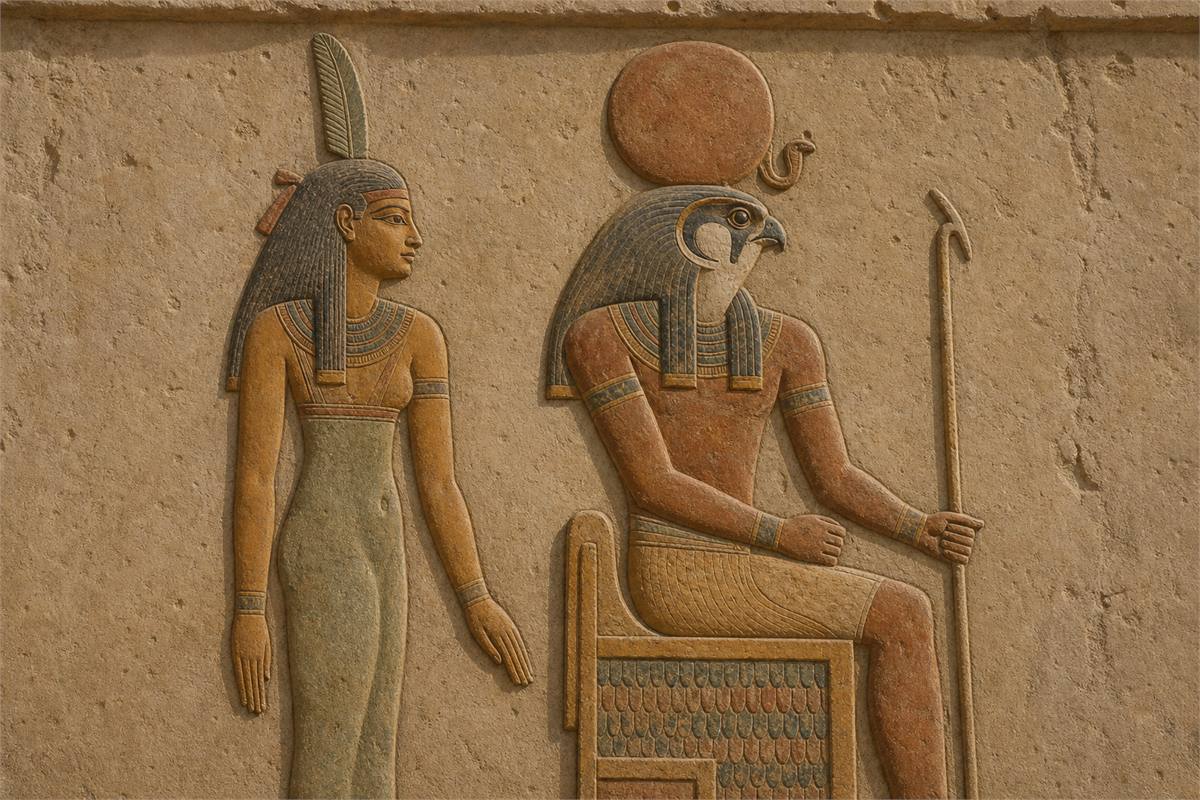
Statements that Ma’at “maintained the stars, seasons, and Nile flood” are best read as a broad account of the Egyptian cosmos, not as a scientific mechanism assigned to one goddess. Egyptian theology varied by period, place, and composition. Some texts and later summaries pair Ma’at with Thoth, while other local traditions give Thoth different consorts or emphasize the two deities as complementary figures of exact judgment and record keeping. A single fixed family tree cannot represent all of ancient Egypt.
Ma’at’s solar setting also distinguishes her from Khepri. Khepri concerns the morning sun, becoming, creation, and renewal; Ma’at concerns the right order in which divine and human life should proceed. Readers can explore that different solar role in the Khepri meaning guide.
Kingship and the Offering of Ma’at
Royal ideology repeatedly states that the king should establish Ma’at and drive out isfet. This made correct ritual, temple support, military defense, administration, and judgment parts of the ruler’s cosmic duty. It did not make every pharaoh the literal human incarnation of the goddess or a judge in the modern constitutional sense.
The Offering of Ma’at is a major temple motif. A king presents a tiny seated or kneeling image of Ma’at to a deity, sometimes in a ritual sequence whose daily liturgy culminates in this offering. The gesture can be read as presenting the whole ordered world and the correctness of the cult back to the god who sustains it. Temple walls show the king as the ritual actor even when priests performed daily service as his delegates.
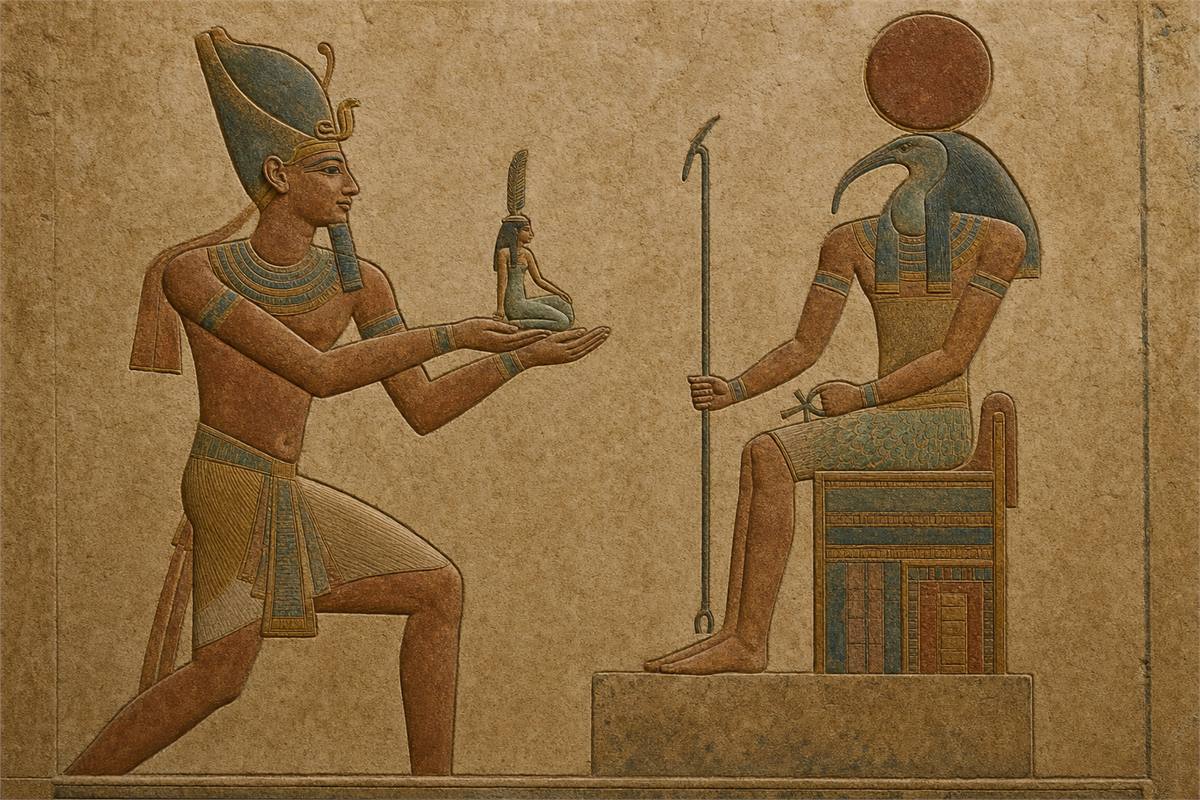
This was not a universal one-time coronation rule requiring every new king to offer the same statuette at accession. The evidence belongs to temple reliefs, ritual manuscripts, royal theology, and objects from different periods. Its importance lies in the continuing royal presentation of order, not in a modern checklist for enthronement.
Ma’at in Administration, Justice, and Social Ethics
Ma’at gave Egyptian administration a normative language, but it was not the country’s only law. No single surviving pharaonic law code covers the whole civilization, yet abundant evidence records royal decrees, property transfers, contracts, disputes, oaths, judgments, punishment, local custom, and court procedure. Courts developed from councils of officials who also carried administrative and notarial duties; later evidence distinguishes local and higher courts.
It is therefore useful to separate ideal and practice. Ma’at expressed the right result and the conduct expected of a ruler, judge, official, or petitioner. Actual institutions had procedures, offices, documents, witnesses, and historical change. Translating Ma’at simply as “rule of law” hides its religious and cosmic dimensions, while saying Egypt had no law beyond Ma’at erases the documentary record.

Personal Conduct in Wisdom Texts and Tomb Biographies
Egyptian wisdom texts turn ethics into practical advice about speech, appetite, authority, wealth, listening, quarrels, and treatment of dependants. The Teaching of Ptahhotep praises what is right as enduring and warns officials against greed and intimidation. Other instructions speak from different periods and social settings, so they should not be compressed into one timeless self-help list.
Elite tomb biographies also present their owners as people who acted according to accepted moral standards. On the Middle Kingdom stela of the official Mentuhotep in the Petrie Museum, the owner says he gave bread to the hungry and clothing to the naked, supported his district during low flood, and heard petitioners. Such claims are valuable evidence for ideals of good office and social provision, while their commemorative purpose means they are carefully constructed self-presentations.
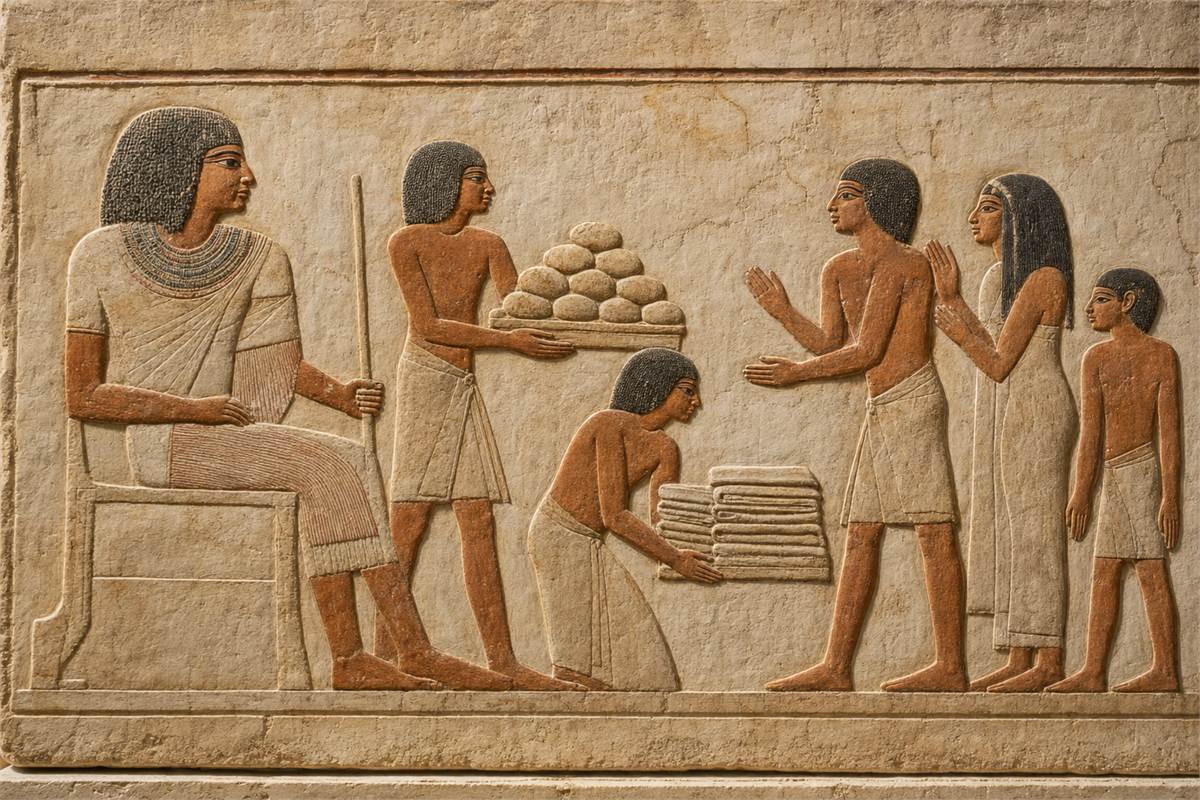
These biographical formulas are not the same text as the Negative Confession in Book of the Dead Spell 125. Both illuminate moral language, but one praises a person’s life and office in a tomb biography, while the other is a funerary declaration before divine assessors.
What the Weighing of the Heart Scene Shows
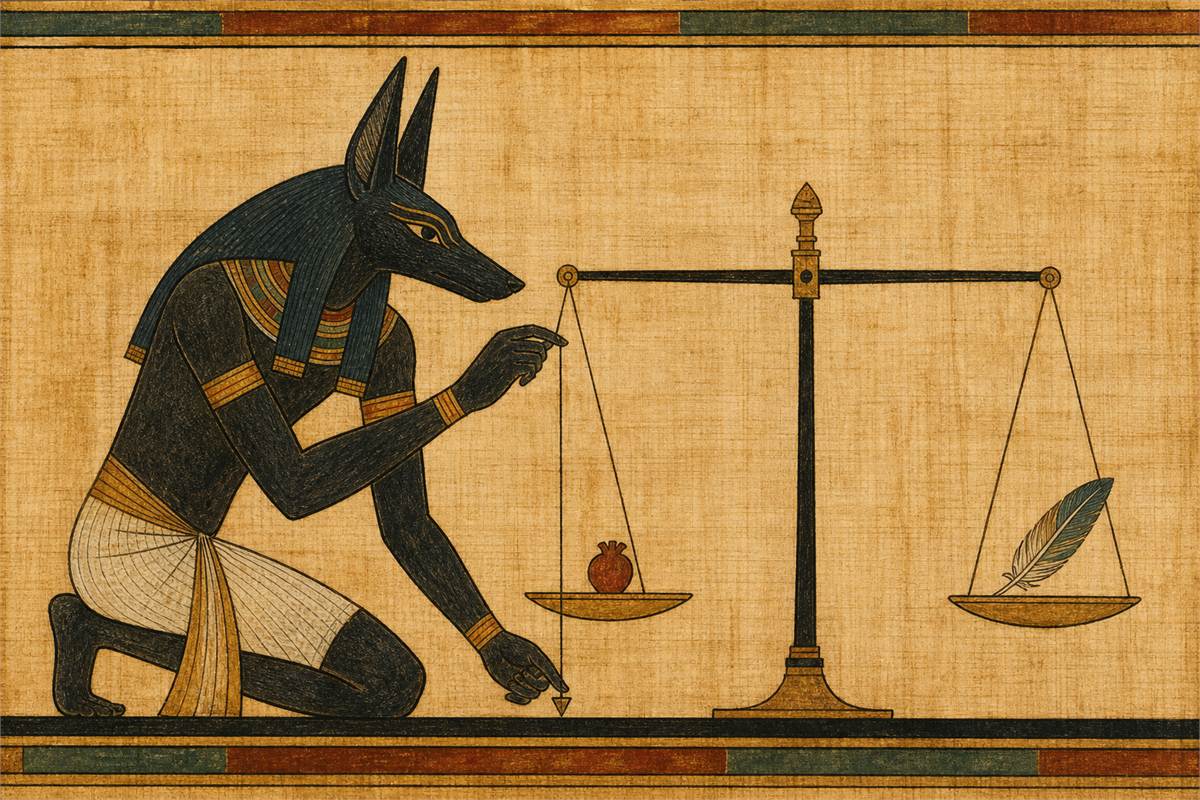
The weighing of the heart is the best-known image associated with Ma’at. In New Kingdom and later funerary papyri, coffins, and tomb decoration, the deceased approaches a divine tribunal. The heart—understood as a center of thought, memory, character, and emotion—is set on one pan of a balance. The other pan holds Ma’at’s feather or a figure of the goddess.
The Book of the Dead of Hunefer
The painted Nineteenth Dynasty papyrus of Hunefer, now British Museum EA 9901,3, provides a clear sequence. Anubis leads Hunefer to the balance and appears again adjusting its plumb line. Hunefer’s heart sits on one pan and the feather hieroglyph of Ma’at on the other. Ammit waits below. Thoth records the result, Horus leads Hunefer onward, and Osiris sits enthroned with Isis and Nephthys.

A visual grammar, not one fixed movie scene
Other manuscripts rearrange participants, use a seated Ma’at figure instead of a feather, include two Ma’at figures, multiply assessors, or combine texts and vignettes differently. Osiris may appear at the end of the register or in a separate shrine. Some balances look perfectly level; others use artistic conventions that should not be turned into a rule that “lighter is better.” The central claim is conformity with Ma’at and a favorable judgment.
The moral weight is symbolic and ritual. Ancient images do not describe the heart becoming physically heavy through “negative energy,” trauma, attachment, or psychological burdens. Those are modern metaphors.
Spell 125 and the Negative Confession
The modern title Book of the Dead refers to a changing repertoire of funerary compositions rather than one canonical book copied identically for everyone. The ancient title is often rendered “Book of Going Forth by Day.” Individual manuscripts selected and arranged spells for their owners; modern editors later assigned chapter or spell numbers.
Book of the Dead Spell 125 is closely associated with arrival in the Hall of the Two Truths, declarations of innocence, the divine assessors, and the judgment vignette. Egyptologists divide the composition into sections such as 125A, 125B, 125C, and 125D. The famous “Negative Confession,” also called the Declaration of Innocence, includes denials of wrongdoing before Osiris and a group of 42 assessors in many manuscripts.
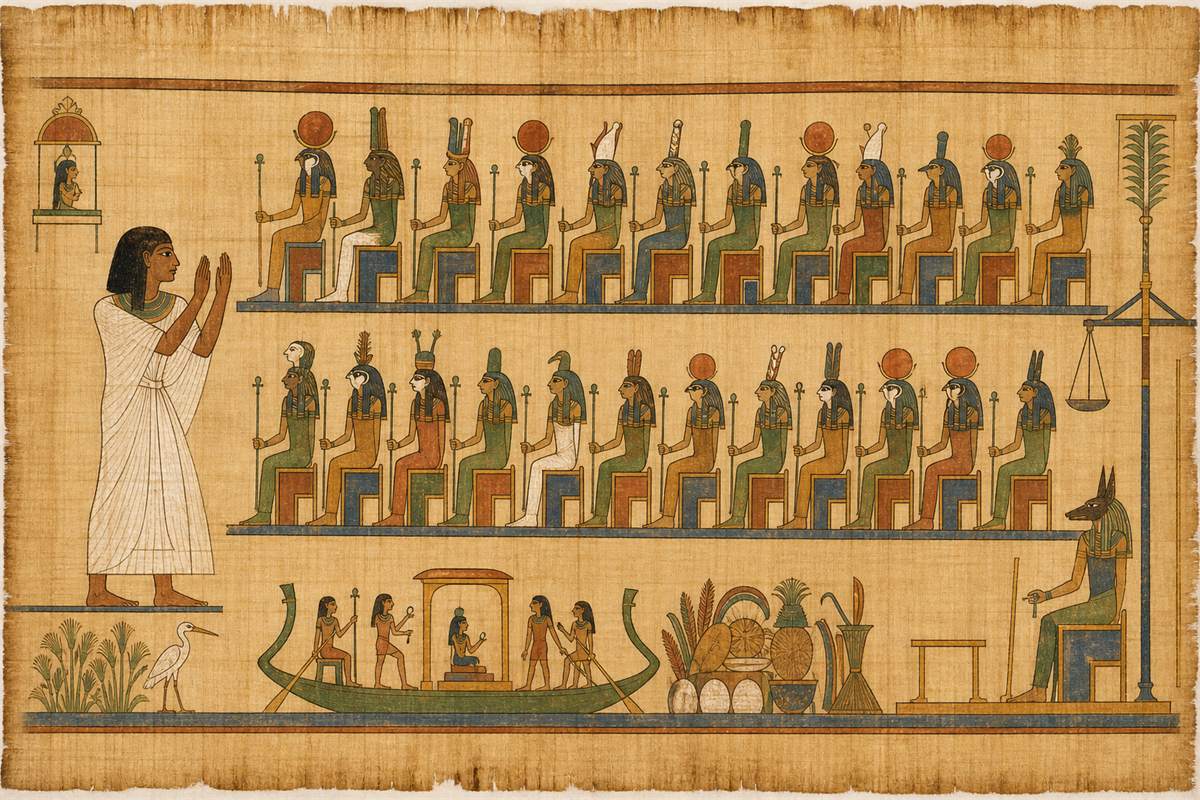
The denials concern social, economic, ritual, and environmental conduct: violence, theft, deceit, improper measures, harm to people, interference with offerings, and other acts categorized as wrong in the composition. They are not a modern “42 Laws of Ma’at” written as a universal ancient legal code, and there is no single historically attested “Ma’at oath” for contemporary recitation.
The earliest written witnesses for Spell 125 belong to the New Kingdom. That date matters: earlier Pyramid Texts and Coffin Texts preserve different funerary corpora, and later papyri continue to vary. A responsible account should not splice every Egyptian afterlife text into one timeless script.
Anubis, Thoth, Osiris, Ammit, and Ma’at in the Scene
| Figure | Typical role in judgment imagery |
|---|---|
| Ma’at | The principle and goddess of right order; represented by the feather, a goddess figure, or both. |
| Anubis | Leads the deceased and operates, checks, or adjusts the balance. |
| Thoth | Records or announces the result as divine scribe. |
| Osiris | Presides over the tribunal or receives the vindicated deceased. |
| Ammit | The composite Devourer who threatens the unsuccessful heart. |
| Horus | In some famous sequences, conducts the vindicated deceased to Osiris. |
| Assessors | A divine panel before whom declarations of innocence are made. |
Ammit is conventionally described as combining the three animals ancient Egyptians regarded as especially dangerous: crocodile, lion, and hippopotamus. The proportions differ. Hunefer’s papyrus labels her front as crocodile, middle as lion, and rear as hippopotamus; other catalogues summarize her more generally. “Crocodile head, lion body, hippopotamus tail” is too rigid for every image.

What Happened After Judgment—Without Oversimplification
A favorable weighing marked the deceased as vindicated and able to join the company of Osiris or continue into a blessed afterlife. Some compositions picture the Field of Reeds as fertile waterways and crops where the dead work, worship, and receive abundance. It is one important image within a much larger funerary landscape, not the only destination in every period and manuscript.
An unfavorable result exposes the heart to Ammit and can be described as a second death or loss of the hoped-for transformed existence. Sources and modern scholars phrase that consequence differently; “the soul is instantly erased forever” turns a complex set of Egyptian ideas about body, name, shadow, ba, ka, and effective spirit into one later concept of a unitary soul.
Passing the tribunal was also not an automatic, self-contained ticket to paradise. Egyptian funerary practice joined ethical vindication with correct burial, preservation of the body and name, ritual knowledge, spells, offerings, family cult, and relationships with gods. The weighing scene is central because it is memorable, not because it cancels everything around it.
Ma’at’s Feather vs. Heart Scarab Spell 30B
Spell 125 and Spell 30B answer related but distinct funerary needs. Spell 125 places the deceased in the hall of judgment and includes declarations of innocence. Spell 30B addresses the heart, asking it not to oppose or testify against its owner during judgment. The text was often placed on heart scarabs, amulets set on or near the chest of the mummy.

The Hunefer judgment vignette demonstrates why modern categories must remain flexible: passages of Spell 30B appear above its weighing scene even though the image belongs to the wider visual world associated with judgment and Spell 125. Manuscripts combined text and image according to their own programs.
This page therefore focuses on Ma’at, the feather, right order, and the tribunal. The Heart Scarab Meaning guide explains the amulet, Spell 30A/30B, materials, placement, and collecting questions in depth. For the solar scarab’s different role, see Scarab Symbol Meaning.
Museum Objects and Evidence
Three objects make the evidence especially concrete. They also show why a guide should identify an object by period, material, museum number, and composition rather than by a generic “Egyptian symbol” label.

| Object | Date and material | What it demonstrates |
|---|---|---|
| Book of the Dead of Hunefer, British Museum EA 9901,3 | Nineteenth Dynasty; painted papyrus | Heart against feather, Anubis at the balance, Ammit, Thoth, Horus, and Osiris in a clear judgment sequence. |
| Judgment before Osiris, The Met 66.99.142 | About 230–150 BCE; papyrus and ink | A Ptolemaic version using a squatting Ma’at figure as the counterweight and two Ma’at figures leading the deceased. |
| Figure of Ma’at, The Met 07.228.30 | Dynasties 26–30, 664–332 BCE; bronze or copper alloy | A crouching goddess figure probably dedicated in a temple; its missing tall feather once fitted a hole in the head. |
Small ancient figures, amulets, reliefs, coffin paintings, papyri, and jewelry can all carry Ma’at imagery, but they are different object classes. Egyptian faience is also a specific quartz-rich material, not a catch-all name for blue Egyptian objects; the Egyptian pottery and faience guide explains that material distinction.
Modern Reception: Tarot, Jewelry, and Popular Culture
Thoth Tarot and the Adjustment card
Aleister Crowley and artist Lady Frieda Harris developed the Thoth Tarot paintings between 1938 and 1943. Crowley’s accompanying Book of Thoth appeared in 1944. In this twentieth-century occult system, the card traditionally called Justice is renamed Adjustment and incorporates Ma’at imagery into a synthesis of tarot, astrology, Qabalah, Thelema, and modern esotericism.
That association belongs to modern reception history. It can reveal how ancient Egyptian names were reinterpreted in European occultism, but it is not evidence that pharaonic Egyptians used tarot or taught Crowley’s system. Modern novels, games, film, and New Age writing likewise select and reshape Ma’at for new audiences.

Ma’at jewelry meaning today
A modern Ma’at necklace, feather pendant, or weighing-of-the-heart design is best described as contemporary jewelry inspired by Egyptian iconography. A wearer may choose it to express truth, fairness, responsibility, thoughtful judgment, or respect for ancient Egyptian art. A generic feather, balance scale, tarot figure, and Ma’at goddess pendant remain different designs even when a seller groups them under the same keyword.

For a wider historical view of collars, amulets, metals, stones, and how jewelry was worn, continue to Ancient Egyptian Jewelry. Eastern Story’s Blessing collection offers a modern path for readers drawn to symbolic objects while keeping cultural meaning separate from claims of supernatural performance.
Choosing Responsible Replicas and Caring for Modern Objects
Replica, museum reproduction, or antiquity?
A responsible listing should say whether an object is a modern design, a replica, or a museum-authorized reproduction. It should identify its maker, materials, dimensions, and manufacturing location. An archaeological antiquity requires a documented ownership history, lawful export evidence where applicable, and careful due diligence. UNESCO’s 1970 Convention and ICOM’s Red List for Egyptian cultural objects make provenance a practical buying issue, not decorative paperwork.

- Material disclosure: look for the base metal, fineness mark where relevant, plating type and thickness if provided, stone or glass identification, resin, enamel, and any feather component.
- Wearability: check pendant dimensions, weight, edge finish, chain length, clasp construction, and nickel or other allergy information.
- Design accuracy: compare the claimed Ma’at figure with museum examples; a feather alone may be Egyptian-inspired without being an ancient Ma’at amulet type.
- Seller evidence: prefer clear photographs, maker details, return terms, and provenance for any object presented as old.
- Cultural context: choose descriptions that explain the ancient source and identify modern interpretation as modern.
Care by material
Modern jewelry should be cared for according to its actual materials and the maker’s instructions. Wipe solid or plated metal gently after wear and keep perfume, cosmetics, sweat, and household chemicals away from vulnerable finishes. Plating is thin, so abrasive polish can remove it. Resin, enamel, stone, glass, and adhesive-set components may each react differently to water, solvents, heat, and ultrasonic cleaning.
A modern decorative feather needs support, protection from crushing and pests, and low-disturbance dust control. A hair dryer can split barbs, scatter dust, and stress attachments regardless of the temperature used. Natural feathers also require lawful species sourcing and attention to hygiene and insect activity.
Paper tarot cards keep best with clean hands, a suitable box or sleeve, dry storage, and protection from prolonged light. Conservation care is stricter for archaeological objects, ancient faience, fragile paint, excavated metal, papyrus, and mixed feather constructions: avoid immersion, steam, ultrasonic cleaners, alcohol, polishing, commercial glue, and home repairs. A trained conservator should examine unstable or historically important material.
Frequently Asked Questions
Related Posts


