
Khepri is the ancient Egyptian god or solar manifestation most closely associated with the rising sun. Shown as a scarab beetle, a scarab-headed figure, or a scarab joined with the sun disk and solar boat, he expresses the sun’s daily coming into being. The Khepri meaning therefore centers on becoming, emergence, transformation, renewal, and the return of light—not on a single fixed English translation of his name.
The familiar phrase “morning Khepri, midday Ra, evening Atum” is useful as a first orientation, but it is not a universal timetable followed everywhere in Egypt for thousands of years. Egyptian solar theology was layered and adaptable. Khepri, Re or Ra, Atum, Re-Horakhty, and composite forms such as Re-Khepri could overlap, merge, or emphasize different ways of understanding the same sun.
Khepri Egyptian God at a Glance

| Question | Direct answer |
|---|---|
| Who is Khepri? | A solar deity or form of the sun associated especially with dawn and coming into being. |
| What does Khepri mean? | His name belongs to the ḫpr word family: to become, happen, come into being, take form, or transform, according to context. |
| What is the Khepri symbol? | The scarab beetle, often combined with a sun disk, wings, a horizon, or a solar boat. |
| Is Khepri the same as Ra? | They can be distinguished, combined, or understood as related solar forms; Re-Khepri is one explicit compound. |
| What does Khepri jewelry mean today? | A modern personal symbol of renewal, resilience, new beginnings, transformation, or the return of light. |
Contents
- Pronunciation, spelling, and the root ḫpr
- Khepri and the rising sun
- What dung beetles actually do
- How beetle behavior became solar symbolism
- Khepri, Ra, and Atum
- How Khepri appears in ancient art
- Funerary texts and the night journey
- Amulets, seals, heart scarabs, and winged scarabs
- Faience, steatite, stone, glass, and metal
- Royal and commemorative scarabs
- The Karnak scarab and visitor lore
- Egyptian Revival and modern Khepri jewelry
- How to choose and care for scarab jewelry
- Ethical collecting and replicas
- Gift meanings today
- Frequently asked questions
How to Pronounce and Understand the Name Khepri
Khepri pronunciation and modern spellings
In modern English, Khepri pronunciation is commonly approximated as KHEP-ree. You may also encounter Kheper, Khepra, Khepera, Chepri, or Khepry. These spellings reflect modern conventions for rendering an ancient name whose writing recorded consonants more clearly than vowels. “Khepri” is the standard form in much English-language Egyptology, but it is not an audio record of how every ancient speaker pronounced ḫprj.
The root ḫpr: becoming, happening, and taking form
The name is linked with the Egyptian root transliterated ḫpr. Its meanings depend on grammar and context, and can include becoming, coming into being, happening, developing, taking form, or transforming. The scarab sign could participate in writing this word family, while ḫprr referred to the scarab beetle or scarab-shaped object and ḫprj gave the divine name rendered Khepri.

That wordplay is more precise than calling Khepri simply “the god of growth” or saying that his name literally means “the self-created god.” Self-generation and solar rebirth are important theological ideas around the scarab, but the name itself works through the broader language of becoming. It can describe a process: something happens, appears, assumes form, or becomes what it is.
Khepri and the Rising Sun
Khepri is strongly connected with the sun at dawn—the moment when light emerges at the eastern horizon and the solar cycle begins again. This is why he is often described as the god of the rising sun in Egypt. The emphasis falls on manifestation: the sun has passed through night and now becomes visible, active, and renewed.
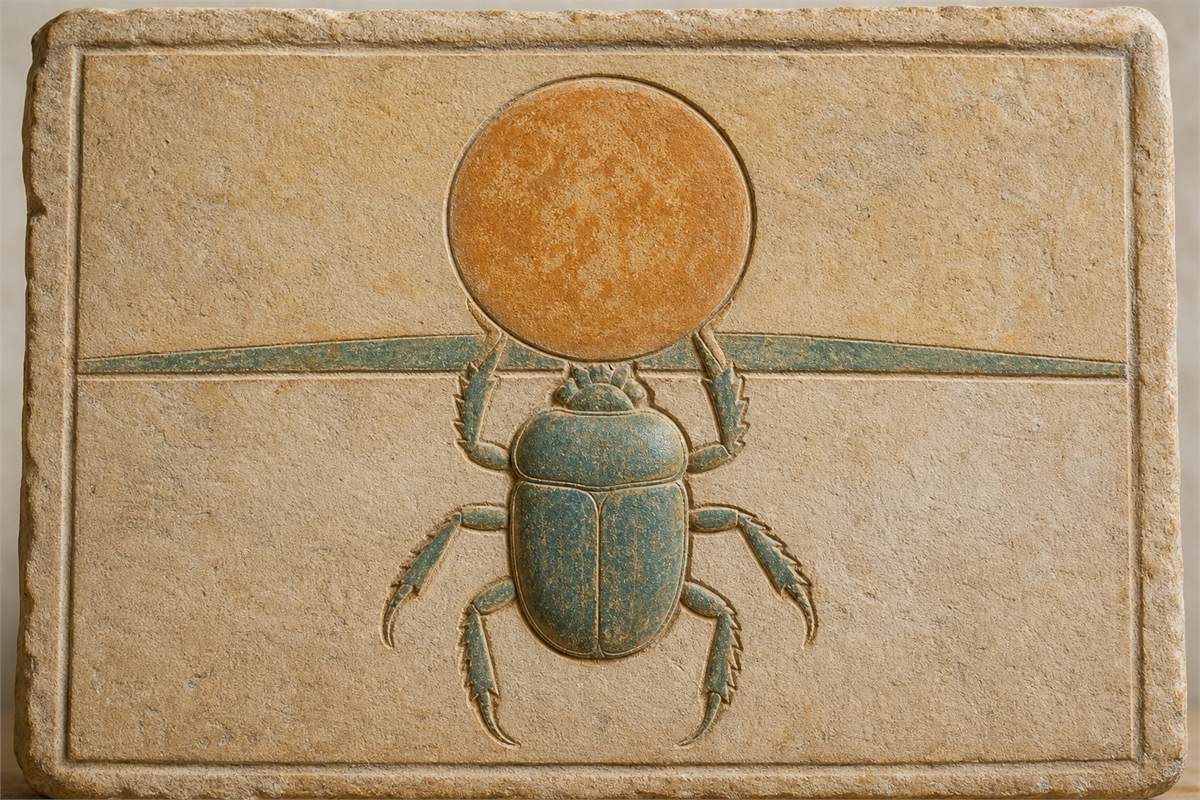
Ancient Egyptian religion did not require Khepri to be a completely separate divine personality with a single temple office. A god could be a named form, appearance, phase, power, or combination of another god without losing all distinction. Khepri could stand as the youthful or newly generated sun and also enter compound identities. In one text or image the scarab may be the sun itself; elsewhere it can accompany, carry, pull, or regenerate the solar deity.
This flexibility also explains why sunrise imagery varies. A modern illustration often shows a beetle pushing a blazing ball across the entire sky. Ancient works do sometimes show a scarab moving or supporting the disk, and a Nineteenth Dynasty coffin can show the beetle pushing the sun disk toward rebirth. Other scenes place the scarab above a disk, within a boat, at the horizon, beneath wings, or in the body of the sky goddess Nut. The idea is consistent—solar renewal—while the visual grammar is not limited to one pose.

What Dung Beetles Actually Do
Scarab beetles are broader than dung rollers
“Scarab beetle” can refer broadly to beetles in the scarab family and related groups. Not every scarab feeds on dung, and not every dung beetle rolls a ball. Modern zoology commonly describes three broad dung-use strategies—rollers, tunnelers, and dwellers. Rollers shape and move dung; tunnelers bury it beneath or near the dropping; dwellers live and reproduce in the dung source. The sacred scarab, Scarabaeus sacer, is a well-known ball-rolling species, but it should not stand in for every beetle represented or every species in the family.

Food balls, brood balls, eggs, and underground development
Ball-rolling dung beetles form dung into compact masses and roll them away from competition. A ball may become food for an adult, or it may be buried and reshaped for breeding. In a prepared brood ball or nest chamber, the female lays an egg. The larva hatches, feeds on the provisioned dung, passes through its developmental stages underground, pupates, and later emerges as an adult.
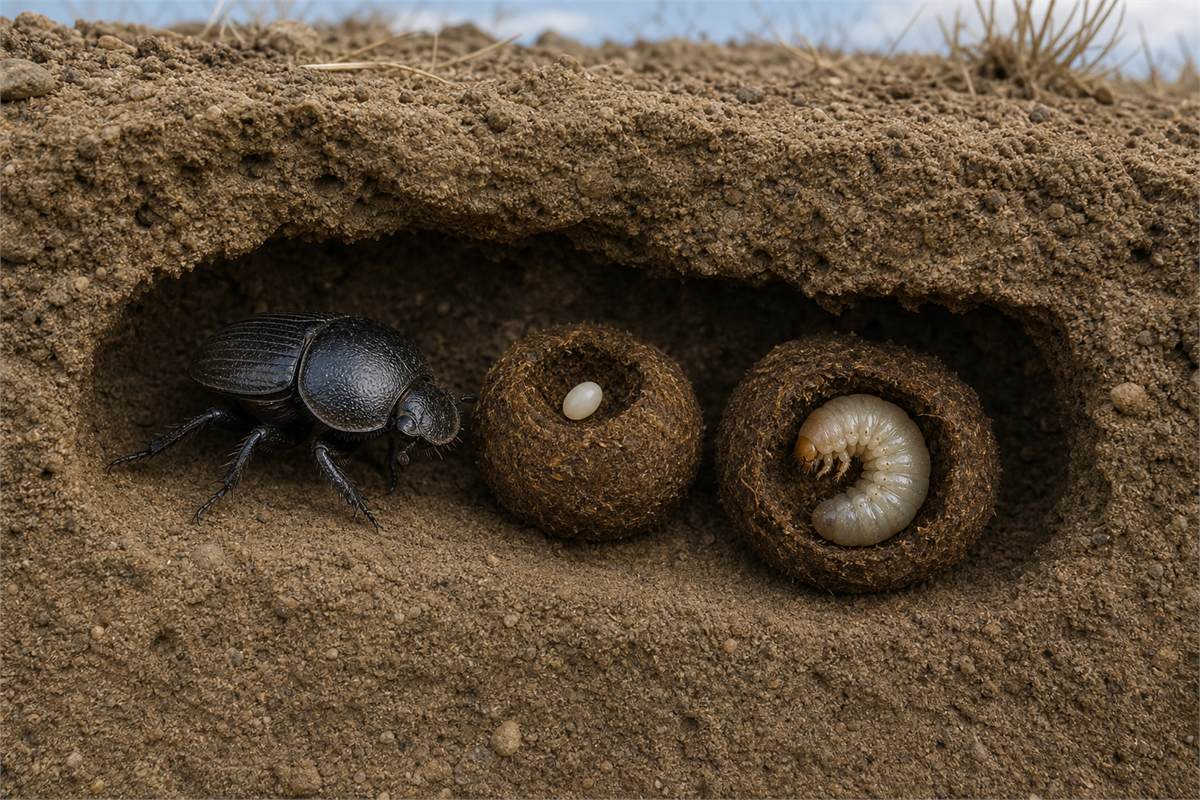
New beetles therefore do not appear from lifeless matter. What an observer above ground can see is discontinuous: adults work with dung, disappear underground, and later young adults emerge. Mating, egg laying, larval feeding, and pupation are hidden. Ancient writers and later interpreters could turn that hidden interval into a language of self-generation, but cultural interpretation should not replace the animal’s real life cycle.
- Rolling: moving a prepared ball away from the dung source, often to reduce competition.
- Burying: placing food or breeding material underground in a chamber.
- Feeding: adults consume suitable dung material; larvae consume the provision in their brood ball or nest.
- Breeding: females lay eggs in prepared brood provisions, and development occurs out of ordinary sight.
From Beetle Behavior to Egyptian Solar Symbolism
The Khepri scarab joins two forms of knowledge: close attention to nature and the Egyptian habit of reading the world through visual and verbal correspondences. A beetle shaping and moving a round mass could evoke the movement of the solar disk. Its emergence from a concealed underground development could evoke dawn, regeneration, and life returning from an unseen realm.

The connection was also linguistic. The scarab hieroglyph participated in the same ḫpr word family used for becoming and transformation. A small creature, a written sign, a divine name, and the daily sun could therefore reinforce one another. Khepri’s power lies less in a single narrated myth than in this dense network of behavior, word, image, and recurring cosmic event.

This is one reason the scarab meaning in ancient Egypt cannot be reduced to “good luck.” Solar regeneration is central, but scarab objects also entered personal names, administrative seals, royal display, funerary ritual, protective formulas, jewelry, and international exchange. The broader Scarab Symbol Meaning guide follows those uses across object types; this page keeps Khepri and solar theology at the center.
Khepri, Ra, and Atum: A Relationship Without Oversimplification
The phrase Khepri, Ra, Atum often appears as a three-part summary of morning, midday, and evening. It is memorable and can describe a real theological pattern, especially when the sun is imagined through changing phases. Yet Egyptian religion developed over more than three millennia, across cities, temples, royal programs, funerary corpora, and priestly traditions. No single chart captures every period.

| Divine name | Common solar emphasis | Important qualification |
|---|---|---|
| Khepri | The sun becoming visible at dawn; renewal and transformation | May be a distinct deity, solar manifestation, or element of compound names such as Re-Khepri. |
| Re / Ra | The sun god in a broad and powerful sense; creator, ruler, traveler in the solar boat | Not restricted to noon, and not represented by only one image. |
| Atum | Completion, creation, the aged or setting sun in some theological schemes | His roles extend far beyond sunset, especially in Heliopolitan creation theology. |
| Re-Horakhty and other compounds | Solar power expressed through merged names and identities | Combination is a normal Egyptian theological strategy, not evidence of one rigid family tree. |
Khepri should therefore not be introduced as an isolated official who “controls dawn” while Ra takes over at noon and Atum clocks in at sunset. A better image is one sun understood through different moments, locations, divine relationships, and creative acts. The Egyptian system could hold distinction and unity at the same time.

How Khepri Appears in Ancient Egyptian Art
The most direct Khepri symbol is the complete scarab beetle. It may stand alone, appear above or below a solar disk, accompany a horizon sign, rest in or near a solar boat, or become winged. On coffins and funerary equipment, the scarab can occupy places where the sun’s regeneration and the deceased person’s hoped-for renewal reinforce one another.

Khepri may also appear anthropomorphically as a human body with a scarab for a head. This form is real, but it should not be treated as the only standard image across all periods. In other works the human body and insect form combine differently, or a labeled scarab communicates the divine identity without a beetle-headed man.
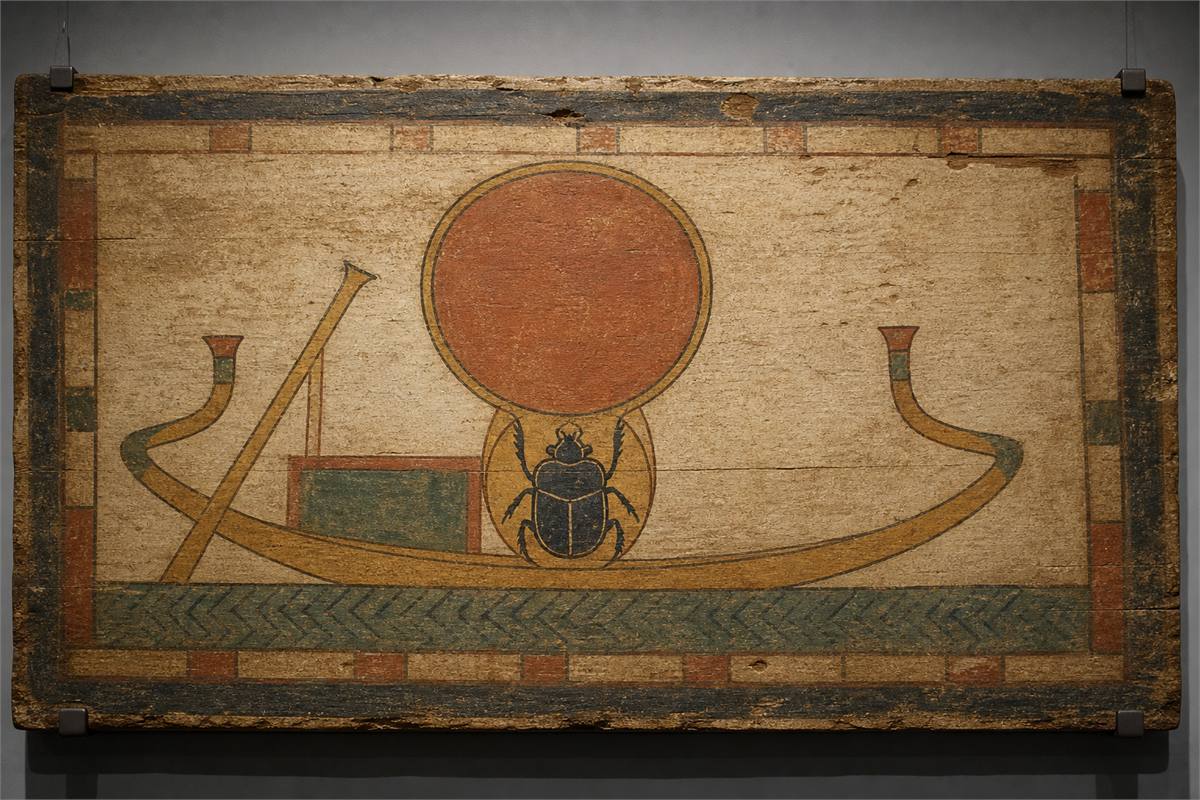
- A complete scarab representing the newly becoming sun.
- A scarab joined with, supporting, or moving the solar disk.
- A scarab connected with the solar boat during the day or night journey.
- A winged scarab on coffins, mummy bead-nets, pectorals, and later funerary equipment.
- A human figure with a scarab head, especially in later and more explicit divine imagery.
Ra is often shown as a falcon-headed man crowned by a sun disk, but that is not a fixed costume for “the strongest noon sun.” Atum is often human in form, yet his theology and imagery are not simply “an old man at sunset.” Egyptian artists selected attributes to fit the ritual and textual setting. Identifying a figure requires its caption, neighboring gods, crown, disk, boat, horizon, and object context.
Khepri in Funerary Texts and the Solar Night Journey
The Amduat and the sun’s renewal
The Amduat—“What Is in the Underworld”—is a New Kingdom composition that maps the sun god’s passage through twelve regions or hours of night. It is not the same work as the Book of the Dead. In the central sixth hour, the sun god reaches the deepest region and is united with the solar or Osirian body in a complex image of renewed life. This moment is better understood as the meeting of complementary divine realities than as Khepri simply merging with Ra’s soul and pushing the sun out.
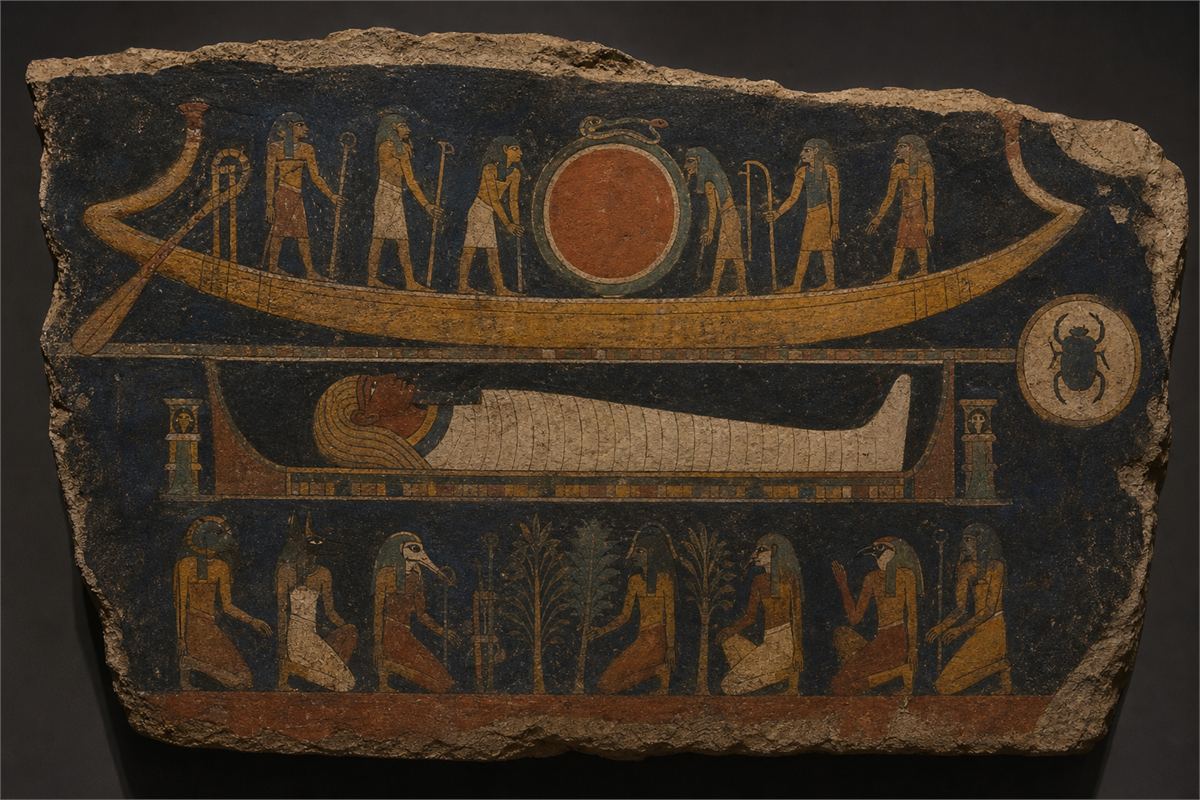
Khepri appears within the wider process of night-long regeneration. A fifth-hour scene can show a scarab pulling the elderly sun god’s boat. In the concluding hour, the rejuvenated sun reaches the eastern horizon and takes scarab form. The sequence makes the scarab an agent and image of rebirth, but not a permanent helmsman with a single nautical job.
The Book of Going Forth by Day
The modern title Book of the Dead refers to a repertoire of funerary compositions that ancient Egyptians called chapters for “going forth by day.” Copies varied, and individual spells also appeared on coffins, amulets, bandages, headrests, and other burial equipment. The texts should not be collapsed with the Amduat into one continuous adventure story.

Khepri and scarab imagery participate broadly in solar and regenerative language, while particular artifacts require particular spells. The clearest scarab example is Spell 30B on heart scarabs, which addresses the deceased person’s heart in the setting of judgment. That use belongs to a specific funerary object and textual purpose; it is not the default inscription on every small scarab bead or seal.
Scarab Amulets, Scarab Seals, Heart Scarabs, and Pectorals
The word “scarab” describes a shape, but ancient objects in that shape could differ sharply in scale, inscription, date, and purpose. A small pierced scarab worn on a string is not the same object as a large heart scarab placed on a mummy, and neither should be confused with an Amenhotep III commemorative scarab or a Late Period winged scarab sewn into a bead-net.

| Object type | Typical features | Main historical use |
|---|---|---|
| Scarab amulet | Usually small, beetle-shaped, often pierced; base may be plain or decorated | Portable amulet, bead, ring element, name bearer, personal or social symbol |
| Scarab seal / seal-amulet | Engraved flat base with a name, title, motif, formula, or design | Making impressions, identifying an owner or office, and sometimes amuletic wear |
| Commemorative scarab | Comparatively large, multi-line royal announcement on the underside | Circulating news of royal marriage, hunts, building, or status, especially under Amenhotep III |
| Heart scarab | Large funerary scarab, often stone, with Spell 30B or a related text | Placed on or near the mummy in relation to the heart and judgment |
| Winged scarab / pectoral | Scarab combined with separate or attached wings; may be faience beadwork or an elaborate jewel | Solar rebirth, funerary identification, chest ornament, or royal composition depending on context |
Scarab amulets versus scarab seals
Most scarab amulets are compact ovals with the beetle’s head, wing cases, and legs modeled on the back. Many are pierced lengthwise so they can be strung or mounted in a swiveling ring. The underside creates a useful surface for a personal name, royal name, title, deity, animal, geometric pattern, protective saying, or cryptographic arrangement. Many bases are also uninscribed.

A seal function and an amulet function can coexist. A Middle Kingdom official might use a named scarab administratively while also wearing it. Later scarabs could repeat the name of a famous ruler long after his reign, which is why a royal cartouche alone cannot securely date an object. The base design is evidence, not a complete certificate.
What Is a Heart Scarab?
A heart scarab is a large funerary amulet attested by the later Middle Kingdom and Second Intermediate Period and common in elite New Kingdom burials and afterward. It was placed on the mummy, over the chest, suspended on a necklace, incorporated into a pectoral, or positioned near the body. It did not substitute for the anatomical heart.

The heart scarab meaning is tied to Egyptian ideas of the heart as a center of thought, memory, identity, and moral witness. During judgment, the heart could testify about its owner’s conduct. Spell 30B—and the less common related version 30A—addresses the heart so that it will not stand against the deceased or obstruct a favorable outcome. Saying the scarab was intended to keep the heart from “betraying” its owner is a useful shorthand when the ritual setting is explained.

Materials, sizes, and texts vary. The Metropolitan Museum’s heart scarab of Hatnefer, for example, is serpentinite on a gold chain; the scarab measures 6.6 centimeters long and carries Spell 30A rather than the more usual 30B. A museum object like this is a precise case, not a template for every heart scarab.
Winged Scarabs and Pectorals
A winged scarab pectoral can combine the beetle with outspread bird wings, sun disks, royal names, deities, cobras, floral elements, or other signs. Some are elaborate gold and stone compositions made for royalty. Others are Late Period funerary assemblies in which a faience scarab and separate wings formed part of a beaded net over the mummy.

These objects should not be used to project every modern moving-wing ring backward into antiquity. Hinged wings, opening shells, gemstone pavé, and mechanical surprises are valid modern design choices, but they are not universal ancient Khepri standards. Ancient wings belong to particular solar, funerary, royal, and protective compositions whose components must be read together.
Materials: Faience, Steatite, Stone, Glass, and Metal
Ancient scarabs were made in humble, precious, and technologically sophisticated materials. Material choice could affect color, cost, durability, inscription, ritual suitability, and social value. It did not follow one permanent gemstone chart in which every blue stone always meant the Nile and every green stone guaranteed health or rebirth.
| Material | What it is | What to examine |
|---|---|---|
| Egyptian faience | A quartz-rich, non-clay ceramic body with an alkaline glaze, commonly blue-green | Glaze survival, chips, salt damage, repairs, and whether the label distinguishes faience from glass or glazed stone |
| Glazed steatite | A soft carved stone fired with a glaze; common for small scarabs | Carving, glaze, drilling, wear, and later recoloring or coating |
| Hard and semi-precious stones | Examples include amethyst, carnelian, jasper, lapis lazuli, serpentinite, and other stones | Correct material identification, inclusions, polish, inscription, breakage, and ancient versus modern cutting |
| Glass and glazed composition | Vitreous materials that expanded design and color possibilities | Weathering, cracks, iridescence, modern imitation, and setting security |
| Gold, silver, bronze, and mixed settings | Metals used for complete forms, mounts, chains, rings, and pectoral structures | Alloy, solder, corrosion, replaced parts, hinge wear, and structural stability |
Egyptian faience scarabs deserve special care in description. Faience is neither a stone painted with ceramic glaze nor simply ancient glass. Its body is largely powdered or crushed quartz with alkaline salts, lime, and colorants. During firing, the ingredients form a bright glaze around a porous siliceous core. Copper commonly produced the celebrated blue-green color, but ancient faience existed in other colors as well.

Lapis lazuli, turquoise, amazonite, carnelian, and other stones certainly appear in Egyptian jewelry and amulets, but their presence in one object does not authorize a universal marketing meaning. Modern designers may use opal for shifting color, emerald for green, enamel for a beetle shell, or diamonds for light. Those are contemporary material and design associations unless a specific ancient object or text supports a historical claim.

Royal Names and Commemorative Scarabs
Some scarab bases name kings, but that does not make every named scarab a royal commission or date it to that king’s lifetime. Names such as Thutmose III’s could be repeated long afterward. Egyptologists compare inscription, beetle form, base design, material, size, manufacture, distribution, and excavated parallels, and even then an individual unprovenanced scarab may receive a broad date range.
Commemorative scarabs form a more specific category. Large examples began in the Eighteenth Dynasty, reached their greatest production under Amenhotep III, and carried multi-line announcements. Surviving groups refer to events such as royal marriages, lion hunts, a lake made for Queen Tiye, and the arrival of the Mitannian princess Gilukhepa. These objects spread royal messages among elite networks; their long texts are not typical of every scarab amulet.

The Karnak Scarab and Modern Visitor Lore
Near the Sacred Lake at Karnak stands a colossal red-granite scarab on an oval plinth. It dates to the reign of Amenhotep III in the Eighteenth Dynasty, around 1390–1352 BCE in the chronology used by the Digital Karnak project. The plinth shows the king offering to the solar deity Khepri. The sculpture originally stood at Amenhotep III’s mortuary temple on the west bank of Thebes and was moved to Karnak in antiquity, probably in the time of Taharqo.

Visitors are often told to circle the monument a certain number of times—frequently seven—and make a wish. Accounts differ about direction, number, and promised result. The sculpture is ancient; the circling custom belongs to modern visitor lore. Without evidence for a pharaonic rite, it is better enjoyed as a contemporary site tradition rather than described as an unbroken ancient ritual or a historical act of devotion to Khepri.
The monument is often advertised as “the largest scarab in Egypt” or even the world. That superlative is difficult to establish consistently because comparisons may include sculptures, reliefs, modern replicas, and incomplete objects. Its secure significance is already impressive: a colossal royal scarab, made for Amenhotep III, explicitly joined to Khepri and relocated within one of Egypt’s most important temple complexes.
Egyptian Revival and Modern Khepri Jewelry
Egyptian Revival scarab jewelry belongs to several historical waves rather than one continuous style. Napoleon’s 1798–1799 Egyptian campaign and the monumental Description de l’Égypte, published from 1809, helped circulate Egyptian forms in European and American design. The decipherment of the Rosetta Stone, archaeological publications, the 1869 opening of the Suez Canal, and continued excavation kept Egypt visible throughout the nineteenth century.
By the 1860s and 1870s, scarabs, lotus flowers, sphinxes, winged disks, and hieroglyphic motifs entered archaeological-revival jewelry and decorative arts. Art Nouveau designers explored insect forms, iridescent glass, enamel, and organic line. The discovery of Tutankhamun’s tomb in 1922 created another surge, and Egyptian imagery became part of Art Deco’s visual language. Modern Khepri jewelry inherits this long design history as well as the ancient religious source.

There is no single “Khepri brand” and no mandatory material formula. Contemporary pieces may use gold, silver, bronze, enamel, glass, lapis, turquoise, opal, emerald, quartz, diamonds, or synthetic stones. A ring may have articulated wings; a pendant may rotate like an old seal; a brooch may favor symmetrical winged geometry. These choices should be evaluated for craftsmanship and wearability, not treated as proof of ancient authenticity or guaranteed spiritual power.

How to read a modern scarab design
- Historical quotation: Does the piece clearly adapt a known scarab, winged disk, pectoral, or seal form?
- Creative interpretation: Which features are modern—hinges, movable wings, gemstone pavé, chain system, scale, or color palette?
- Material truth: Are stones natural, synthetic, treated, assembled, or glass, and are metal fineness and plating disclosed?
- Respectful language: Does the maker distinguish ancient religious context from present-day personal meaning?
How to Choose and Care for Scarab Jewelry
A practical buyer checklist
- Decide what you are buying. A modern scarab jewel, licensed museum reproduction, vintage Egyptian Revival piece, tourist souvenir, and claimed antiquity belong to different markets and require different evidence.
- Confirm material and construction. Ask about metal fineness, plating thickness, gemstone identity, treatments, glass or enamel, adhesives, replacements, and maker’s marks.
- Inspect scale and comfort. Check dimensions, weight, back surface, sharp legs or wing tips, balance on the chain, ring clearance, brooch pin security, and whether moving parts pinch.
- Examine workmanship. Look for chipped enamel, cracked stones, loose settings, worn hinges, weak jump rings, bent prongs, solder repairs, abrasive edges, or unstable ancient fragments mounted in modern metal.
- Match meaning to the wearer. Choose renewal, transformation, resilience, dawn, or cultural interest as a personal message rather than relying on a vague “lucky” label.

Care follows material. Wipe sturdy modern metal gently after wear and store pieces separately. Keep perfume, chlorine, household chemicals, and cosmetics away from porous stones and enamel. Avoid soaking faience, ancient glazed surfaces, glued settings, pearls, turquoise, lapis, or unknown mixed materials. Articulated wings and rotating scarab mounts need periodic inspection because small pins and hinges take repeated stress.

An antique or archaeological object needs a conservator’s mindset: stable storage, minimal handling, no aggressive polishing, and no ultrasonic or steam cleaning without material-specific approval. A fresh shine can remove ancient surface evidence, weaken glaze, or erase the very wear that helps specialists understand the object.
Ethical Collecting, Provenance, and Replicas
The safest answer to how to identify an ancient scarab amulet begins with documentation, not color. Genuine scarabs vary enormously, and modern copies can imitate glaze loss, dirt, drilling, inscriptions, and old mounts. Museums themselves preserve historical forgeries that once convinced collectors. A seller’s claim, a green surface, or a pharaoh’s name cannot carry the burden alone.

- A documented chain of ownership and the dates at which the object left each country.
- Invoices, auction records, collection labels, old photographs, publications, excavation records, or museum deaccession paperwork where applicable.
- Legal export and import documents under the rules of the source country, transit countries, and destination country.
- Exact dimensions, weight, material analysis, drilling method, tool marks, underside design, repairs, restoration, and mount history.
- Independent comparison with excavated groups and museum catalogues, not only with other market listings.
The 1970 UNESCO Convention treats archaeological objects, inscriptions, coins, and engraved seals as cultural property categories and calls for measures against illicit import, export, and transfer. National laws differ and may be stricter or earlier. For a valuable or potentially ancient scarab, use a reputable specialist, obtain written provenance, check relevant stolen-art databases and cultural-property rules, and seek independent Egyptological or laboratory advice before purchase.
A clearly labeled replica can be the most responsible and enjoyable choice. Museum reproductions and honest modern designs let the wearer appreciate the form without removing archaeological evidence from its context. They also allow durable settings, comfortable scale, disclosed materials, and a creative relationship with Khepri that does not depend on owning an ancient burial object.

Scarab Jewelry Gift Meaning Today
A scarab jewelry gift meaning can be simple and personal: dawn after a difficult period, courage to begin again, steady growth through change, memory of a journey, or respect for ancient Egyptian art. A Khepri pendant suits graduation, recovery from a setback, a move, a new career, a creative launch, or any moment when “becoming” feels more honest than instant transformation.

The gift message should stay with the person rather than promise an outcome. “For the light that returns,” “for your next beginning,” or “a reminder that change can take form” makes the symbolism intimate without turning ancient religion into a sales claim. For readers choosing a broader symbolic gift, the Eastern Story Blessing collection organizes pieces around intention, care, renewal, and meaningful giving.
Frequently Asked Questions
Khepri as a Lasting Image of Becoming
Khepri endures because the image is both small and cosmic. A beetle moves matter across the ground; a written sign expresses becoming; the sun appears at the horizon; a funerary text imagines renewed life; a jewel carries the form into a person’s hand. None of these layers needs to erase the others.
To understand Khepri well, keep the distinctions clear: beetle biology and ancient interpretation, Khepri and the wider sun god, scarab amulet and seal, heart scarab and winged pectoral, ancient material and modern design, archaeological object and replica. Those distinctions do not weaken the symbol. They reveal why the Egyptian scarab god became one of history’s most compelling images of change taking form.
Related Posts


One Comment