
Qilin meaning begins with an unusual combination: gentle virtue, auspicious arrival, and strength held under moral control. The Qilin (麒麟) is a legendary creature in Chinese culture whose image has changed across texts, dynasties, regions, and art forms. It may look deerlike, dragon-headed, scaled, hoofed, horned, or flame-wreathed, but its most enduring role is that of a ren shou (仁兽), a benevolent beast associated with humane rule, exceptional people, peace, and refined blessing.
English speakers often call it the “Chinese unicorn,” yet that phrase is only a convenient approximation. Qilin Chinese mythology is not centered on a white horse with one horn, and historical Qilin appearance was never governed by a single fixed model. This guide follows the creature from early literature and Confucian commentary to the Qilin-and-giraffe episode of the Ming dynasty, then into art, dress, folk performance, modern decor, jewelry, gifts, placement, and material-specific care.
Qilin Meaning at a Glance
- Core meaning: auspicious arrival, benevolent authority, humane government, peace, worthy people, family blessing, and distinguished promise.
- Historical layer: an omen connected with virtuous rule, sages, and ordered political life.
- Folk layer: Qilin Songzi (麒麟送子), talented descendants, protection, celebration, and good wishes for a household.
- Modern layer: cultural identity, art, jewelry, decor, meaningful gifts, and brand names that borrow the creature’s prestigious associations.
- Appearance: variable rather than fixed; deer, ox, horse, dragon, fish-scale, lion, flame, cloud, and giraffe-like features appear in different periods.
- English name: keep the pinyin Qilin; use “Chinese unicorn” only as an explanatory search term.
Contents
- What a Qilin is and how its name works
- Early literature and the Four Spirits
- How Qilin appearance changed
- Historical, folk, and modern symbolism
- Qilin and Confucius
- Qilin Songzi and family blessing
- The Ming giraffe and maritime diplomacy
- Art, clothing, architecture, and folk performance
- Statue placement, gifts, jewelry, and care
- Frequently asked questions
What Is a Qilin?
A Qilin is a legendary hoofed creature within the Chinese auspicious-animal tradition. It is not one of the twelve zodiac animals and it is not simply another dragon, deer, horse, or guardian lion. Its identity comes from the meeting of name, form, behavior, and moral meaning. In literature it can signal a rare and well-ordered age. In art it can praise a ruler, mark status, bless a family, celebrate a gifted child, or bring an atmosphere of auspicious dignity to an object.

The word is pronounced approximately “chee-lin” in modern Mandarin. Older English catalogues may spell it kylin, while kirin reflects the Japanese reading and is also familiar through modern brands. When writing about the Chinese tradition, Qilin is the clearest primary name because it preserves the original cultural term rather than replacing it with an imperfect Western equivalent.
Qilin, Lin, and the male-female explanation
Early texts often use the single character lin (麟), while later writing commonly uses the compound qilin (麒麟). Lexicographic traditions include an explanation in which qi is male and lin is female. The Shuowen Jiezi defines qi as a benevolent beast and records a one-horned, deerlike form; its entry for the graph lin describes the female of the qi. Other dictionaries, commentaries, artistic labels, and ordinary usage are not always so tidy.
That linguistic history should not be turned into a modern furnishing law. A single Qilin sculpture is not incomplete, a pair is not automatically male and female, and there is no dependable universal rule that the male must stand on the left and the female on the right. Pairing can create symmetry and a “good things come in twos” feeling, but it is a design choice unless a particular object, workshop tradition, inscription, or documented ritual supplies a more specific reading.
Qilin vs. Chinese Unicorn
| Feature | Qilin | Western unicorn |
|---|---|---|
| Cultural origin | Chinese literary, political, artistic, and folk traditions | European and Mediterranean literary and visual traditions |
| Typical body | Composite and variable; often deerlike or dragonlike with hooves, scales, mane, flames, or cloud forms | Usually horse- or goat-like, especially in later European art |
| Horns | One horn appears in important descriptions, but art may show one, two, or antler-like horns | Usually defined by one prominent horn |
| Main symbolic center | Virtuous rule, auspicious arrival, humane strength, sages, worthy descendants, and household blessing | Purity, chastity, rarity, healing lore, and untamed nature, depending on period |
| Best English usage | Use Qilin; explain “Chinese unicorn” as a rough comparison | Use unicorn |

The comparison survives because horned Qilin images give English readers a quick visual bridge. It becomes misleading when it erases the creature’s composite body, political history, Confucian associations, and changing artistic forms. A useful description is “a Chinese auspicious creature sometimes called the Chinese unicorn,” followed by the original name.
Early Qilin Records: Poetry, Ritual, and the Four Spirits
The Qilin did not enter Chinese culture as a fully standardized dragon-headed statue. Early literature gives separate glimpses. The poem “Lin Zhi Zhi” (麟之趾, “The Feet of the Lin”) in the Book of Songs praises noble descendants through images of the Lin’s feet, forehead, and horn. The poem makes the creature a comparison for admirable lineage and character, but it does not provide a complete zoological portrait.

The Book of Rites, in the “Liyun” chapter, contains the famous line “Lin, phoenix, tortoise, and dragon are called the Four Spirits” (麟凤龟龙,谓之四灵). This is a secure foundation for explaining why the Qilin belongs beside the phoenix, tortoise, and dragon in a major classical grouping. The sentence names four numinous creatures; it does not call the Qilin “first,” “chief,” or “highest” among them.
Across later philosophical and political writing, the appearance of rare auspicious animals became part of a language of governance. A peaceful realm, restrained power, flourishing life, and an ethically worthy ruler could be imagined through the arrival of the Qilin. This is why historical Qilin meaning is not merely “luck.” It belongs to a larger idea: moral order should become visible in the condition of the world.

The benevolent beast in later commentary
Commentarial traditions gradually supplied a richer moral anatomy. One influential description presents a deerlike body, ox tail, horse feet, yellow coloring, round hooves, one horn with flesh at its tip, a voice tuned to musical pitches, and movement measured by ritual order. It also says the creature avoids stepping on living insects or treading on growing grass. The image of a horn softened at the end supported the idea of “armed yet not harmful”: power exists, but virtue governs its use.
These phrases are valuable, but they belong to specific layers of commentary. “It does not tread on living creatures,” “its horn has flesh,” “its sound accords with the bells,” and “it moves according to rule” should not be stitched together as though every early source described one biological species in exactly the same way. Read together, they show how later scholars made the Qilin’s body express benevolence, restraint, harmony, and cultivated conduct.
How Qilin Appearance Changed
There is no single correct Qilin appearance for every century. Early references emphasize a Lin’s horn or deerlike character. Later descriptions add an ox tail, horse feet, round hooves, colored markings, musical voice, and one softened horn. Artists then adapted the creature to the visual language of their own time: dragon heads, antlers, scales, cloven hooves, lionlike tails, manes, flames, clouds, wings, and long-necked giraffe features all appear.
From deerlike Lin to composite auspicious beast
A deer or musk-deer-like body offered an early visual base. The hoofed form suited a creature that moved through the world without predation, while a horn gave artists an obvious sign of rarity. As dragon imagery became a dominant visual language of supernatural power, Qilin heads and bodies often became more dragonlike. Scales linked the creature to numinous water and dragon imagery; flames or cloud scrolls declared that it was not an ordinary animal.

By the Ming and Qing periods, a viewer might encounter a Qilin with a broad dragon head, paired antlers, a scaled torso, cloven hooves, a mane, and flames rising from the joints. Another object might show a single horn and a compact deer body. A court textile influenced by the celebrated giraffe could show a longer neck and patterned coat. Identification therefore depends on date, medium, inscription, surrounding motifs, and museum context—not on one checklist alone.
Does a Qilin always have one horn?
No. A single horn is historically important and helps explain the “Chinese unicorn” translation, but surviving art includes Qilin with one horn, two horns, branching antlers, or forms whose horn is visually ambiguous. A two-horned Qilin is not automatically a mistake. The best question is not “Does it match the only true anatomy?” but “What period, region, object type, and artistic convention shaped this image?”

What Does the Qilin Symbolize?
The Chinese Qilin symbol carries different meanings at different historical levels. Keeping those levels distinct makes the symbolism richer and more accurate.
| Cultural layer | Main Qilin meaning | Typical setting |
|---|---|---|
| Early and imperial traditions | Auspicious omen, humane rule, peace, sages, political legitimacy, exceptional virtue | Classical texts, court praise, historical commentary, imperial art |
| Later folk traditions | Qilin Songzi, talented descendants, family continuity, household protection, festive blessing | New Year prints, embroidery, carvings, household images, celebrations |
| Modern life | Cultural identity, elegant strength, benevolent leadership, personal intention, meaningful gifts | Jewelry, decor, art, cultural products, logos, brand names |
Auspicious arrival and humane government
In classical and imperial settings, the Qilin could signify that virtue had become powerful enough to shape public life. It praised rulers who governed humanely and imagined an age in which living things flourished without needless violence. Court praise sometimes used the creature politically, so an announced Qilin sighting was never a neutral nature report. It could validate a reign, honor an emperor, or express a hope that government would match the omen.

Rare talent and distinguished children
Expressions such as lin’er (麟儿, “Qilin child”) praise a child of exceptional promise. The idiom feng mao lin jiao (凤毛麟角), “phoenix feather and Qilin horn,” means something extremely rare and precious. These expressions extend the creature’s rarity and auspicious character into a language for talent, moral promise, and distinction.
Protection, prosperity, study, and career wishes
Modern decor and jewelry often attach protection, household peace, prosperity, academic success, and professional progress to the Qilin. These are best understood as folk meanings and gift language. A Qilin on a desk can represent disciplined leadership or encouragement for study; a pendant can carry a family’s wish for safety and honorable growth; a shop display can express welcome and auspicious beginnings. The object’s value lies in the relationship between culture, design, and the intention of the person who chooses it.

Qilin and Confucius: History, Commentary, and Legend
The Western Hunt and the captured Lin
The Spring and Autumn Annals records, under the fourteenth year of Duke Ai of Lu, “In spring, in the western hunt, a Lin was captured” (十有四年春,西狩获麟). That short entry is the firm textual core. The Zuo Commentary adds that a member of the Shusun household’s hunting party captured an unfamiliar animal, that it was first regarded as inauspicious, and that Confucius identified it as a Lin.

Later commentators gave the episode enormous meaning. Because the received Annals ends with this line, traditions developed around “ending the brush at the captured Lin” (huo lin jue bi, 获麟绝笔). Some explained that a benevolent omen had appeared in a disordered age and met a violent end; others used the episode to interpret the structure and moral purpose of the chronicle.
It is safer to distinguish three things: the chronicle records a captured Lin; commentarial tradition connects Confucius with recognizing and grieving over it; and later storytelling turns the event into a dramatic final act. The early entry does not say that Confucius personally watched the capture, nor does it narrate a decision to stop writing at that moment.
The Qilin bringing a jade book before Confucius’s birth
A different story belongs to later legend. In the Qilin Tushu (麒麟吐书, “Qilin bringing forth a book”) theme, a Qilin appears before Confucius’s birth and presents a jade tablet or book announcing the coming of a sage. The Palace Museum preserves a Qing-dynasty jade sculpture of a reclining Qilin exhaling cloud forms and carrying a book on its back, demonstrating how fully this legend entered later court art.

This is not a claim about a documented event before Confucius’s birth. It is a later cultural narrative that joins the Qilin’s auspicious arrival with the arrival of extraordinary learning. In art and gifts, the motif can therefore represent education, wisdom, scholarly promise, and respect for a child’s potential.
Qilin Songzi: The Folk Image of Bringing a Child
Qilin Songzi (麒麟送子), “the Qilin brings a child,” is a later folk image rather than a doctrine of early classical texts. Prints, embroidery, carvings, and household pictures may show a child riding a Qilin, a deity accompanied by children and a Qilin, or a Qilin carrying books and precious objects. The wish is not only for birth. It often imagines a child who grows into an intelligent, honorable, and successful person.
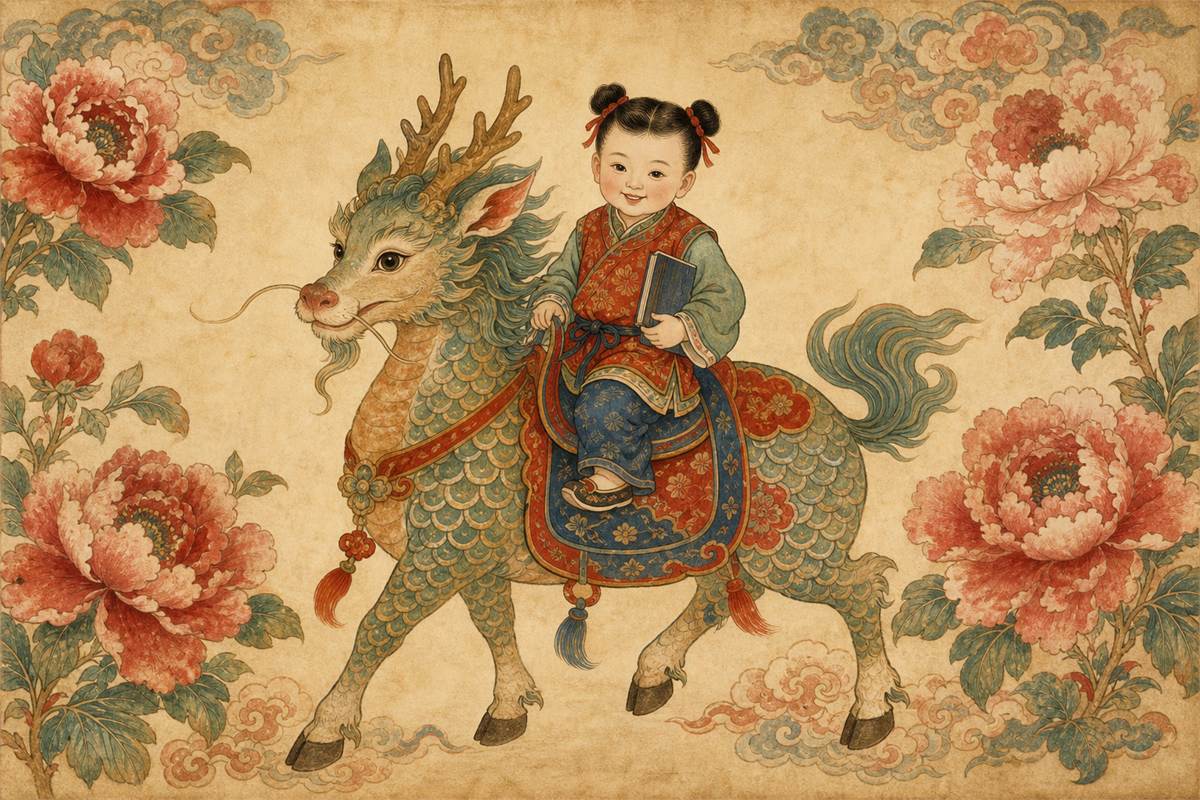
The motif reflects historical family ideals, including the importance placed on descendants and achievement. Modern gift giving needs more sensitivity. A Qilin Songzi object can be meaningful when the recipient values the tradition or has explicitly welcomed a family-blessing theme. For newlyweds or people of childbearing age, choose it only after considering their wishes; a Qilin gift can instead emphasize virtue, a new chapter, family harmony, or distinguished potential without assuming that the recipient wants children.
Why the Ming Court Called a Giraffe a Qilin
The Qilin giraffe Ming dynasty story is one of the most revealing moments in the creature’s history. In September 1414, an envoy sent by the ruler of Bengal presented a giraffe at the Yongle court. Bengal was a major maritime trading center, and the animal itself ultimately came from Africa. Its tall body, gentle behavior, patterned coat, and unfamiliar form invited comparison with the legendary Qilin.

Court officials celebrated the animal as an auspicious sign. Paintings associated with the event show a giraffe led by a keeper, and laudatory inscriptions connected its arrival with imperial virtue. The identification had political force: Yongle had taken the throne through civil war, and a Qilin-like omen could help represent his reign as legitimate and cosmically favored.
Where Zheng He fits—and where the simple version goes wrong
Zheng He’s seven maritime expeditions created the diplomatic and commercial world in which such embassies and exotic animals could reach the Ming court. It is common to say, “Zheng He brought back a giraffe and people called it a Qilin,” but that sentence compresses separate events. The 1414 giraffe was formally presented by a Bengal embassy. Later arrivals included giraffes associated with East African polities such as Malindi. Zheng He’s fleets are central to the wider history, yet the giver, route, and year should not be collapsed into one voyage anecdote.

The giraffe did not replace the traditional Qilin. Ming art continued to show more conventional dragonlike and deerlike forms, while some court images and textiles adopted longer necks or patterned coats. The result was an exchange between natural history, diplomacy, political imagery, and an older mythical vocabulary.
Qilin in Art, Dress, Architecture, and Folk Performance
Painting, jade, ceramics, and decorative arts
Qilin images appear on paintings, textiles, jade carvings, seals, lacquer, porcelain, metalwork, New Year prints, embroidered panels, and architectural ornament. The material changes the emphasis. A court painting may turn the Qilin into diplomatic evidence. A jade Qilin with a book may honor learning and the Confucian birth legend. A porcelain beast may serve as an incense-stick holder while bringing auspicious imagery into a scholar’s room. A popular print can join the creature with children, peonies, peaches, books, or official emblems to build a layered household blessing.

Architecture uses the creature in stone, brick, wood, ceramic, and glazed ornament. On gates, screens, roof elements, railings, tomb approaches, or carved panels, the Qilin can mark auspicious protection and dignified transition. Identification still requires care: lions, Xiezhi, Tianlu, Bixie, dragon-horses, and Qilin share visual features, and a modern label should not be projected backward without examining the object’s date and context.
Qilin rank badges and official dress
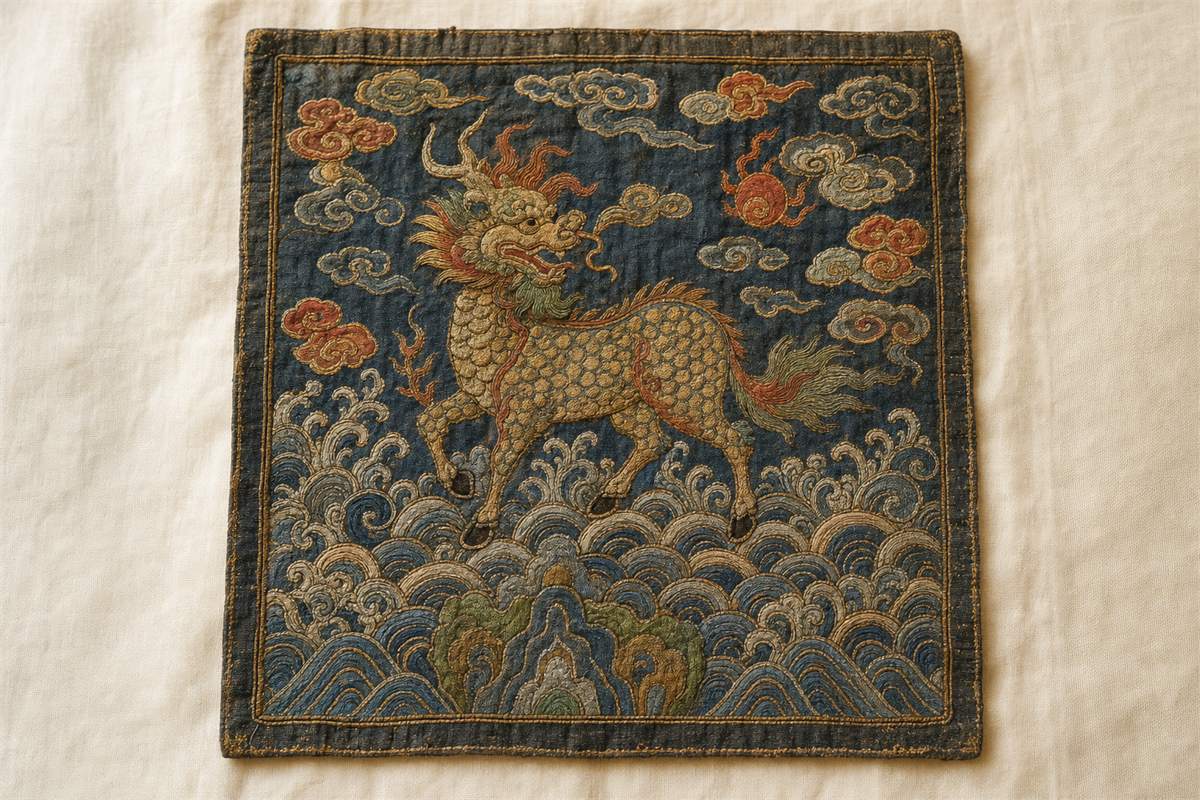
Qilin badges show why dynasty and regulation matter. In the Qing dynasty, after 1662, the Qilin became the insignia of first-rank military officials; before that change it had been worn by nobles. Ming textiles also include Qilin badges associated with high nobles, and giraffe-influenced forms appear in some surviving examples. It is therefore inaccurate to say that “first-rank military officials in both the Ming and Qing always wore Qilin.” Badge systems changed, enforcement varied, and the same creature could indicate noble status in one context and military rank in another.
Qilin dance as living heritage
Qilin dance is a living folk-performance tradition rather than a museum survival frozen in one form. China’s national intangible-cultural-heritage system lists Qilin Dance under project number III-43; the second national list in 2008 included traditions from places such as Lankao in Henan, Huanghua in Hebei, and Haifeng in Guangdong, with later extensions elsewhere. Local versions differ in costume, music, movement, martial-arts elements, and festival setting. What unites them is the transformation of the auspicious creature into communal movement, sound, celebration, and prayer for a peaceful year.

Qilin Statue Placement Without Invented Rules
Qilin statue placement works best when symbolism, sight lines, and physical safety support one another. A welcoming entry, living-room shelf, study, reception area, or office can all suit the creature. Choose a position where the form is readable and the object does not crowd the room. An outward-facing pose can feel watchful; an inward-facing pose can make the Qilin part of the household composition. Neither direction is a universal requirement.

- Scale: match the object to the shelf, console, garden, or desk. Leave visual space around horns, tail, and flame details.
- Stability: use a level surface, a non-slip pad, and a base wide enough for the center of gravity. Keep the statue away from table edges.
- Traffic: avoid narrow walkways, door swings, curtains, and places where bags or sleeves can catch a projecting horn.
- Children and pets: place heavy, sharp, brittle, or small detachable objects beyond easy reach.
- Heat and light: keep wood, gilding, resin, adhesives, dyed stone, and some glass away from radiators, fireplaces, strong spotlights, and prolonged direct sun.
- Large stone sculpture: confirm floor or ground bearing capacity, drainage, anchoring, wind exposure, and local installation requirements with a qualified installer or structural professional.

A pair is optional. Bedroom placement is also a matter of aesthetics, available space, and safety. There is no broadly reliable tradition requiring a Qilin to face a door, occupy a wealth corner or “White Tiger position,” avoid every mirror, stay out of every bedroom, remain untouched by visitors, or be worn at a particular two-hour period. Such rules usually come from modern commercial feng shui lists rather than one shared historical practice.
Qilin Jewelry and Gift Meaning
Qilin jewelry turns a large cultural image into a close personal object. A pendant can emphasize the creature’s profile, horn, cloud mane, or book. A bracelet charm may simplify the head or hoofed body. A seal, desk piece, or miniature carving gives more room for narrative details. The best design keeps enough distinctive features to avoid becoming an anonymous dragon or generic “lucky beast.”

| Recipient or occasion | Thoughtful Qilin gift meaning | Useful format |
|---|---|---|
| Child’s birthday or first-year milestone | Healthy growth, curiosity, honorable promise, and family care | Rounded pendant, keepsake seal, small framed art; avoid sharp, heavy, or detachable pieces for direct child use |
| Graduate or student | Learning, discipline, rare potential, and a wise path | Qilin-with-book seal, pendant, desk object |
| Promotion or professional milestone | Benevolent leadership, integrity, recognition, and steady progress | Metal desk sculpture, seal, understated jewelry |
| Housewarming | Peaceful household, welcome, cultural beauty, and an auspicious new chapter | Ceramic, wood, glass, or stone decor selected for the space |
| Business or cultural gift | Respect, distinguished achievement, and a bridge to Chinese cultural symbolism | Clearly documented craft object with a short meaning card |
| Wedding or partnership | Harmony, mutual respect, and a flourishing shared life | Paired or single design, chosen around the couple’s taste rather than an automatic fertility message |

Material changes the emotional tone. Gold feels ceremonial and celebratory. Bronze or brass gives visual weight and suits a study or office. Nephrite and jadeite connect the Qilin with the broader cultural language of jade, virtue, polish, and family memory; readers comparing those materials can continue with the jade meaning in Chinese culture guide. Ceramic and liuli can emphasize color and light, while wood brings warmth and visible carving.
Qilin Materials and Care
Care a Qilin object according to its actual material, surface coating, construction, inlay, previous repair, and condition. “Metal,” “jade,” “stone,” and “liuli” are not single care categories. Test the gentlest method first, stop if color or finish transfers, and treat antiques, excavated objects, heirlooms, valuable jewelry, and museum-quality pieces as conservation cases rather than household-cleaning projects.

| Material | Everyday care | Important limits |
|---|---|---|
| Gold jewelry | Wipe with a clean soft cloth after wear. Plain, sound gold may be cleaned briefly with lukewarm water and mild soap, then rinsed and dried completely. | Check stones, enamel, hollow construction, glue, plating, and patina first. Avoid abrasive toothpaste, chlorine, and casual polishing of antique surfaces. |
| Copper, bronze, brass, and other copper alloys | Dust with a soft brush or cloth, keep dry, and handle with clean dry hands. Preserve an intentional patina. | Metal polish removes surface material. Do not apply wax, silicone, lacquer, or corrosion chemicals as a universal treatment. Powdery or expanding corrosion needs a metals conservator. |
| Gilded or gold-toned surfaces | Use gentle dry dusting and minimal handling. | Gilding may be extremely thin; rubbing and metal polish can expose the base metal. Painted “gold” finishes and electroplating require different care. |
| Nephrite, Hetian jade, and jadeite | Protect from hard knocks and store separately. Warm mild soapy water and a soft cloth are the safest general method for sound modern jade; dry holes, cords, and settings carefully. | Jade can be dyed, bleached, impregnated, waxed, coated, assembled, or repaired. Skip steam and ultrasonic cleaning when treatment or construction is uncertain. |
| Stone sculpture | Remove loose dust gently and keep bases, drains, and surrounding ground clear. Inspect for cracks, movement, salts, biological growth, and unstable previous repairs. | Do not assume every outdoor stone needs annual waterproofing. Coatings can trap moisture or alter appearance. Large or deteriorated works need stone and structural specialists. |
| Ceramic | Handle with two hands, support from below, and dust with a soft brush. Sound glazed modern ceramic may tolerate careful damp cleaning. | Do not lift by horns, handles, or tails. Avoid washing unglazed, crackled, flaking, cold-painted, gilded, salt-contaminated, or previously repaired ceramic. |
| Liuli and glass | Protect from impact and thermal shock; dust gently. Clean stable modern uncoated glass with a soft cloth and minimal moisture when appropriate. | “Liuli” may mean cast glass, glazed ceramic, resin, or a coated composite in retail listings. Cold paint, foil, gilding, glue, and unstable historic glass change the method. |
| Wood carving | Keep a stable indoor environment, dust with a soft brush or dry cloth, support the base, and inspect for insects and loose joins. | Wood does not need routine oiling. Water can raise grain or stain unfinished wood; commercial polish and wax can build up or damage original finish. Active infestation or lifting paint needs a conservator. |

The phrase “people nourish jade” (ren yang yu, 人养玉) is a cultural way of describing the intimacy that develops through wearing and handling. Practical care remains straightforward: avoid impact, keep cosmetics and cleaners away, wipe gently, dry thoroughly, inspect cords and settings, and store pieces separately. Body oils may change surface appearance; they are not a substitute for safe cleaning or professional repair.
How to Choose a Qilin Object Thoughtfully
- Start with the purpose. Decide whether you want cultural art, wearable jewelry, a household blessing, a study object, or a milestone gift.
- Read the form in context. One or two horns can both be valid. Look at the hoofed body, head, scales, mane, flames, clouds, book, child, or accompanying inscription.
- Confirm the material. Ask whether “jade” means nephrite or jadeite, which copper alloy is used, whether gold is solid or plated, and whether liuli is glass, glaze, or resin.
- Check construction and size. Examine weight, base stability, edge finish, cord, clasp, setting, repairs, and actual measurements.
- Match the message to the recipient. Choose virtue, learning, family harmony, a new beginning, or cultural appreciation rather than assuming fertility, wealth, or promotion.
- For older objects, request provenance and condition information. A confident age claim requires more than dark patina, artificial staining, or a vague story.
- Plan care before purchase. A delicate gilded figure, outdoor stone sculpture, jade pendant, and painted wood carving need very different environments.

Price alone cannot identify quality. Craftsmanship is visible in proportion, carving depth, clean transitions, stable construction, surface finish, and whether the maker understands the chosen iconography. A small object with clear material disclosure and a well-matched gift message can carry more meaning than a larger piece covered in unsupported claims.
Qilin, Dragon, Phoenix, and Other Auspicious Beasts
| Creature | Primary cultural emphasis | How it differs from Qilin |
|---|---|---|
| Chinese dragon (龙) | Cosmic power, water, rain, authority, movement, transformation | Broader and more powerful cosmological role; Qilin centers benevolent auspicious arrival and humane virtue |
| Chinese phoenix (凤凰) | Virtue, harmony, grace, ordered rulership, renewal in modern reading | Bird tradition with its own court, gender, and marriage symbolism |
| Tortoise (龟) | Longevity, endurance, divination, cosmic structure | Included with Lin, phoenix, and dragon among the Four Spirits, but not a Qilin form |
| Pixiu (貔貅) | Modern wealth guarding and protective display, with older beast traditions behind it | Usually fiercer and more commerce-centered in modern use |
| Xiezhi (獬豸) | Justice, judgment, and the ability to distinguish right from wrong | A judicial beast, not a general synonym for Qilin |
| Tianlu and Bixie | Winged-beast, tomb, guardian, and auspicious traditions that vary by period | Related visual field, but distinct names and archaeological contexts |
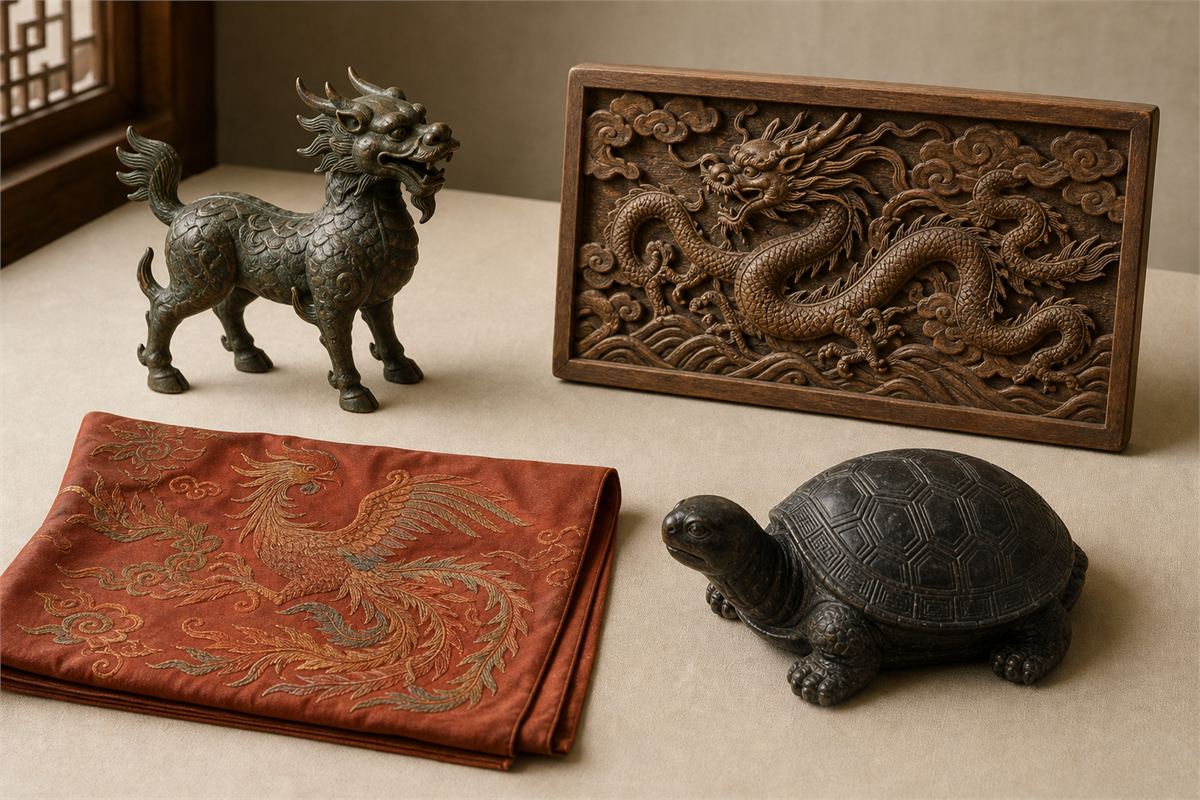
The Dragon and Phoenix meaning guide explores another major auspicious pairing. Qilin belongs in the same cultural world but brings a quieter tone: rare virtue arriving without aggression. For readers choosing a symbolic object or gift, the Eastern Story blessing collection offers a natural next step from cultural meaning to a piece selected with intention.
Frequently Asked Questions
A Living Symbol of Gentle Strength
The Qilin has endured because it can change shape without losing its moral center. An early horned Lin, a benevolent beast in commentary, a creature mourned at the end of a chronicle, a courtly giraffe, a Qilin bringing a child or book, a rank badge, a festival dance, a jade pendant, and a modern sculpture all belong to different moments. Together they express a lasting ideal: strength can be dignified, authority can be humane, and blessing can arrive quietly.

Choose a Qilin object for the meaning that fits your life or gift: virtue, learning, family care, peace, cultural memory, or a new beginning. Let material, scale, craftsmanship, and the recipient’s own taste complete the story.
Related Posts


3 Comments