
Quick answer: a jade peace buckle (平安扣), often called Ping An Kou, is a round jade pendant with a circular outer edge and a circular center opening. Its clearest meaning is peace, safety, smooth passage, and a complete life. In Eastern jewelry culture, the double-circle form also speaks of harmony, family unity, inner calm, and the wish to keep good fortune close.
The shape looks simple, but that simplicity is the point. A peace buckle has no sharp corners, no carved scene, and no complicated pattern. It relies on 2 circles: the outer round form suggests the broad world, heaven, and the flow of life, while the inner opening suggests the still center of the heart. When it is made from Hetian jade (和田玉), white jade, jadeite (翡翠), or another fine jade material, the pendant adds the quiet virtue language of jade itself.
Jade Peace Buckle Meaning at a Glance
| Theme | What the peace buckle symbolizes | How it appears in jewelry or gifting |
|---|---|---|
| Peace and protection | The name Ping An Kou carries the wish for safety, health, smooth travel, and peaceful daily life. | Worn as a pendant, bracelet charm, waist ornament, bag charm, or car hanging for an everyday blessing. |
| Roundness and harmony | The outer circle and inner circle suggest wholeness, family harmony, balanced relationships, and life without harsh edges. | A good gift for parents, partners, children, close friends, and people entering a new stage. |
| Fortune and blessing | Its round form recalls an ancient coin, so it is also associated with incoming fortune, stable work, and gathered blessings. | Often chosen by business owners, graduates, travelers, and people who want a calm good-luck piece. |
| Wisdom and openness | The open center can be read as a clear mind; the smooth line expresses the Zhongyong / middle way (中庸之道). | Fits restrained daily styling, meditation jewelry, and meaningful minimalist design. |
| Love and unity | The large circle holding a smaller circle suggests one heart, one family, or 2 lives moving together. | Used as a partner gift, wedding-season gift, or a quiet promise of shared peace. |

What Is a Peace Buckle (平安扣)?
A peace buckle (平安扣) is a smooth circular jade pendant with a round hole in the center. In English it is often described as a jade peace buckle, Ping An Kou, safety buckle, peace button, round jade pendant, or circular jade amulet. The older cultural names include Huai Gu (怀古), meaning a form that remembers antiquity, and Luohan Eye (罗汉眼), a name that points to the calm, watchful circular opening.

The most recognizable form is plain and polished. There may be slight doming, a soft convex surface, or a flatter disk-like body, but the key features remain the same: 1 continuous round outer edge, 1 round center opening, and a surface that should feel smooth against the skin. This is why the piece works across age and gender. It does not need heavy decoration to carry meaning.
In modern Eastern jewelry, the peace buckle appears as a necklace pendant, a small bracelet charm, a hand-braided cord piece, a K-gold setting, an earring drop, a ring element, a waist hanging, or a car ornament. A small pendant can be worn close to the body; a larger piece can be held, displayed, or used as a quiet object of blessing.
Two Origin Stories: Jade Bi and Ancient Coin
The first and most common origin story connects the peace buckle to the jade bi (玉璧), the ancient round jade disk used in ritual culture. A jade bi is larger, flatter, and historically tied to ceremonial ideas of heaven, order, and reverence. Over time, this circular language became smaller, simpler, and easier to wear, creating a pendant form suited to daily life.

The second origin story connects the peace buckle to ancient coins. Traditional coins suggested wealth, circulation, and the movement of value, while jade added warmth, refinement, and a more personal feeling. A peace buckle looks like a jade version of a coin, but with a round center instead of a square hole. That difference matters: the round opening softens the object and turns it from a money image into a symbol of smoothness, completeness, and blessings that flow without obstruction.
Both origin stories can sit together. The jade bi story gives the peace buckle its ritual and philosophical depth. The coin story gives it a more everyday wish for fortune, steady livelihood, and good opportunities. This is why one small pendant can feel both ancient and practical.
Core Symbolism: Peace, Harmony, Fortune, and Wisdom
Peace and smooth passage
The most direct meaning is peace. Ping An means safety, calmness, and being well; Kou means buckle or button. Together, the phrase feels like a wish to fasten peace close to the wearer. Parents give it to children for safe growth. Children give it to parents for health and long life. Friends give it before travel, graduation, a new job, a move, or a year of change.

Roundness, completion, and harmony
A peace buckle has no corners and no sharp points. This is why it naturally becomes a symbol of completion, family harmony, and a life that moves without unnecessary conflict. The outer circle can be read as the open world; the inner circle can be read as the quiet self. Together they echo unity of heaven and humanity (天人合一), a traditional idea that outer order and inner balance belong together.

Fortune, blessing, and the coin image
Because the form resembles an old coin, the peace buckle is also associated with gathering fortune, welcoming blessings, and steady prosperity. In gift language, this is a warm wish rather than a loud promise: may good things come in from many directions, may work go smoothly, and may the wearer have enough support for the next step.
Clear mind and the middle way
The open center gives the piece another layer: a clear heart and an open mind. The soft line, balanced form, and lack of aggressive detail fit the Zhongyong / middle way (中庸之道), where good judgment means moving with steadiness rather than extremes. In this reading, the peace buckle is not only a charm for peace; it is also a reminder to speak gently, act clearly, and leave room for others.
Unity and shared happiness
The large circle and small circle can also be read as 2 circles of belonging: family and self, partners and shared life, elder and child, or giver and receiver. This is why the peace buckle works as a partner gift. It can say: may we stay of one heart, may peace stay between us, and may happiness be held close.
Why Hetian Jade and Jadeite Change the Feeling
Material changes the emotional tone of the same shape. Hetian jade (和田玉), especially white jade, mutton-fat white jade, pale green, yellow-toned, or soft pink material, gives the peace buckle a warm and inward feeling. Its appeal is oiliness, fine texture, gentle polish, and the sense that the jade becomes more personal through wear.
Jadeite (翡翠) gives the form a brighter, clearer, and more luminous mood. Icy jadeite, glassy jadeite, floating-flower material, and vivid green jadeite make the peace buckle feel more jewel-like and contemporary. If Hetian jade is quiet and inward, jadeite is often more crisp, translucent, and visually lively.

Both materials fit the same symbolic structure. Hetian jade emphasizes restraint, warmth, and gentleman virtue in jade (君子比德于玉), the idea that jade reflects cultivated character. Jadeite emphasizes light, color, and a fresh modern elegance. Buyers can choose by feeling: soft and low-key, or clear and bright.
For broader material background, Eastern Story has separate guides to what Hetian jade is, jade meaning in Eastern culture, and jewelry materials. This peace buckle guide keeps its focus on the round pendant form and its gift language.
Modern Eastern Jewelry Design: From Red Cord to 18K Gold
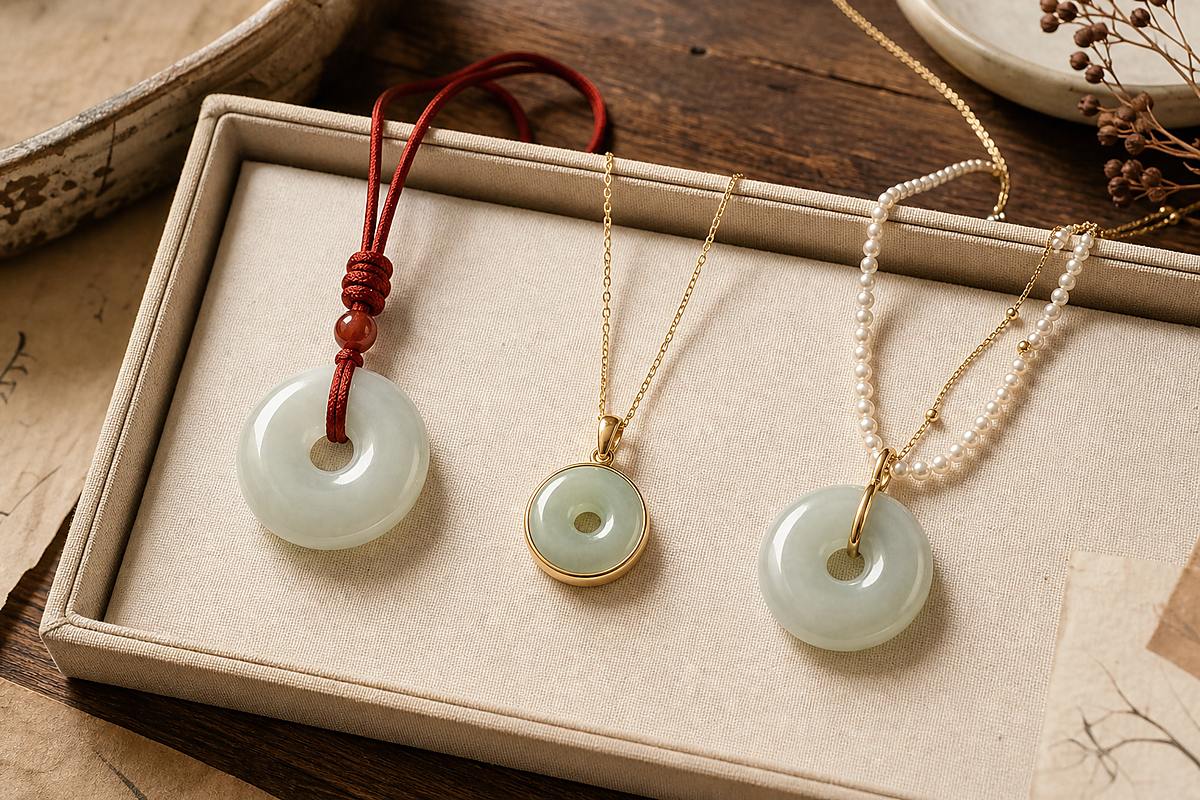
The traditional image is a plain jade peace buckle on a red cord, but modern Eastern jewelry has expanded far beyond that 1 format. The same circular pendant can now look devotional, minimalist, vintage, luxurious, or sharply contemporary depending on setting, cord, metal, and scale.
| Design style | Materials and details | Best use |
|---|---|---|
| Plain Hetian jade pendant | White jade, pale green jade, yellow-toned jade, pink-toned jade, or other smooth nephrite, usually kept as a plain polished surface. | Daily wear, parents, elders, understated personal blessing, quiet new-Chinese styling. |
| Jadeite peace buckle | Icy, glassy, floating-flower, or green jadeite with a clean polished round form. | Minimalist outfits, formal dressing, people who like clarity, light, and a refined cool tone. |
| 18K gold and diamond setting | 18K yellow gold, white gold, or rose gold with a protective rim, bail, or small diamond accents. | Light-luxury office wear, gifts with a more finished jewelry feeling, and pieces that need edge protection. |
| Ancient-style gold and filigree | Old-gold texture, bamboo, ruyi, plum blossom, enamel, or fine filigree details around the buckle. | A richer Eastern vintage mood, formal gifts, festive occasions, and heirloom-style presentation. |
| Hand-braided cord | Waxed cord, silk cord, mandala knots, double-connection knots, small jade beads, Nanhong, turquoise, amber, or matching accent beads. | A calmer handmade feel, meditation jewelry, daily casual wear, and color-controlled styling. |
| Mixed-material layering | Pearls, fine gold chains, tiny bead strands, or small peace buckles stacked with other necklaces. | Modern styling that keeps the jade meaningful without making the outfit feel old-fashioned. |

Peace buckles also move across product types. A small round buckle can become a ring element, a bracelet charm, a pair of earrings, a waist hanging, a bag charm, or a car ornament. That category expansion is one reason the motif continues to feel alive: it can carry an old blessing through new silhouettes.
Who Should Wear or Receive a Jade Peace Buckle?
The peace buckle is unusually flexible because it is not tied to 1 age, gender, or life stage. Men often wear it for a steady, grounded, low-key look. Women may wear it for softness, elegance, and a gentle Eastern accent. Children can receive it as a family blessing. Elders can receive it as a wish for health, longevity, and an untroubled heart.

| Receiver | Best gift meaning | Good design direction |
|---|---|---|
| Parents or elders | Health, long life, peace at home, and a child's steady affection. | Warm Hetian jade, plain white jade, soft green jade, or a restrained gold bail. |
| Children or younger relatives | Safe growth, protection in folk tradition, learning, and a smooth path. | Smaller pendant, smooth edges, secure cord, and comfortable size. |
| Partner or spouse | One heart, shared peace, complete love, and happiness held close. | Pair pendants, 18K gold setting, simple jadeite, or a polished Hetian jade piece. |
| Friend or colleague | Good luck, smooth work, safe travel, and a clean new beginning. | Minimalist pendant, bracelet charm, or a practical cord design. |
| Business owner or career-focused wearer | Steady fortune, clear judgment, and smooth movement through decisions. | Coin-like round shape, dark cord, jade with strong polish, or a refined metal setting. |
For a store path, the closest Eastern Story shopping direction is the Blessing collection. Readers who prefer jade and red cord symbolism can also explore the Red Thread of Intention jade bead bracelet and the Harmonized Fortune jade and red stone bracelet. These are not peace buckles, but they share the same broader blessing language of jade, red cord, protection, and good fortune.
How to Choose a Good Peace Buckle
- Look at the jade texture. Fine Hetian jade should feel smooth, dense, and gently oily after polish. Good jadeite should show pleasing color, translucency, and a lively surface.
- Check the roundness. The outer circle and inner opening should look balanced. A peace buckle depends on proportion more than decoration.
- Touch the edges. The rim and center hole should be rounded and comfortable, without sharpness, burrs, or rough drill marks.
- Inspect cracks and impurities. Natural jade can have texture, but obvious fractures through the ring weaken both beauty and durability.
- Match size to use. Small pieces suit close daily wear; larger pieces work better as statement pendants, handheld pieces, bag charms, or car hangings.
- Choose setting by lifestyle. A cord is soft and traditional; 18K gold protects edges and feels more jewelry-like; hand-braiding adds handmade warmth.
The best piece is not always the most ornate. A peace buckle succeeds when the jade, polish, circle, and wearing purpose feel aligned. The form is simple enough that poor proportion or rough finishing becomes easy to notice.

Wearing, Care, and the Idea of “People Nourish Jade”
Smaller peace buckles are often worn close to the skin. In folk language, close wear lets the object and wearer become familiar with each other. This connects to the saying that people nourish jade for 3 years, and jade nourishes people for a lifetime. In practical terms, regular wear gives the surface contact with warmth and skin oils, while careful handling keeps the polish looking soft and bright.

Jade is durable, but it should still be treated as fine jewelry. Remove it before heavy exercise, housework, swimming, showering, or any activity that may strike the pendant against hard surfaces. Keep it away from strong acids, strong alkalis, perfume, lotion, and harsh cleaners. Clean it with warm water when needed, then dry it with a soft cloth.
A peace buckle also asks for clean presentation. If it is a gift, choose a cord, chain, or setting that suits the receiver's style. If it is worn daily, inspect the cord, clasp, bail, or metal setting regularly. For more everyday maintenance, use the Eastern Story jewelry care guide.
How the Peace Buckle Connects with Other Jade Symbols
A peace buckle is easiest to understand beside other jade forms. If you want the wider language of carved animals, flowers, ruyi, gourds, coins, and auspicious patterns, read Chinese jade carving meanings. If you want the material and virtue tradition behind jade itself, continue with jade meaning in Eastern culture or what Hetian jade is.

The peace buckle also shares ancestry with the jade bi (玉璧), but the feeling is different. A jade bi belongs more to ancient ritual form and ceremonial symbolism; a peace buckle turns the circular idea into a personal pendant for daily blessing. Huai Gu (怀古) and Luohan Eye (罗汉眼) are best read as older names and poetic descriptions for the same family of round peace-buckle forms, rather than separate things a beginner needs to choose between.
Frequently Asked Questions

Conclusion
A jade peace buckle is powerful because it says a lot with a very small shape. Its 2 circles hold the wish for peace, completeness, fortune, clear judgment, and family harmony. Its possible roots in the jade bi and ancient coin give it both historical depth and everyday warmth.

Choose a peace buckle when the gift needs to feel sincere, calm, and easy to wear. In Hetian jade it feels soft and inward; in jadeite it feels bright and refined; in 18K gold or hand-braided cord it becomes part of modern Eastern jewelry. The blessing remains the same: keep peace close, let life move smoothly, and carry good wishes with you.
Related Posts


6 Comments