Lingzhi meaning centers on longevity, auspicious blessing, wish fulfillment, refined vitality, and the hope that life may unfold with peace and dignity. In Eastern culture, Lingzhi (灵芝) is known as an auspicious herb (瑞草) and immortal herb (仙草). Its meaning joins materia medica, myth, jade carving, decorative pattern, gift language, and folk blessing into one flexible symbol.
For English readers, Lingzhi can be confusing because the same word points to a real medicinal fungus, a mythic long-life plant, and a carved motif in jade and decorative art. This page keeps those layers together without mixing their roles: Lingzhi is a biological Ganoderma fungus, a classical symbol of vitality, a visual cousin of Ruyi (如意), and one of the most useful longevity motifs in Eastern jade carving.
Lingzhi Meaning at a Glance
| Layer | Lingzhi (灵芝) meaning | Where it appears |
|---|---|---|
| Core blessing | Longevity, health wishes, good fortune, auspicious arrival, and graceful vitality | Jade carving, birthday gifts, plaques, pendants, home objects |
| Ruyi connection | The curved cap resembles a Ruyi (如意) head, so Lingzhi can express wish fulfillment and smooth progress | Lingzhi Ruyi pattern (灵芝如意纹), Lingzhi Ruyi (灵芝如意), jade scepters |
| Mythic layer | Immortal herb (仙草), Queen Mother of the West medicine, and the life-saving herb in the White Snake legend | Legends of Xiwangmu (西王母), White Snake Lady (白娘子), Xu Xian (许仙) |
| Pattern language | Cloud-like cap, curled sprig, auspicious fungus, and long-life motif paired with cranes, bats, deer, peaches, and pine | Lingzhi cloud-crane pattern (灵芝云鹤纹), Crane Carrying Lingzhi (鹤衔灵芝), Songhe Xianzhi (松鹤衔芝) |
| Jade meaning | Jade Lingzhi (玉灵芝) joins the long-life wish of Lingzhi with jade's refinement, dignity, and lasting beauty | Pendants, plaques, Ruyi forms, table objects, carved deer-and-Lingzhi scenes |
What Is Lingzhi (灵芝)?
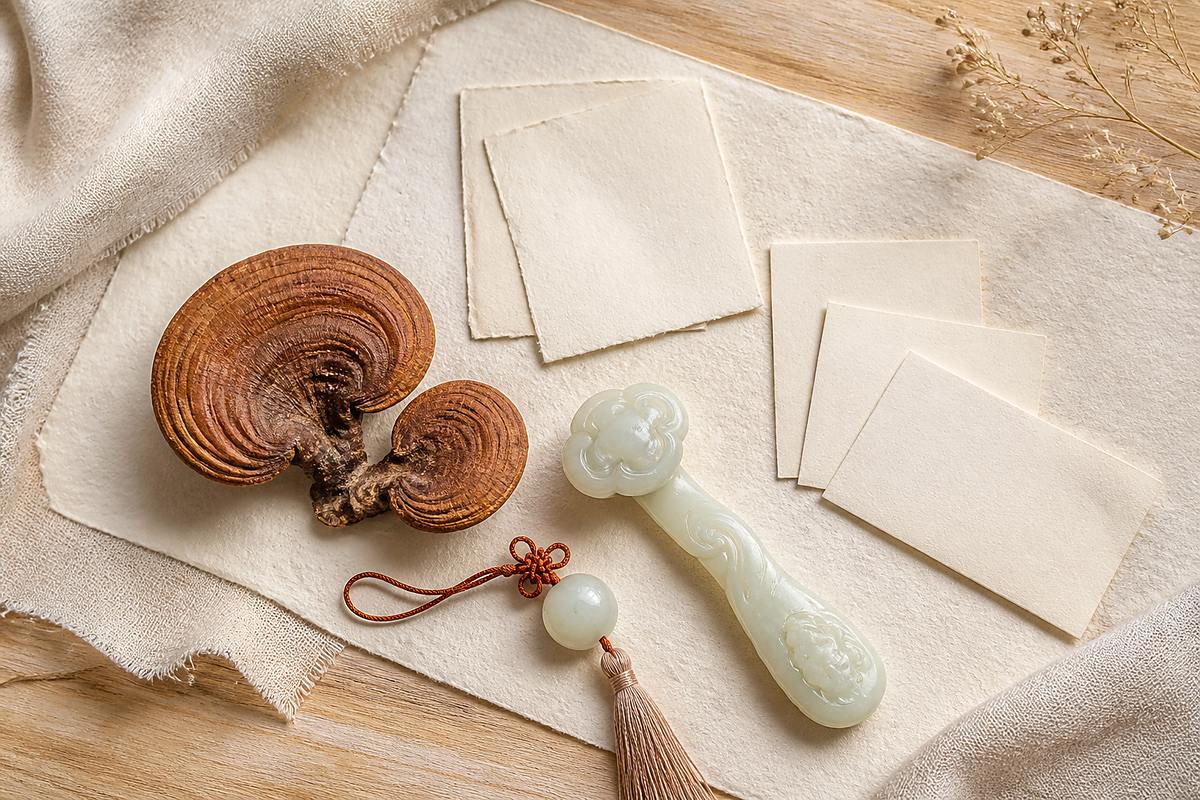
Lingzhi (灵芝) refers to Ganoderma fungi, especially red and purple forms used in Eastern materia-medica language, but in symbolism it is much more than a botanical object. The name itself carries the feeling of spiritual potency, vitality, and long life. That is why English often translates it as the “mushroom of immortality,” while Eastern symbolic art treats it as an auspicious herb (瑞草) and immortal herb (仙草).

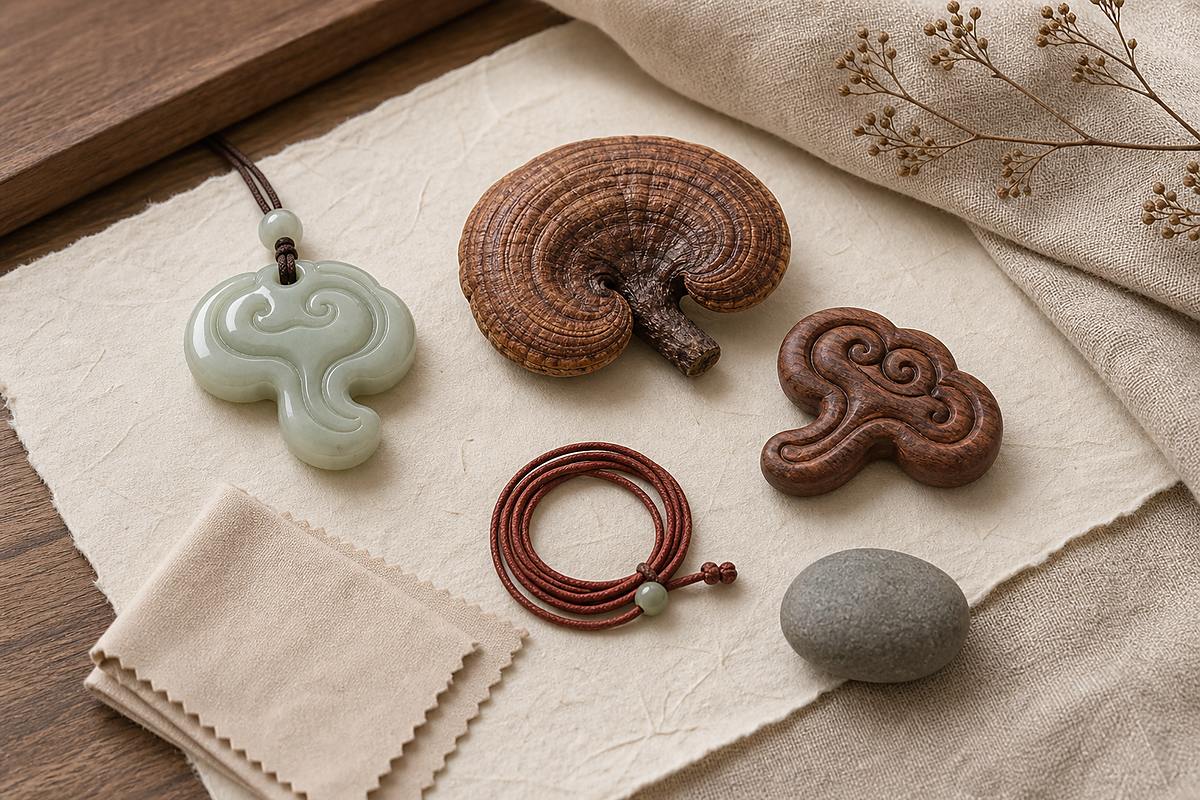
As a material object, Lingzhi has a recognizable form: a kidney-shaped, semicircular, or nearly round cap; a dark purple, reddish-brown, or purple-brown glossy surface; brown to chestnut-brown flesh; and off-white, pale brown, or dark brown pores. Traditional descriptions often note 5-6 pores per millimeter, with a side, back-side, or offset stalk that can be the same color as the cap or deeper. In Chinese materia-medica distribution notes, Lingzhi is associated with places such as Zhejiang, Heilongjiang, Jilin, Anhui, Jiangxi, Hunan, Guizhou, Guangdong, and Fujian.
Those physical details matter because the carved motif comes from a real visual structure. A Lingzhi cap can look like a cloud, a curled wave, a small Ruyi head, or a clustered sprig. Artists made that flexible outline into a design language. In jade, metal, wood, porcelain, textile, architecture, and painting, a small Lingzhi form can quietly signal longevity, auspicious atmosphere, and refined blessing.
Core Symbolic Meanings of Lingzhi
Longevity and Life Extension
The strongest Lingzhi meaning is longevity. The Eastern classic Shennong Bencao Jing (神农本草经) places Lingzhi among superior materia-medica categories and praises long use with language of a light body, staying youthful, lengthened years, and immortal life. In symbolic writing, that classical tone helped Lingzhi become a visible long-life wish rather than only a fungus.

Legend strengthened the meaning. Chang'e is sometimes linked with immortal medicine, Peng Zu is said to have lived 880 years with a youthful appearance, and Lingzhi appears in stories of life-saving or immortal herbs. In the White Snake legend, White Snake Lady (白娘子) seeks an immortal herb to save Xu Xian (许仙). In Xiwangmu immortal medicine (西王母仙药) stories, the Queen Mother of the West (西王母) belongs to a world where herbs, peaches, cranes, and immortality gather around long life.
Auspicious Blessing and Ruyi Wishes
Lingzhi also means auspicious arrival and smooth wishes. Its cap can resemble a small cloud of good omen, called an auspicious cloud or qingyun in classical visual language. Its outline also resembles Ruyi (如意), the wish-granting scepter and auspicious object whose name means “as one wishes.” This is why Lingzhi Ruyi pattern (灵芝如意纹), Lingzhi Ruyi (灵芝如意), Fu-Shou Ruyi (福寿如意), and Wan Shi Ru Yi (万事如意) feel natural together.

Han-period court culture gave Lingzhi a public auspicious tone. Emperor Wu of Han is associated with the “Song of the Zhi Chamber,” and Lingzhi became part of a language of favorable signs and peaceful rule. On huabiao columns and architectural decoration, Lingzhi-like clouds and auspicious forms can express social peace, ordered blessing, and the hope that the household or country is settled and flourishing.
Nobility, Refinement, and High Character
Because Lingzhi was considered rare and difficult to find, it also became a symbol of distinction. Imperial and elite language used names such as zhi halls and zhi gardens to suggest honor and refinement. The phrase Zhilan Yushu (芝兰玉树) connects zhi, orchid, and jade-tree imagery with noble character, talented descendants, and cultivated presence.
In literati painting and decorative art, Lingzhi often appears with bamboo, orchid, pine, cranes, or rocks. These pairings make the symbol quieter and more elegant. Lingzhi here is not a loud promise of luck; it is a cultivated image of character, long life, and dignified taste.
Protection, Blessing, and Spiritual Potency
Daoist language connected Lingzhi with spiritual clarity and communication with higher realms. Buddhist-inspired art sometimes placed it near auspicious treasure and offering imagery. In folk prints and home decoration, Lingzhi could help create a household atmosphere of blessing, safety, and good timing. In modern gift language, many people use it to express health wishes, elder respect, family care, and a gentle hope for steady life.
Why Lingzhi Became a Longevity Symbol
Lingzhi became a long-life symbol because several layers reinforced one another. The first layer is classical materia-medica language. The second is myth, where immortal herbs, long-lived figures, and life-saving quests make Lingzhi emotionally memorable. The third is visual art, where the curved cap fits naturally beside cranes, peaches, pine trees, deer, bats, and the longevity character Shou (寿).

Modern biological research adds another reason the symbol still feels contemporary. Ganoderma lucidum is widely studied for polysaccharides, triterpenes, peptides, sterols, immune modulation, oxidative-stress pathways, and aging-related mechanisms. In cultural writing, this research background helps explain why Lingzhi remains a health and longevity emblem today. In Eastern Story content, the meaning is best framed as cultural symbolism, gift language, and traditional wellness association rather than a medical instruction.
This layered background is why Lingzhi can serve as a compact cultural totem of “life enduring + blessing complete.” A small fungus form can carry medicine, myth, art, folk life, and personal wishes at the same time.
Lingzhi and Ruyi: Similar Shape, Different Objects
Lingzhi and Ruyi are closely connected, but they are different things. Lingzhi (灵芝) is a real fungus and a symbolic motif. Ruyi (如意) is an auspicious object and decorative form, usually with a long handle and a cloud-shaped head. Early Ruyi forms may have developed from practical hand tools, court objects, or Buddhist-associated implements, then became refined display pieces and gift objects.
| Comparison | Lingzhi (灵芝) | Ruyi (如意) |
|---|---|---|
| Basic identity | Ganoderma fungus and auspicious herb motif | A wish-fulfilling scepter, ornament, or auspicious object |
| Shape | Umbrella-like or kidney-shaped cap, glossy surface, side or offset stalk | Slender handle with a cloud or Lingzhi-shaped head, often S-curved |
| Common types | Single sprig, clustered fungus, Lingzhi cloud, Lingzhi with animals or fruit | Straight-handle Ruyi, Lingzhi Ruyi, three-inlay Ruyi |
| Materials | Natural fungus, jade, wood, metal, porcelain, textile motif | Jade, jadeite, coral, agate, tourmaline, ivory, wood, metal, gilt copper, inlaid treasures |
| Main meaning | Longevity, auspicious vitality, immortal herb, health blessing | Wish fulfillment, smooth progress, authority, ceremonial blessing |
| Overlap | The cap can resemble a Ruyi head | One Ruyi type is explicitly shaped like Lingzhi |

Because the forms overlap, people often say “Lingzhi is Ruyi” in a symbolic sense. The more precise reading is that Lingzhi can stand for Ruyi-like wishes, and Ruyi can borrow the Lingzhi head form. Together they create Lingzhi Ruyi (灵芝如意), a strong blessing for smooth wishes, long life, and good fortune. For the dedicated Ruyi object and jade gift context, read Jade Ruyi meaning.
Lingzhi Pattern Meaning and Historical Evolution
Lingzhi pattern (灵芝纹样) is one of the important auspicious motifs in Eastern decorative art. Its form changed over time, moving from abstract geometry into fungus caps, cloud heads, curled vines, and multi-layered Ruyi-cloud compositions.
| Period | Common Lingzhi pattern direction | Meaning layer |
|---|---|---|
| Shang-Zhou period (商周时期) | Abstract geometric and early auspicious forms | Proto-symbolic ornament, order, ritual atmosphere |
| Han period (汉代) | More recognizable fungus-cap and auspicious-zhi imagery | Favorable sign, long life, peaceful rule |
| Tang-Song period (唐宋时期) | Cloud-head scrollwork, curled grasses, elegant decorative rhythm | Ruyi-like wish, refined blessing, flowing vitality |
| Ming-Qing period (明清时期) | Multiple fungus heads stacked into smooth Ruyi-cloud forms | Longevity, rank, cultivated prosperity, auspicious completion |
| Qianlong period (清代乾隆时期) | Imperial ornament with dragon, cloud, textile, enamel, jade, and architectural use | Royal dignity, ordered blessing, ornate visual authority |
| Modern design | Simplified flat pattern, cultural products, jewelry, home decor, branding motifs | Traditional blessing translated into modern visual language |

Lingzhi patterns appear across ceramics, textiles, architecture, and decorative objects. Longquan celadon, brocade such as Ming Wanli-style Lingzhi pattern fabrics, palace caissons, carved beams, furniture ornament, and jade plaques all use the motif in different ways. Daoist interpretation reads Lingzhi as a symbol of cultivation and transcendence; Confucian interpretation can emphasize gentlemanly character; Buddhist art may fold it into auspicious and turning-wheel imagery. The result is a multi-faith, multi-art motif that remains easy to recognize.
Common Lingzhi Motif Combinations
Lingzhi often becomes more specific when paired with another symbol. The same sprig can shift from long life to good fortune, birthday blessing, high character, family harmony, or peaceful success depending on the companion motif.
| Combination | Chinese term | Meaning |
|---|---|---|
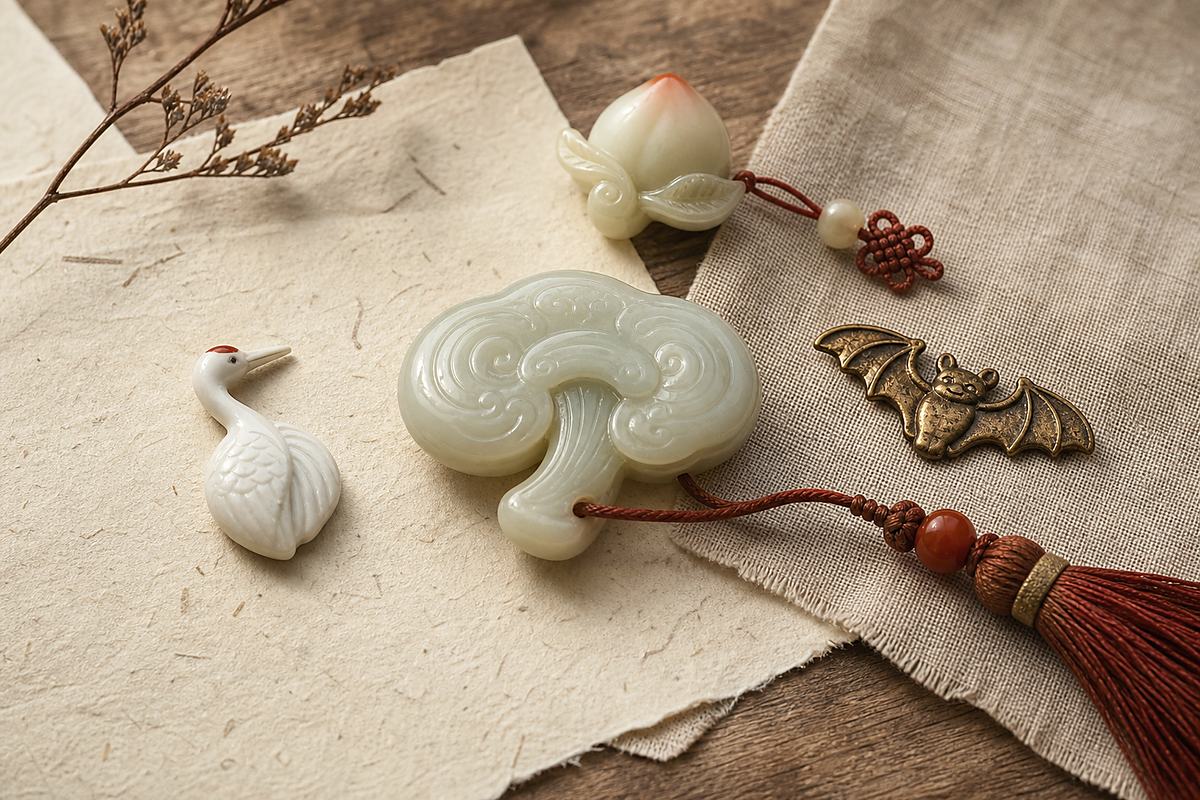
| Lingzhi with clouds and cranes | Lingzhi cloud-crane pattern (灵芝云鹤纹) | Longevity, elegant age, and auspicious sky imagery |
| Crane carrying Lingzhi | Crane Carrying Lingzhi (鹤衔灵芝) | Long life, blessing carried from the immortal realm, refined birthday language |
| Pine and crane with Lingzhi | Songhe Xianzhi (松鹤衔芝) | Elder respect, endurance, long life, and noble quietness |
| Lingzhi with bats | Lingzhi with bats (灵芝配蝙蝠) | Good fortune through the Fu (福) wordplay of bats plus longevity from Lingzhi |
| Lingzhi with longevity peach | Lingzhi with longevity peach (灵芝寿桃) | Birthday blessing, long life, and fullness of years |
| Lingzhi with deer | Deer holding or resting near Lingzhi | Longevity joined with lu (禄) wordplay, rank, prosperity, and graceful movement |
| Lingzhi with Ruyi | Lingzhi Ruyi (灵芝如意) | Long life and wishes fulfilled; a natural bridge between fungus and scepter form |
| Lingzhi with orchids and jade tree | Zhilan Yushu (芝兰玉树) | High character, cultivated descendants, and refined family blessing |

These combinations also explain why Lingzhi belongs inside the broader Chinese jade carving meanings system. It is a single motif, but it can participate in larger scenes that include animals, plants, auspicious characters, cloud scrolls, and Ruyi forms.
Jade Lingzhi (玉灵芝) in Carving and Jewelry
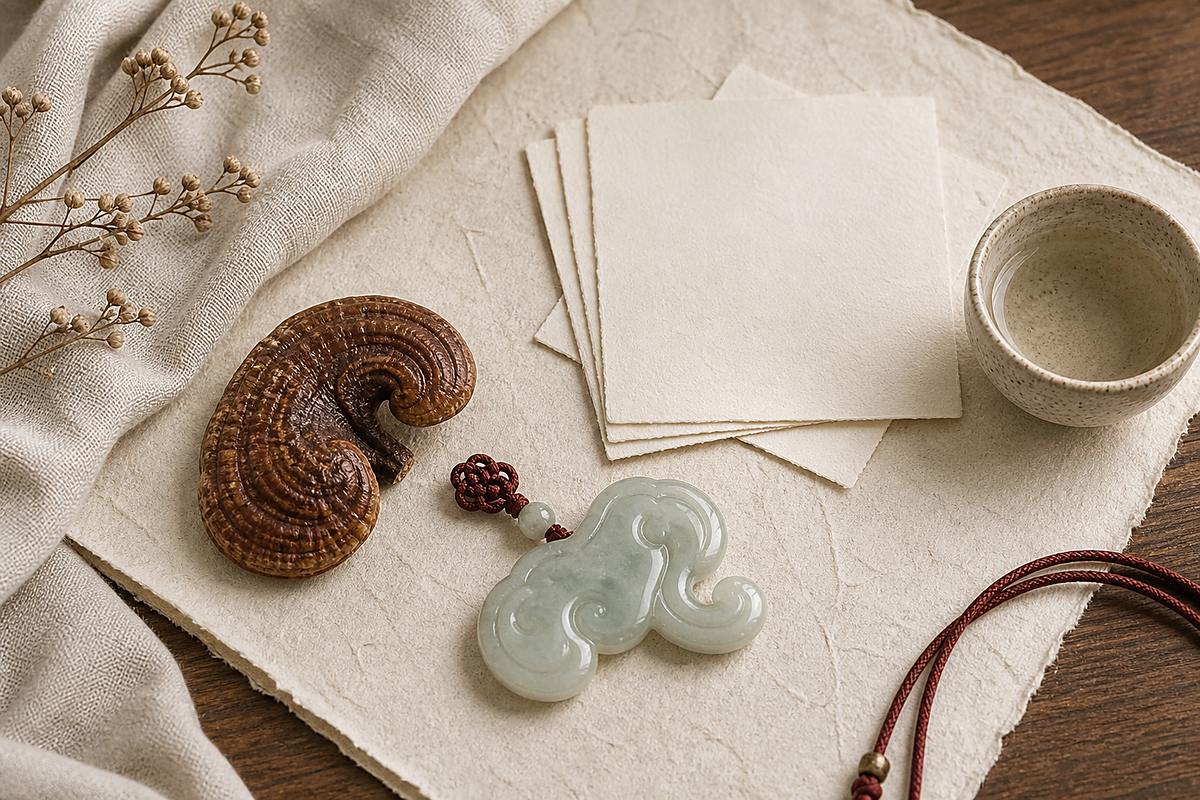
Jade Lingzhi (玉灵芝) combines two symbolic worlds. Jade contributes purity, warmth, refinement, resilience, and dignified beauty. Lingzhi contributes longevity, auspicious vitality, and Ruyi-like wishes. Together they make a calm, meaningful object for wearing, display, or gifting.
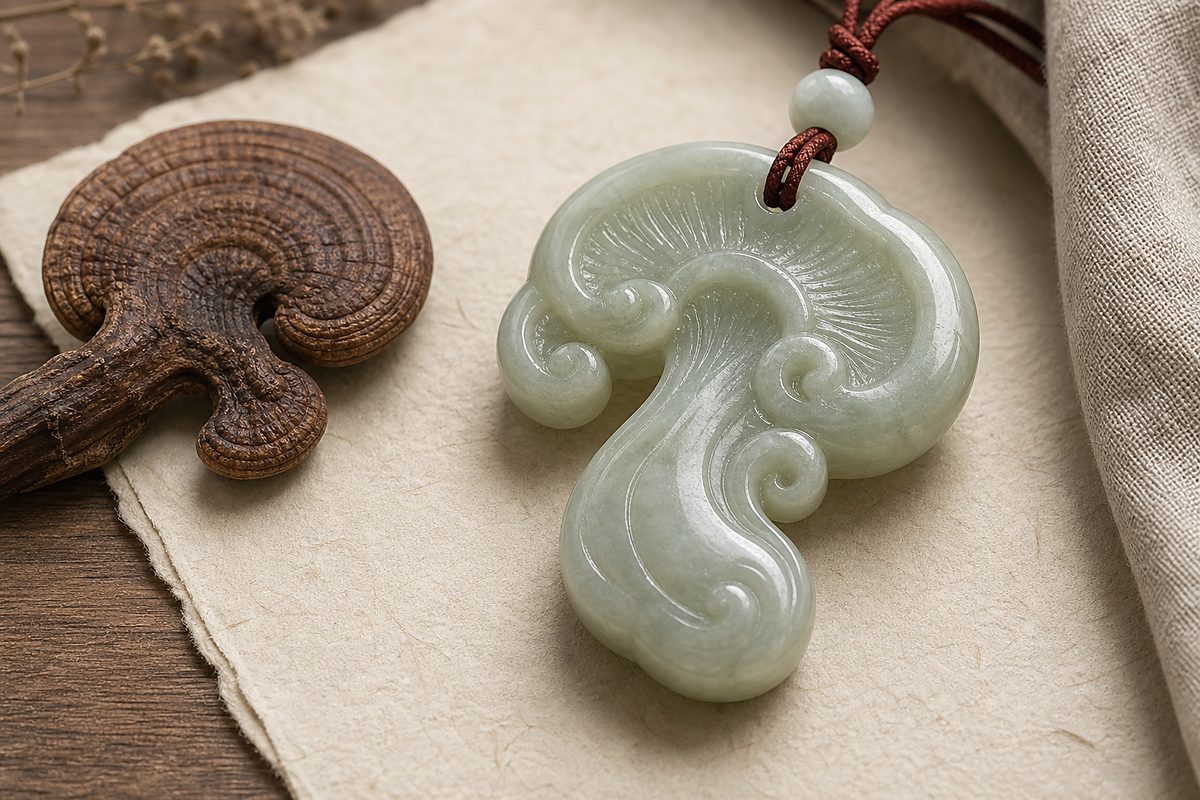
In jade carving, Lingzhi can appear as a pendant, small plaque, Ruyi head, table ornament, animal-held sprig, or clustered fungus. Qing examples such as three-color carved jadeite Lingzhi Ruyi forms show how the fungus could become the main body of a ceremonial object: a Lingzhi-shaped Ruyi head, cloud scrolls, vine-like handle, openwork carving, relief carving, and color-following design. White, positive green, and dark jade tones can be arranged so that the color follows the form and the form grows from the color.

Other forms are more intimate. A mid-Qing Hetian jade seed-material pendant with Lingzhi Ruyi pattern can use round carving and openwork to shape a fungus cluster, with small zhi forms across the body and Fu (福) motifs on the Ruyi head. Its message can be read as Heaven Protects Ninefold Wishes, Fu-Shou Ruyi (福寿如意), and good wishes gathered in a small wearable object. A Ming-period reclining deer holding Lingzhi turns the same motif into a scholar's desk object or display piece: rougher carving, unusual design, and a graceful long-life scene.
Craft details matter. Lingzhi jade work is often judged by material choice, natural color use, carving depth, line rhythm, openwork, relief, polish, and edge comfort. Round carving, openwork, deep relief, shallow incised lines, and clever color carving can all make the fungus feel alive. A well-finished jade Lingzhi should have smooth inner and outer walls, clear shape, comfortable touch, and no sharp distracting edges.
Lingzhi Gift Meaning
A Lingzhi gift is a respectful way to say: may you be healthy, long-lived, blessed, and steady in life. It is especially natural for elders, birthdays, recovery milestones, family celebrations, weddings, housewarming, and business relationships where the message should feel refined rather than loud.

- For elders: Lingzhi expresses health, long life, care, and gratitude.
- For birthdays: Lingzhi with longevity peach, crane, pine, or Shou (寿) gives a clear long-life message.
- For weddings or family gifts: Lingzhi with bats, Ruyi, or harmonious paired forms can express Fu (福), smooth wishes, and family completion.
- For study or career: Zhilan Yushu (芝兰玉树) and refined Lingzhi forms can suggest cultivated talent, noble character, and steady growth.
- For business gifts: Lingzhi Ruyi (灵芝如意) works as a dignified blessing for cooperation, smooth progress, and prosperity.
Modern edible and wellness-style Lingzhi gifts also exist, including spore oil, spore powder, Lingzhi tea, Lingzhi-shihu tea, Lingzhi-rose tea, Lingzhi with kudzu and polygonatum, and ginseng-plus-Lingzhi gift boxes. These gifts usually carry a health-care message. For Eastern Story's cultural-symbolic pages, the strongest use is still the visible motif: jade Lingzhi, carved Lingzhi, jewelry, home objects, and elegant blessing pieces.
Wearing Lingzhi: Pendant, Bracelet, and Daily Meaning
When worn as jewelry, Lingzhi is usually chosen for longevity, auspiciousness, peace, and refined taste. A small pendant can feel quiet and personal. A jade bead or carved charm can add a long-life note to a bracelet. A larger plaque or Ruyi-shaped carving feels more ceremonial and gift-ready.

Wearing meaning depends on the visible design. Crane Carrying Lingzhi (鹤衔灵芝) emphasizes longevity. Lingzhi with bats (灵芝配蝙蝠) emphasizes good fortune. Lingzhi with longevity peach (灵芝寿桃) emphasizes Fu-Shou, or blessing and long life together. A clean jade Lingzhi without many companion symbols is more understated: health wishes, calm vitality, and a quiet companion in daily life.
Choose by scale, material, and edge finish. Hetian jade makes Lingzhi feel warm and classical. Jadeite can feel brighter and more polished. Gold, silver, or enamel can make the motif more decorative. Red cord adds folk blessing language. For practical daily wear, check surface smoothness, cord strength, clasp security, and whether the carving catches fabric. The Eastern Story care guide is useful for jade, cord, gemstone, and metal pieces.
Lingzhi in Jewelry, Home Decor, and Modern Design
Lingzhi works well in jewelry because its outline is small, curved, and easy to stylize. It can be carved into pendants, necklaces, bracelet charms, Ruyi heads, earrings, or miniature table pieces. A jade Lingzhi object feels more cultural and lasting; a simplified metal or enamel Lingzhi feels more modern; a natural Lingzhi display object feels closer to herb, forest, and study-room atmosphere.

In home decor, dried Lingzhi can be treated as a display object for a shelf, living room, or study; carved Lingzhi forms can appear in tea ware, lamps, wall art, printed decor, or incense sachets. Natural Lingzhi needs preservation work, while jade Lingzhi and gilt-bronze Lingzhi ornaments feel more durable and formal. Folk placement habits may place Lingzhi in an elder's bedroom southwest corner or on a central living-room tea table, while avoiding the kitchen area, direct door-window rush, or lonely single placement when a paired composition would fit the scene better.

Modern design often simplifies Lingzhi into a flat cloud-like motif. This works for cultural products, packaging, home decoration, and jewelry branding when the shape remains specific enough to read as Lingzhi rather than a generic cloud. The best modern use keeps the symbol calm: clean curves, balanced negative space, and a clear relationship to longevity, blessing, or Ruyi wishes.
How to Read or Choose a Lingzhi Piece
- Start with the main object: decide whether the design is a true Lingzhi sprig, a Ruyi head, a cloud scroll, or a mixed form.
- Read the companion symbols: cranes, bats, peaches, deer, pine, Ruyi, and Shou (寿) change the message.
- Check the material: jade, jadeite, Hetian jade, wood, bronze, textile, ceramic, or natural fungus each carries a different mood.
- Match the occasion: birthdays and elder gifts favor longevity; business gifts favor Lingzhi Ruyi; home decor favors auspicious atmosphere and refined display.
- Inspect the craft: look for smooth polish, clear edges, balanced fungus heads, natural color use, and carving that is detailed without becoming crowded.
- Keep the wording precise: describe Lingzhi as longevity, blessing, Ruyi-like good wishes, and refined vitality.
For product discovery, Lingzhi works best as a guide into meaningful jade, blessing jewelry, and symbolic objects rather than as a single product category. Start with the Eastern Story Blessing collection, or explore jade-related pieces such as Harmonized Fortune · Jade & Red Stone Bracelet and Red Thread of Intention · Handcrafted Red Cord Bracelet with Jade Beads.
Frequently Asked Questions
Lingzhi meaning is powerful because it is layered without becoming heavy. A single Lingzhi (灵芝) can speak of longevity, auspicious herb (瑞草), immortal herb (仙草), Ruyi wishes, jade refinement, high character, family blessing, and the quiet hope that life may be long, steady, and full.
To continue the symbol journey, read Chinese jade carving meanings, explore Jade Ruyi meaning, learn the broader meaning of jade in Eastern culture, or browse the Eastern Story Blessing collection for meaningful jewelry and symbolic gifts.
Related Posts


4 Comments