
Green phantom quartz is quartz with green internal phantom layers: older crystal-growth surfaces preserved inside a later stage of clear or translucent quartz. It is also widely called green ghost crystal, green phantom crystal, or, in Chinese-language crystal retail, green ghost quartz. Its appeal comes from two connected qualities: a real mineral structure inside the stone and a modern symbolic language of growth, steady prosperity, renewal, and grounded progress.
The host mineral is quartz, with the chemical formula SiO2. The green appearance usually comes from mineral inclusions or coatings along earlier growth surfaces, commonly described in the trade as chlorite-rich material and, in some specimens, actinolite or other amphibole-type inclusions. Exact inclusion identification depends on observation and testing, but the visual idea is simple: the green material marks a previous stage of the crystal, and later quartz grew around it.
Green Phantom Quartz at a Glance
- Mineral identity: quartz, SiO2, trigonal crystal system, usually with a vitreous luster.
- Typical physical data: Mohs hardness 7, specific gravity around 2.65 to 2.66, and quartz refractive indices near 1.544 to 1.553.
- Green phantom source: internal layers, films, clouds, points, or pyramidal outlines associated with green mineral inclusions.
- Common names: green phantom quartz, green phantom crystal, green ghost crystal, and green ghost quartz.
- Symbolic direction: growth, renewal, earned abundance, patience, emotional steadiness, and visible progress over time.
- Best buying focus: natural-looking inclusion depth, clear disclosure, stable jewelry construction, and a seller who can explain the material.
What Is Green Phantom Quartz?
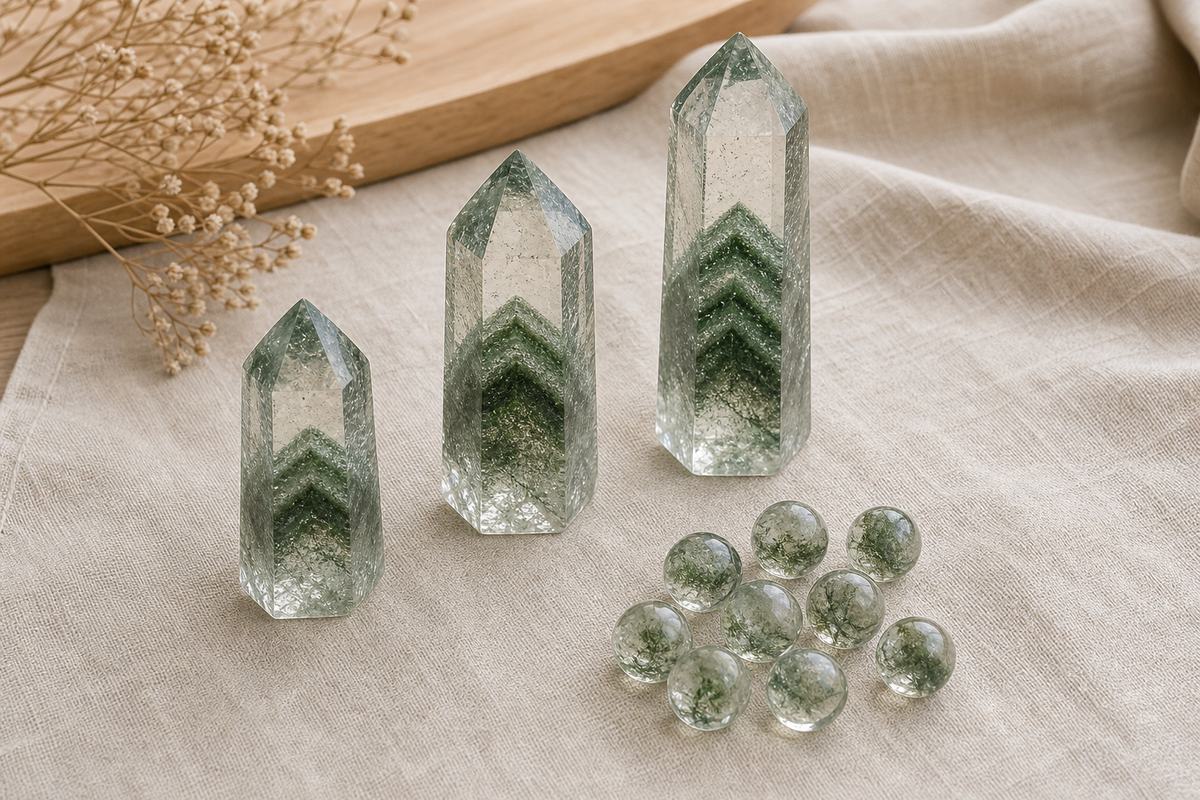
Green phantom quartz is a visual and trade name rather than a separate mineral species. The main mineral is quartz. The word phantom describes an internal outline that repeats the shape of an earlier crystal surface. When that outline appears green, the stone may look as if a mossy mountain, treasure basin, stepped pagoda, inner pyramid, or small ghost crystal is floating inside the larger crystal.

This is why Chinese retail often calls it green ghost crystal. The name is poetic, but it points to a real visual effect: the included layer is inside the quartz, not just painted on the surface. Fine particles may create misty green clouds; denser films may create crisp phantom outlines; layered growth may resemble a basin, terrace, thousand-layer mountain, or pyramid.
A uniformly green stone, dyed glass, green quartz without an internal outline, and scenic inclusion quartz without a clear phantom structure should be judged separately. Readers comparing quartz, jade, agate, and related materials can also use the Eastern Story Material Guide.
Mineral Facts: Composition, Structure, and Appearance
| Feature | Green phantom quartz | Why it matters |
|---|---|---|
| Main composition | Silicon dioxide, SiO2 | The host is quartz, even when the internal inclusion is green. |
| Crystal system | Trigonal; quartz crystals often show a six-sided, pseudo-hexagonal habit | The phantom may repeat an earlier crystal shape inside the larger crystal. |
| Hardness | Mohs 7 | Durable for many jewelry uses, while fractures, drill holes, and settings still need care. |
| Specific gravity | About 2.65 to 2.66 | Useful as part of gemological identification, especially against glass or resin imitations. |
| Refractive index | Common quartz range near 1.544 to 1.553 | Useful for gem testing when the stone is transparent enough. |
| Green inclusions | Often described as chlorite-rich; actinolite or other minerals may also be discussed | Appearance alone should be supported by testing for valuable pieces. |
| Visual forms | Pinpoints, clouds, mist, clumps, films, pyramids, basins, terraces, or mountain-like layers | The pattern is central to beauty, value, and meaning. |

The green color is usually uneven. It may shift from pale gray-green to moss, olive, forest green, or deep green, sometimes with white veils, gray patches, or darker mineral clusters. That unevenness is part of the appeal. A natural phantom often rewards movement: as the crystal turns, the inner layer appears to rise, recede, or change depth.
How the Green Phantom Forms
Green phantom quartz forms through interrupted and resumed crystal growth. Silica-rich hydrothermal fluids supply material for quartz crystallization. During a pause or change in conditions, green mineral material such as chlorite-rich particles may settle on the growing crystal face. Later, quartz growth resumes and encloses that marked surface inside the crystal.

Over long geological time, this process can repeat. One crystal may contain a single clear phantom; another may contain several stacked outlines. That is the source of the “thousand-layer mountain” feeling seen in some pieces. The phantom is not a separate crystal glued inside the quartz. It is a preserved growth stage, sealed by later quartz.
The most desirable specimens often balance transparency with strong internal scenery. Too many fractures can make the crystal look cloudy or unstable; too little inclusion can make the phantom hard to see. For jewelry, the best pieces are not always the most dramatic specimens. Wearability, comfort, and material disclosure matter as much as the inner landscape.
Green Phantom Quartz Meaning in Eastern Jewelry Symbolism
In modern Eastern crystal jewelry, green phantom quartz is commonly read as a symbol of steady growth. The older outline remains visible, but the crystal has grown beyond it. This makes the stone a natural image for progress after a pause, business built step by step, emotional steadiness under pressure, and a wider perspective on earlier life stages.

- Growth: the phantom layer shows that development can happen in stages rather than all at once.
- Renewal: green connects the crystal with spring, leaves, recovery, and fresh movement.
- Steady abundance: the layered structure suggests accumulation through effort, not sudden speculation.
- Focus: the inner mountain or basin gives the eye a quiet center, which makes it useful as a personal reminder.
- Emotional steadiness: many wearers choose green crystal jewelry for calm, balance, and a grounded daily ritual.
- Perspective: the smaller outline inside the larger crystal turns the past into part of a broader whole.
This meaning is best understood as cultural symbolism and emotional value in modern jewelry practice. The stone can carry a wish, a reminder, or a personal ritual. It should be presented with the same calm tone Eastern Story uses for other blessing objects: worn with intention, not expectation.
Is Green Phantom Quartz a Wealth Stone?
Green phantom quartz is often treated as a wealth stone in modern Eastern folk jewelry. In Chinese-language retail it may be nicknamed Gui Lao Cai Shen, and it is often linked with zheng cai, meaning regular or earned income: salary, bonuses, business revenue, client growth, and stable operating profit. This is different from a wish for sudden speculative windfall.
The symbolism comes from the stone’s form. Green suggests growth and fertile conditions, while the phantom layers suggest accumulation over time. For an office worker, it can represent steady career development. For an entrepreneur, it can represent building a foundation, keeping partners aligned, and noticing progress that happens gradually. For a gift, it can say: may your work grow with patience, clarity, and stable support.
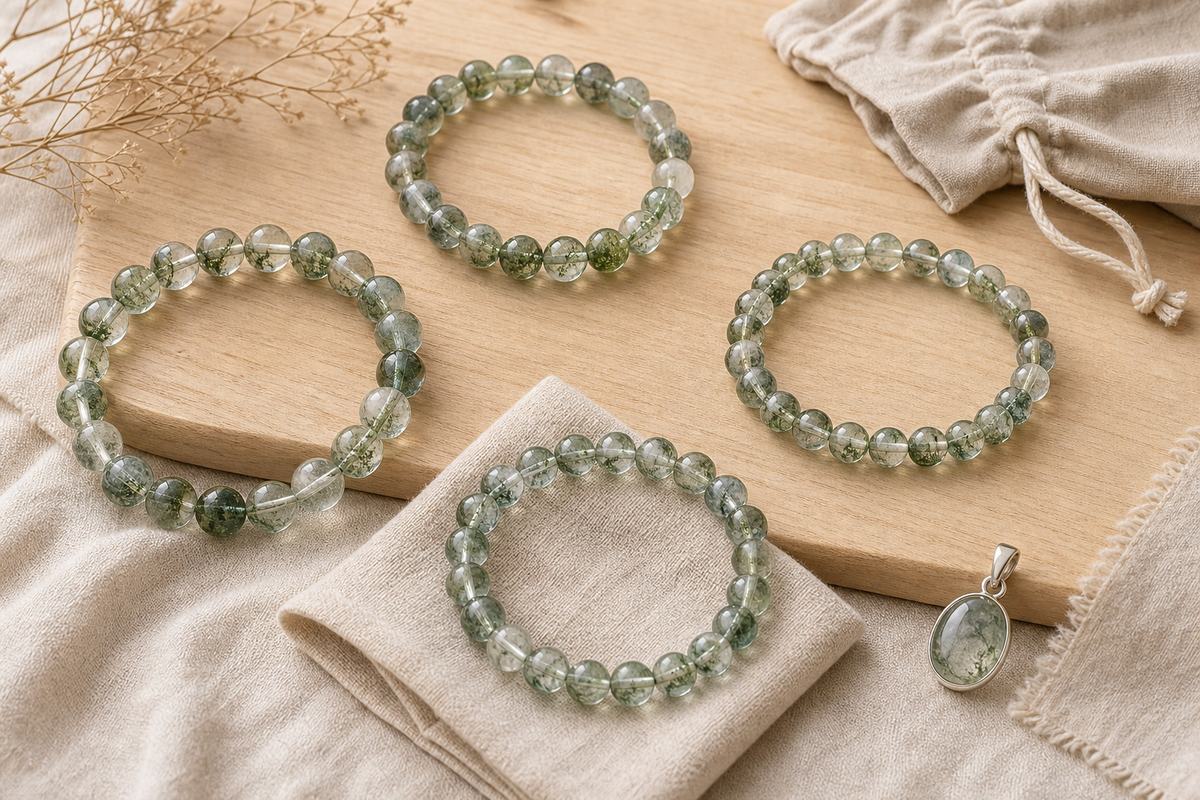
In everyday use, the wealth meaning works best as a practical emotional cue. A green phantom bracelet can remind the wearer to review finances, protect a business reserve, keep learning, follow up with clients, or stay steady during a demanding season. Readers interested in broader good-fortune jewelry language can continue with Eastern Story’s Good Luck Bracelet Meaning guide.
Green Phantom Quartz, Green Ghost Crystal, and Garden Quartz
| Name | What it usually points to | Buying note |
|---|---|---|
| Green phantom quartz | Quartz with a green internal phantom outline | Look for a crystal-shaped growth boundary inside the host quartz. |
| Green ghost crystal | A common retail name for green phantom quartz in Chinese crystal culture | Poetic name; still ask for material and treatment disclosure. |
| Garden quartz or lodolite | Quartz with scenic inclusions, clouds, plumes, or landscape-like scenes | May overlap with phantom quartz, but not every scenic inclusion is a phantom. |
| Chlorite quartz | Quartz where chlorite-group inclusions are present or claimed | Best used when the inclusion has been reasonably identified. |
| Green aventurine | A different quartz-family material with more even green body color and sparkle | Usually lacks a phantom crystal outline. |
| Moss agate | Chalcedony with branching, moss-like inclusions | Beautiful but structurally different from crystalline quartz with phantom growth. |

Retail names overlap, especially in beads and online listings. The safest habit is to describe what is visible: transparent or translucent quartz, green internal layer, basin-like inclusion, pyramid phantom, garden scene, or mixed mineral clouds. Accurate description protects the buyer and makes the stone’s story clearer.
How to Choose Green Phantom Quartz Jewelry
Choose according to use. For daily wear, 8 to 10 mm bead bracelets and simple pendants are practical because they show the green inclusions without becoming heavy. For a tighter budget, scattered “starry” inclusions or layered tower patterns can still be attractive. For collectors, transparent Brazilian-style specimens, basin-like scenes, pyramid phantoms, strong depth, and saturated green layers are often more desirable.
- Check the structure: look for internal depth, not only surface color.
- Compare color transitions: natural-looking green usually has variation, soft edges, clouds, points, or layered movement.
- Inspect clarity and fractures: some ice cracks and veils are normal, but severe instability affects durability.
- Ask for disclosure: dye, coating, fracture filling, assembly, heat, irradiation, laboratory growth, or imitation should be stated clearly.
- Review construction: drill holes, elastic, cord, clasps, prongs, bails, and metal quality affect daily wear.
- Use certificates thoughtfully: a report can support quartz identification, while inclusion naming may require more specific testing.

As a broad retail sorting frame, entry green phantom beads or common layered pieces may appear in the tens to several hundred RMB range in Chinese-market listings; better layered or partial-basin pieces may sit from several hundred to a few thousand RMB; large, transparent, strongly scenic collector specimens may climb much higher. Treat these ranges as a way to compare tiers, not as a universal price chart. Size, origin, cutting, pattern, transparency, treatment, seller reputation, and documentation all affect price.
Natural vs Imitation: Practical Signs to Check
| Check | Natural-looking green phantom quartz | Common warning sign |
|---|---|---|
| Color | Uneven green with natural transitions, clouds, points, or layered density | Flat, overly bright, perfectly uniform green |
| Inclusion depth | Internal layers change as the stone turns | Pattern looks printed, shallow, repeated, or fixed from every angle |
| Clarity | May include veils, ice cracks, growth lines, or small mineral particles | Too perfect for the claimed price and origin, or color gathered only in cracks |
| Touch and durability | Quartz feels cool at first and has Mohs hardness 7 | Soft resin, glassy imitation behavior, or easy surface marks |
| Documentation | Seller can provide clear photos, video, disclosure, and testing for expensive pieces | Vague certificate, no treatment statement, or refusal of independent testing |

For valuable material, visual checks should be supported by a qualified gemological or mineralogical opinion. GIA has reported laser-engraved phantom quartz imitations, which is a useful reminder that an apparent internal outline still deserves careful inspection under magnification and, when appropriate, additional testing.
Care and Everyday Wear
Green phantom quartz can be suitable for daily jewelry, but the whole piece matters: quartz, inclusions, fractures, cord, elastic, metal, adhesive, and surface finish. Clean most pieces with lukewarm water, mild soap, and a soft cloth or soft brush when the setting allows. Rinse carefully and dry fully before storage.

- Avoid impact: remove bracelets and pendants before heavy work, gym sessions, ball sports, or any activity where the piece may strike a hard surface.
- Limit chemicals: keep it away from perfume, harsh cleaners, strong acids or alkalis, chlorine, and abrasive powders.
- Be careful with water: brief cleaning is different from swimming or showering; water can weaken cords, elastic, glue, coatings, or metal parts.
- Avoid heat shock: sudden temperature changes can stress fractures or settings.
- Store separately: use a soft pouch or compartment so metal edges and harder gems do not scratch or chip the piece.
- Inspect regularly: check stringing, knots, clasps, prongs, and drill holes before regular wear.
The unrelated care rules for quartz watches, watch batteries, magnetic fields, water-resistance ratings, and quartz countertops belong to other products. For green phantom quartz jewelry, the useful care focus is simple: gentle cleaning, impact protection, chemical avoidance, heat caution, and separate storage. For mixed-material pieces, the Eastern Story Care Guide gives broader jewelry-care context.
A Meaningful Way to Wear or Gift It
The strongest way to wear green phantom quartz is to match the stone’s layered image with a specific intention. For work, it can symbolize patient career growth. For business, it can stand for stable revenue and careful foundations. For personal life, it can be a quiet companion for emotional steadiness, focus, and returning to center after a demanding period.
As a gift, green phantom quartz suits people entering a new job, building a business, rebuilding a routine, graduating into a new stage, or learning to value slow progress. The message can be simple: may your growth be steady, may your work gather strength, and may each stage become part of a larger story.

If you prefer finished symbolic jewelry rather than loose specimens, browse Eastern Story’s Blessing Shop for pieces organized around protection, harmony, clarity, strength, renewal, and good wishes. Choose the piece whose actual materials, construction, and story fit the wearer.
Frequently Asked Questions
Conclusion: A Stone of Visible Growth
Green phantom quartz is meaningful because its structure and symbolism support each other. As a mineral specimen, it records stages of quartz growth marked by green inclusions. As a modern Eastern jewelry symbol, it speaks to steady progress, earned abundance, calm focus, and the patience to let each stage become part of a larger story.
The best piece is the one whose inner landscape, material disclosure, construction, and message all feel clear. Choose the phantom you can actually see, the seller who explains it plainly, and the design that feels quiet enough to wear with intention in everyday life.
Related Posts


5 Comments