
Dyed bone beads carry the beauty of color and the warmth of a personal blessing: red for joyful protection, green for renewal, black for steadiness, blue for calm, honey tones for abundance, and cream for a clear, peaceful heart. These are welcoming meanings for contemporary jewelry and gifts. A strand can accompany a fresh beginning, celebrate a relationship, or hold a wish for peace and good fortune close to the wearer.
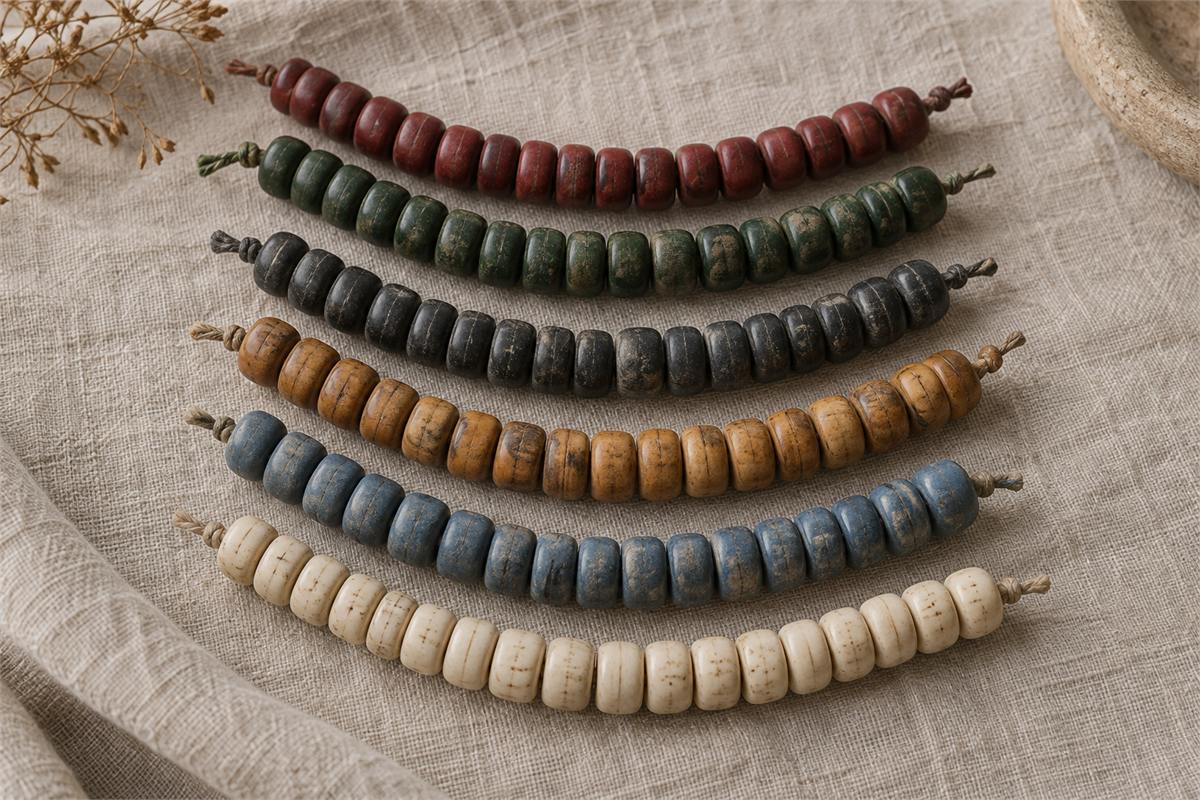
Dyed bone beads (染色骨珠) are animal-bone beads whose color has been deliberately added or changed. The bone can be genuine while the color is artificial. Clearly described dyeing is a creative treatment; passing newly colored beads off as naturally ancient or rare material is a different matter. Their appeal lies in the meeting of an organic surface, a maker’s color choices, and the story someone chooses to carry.
Six color families and the wishes they carry
In Eastern-inspired jewelry, color gives a blessing a visible form. The following readings offer a language for choosing and gifting a strand today. A maker’s own story or a particular religious community may give a color additional meaning.
| Color family | Modern blessing language | A meaningful moment |
|---|---|---|
| Red, burgundy, and vermilion | Joy, vitality, affection, and protective good fortune | A celebration, a loving gift, or a courageous new chapter |
| Green and deep forest green | Renewal, growth, harmony, and wishes for well-being | A fresh start or encouragement through change |
| Black and charcoal | Steadiness, quiet strength, and protection | A grounding companion or a gift of reassurance |
| Honey, yellow, and caramel | Warmth, abundance, wisdom, and continuity | A milestone or a wish for a flourishing life |
| Blue and indigo | Calm, spaciousness, clear intention, and a smooth path ahead | Encouragement before work, study, or a journey |
| White, ivory-toned, and cream | Clarity, simplicity, peace, and wholeness | A thoughtful beginning or an understated everyday blessing |
Red: celebration, connection, and a wish for protection
A deep red strand feels warm and alive. Red’s place in Eastern celebrations makes it a natural choice for a joyful occasion, a loving relationship, or a wish that someone stays safe and well. Burgundy and wine-red tones bring a quieter mood than a bright scarlet; both can carry affection and confidence. A gift can express “peace and may your wishes be fulfilled”—ping’an ruyi (平安如意)—in a color that feels close to the heart.

Green: renewal and a flourishing life
Green brings to mind leaves, new growth, and a landscape returning to life. A forest-green bracelet can welcome a fresh chapter or carry a wish for well-being and a life that continues to flourish. The contrast between a richly colored surface and small organic marks gives the strand its individual character. The hue is an aesthetic choice, separate from the animal species or age of the beads.

Black: quiet strength and a steady heart
Black gives a strand a composed, graphic presence. It is chosen to invite protection, inner steadiness, and the strength to keep one’s direction through busy or uncertain days. Pale spacers can sharpen that contrast; dark wood or metal can make the whole piece feel more restrained. A black bead and an ebony spacer may look harmonious while remaining different materials.

Honey and caramel: warmth, continuity, and abundance
Golden yellow and caramel tones suggest warmth, maturity, and the hope of a generous, fulfilling life. They suit a milestone gift or an object kept as a companion over many years. Bone can develop a yellow-brown surface with age, and makers can also deliberately create honey-colored finishes. Enjoy the warmth of the color while reading the treatment description separately from any claim about age.

Blue and cream: calm, clarity, and peaceful beginnings
Blue offers a spacious, restful mood: an open sky, still water, and room to breathe before the next step. It can carry encouragement for a new job, a course of study, or a journey. Cream and off-white keep the surface quieter, emphasizing rounded forms and gentle variations in the material. They are lovely choices for wishes of clarity and peace. An ivory-toned color describes appearance; bone and ivory are distinct materials.

Choosing a color that feels personal
The most memorable strand often connects a color to an actual moment. Choose red to celebrate someone you love, green to welcome change, black for reassurance, or blue for a calmer daily rhythm. A honey-colored strand can honor continuity; a cream strand can mark a simple, intentional beginning. These choices can be as personal as the words written in a gift card.

Pattern adds another layer. Stripes, carved details, contrasting spacers, and alternating colors can make the piece playful, contemplative, or quietly ceremonial. A patterned bead may be created by selective staining or a resist method that leaves parts of the surface lighter. Its design is best understood through the maker and the finished object. A familiar-looking stripe alone does not establish a named regional tradition.

What the bone and the added color each contribute
Bone has both mineral and organic components, with small channels and pores that can receive color. Cleaning and preparation, the density of the piece, the colorant, and a final coating all influence the appearance. Dye may enter the surface to different depths; paint and colored coatings may sit more visibly above it. Fine pits, lines, and uneven absorption can remain part of a finished bead’s texture.

Beads described as camel bone, yak bone, cattle bone, or sheep bone can be colored in similar ways. Species should come from the material description and reliable sourcing information. Resin, horn, wood, and bone can also be combined in one strand, so check the full composition rather than assuming every component is the same.
Dye, stain, coating, and an antiqued finish
Immersion dyeing and staining introduce color to the surface and its pores. Selective application or resist techniques create patterns. Paint, lacquer, wax, resin, and other coatings can change both color and gloss. Deliberate antiquing creates a worn or aged appearance on a newer object. These are broad treatment categories, and several may be used together; a seller’s description should identify the actual finish.
Plant-derived colorants can be part of a maker’s process, including tea-based stains or dyes associated with sappanwood and indigo. Their use should be described for the specific piece. “Natural” identifies an origin, rather than establishing skin compatibility, environmental performance, or resistance to fading. Synthetic dyes also vary widely. The finished formulation, fixing process, coating, and intended contact with skin matter more than a simple natural-versus-chemical label.
What does “Zhusha Gong” mean on red bone beads?
Red beads may be sold under the market name Zhusha Gong (朱砂供). Treat it as a name that needs a material and treatment description: the words alone do not establish that cinnabar was used. Nor do they establish long contact with a red robe, monastic ownership, or a particular blessing ceremony. A modern red strand can carry a beautiful wish for protection and connection through its own color and story.

Similarly, names evoking ancient green beads or labor-intensive red finishes describe a seller’s presentation unless accompanied by the object’s actual history and process. A green surface does not date a bead to an ancient dynasty, and deep red does not reveal how many treatment cycles it received. For the wider cultural setting, Tibetan bone jewelry includes varied objects and uses; a decorative bracelet, a prayer strand, and a ritual ornament each deserve their own explanation.
How to understand a colored strand before buying
Start with the feeling that drew you to it, then ask a few clear questions about the object. Honest answers help the color and meaning remain enjoyable after the first impression.
- What animal material is named, and are any beads or spacers made from something else?
- Is the strand dyed, stained, painted, antiqued, coated, or a combination?
- What finish touches the skin, and what care does the maker recommend?
- Do photographs show the holes, edges, recesses, and the entire strand?
- Is an antique or religious history being claimed, and what supports that specific history?
- What are the return arrangements if the finish transfers color or differs from the description?
Observe rather than experiment. Saturated color, very even beads, dark pores, or color gathered near a hole can prompt a question about treatment. They cannot by themselves identify the dye, its ingredients, a metal content, or the animal. Pale areas and natural-looking variation are also insufficient to establish that a bead is untreated.

Strong odor, stickiness, flaking, or color rubbing off during ordinary handling is a reason to stop contact and speak with the seller. Smell and transfer do not identify a chemical formula. If a rash or irritation develops, remove the jewelry and seek medical advice when needed; a reaction may involve a colorant, a coating, a metal component, or something else in contact with the skin.
Consider whether the recipient is comfortable with animal-derived jewelry. Choose clearly identified, responsibly sourced material, and check applicable wildlife and import rules before buying or carrying animal products across borders. Requirements depend on the species, origin, destination, and transaction.
How dyed bone beads change with wear
Part of the pleasure of a treasured strand is watching its surface become familiar. Gentle use may soften a gloss or bring subtle changes in tone. Collectors use baojiang (包浆), or patina, for the surface character that develops through time and handling. On dyed beads, that character also reflects the original coloring and any coating.
Several changes are possible. Raised areas and hole edges may lighten through friction while recesses stay dark. Light can fade sensitive colorants. A coating may lose gloss, scratch, or begin to peel. Deposits from handling may make a surface look darker or cloudier. The direction and speed of change depend on the particular bead and finish, so there is no universal sequence from pale to dark or from opaque to a jade-like appearance.

A gentle, stable change can become part of a personal story. Persistent transfer, a sticky surface, crumbling areas, or new cracks calls for advice rather than more rubbing. Dark marks inside a pore are not a reliable way to diagnose heat treatment, decay, species, or age, and digging into them can damage the bead.
Gentle care that respects the color
Follow the maker’s guidance for the specific coating. For ordinary dust, lightly wipe an intact surface with a soft, dry cloth. Keep the strand away from soaking, strong sunlight, heaters, and abrupt environmental changes; remove it before bathing or swimming. Store it separately in a clean, padded container, away from materials that shed color.

Leave alcohol, toothpaste, abrasive scrubbing, bleach, and immersion tests out of home identification. They can alter the finish without answering what the bead is made from. Avoid routine applications of cooking oil, baby oil, or other conditioning products unless the maker or a qualified conservator has recommended a treatment for that object. Added oils and moisture can change a colored surface.
If water splashes onto the strand, gently blot it with a soft cloth and allow it to dry away from direct heat. For staining, whitening, flaking, or a crack, consult the maker or a conservator before attempting repairs. A short daily handling ritual can be enjoyable, but the finish does not require a fixed number of minutes, a glove schedule, or alternating days of rubbing and storage.
Frequently Asked Questions
A color to carry, a blessing to keep
A colored bone strand can hold the warmth of a gift, the pleasure of a beautiful surface, and a wish for days filled with peace and possibility. Choose a color that speaks to your own story, and let clear material descriptions support that connection. Explore the Eastern Story Blessing collection for meaningful objects chosen to carry care, hope, and good fortune.
Related Posts


