
Carnelian and onyx both belong to the chalcedony family, yet they tell very different visual and emotional stories. Carnelian is usually translucent orange, red, or reddish brown, with warmth distributed through the stone. Onyx, in gemological use, is chalcedony with approximately parallel bands; in modern jewelry, the name is also widely applied to uniformly black chalcedony, much of which has been dyed. Carnelian is often chosen to welcome courage, creative energy, and a confident beginning. Onyx carries a wish for steadiness, protection, focus, and peace. The most useful comparison brings together color, banding, translucency, treatment, jewelry design, and the intention you want the piece to accompany.

Both materials are microcrystalline quartz, commonly described as chalcedony, and sit around 6.5–7 on the Mohs scale. Their shared composition explains why their basic durability overlaps, yet it does not make the names interchangeable. In Chinese-language jewelry markets, red agate Hong Manao (红玛瑙) can overlap with carnelian in retail speech, so a useful description should still address color, translucency, banding, and treatment. Carnelian’s identity is led by its orange-to-red body color. Classical onyx is led by its layered structure. Black retail onyx adds a market convention worth understanding before choosing a piece for its beauty or meaning.
Carnelian vs onyx at a glance
| Question | Carnelian | Onyx |
|---|---|---|
| Defining appearance | Orange to red or brownish-red chalcedony | Chalcedony with straight, parallel bands; commonly sold in black |
| Typical light behavior | Translucent at thin edges or throughout | Varies; black material often appears opaque |
| Pattern | Usually even, cloudy, or softly zoned | Parallel layers are the classical feature |
| Frequent treatment | Heating and dye may deepen orange-red color | Dye commonly creates even black color |
| Visual mood | Warm, lively, sunlit | Graphic, restrained, architectural |
| Best buying question | Is the color natural, heated, or dyed? | Is it banded onyx, dyed black chalcedony, or another black material? |
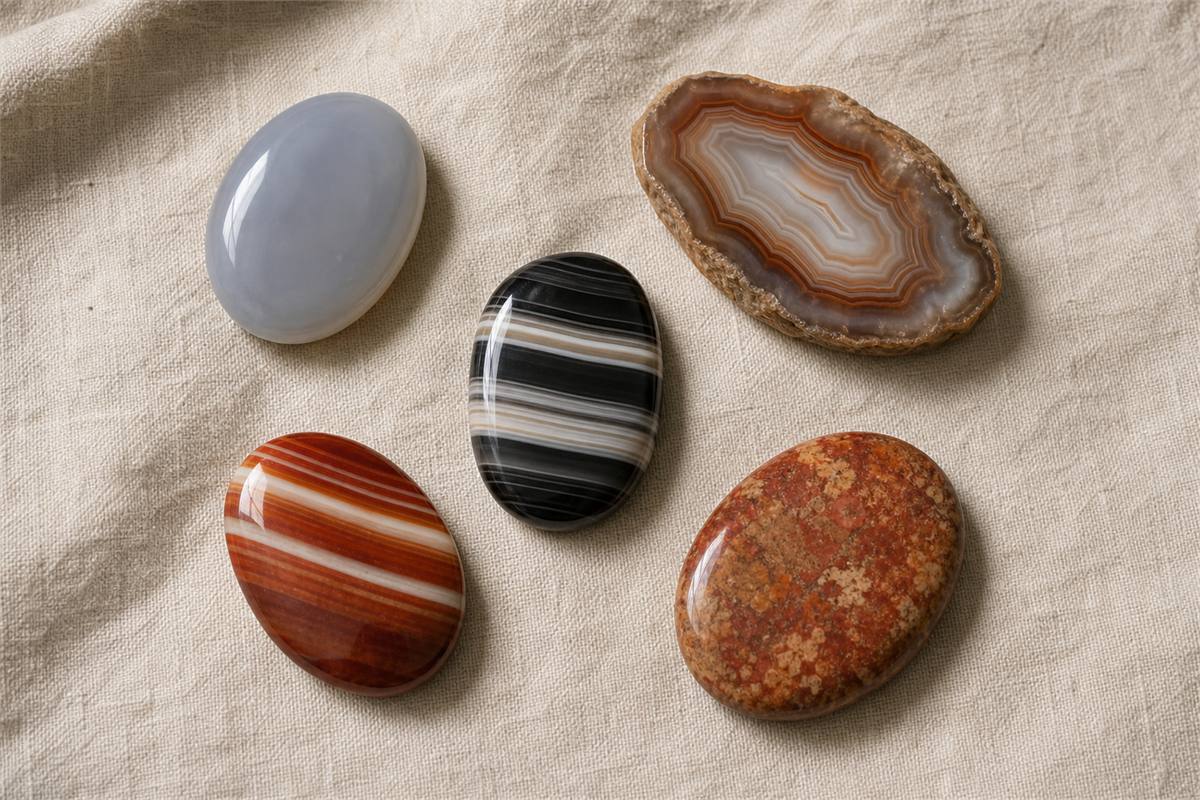
The comparison becomes clearer when agate and sardonyx enter the picture. Agate is chalcedony with recognizable banding or organized pattern. Sardonyx combines sard—brownish-red chalcedony—with contrasting onyx-like bands. A reddish stone with strong white parallel layers may therefore be described more precisely as sardonyx than as plain carnelian.
Why the names overlap in stores
Gem names develop through mineralogy, historical use, and retail habit. Classical onyx refers to parallel-banded chalcedony, often black and white or brown and white. Today, “black onyx” commonly means black-colored chalcedony even when its bands are hidden or absent. Some sellers also apply the name to black glass, coated material, or other dark stones. Carnelian has a more stable color range, but listings can still blur it with red agate, sard, heated agate, and dyed chalcedony.

For a material-first explanation of these relationships, Eastern Story’s chalcedony guide maps the broader family, while the agate guide explains bands, varieties, and treatments. The important point for a buyer is simple: a trade name begins the investigation; it does not finish it.
How to compare carnelian and onyx in your hand
Use neutral light before using a loupe
Place the stone near a window without direct sun and examine the face, edge, back, and drill holes. Carnelian often glows orange-red at thinner areas. A dark bead may look nearly opaque face-on but reveal warm translucency around its hole. Uniform black onyx may remain visually dense, although thin edges can still transmit light. Lighting alone is a clue, not a laboratory conclusion.

Look for the pattern that supports the name
Rotate the object and notice how its pattern continues into depth. Approximately parallel layers support an onyx or sardonyx description. Curving fortification bands suggest another agate variety. Soft, cloudy orange-to-red color without a dominant parallel pattern fits carnelian more comfortably. These are naming clues rather than a formula for proving natural origin: color, banding, bubbles, drill holes, fractures, weight, touch, sound, fluorescence, and transmitted light cannot individually confirm treatment, provenance, age, or value.

Inspect color concentration
Dye can sometimes collect in fractures, pores, drill holes, and pale zones, yet treatment may also be visually subtle. Heating can strengthen warm carnelian color without leaving an obvious line. Dyeing, heating, impregnation, filling, reconstructed material, glass, and resin are different conditions and should not be collapsed into one category. Treatment disclosure helps a reader compare like with like, while destructive household tests can damage polish, thread, adhesive, and settings without producing a dependable answer.

Which one is better for jewelry?
Choose by wish, design, and construction rather than by a universal ranking. Carnelian brings visible warmth to gold-toned metals, red cord, wood, and cream textiles. Its translucency rewards cabochons, beads, and carvings that allow light to enter, making it a natural companion for a new venture, a creative milestone, or a gift of encouragement. Black onyx creates strong contrast with silver, gold, white metal, pearls, or clear stones. Its clean outline suits seals, signet rings, graphic pendants, cameos, and restrained bead strands chosen to invite composure and protection.

- For a ring, examine edge chips, backing, adhesive, and pressure from prongs or bezel walls.
- For beads, check centered holes, fresh chips, matching, cord abrasion, and whether color gathers inside drilling.
- For a carving, judge polish and thin projections as carefully as color.
- For a premium natural-color claim, ask for a clear written description of any known heating, dyeing, filling, coating, or reconstruction.
- For everyday wear, choose a setting that protects exposed edges and remove the piece before impact-heavy work.
The carnelian material guide goes deeper into color, history, quality, and care. If your interest is specifically a black bead bracelet, the black agate and black onyx guide addresses size, construction, identification, and buying language.
Carnelian and onyx meaning: warm movement and quiet protection
Carnelian’s fiery orange-red palette is widely associated with initiative, creative momentum, confidence, and the willingness to begin. In East Asian color language, red can carry joy, vitality, celebration, and auspicious intent. A carnelian gift can express encouragement for a new project, a courageous decision, or a return to joyful participation in life. In contemporary crystal culture it may also be linked with lower-chakra language, but its most accessible story is the warmth of action: a bright reminder to move toward what matters.
Onyx is commonly framed through steadiness, restraint, focus, resilience, and clear boundaries. Its visual strength comes from simplicity: a dark surface or layered pattern that holds a clean outline. It is worn to invite a settled mind and a sense of being quietly held through demanding seasons. When carnelian and onyx appear together, the pairing tells a nuanced story—warm action balanced by composure, creative energy held within deliberate limits, and courage accompanied by peace. For a graduation, career change, creative launch, or personal reset, the two can carry a wish for ping an ru yi (平安如意): peace, safety, and life unfolding in harmony.

What shapes carnelian and onyx price?
Size, translucency, banding, evenness, fracture condition, cut, matching, carving, setting, and treatment all influence value. An ordinary dyed black chalcedony bead should not be priced as an exceptional rare mineral merely because it carries the onyx name. Likewise, vivid carnelian can be beautiful and wearable whether heated or natural-color, but the description should let buyers compare like with like.

- Ask for the seller’s exact material name and treatment statement.
- View the exact item rather than relying only on representative photography.
- Compare edges, backs, drill holes, and several beads from the same strand.
- Separate the value of the stone from the value of metal, carving, setting, and brand work.
- For a significant purchase, read the description and return terms before deciding whether the whole piece—stone, setting, craft, and story—feels right for you.
Care for both as finished jewelry
Chalcedony is relatively durable, but a finished piece may include dye, filling, coating, elastic, adhesive, delicate carving, stringing material, prongs, or soft metal. Wipe it after wear with a soft cloth; when more cleaning is needed, use brief contact with lukewarm water and a small amount of mild soap, then rinse carefully and dry thoroughly. Keep the jewelry away from high heat, sudden temperature changes, bleach, acids, solvents, cosmetics, and hard impacts. Skip prolonged soaking and oil-based home treatments, and do not treat ultrasonic or steam cleaning as universal choices. Store it separately and check bead holes, cord, clasps, prongs, and links from time to time.

Eastern Story’s jewelry care guide uses the most sensitive component as the cleaning limit. That approach protects both stones equally well: identify the object first, then care for the whole object rather than relying on one hardness number.
Choose the story you want to carry
Carnelian is the clearer name for orange-to-red chalcedony whose identity is led by warm body color; onyx is the gemological name associated with approximately parallel-banded chalcedony and, by modern retail convention, much black chalcedony. Choose carnelian when you want warmth, courage, creativity, and the feeling of a bright beginning. Choose onyx when you want calm contrast, order, resilience, and quiet protection. Worn together, they can become a small daily companion for moving forward without losing your center—a wish for confident action, harmonious boundaries, and all things going as hoped.

Frequently Asked Questions
Related Posts


