
A good jade bangle guide starts with material, not color alone. Jadeite and nephrite are different mineral aggregates, while Xiuyan jade, Dushan jade, chalcedony, quartzite, serpentine, glass, and resin belong to different material categories. After identifying what the bangle is sold as, compare its color, luster, structure, fractures, dimensions, wall thickness, finish, treatment, and return terms.
The Chinese word yu (玉) can describe a broader cultural family of beautiful, workable stones than the mineralogical use of “jade” in English. That wider tradition is important, but it should not erase material differences. A well-made chalcedony or Xiuyan bangle can be attractive and meaningful in its own right; it does not need to be presented as jadeite.
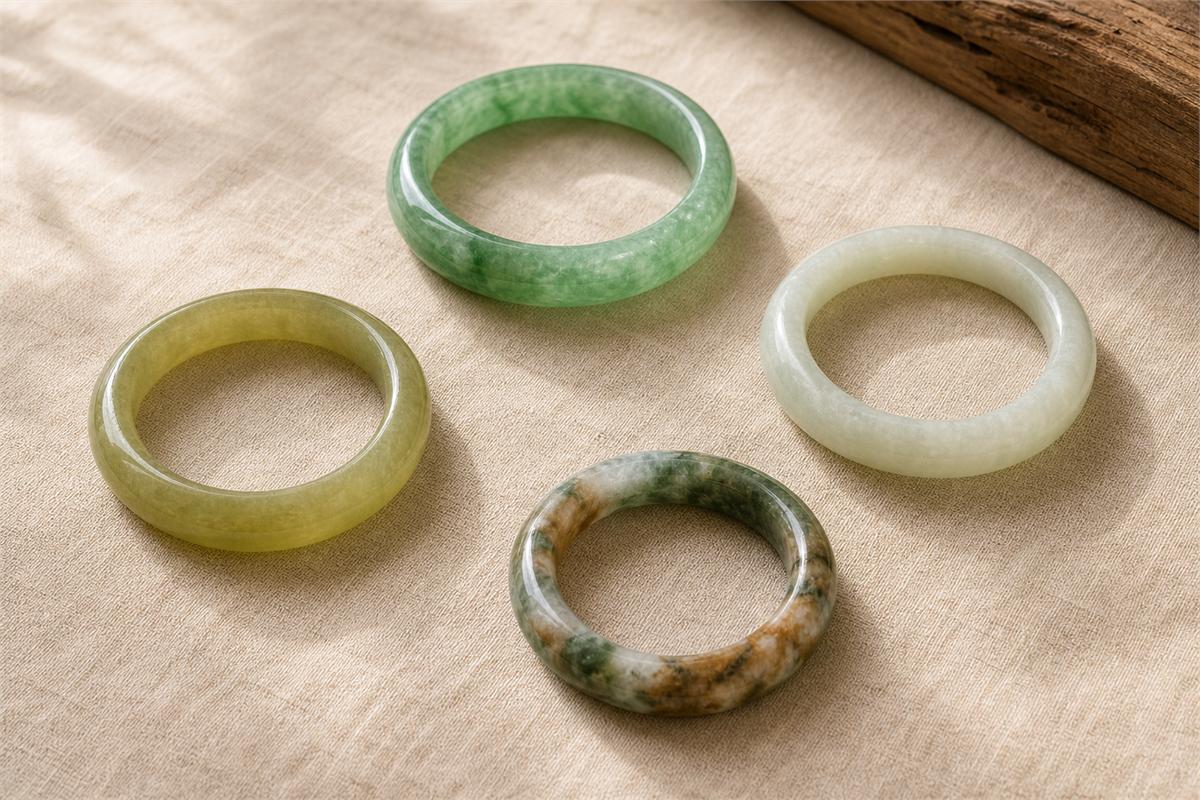
Jade bangle materials at a glance
| Material | Typical appearance | What buyers should know |
|---|---|---|
| Jadeite | Glassy to soft vitreous luster; opaque to semitransparent; green, lavender, white, yellow, red, black, and mixed colors | Color, transparency, texture, fractures, proportion, polish, and treatment strongly affect price. See the focused jadeite guide. |
| Nephrite | Often waxy, greasy, or softly polished; commonly white, cream, green, gray, brown, or black | Fine texture, even color, usable size, fractures, craftsmanship, and market origin claims all matter. |
| Xiuyan jade | Often green, yellow-green, white, or translucent with a waxy to vitreous surface | A broad commercial category commonly associated with serpentine-rich material; the Xiuyan jade guide evaluates it on its own terms. |
| Dushan jade | Frequently multicolored, mottled, or patterned | A distinctive carving and jewelry stone, not mineralogically identical to jadeite or nephrite. |
| Chalcedony | Fine-grained, often translucent; available in white, gray, blue, red, green, and dyed colors | A quartz material with its own appearance and market; agate is a banded variety of chalcedony. Read the separate chalcedony guide. |
| Quartzite | Granular to compact, often white or green, with a vitreous surface | May be sold under many trade names; the sales name should not imply jadeite or nephrite. |
| Serpentine | Commonly green, yellow-green, or creamy with a waxy feel | Often softer and more scratch-sensitive than jadeite; some Xiuyan material is serpentine-rich. |
| Calcite-rich material | White or pale, sometimes marketed as “Afghan jade” | Usually a carbonate material rather than jadeite or nephrite; acids and abrasion require extra caution. |
| Glass or resin | Can imitate vivid color, translucency, or an unusually uniform surface | Imitation materials. Bubbles or mold marks may appear, but their absence proves nothing. |
“Water-mo” or shuimo material is also more complicated than the phrase “jadeite companion mineral” suggests. The market name is commonly associated with albite-rich material, but it is not a simple synonym for jadeite or for every stone found near jadeite deposits. Judge the named material rather than relying on a story about geological association.

Common jade bangle types and shapes
Round, flat, and oval profiles
A round-bar bangle has a circular or near-circular cross-section. It feels substantial, but the inner curve concentrates more material around the wrist. A flat-bar bangle has a flatter inner face and a broader visible outer surface, which can distribute contact more comfortably. An oval or “princess” bangle follows the shape of the hand and wrist more closely, so orientation matters when putting it on.

Plain, carved, hinged, and sectional bangles
A plain hololith bangle is cut from one piece of material and exposes color, texture, polish, and fractures clearly. Carving can create expressive floral, cloud, dragon, or abstract details, yet deep relief also creates thinner high points and recesses that collect residue. Hinged or sectional designs improve access for some wrists but add metal fittings, joints, solder, adhesives, or moving parts that require separate inspection and care.

Thin walls feel light and can make translucent material look brighter; thicker walls feel more substantial and generally leave more material around minor surface features. Neither is automatically better. A thin or deeply carved bangle has less material to absorb an impact, while a very wide or thick one may interfere with wrist movement, sleeves, desks, and daily work.
Color, luster, texture, and transparency
Jadeite may have a bright vitreous luster, but it can also look softer depending on texture and polish. Nephrite is often appreciated for a waxy or gently greasy luster and fine interlocking structure. Xiuyan jade, chalcedony, Dushan jade, quartzite, and serpentine each reflect and transmit light differently. This is why one jadeite “water” vocabulary should not be applied to every bangle.

View color beside a neutral white or gray background in indirect daylight. Rotate the bangle and compare the outer face, inner rim, and sidewall. Look for attractive transitions as well as abrupt concentrations along pits, seams, or fractures. Even color can be natural, treated, or manufactured; uneven color can be natural, treated, or simply part of the design. Color distribution is an observation, not a final identity test. The jade colors guide explores color across materials without turning hue into material identity.
Fine texture can create smoother reflections, while a coarser aggregate can look granular or cloudy. Transparency ranges from opaque to semitransparent across many materials. In jadeite, color, transparency, and texture are major quality factors, but nephrite places greater emphasis on fineness, evenness, luster, color, and carving suitability. Natural material may contain inclusions or fractures, yet a clean-looking bangle is not automatically an imitation and visible inclusions are not mandatory.
Color alone cannot establish geographic origin. Whiteness, oil-like luster, translucency, apparent grain under a phone light, or a seller’s regional stereotype cannot reliably separate material from Xinjiang, Russia, Qinghai, Korea, or another source. Origin and market history can influence price, but they require more than a visual shortcut.
Polish and craftsmanship: what to inspect
High polish creates stronger, sharper reflections. Soft polish and matte finishes scatter light and can suit quieter designs or materials with a waxier visual character. One finish is not universally superior, and a bright surface is not automatically hiding flaws. Terms such as “cold polish,” “hot polish,” and “ice polish” do not have one fixed meaning across every workshop, material, and market.

- Reflection: rotate the bangle and watch whether reflected lines flow smoothly or break into distracting waves.
- Pits and drag marks: inspect the inner rim, outer curve, and carved recesses for unfinished points.
- Edges: the opening should feel comfortable, without sharp ridges or abrupt transitions.
- Roundness and symmetry: compare the circle or oval from several angles.
- Consistency: check whether bar width and wall thickness change unexpectedly.
- Carving: look for clean joins, intentional depth, readable details, and no fragile projections.

A coating may be decorative, protective, or used to alter surface appearance. The important buying issue is accurate description and suitable care, not the assumption that every coating has the same purpose. Likewise, wax finishing, dye, bleaching, polymer impregnation, and surface coating are different interventions and should not be collapsed into one label.
How to choose the right inner diameter, width, and thickness
Inner diameter is the distance across the opening, measured from inside edge to inside edge. Bar width describes how broad the bangle appears across the wrist, while bar or wall thickness describes its depth. Sellers sometimes use “width” and “thickness” inconsistently, so match every number to a diagram or photograph.

Measure the widest part of the compressed hand, not only the wrist. Knuckle shape, thumb mobility, swelling, hand dominance, and personal comfort change the result. A size chart is a starting point; the final choice must follow the wearer’s actual hand shape and a careful try-on. An oval bangle can fit differently from a round bangle with the same quoted inner diameter. After fit, use the separate left-or-right wrist guide to plan comfortable daily wear.
For daily wear, consider desk contact, sleeve clearance, watches, rings, caregiving, tools, sports, and household tasks. Wider and thicker bangles may feel secure but can be cumbersome. Narrower and thinner bangles are lighter but may be more vulnerable to impact. Carved high points can catch fabric, and existing fractures increase breakage risk regardless of hardness.

Durability: hardness is not impact resistance
Hardness describes resistance to scratching; toughness describes resistance to breaking. Jadeite and nephrite are known for interlocking structures and strong toughness, yet a finished bangle remains a rigid ring exposed at the wrist. Tile, stone counters, metal edges, and doorframes can deliver a concentrated blow. Thin walls, open fractures, sharp carving, repaired sections, and drilled or hinged areas increase risk.

Remove a bangle before impact-heavy work, strength training, contact sports, moving furniture, or any task where the wrist may be trapped. Do not stack it directly against diamonds, abrasive stone beads, or hard-edged metal jewelry. A soft spacer or separate wrist reduces rubbing and repeated knocks.
What determines jade bangle price?
Price is shaped by material, color, transparency or fineness, texture, fractures, size, bar width, wall thickness, craftsmanship, treatment, stated origin, seller market, and current demand. A large hololith bangle consumes more usable rough than a small pendant, while vivid color or high transparency can amplify the value of fine jadeite. Nephrite, Xiuyan jade, chalcedony, quartzite, and Dushan jade follow different quality traditions and should not be forced into a jadeite-only ladder.

Practical dollar bands for nephrite bangles
A useful shopping ladder for nephrite bangles is under $1,000, $1,000–$3,000, $3,000–$6,000, and $6,000–$10,000. Moving upward should bring a visible combination of finer texture, more desirable color, fewer durability-relevant fractures, better proportion, and stronger workmanship. A regional name by itself is not enough to justify the step.
Common jadeite market bands
In jadeite retail language, broad texture-and-transparency bands are often priced as follows: bean-texture bangles at $500–$3,000, glutinous-texture bangles at $4,000–$20,000, glutinous-ice bangles at $50,000–$100,000, ice-texture bangles at $100,000–$500,000, and glass-like bangles above $800,000. These terms belong to jadeite market practice, not to every material called yu. Within any band, color, fractures, dimensions, thickness, polish, treatment, and seller market can change the price sharply.
Buy the actual combination of qualities you can see and use. A saturated green bangle with poor proportions or an open fracture may be less suitable than a quieter piece with an even wall and excellent finish. Thin cutting can increase apparent translucency, so always compare the side profile and measurements before comparing price.
A safe, non-destructive buying inspection
- Confirm the sales name. Ask whether the bangle is jadeite, nephrite, Xiuyan jade, Dushan jade, chalcedony, quartzite, serpentine, calcite-rich stone, glass, resin, or another material.
- Read the treatment description. Separate dyeing, bleaching, polymer impregnation, coating, waxing, assembly, repair, and synthetic or imitation construction.
- Inspect indirect daylight views. Request the full circle, both sidewalls, inner rim, outer face, and a slow rotation against a neutral background.
- Examine with modest magnification. Look for fractures, chips, pits, polish drag, color concentration, repaired zones, joints, and worn coatings.
- Check every dimension. Match inner diameter, bar width, thickness, profile, and weight to the exact item.
- Compare structure and price. Make sure the material, visual quality, construction, and asking price tell a coherent story.
- Review returns. Size-sensitive rigid bangles need clear return timing and condition rules.

Luster, cool touch, hand weight, tapping sound, phone-light appearance, ultraviolet fluorescence, estimated density, bubbles, orange-peel texture, and etched-looking networks can each prompt a closer look. None can independently establish natural origin, exact material, geographic source, or treatment. Glass may have no visible bubbles; natural stone may look very clean; treated jadeite may show weak or variable visual clues.

Do not scratch with a knife, strike the bangle, suspend and collide it with another bangle, burn it, apply alcohol to search for dye transfer, or expose it to acids or other chemicals. These tests can harm the surface, weaken an existing fracture, damage a coating or filling, and still produce an ambiguous result.
Jadeite A, B, and C terminology
A, B, and C terminology belongs mainly to the jadeite trade. A jadeite generally means natural jadeite or jadeite with traditional surface waxing; B jadeite refers to material bleached and impregnated with polymer; C jadeite refers to dyed material; B+C combines impregnation and dyeing. These labels should not be copied automatically onto nephrite, Xiuyan jade, chalcedony, quartzite, or every stone sold under the cultural umbrella of yu.

Treatment and imitation are also separate ideas. A dyed or polymer-impregnated jadeite bangle is still based on jadeite material, while glass and resin are imitation materials. Quartzite, chalcedony, serpentine, Dushan jade, and calcite-rich stone are genuine materials when sold under their correct names. Value depends on disclosure, appearance, workmanship, wearability, and market demand rather than a blanket “real versus fake” verdict.
Care by material and construction
For every bangle, avoid hard impact, abrasive contact, extreme temperature changes, strong acids or alkalis, bleach, and scouring products. Clean with warm water, a soft cloth, or a very soft brush, then rinse and dry thoroughly. Mild soap can be used when the construction and surface treatment allow it.

- Solid untreated jadeite or nephrite: gentle hand cleaning is the safest routine; keep away from impact and harder jewelry.
- Serpentine-rich, calcite-rich, or softer stones: take extra care with scratching, acids, and abrasive cleaners.
- Dyed, coated, or polymer-treated pieces: avoid heat, solvents, steam, and aggressive cleaning that can affect the treatment.
- Hinged, inlaid, repaired, or glued bangles: keep joints dry after cleaning and avoid ultrasonic cleaning unless every component and adhesive is known to tolerate it.
- Carved bangles: use a soft brush in recesses and dry grooves carefully.
Routine soaking, sealed “hydration,” a nearby cup of water, and oiling are unnecessary general practices. Body oil may change surface appearance temporarily, but it does not rebuild the internal structure. Store the bangle clean and dry in a padded compartment where it cannot strike other jewelry. Eastern Story’s jewelry care guide and material guide provide broader everyday guidance.
Meaning, gifting, and common misconceptions
Jade bangles have long been worn as objects of beauty, family connection, personal refinement, and blessing in Eastern life. Their circular form can suggest continuity and wholeness, while a piece passed between generations can carry memories beyond its market price. These are cultural meanings and personal associations, not physical effects produced by the stone.

Wear does not transform a coarse internal structure into a fine one. Surface contact, cleaning, skin oils, and lighting can change how luster appears, but they do not turn one mineral aggregate into another. A bangle also cannot be expected to preserve value or appreciate simply because it is called jade. Condition, material, treatment, design, provenance, demand, and resale context all matter.
For a gift, confirm the recipient’s inner diameter, preferred profile, daily activities, color taste, and comfort with a rigid bracelet. Explore the jade meaning guide for broader symbolism or the Blessing collection for pieces chosen around intention and story.
Frequently Asked Questions
Related Posts


