
Five Elements Snake meaning involves three related but different systems. The Earthly Branch for the Snake is Si (巳), which is conventionally associated with yin Fire. A Snake year is also paired with a Heavenly Stem, producing the familiar Wood Snake, Fire Snake, Earth Snake, Metal Snake, and Water Snake labels. Na Yin (纳音) is a third classification within the 60-year cycle, and its element may differ from the Heavenly Stem label.
This distinction explains a common puzzle: 2025 is a Wood Snake year because Yi (乙), its Heavenly Stem, belongs to Wood, yet the Na Yin for Yi-Si (乙巳) is Fudeng Huo (覆灯火), or Lamp Fire. Both descriptions can appear in traditional calendars, but they answer different questions. This guide separates them before exploring traditional combinations, color and material symbolism, and practical ways to choose a snake-shaped bracelet or gift.
Five Elements Snake Meaning at a Glance

| Layer | What it describes | Snake example | How to read it |
|---|---|---|---|
| Earthly Branch element | The conventional Five Phases association of the branch | Si (巳) is yin Fire | This is the base branch correspondence for the Snake. |
| Heavenly Stem year element | The element of the stem paired with Si in a given year | Yi-Si is Wood Snake; Ding-Si is Fire Snake | This creates the five common elemental Snake year labels. |
| Na Yin | A separate named classification assigned to each stem-branch pair | Yi-Si has the Na Yin Fudeng Huo (覆灯火) | Do not substitute it for the Heavenly Stem label or the branch element. |
Wu Xing (五行) is often translated as the Five Elements, although “Five Phases” better conveys a system of movement and relationship: Wood, Fire, Earth, Metal, and Water generate and regulate one another in traditional cosmology. Zodiac pages often simplify that system to a single year label. The simplification is useful for finding a year, but it becomes misleading when “Wood Snake” is presented as if it were the Snake’s branch element, a complete personal chart, and the year’s Na Yin all at once.
Why the Earthly Branch Si Is Associated With Fire
The Snake is represented by the sixth Earthly Branch, Si (巳). In the conventional branch-to-phase table, Si belongs to yin Fire. Traditional calendrical correspondences also connect Si with the two-hour period from 9:00 to 11:00, the southeast, and the opening of summer in the seasonal cycle. These are components of an old timekeeping and correlative system, not a scientific personality profile.

The Fire association remains the branch’s base layer even in a Wood Snake, Earth Snake, Metal Snake, or Water Snake year. In other words, calling 2025 a Wood Snake does not turn Si itself into Wood. It means a Wood Heavenly Stem is paired with the Fire-associated Si branch. Readers who want the wider animal cycle, traditional imagery, and year list can continue with the Year of the Snake guide or the broader Eastern zodiac overview.
The Five Elemental Snake Years and Their Na Yin

| Common year label | Ganzhi | Common example years | Heavenly Stem element | Na Yin |
|---|---|---|---|---|
| Wood Snake | Yi-Si (乙巳) | 1965, 2025 | Yi (乙): yin Wood | Fudeng Huo (覆灯火), Lamp Fire |
| Fire Snake | Ding-Si (丁巳) | 1917, 1977, 2037 | Ding (丁): yin Fire | Shazhong Tu (沙中土), Earth in Sand |
| Earth Snake | Ji-Si (己巳) | 1929, 1989 | Ji (己): yin Earth | Dalin Mu (大林木), Great Forest Wood |
| Metal Snake | Xin-Si (辛巳) | 1941, 2001 | Xin (辛): yin Metal | Baila Jin (白蜡金), White Wax Metal |
| Water Snake | Gui-Si (癸巳) | 1953, 2013 | Gui (癸): yin Water | Changliu Shui (长流水), Long-Flowing Water |
The pattern repeats every 60 years. That is why 1965 and 2025 are both Yi-Si Wood Snake years, while 1977 and 2037 are both Ding-Si Fire Snake years. The label “Fire Snake” in this table comes from Ding Fire, even though the pair’s Na Yin is Earth in Sand. Likewise, an Earth Snake year has Great Forest Wood as its Na Yin, and a Metal Snake year has White Wax Metal. The overlap in the Metal Snake row is a coincidence of naming, not proof that the two classification methods are identical.

Is a Wood Snake the Same as a Wood Na Yin?
No. “Wood Snake” normally names the combination of a Wood Heavenly Stem with the Snake branch. For 1965 and 2025, that stem is Yi (乙). The Na Yin for the complete Yi-Si pair is Lamp Fire, not Wood. Na Yin assigns one of 30 named images to pairs within the sexagenary cycle; each image spans two consecutive Ganzhi and belongs to a phase category of its own.

A clear description therefore states the layer: “2025 is a Yi-Si Wood Snake year; Si is a Fire-associated branch; the year’s Na Yin is Lamp Fire.” A vague statement such as “the 2025 Snake is Fire, not Wood” loses the distinction, while “Wood Snake means a Wood Na Yin” creates the opposite error. Using the full stem-branch name is the most reliable way to keep the systems aligned.
How to Check a Snake Year Near Lunar New Year
A Gregorian year does not begin on the same date as a lunar zodiac year. Someone born in January or early February may still belong to the previous zodiac year. Popular zodiac tables usually change the animal sign at Lunar New Year, also called the Spring Festival. Some Four Pillars or Ganzhi calendar methods use the solar term Lichun (立春, Beginning of Spring) as a year boundary instead.

- Record the exact birth date and, if using a full traditional chart, the birth time and place.
- Decide which convention the source uses: Lunar New Year, Lichun, or another stated calendar rule.
- Check the exact boundary date for that year rather than assigning the animal from the Gregorian number alone.
- Keep a simple zodiac-year answer separate from a complete Ba Zi (八字, Eight Characters) analysis, which uses year, month, day, and hour pillars.
This boundary check is especially important for gift engraving, birth-year cards, and personalized jewelry. When the birth date is close to the seasonal transition and the recipient’s convention is unknown, a general snake motif or a non-year-specific blessing may be more thoughtful than printing a technical element label.
Traditional Symbolism of the Five Snake Types
Traditional and modern zodiac writing often gives each phase a vocabulary of virtues, movements, colors, and seasons. These associations can enrich a story, design brief, or gift card. They work best as cultural imagery rather than fixed claims about every person born in the same year.

Wood Snake: growth, flexibility, and cultivated form
Wood is associated with spring, growth, extension, and living form. Paired with the Snake, it creates a modern symbolic language of patient renewal, graceful change, and ideas that mature over time. Green, blue-green, bamboo, wood grain, leaves, and restrained jade colors can express this theme visually. These choices describe an aesthetic story; they are not a universal prescription for everyone born in 1965 or 2025.
Fire Snake: warmth, visibility, and expression
Fire is linked with summer, brightness, warmth, ceremony, and visibility. A Fire Snake design may use red enamel, warm gold, polished surfaces, or a more dramatic curve. In gift language, the emphasis can be presence, creative courage, or celebrating a visible milestone. It need not become a prediction about career, popularity, temper, or a particular future year.
Earth Snake: steadiness, craft, and continuity
Earth commonly carries ideas of support, center, reliability, and material substance. Yellow, ochre, brown, carved stone, ceramic, or softly textured metal can create an Earth Snake palette. It suits gifts marking a home, an apprenticeship, a long project, or a family tradition because the object’s message is continuity and care—not a promise of wealth or a timetable for success.

Metal Snake: structure, precision, and refinement
Metal is associated with structure, refinement, definition, and autumn. Silver, gold, platinum, steel, white tones, crisp scales, and sharply controlled lines translate this vocabulary into jewelry. A Metal Snake piece can feel minimal and architectural or highly articulated. The quality of the clasp, hinge, links, edges, and finish matters more than attaching a guaranteed “clarity” result to the material.
Water Snake: depth, flow, and adaptability
Water is connected with winter, flow, depth, and responsive movement. Blue, black, ink-like surfaces, dark jade, obsidian, onyx, glass, or fluid chains can carry that visual language. Black and blue are not blanket taboos for all Snake signs, and materials such as obsidian or ink-colored jade do not become unsuitable from the zodiac animal alone. Choose them for color, craftsmanship, durability, and personal taste.
Si-Shen Harmony, Si-You-Chou Combination, and Si-Hai Clash
Traditional almanacs and metaphysical texts organize branches through named relationships. Si-Shen (巳申) is called a Six Harmony pairing, Si-You-Chou (巳酉丑) forms a Three Harmony combination, and Si-Hai (巳亥) is classed as a clash. In English zodiac content these are often reduced to “best match” and “worst match,” but the original framework is more technical and depends on how branches interact within a larger chart.
| Traditional relation | Branches | Common cultural use | Responsible interpretation |
|---|---|---|---|
| Six Harmony | Si (Snake) and Shen (Monkey) | Paired motifs, almanac language, symbolic cooperation | A traditional pairing category, not a forecast of compatibility or marriage. |
| Three Harmony | Si (Snake), You (Rooster), Chou (Ox) | Grouped zodiac designs and symbolic composition | A three-branch pattern, not a guarantee of teamwork, status, or money. |
| Clash | Si (Snake) and Hai (Pig) | Contrast in traditional branch tables | A calendrical relation, not a reason to judge a person or avoid a relationship. |

For jewelry or decor, these relationships can be used as an informed design reference. A Snake-and-Monkey seal, or a Snake-Rooster-Ox composition, may interest someone who already values that tradition. It should be offered with an explanation of the motif, not marketed as a device that changes another person’s behavior or secures a result.
Snake Colors and Materials as Cultural Choices
Five Phases color tables commonly associate Wood with green or blue-green, Fire with red or purple, Earth with yellow or brown, Metal with white or metallic tones, and Water with black or deep blue. Historical color systems vary by period, text, region, ritual setting, and translation, so this palette is best used as a design map rather than a dress code.

| Phase | Common color family | Material or craft ideas | Useful design question |
|---|---|---|---|
| Wood | Green, blue-green | Bamboo, carved wood, jadeite or nephrite in green tones, textile cord | Does the natural texture suit the recipient’s style and daily wear? |
| Fire | Red, vermilion, purple | Enamel, glass, red cord, warm metal, red-toned stones | Will the accent feel celebratory, subtle, or too visually dominant? |
| Earth | Yellow, ochre, brown | Ceramic, stone, lacquer, warm-toned jade, matte metal | Is the surface durable and comfortable for the intended use? |
| Metal | White, silver, gold | Sterling silver, gold, platinum, steel, metal filigree | Is the alloy disclosed, suitable for the wearer, and finished safely? |
| Water | Black, navy, deep blue | Dark jade, obsidian, onyx, glass, blue stone, fluid chain | Are the material identity, treatment, and care needs clearly described? |

A single zodiac sign cannot reveal an individual’s complete Five Phases balance. Traditional Ba Zi analysis considers far more than the birth-year animal, while modern shoppers also have practical needs such as metal sensitivity, workplace dress, climate, weight, and maintenance. A reader does not need to avoid black, blue, obsidian, or dark jade simply because Si belongs to Fire. The Eastern Story material guide offers a better starting point for comparing material identity and everyday use.
How to Choose a Snake-Shaped Bracelet or Gift
Start with the structure, not the element label
A snake motif can be literal, abstract, flexible, rigid, or reduced to a scale pattern. The structure determines comfort and durability. An open cuff is easy to recognize but needs a well-shaped opening and smooth head and tail. A hinged bangle gives a cleaner circle but depends on a secure hinge and clasp. A coiled or tubogas-style bracelet creates continuous movement around the wrist; it must flex evenly without pinching. A chain bracelet with a snake charm is lighter and easier to size. Beaded or cord bracelets can add a small snake bead without making the entire piece visually dominant.
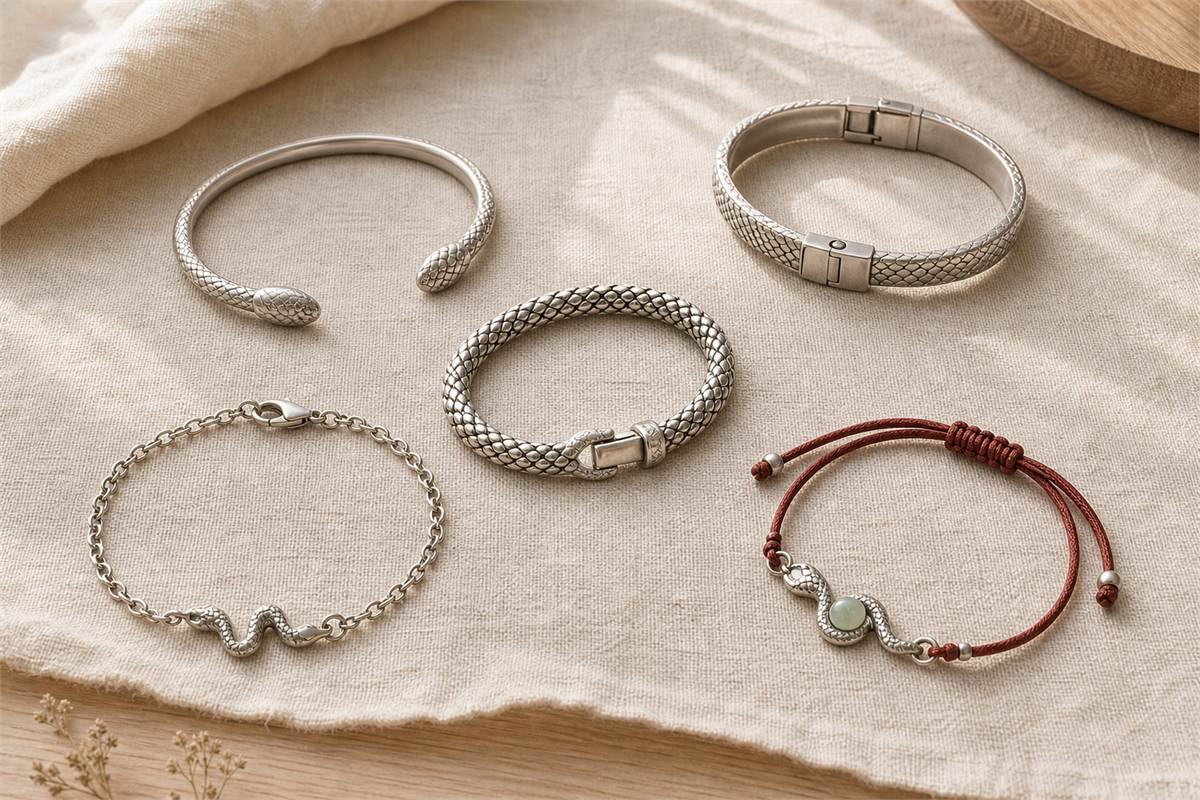
Design history shows how varied the motif can be. Bulgari’s official Serpenti history presents snakes in both realistic and geometrically abstract forms, often emphasizing flexible goldsmith construction. Cartier documents a fully articulated 57-centimeter snake necklace commissioned by María Félix in 1968 and set with 2,473 diamonds. These are useful examples of engineering and motif interpretation, not a ranking, resale forecast, or instruction to buy a particular brand.
Match the material to wear, care, and sensitivity
- Gold, silver, platinum, or steel: ask for the alloy or fineness, total weight, hallmark information, plating details, and repair options. “Gold tone” is not the same as solid gold.
- Plated or fashion metal: confirm the base metal and whether the wearer has nickel or other metal sensitivities. Check edges, solder points, and areas where plating may rub.
- Jade and other carved stone: request the material name, treatment disclosure, dimensions, weight, and close photographs of cracks, polish, and drill holes. Jadeite and nephrite are different materials; “jade color” may describe color rather than identity.
- Gem-set designs: check whether stones are natural, laboratory-grown, treated, or imitation, and whether the setting protects pointed or raised areas.
- Wood, bamboo, lacquer, or textile: consider humidity, water exposure, surface coatings, color transfer, and how the cord or joint can be replaced.
Crystals and gemstones can carry traditional or modern symbolic language, but a material choice should not be presented as medical care, emotional treatment, energy correction, or a decision-making aid. Its color, texture, origin story, craft, and personal association are already meaningful reasons to choose it.
Measure the piece as it will actually fit
For a chain or cord bracelet, measure the wrist where the piece will sit and compare that number with the finished inner circumference, not only the advertised total length. Thick beads and sculptural snake heads reduce usable space. For a rigid bangle, check inner diameter and the widest part of the hand. For an open cuff, check the internal width, opening, metal flexibility, and whether repeated bending is allowed. For a coiled bracelet, ask for the supported wrist range and total weight.

The snake’s head, tail, scales, and stone settings should feel smooth against skin and clothing. Test whether pointed details catch knitwear, hair, or cuffs. A heavy front ornament may rotate underneath the wrist, while an overly tight coil may pinch during movement. If the piece is a surprise gift, an adjustable chain or exchangeable size is often safer than a rigid form.
Use a specification-based budget
There is no useful universal dollar table for snake jewelry because price can change with metal weight, alloy, stone identity and treatment, articulation, handwork, brand provenance, and after-sales service. A practical budget starts with specifications. Decide the maximum total cost, including taxes, shipping, possible resizing, and future repair. Then choose which feature matters most: a clear motif, solid precious metal, carved natural material, complex movement, or documented designer history.
- Motif-first budget: prioritize a comfortable, well-finished snake form and honest base-metal or textile disclosure.
- Material-first budget: choose a simpler construction in a clearly identified metal, jade, or stone rather than paying for complexity with unclear materials.
- Craft-first budget: reserve more for articulation, engraving, enamel, stone setting, carving, or repairable construction.
- Provenance-first budget: pay attention to signed pieces, documentation, condition, service history, and return terms instead of assuming a name predicts future value.

Complete a gift check before ordering
- Confirm whether the recipient likes literal snakes, abstract curves, or only subtle scale patterns.
- Check wrist size, dominant hand, preferred looseness, daily activities, and whether the piece must fit under a sleeve.
- Ask about metal allergies, fragrance sensitivity, and materials they avoid for ethical or personal reasons.
- Verify the material, dimensions, weight, clasp, hinge, treatment, warranty, repair path, and return window in writing.
- Inspect close photographs of edges, joints, stone settings, drill holes, polish, and the inside surface.
- Choose a card message that explains the intended symbolism—renewal, wisdom, continuity, or a zodiac year—without predicting health, relationships, career, or fortune.
- Include care instructions. The jewelry care guide covers gentle routines and storage principles for different materials.
Beyond jewelry, a snake-year gift can be a personal seal, a carved jade or stone object, a paper-cut design, a textile, an illustrated book, a bamboo piece, or a lacquer object. A customized seal needs correct name characters and an approved seal-script layout. Bamboo and lacquer gifts should name the workshop, process, dimensions, finish, and care needs when that information is available. Craft specificity gives the object more depth than a generic “lucky snake” label.
“Little Dragon,” Fuxi and Nuwa, and the White Snake
The Snake is sometimes affectionately called the “little dragon” Xiaolong (小龙) in Chinese-speaking contexts. The phrase can soften the animal’s image or connect a Snake year with the prestige of the Dragon, but it is a colloquial expression rather than proof that Snake and Dragon are the same zodiac sign. A product description should explain the phrase instead of treating it as a universal ancient title.

Fuxi (伏羲) and Nuwa (女娲) belong to a different mythic context. Early images may show the culture heroes with human upper bodies and intertwined serpent-like or dragon-like lower bodies, sometimes alongside cosmological instruments. Their iconography concerns origins, order, kinship, and the making or repair of the world. It should not be used as a generic historical endorsement for every snake charm.
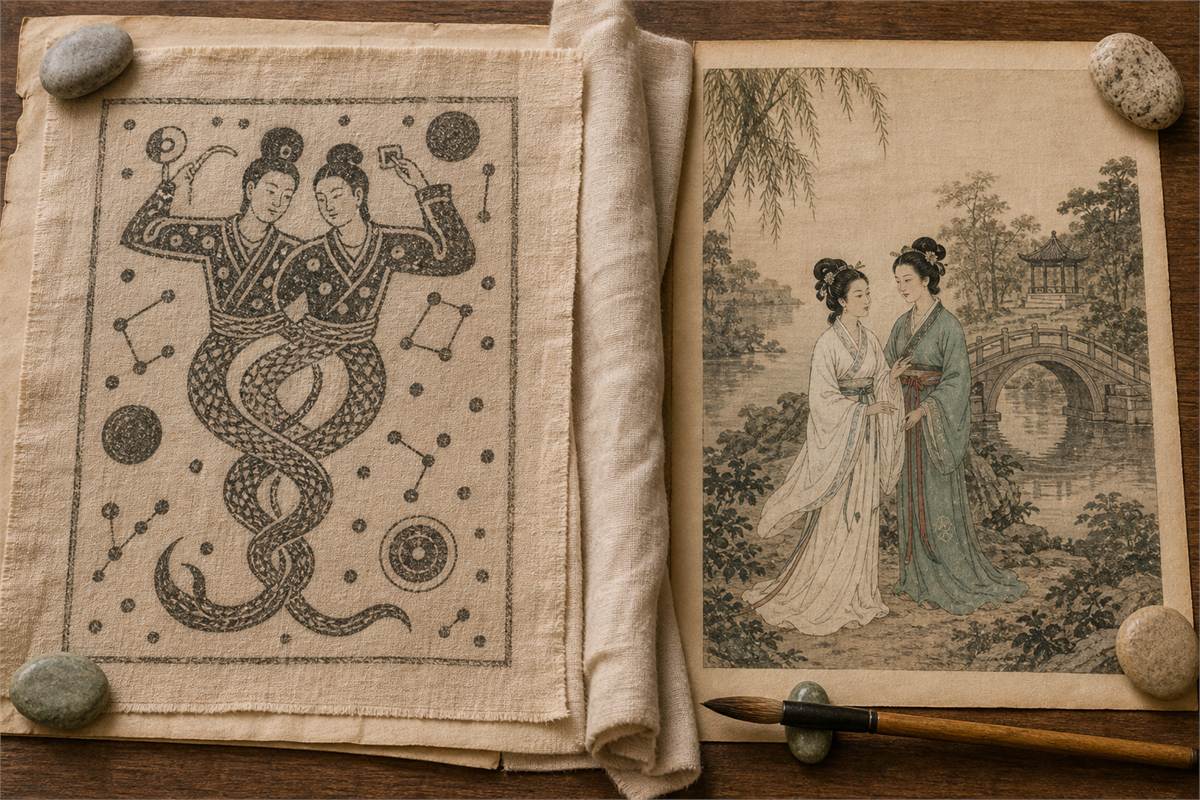
The White Snake legend is another distinct tradition. Its best-known later versions tell of Bai Suzhen (白素贞), a white snake spirit, and Xu Xian (许仙), weaving love, transformation, religious authority, separation, and reunion into a story that evolved across performance and literature. A White Snake-inspired gift can reference that narrative, while an elemental Snake bracelet usually belongs to zodiac and Wu Xing symbolism. Keeping the contexts separate makes both stories clearer.
Using Five Elements Snake Symbolism Thoughtfully
The most useful approach is to identify what kind of statement is being made. “Si belongs to Fire” is a traditional branch correspondence. “2025 is a Wood Snake year” follows the Heavenly Stem. “Yi-Si has Lamp Fire as its Na Yin” belongs to another classification. “Green jade suits the idea of growth” is an aesthetic interpretation. “Snake and Monkey form Six Harmony” is an almanac relationship. Each statement has a place when its layer is named.

Personal destiny readings are far more complex than a birth-year animal. A respectful cultural guide can explain the system, show its symbolic vocabulary, and help someone select a meaningful object without reducing people to a personality list or using fear about colors, directions, relationships, health, or money. Readers interested in birth-year customs can also explore the Benmingnian (本命年) guide.
Conclusion
Five Elements Snake meaning becomes clear once the three layers are separated. Si (巳) is the Fire-associated Snake branch. Wood, Fire, Earth, Metal, and Water Snake year names follow the Heavenly Stem paired with Si. Na Yin assigns the complete Ganzhi pair another named phase image, which may be different again.
Use those distinctions to read year tables accurately, especially around Lunar New Year, and to appreciate traditional combinations without turning them into verdicts about real relationships or future events. For jewelry and gifts, let the framework inspire color, craft, story, and intention—then make the final decision through fit, material disclosure, comfort, workmanship, budget, and the recipient’s taste. For a wider range of symbolic objects, visit the Eastern Story Blessing collection.
Frequently Asked Questions
Related Posts


