
Thangka art is a Himalayan Buddhist tradition of portable sacred images, most often painted on prepared cloth and mounted in textile, though embroidered, appliquéd, printed, and mixed-media examples also exist. A thangka may portray a Buddha, bodhisattva, Tara, protector, teacher, lineage, mandala, refuge field, or narrative scene. Its purpose and meaning come from the particular subject, Buddhist tradition, and history of the work—not from a single universal code.
For viewers, the most rewarding approach is both warm and careful: first meet the image as a whole, then notice the central figure, surrounding relationships, gestures, objects, color, setting, and inscriptions. This guide explains what thangkas are, how they are made, how major painting traditions developed, how to look without guessing, and how to display and care for one respectfully at home.
What makes an artwork a thangka?
The word thangka refers to a Tibetan and Himalayan form of religious image that can be transported and displayed. Painted examples usually consist of a prepared cloth support, a carefully planned composition, layers of color and line, and often a textile surround with rods that allows the work to be rolled. Some remain as unmounted painted cloth; others are made through embroidery or appliqué. Large textile images may be unfurled for public festivals, while smaller works support teaching, contemplation, ritual practice, or personal devotion.
Thangka traditions grew over centuries through exchanges among Tibetan regions and artistic communities in India, Nepal, Kashmir, China, Mongolia, and the wider Himalayas. It is safer to speak of a long, changing history than to assign the entire art form to one ruler or one seventh-century event. Portability is important, but a thangka is more than a “movable mural”: its cloth construction, mounting, iconography, and use give it a distinct life as an object.

| Look first | Questions to ask | Why it helps |
|---|---|---|
| Central figure | Who is shown, and in what form? | Establishes the primary subject. |
| Surrounding figures | Are they teachers, attendants, lineage figures, or protectors? | Places the center within a teaching or transmission. |
| Gestures and attributes | Which hands, implements, seats, and ornaments appear together? | Combinations are more reliable than one isolated clue. |
| Setting | Is this a landscape, palace, mandala, pure land, or ritual ground? | Shows what kind of visual world the image creates. |
| Inscriptions and history | Are names, dedicatory notes, seals, or records available? | Can clarify identity, patronage, use, and date. |
Why thangkas were created
Within Tibetan Buddhist settings, thangkas can make teachings visible. A teacher may use one to explain a life story, lineage, deity, or mandala. A practitioner may contemplate an image connected to a specific practice. A monastery may display a work for a ceremony or festival. A commissioned painting may also express gratitude, remembrance, devotion, or wishes for the well-being of others.
Today, thangkas also enter museums, private collections, and homes. The same painted surface may therefore be encountered as a sacred image, a work of art, a historical object, or several of these at once. Before deciding how to handle or display one, learn what kind of object it is and what is known about its previous use. If it belongs to a living practice, a qualified teacher or community connected to that tradition can offer guidance that a general article cannot.

How a painted thangka is made
Preparing the cloth and drawing the composition
For many traditional painted thangkas, cotton cloth is stretched on a frame, coated with a ground, and polished to create a smooth surface. The artist then establishes the composition with measured lines. Systems of iconometric proportion guide the relative placement of a figure’s face, body, seat, halo, and attributes. These systems are real and important, but they are not one universal grid: texts, traditions, figure types, and workshops may use different measurements.

Drawing may pass through several stages, from overall geometry to increasingly fine detail. The face is commonly completed with particular care. The painterly act sometimes translated as “opening the face” or “opening the eyes” should not be confused with a later religious consecration. Nor should preparatory observances or ritual timing described in one workshop be presented as mandatory for every artist.
Color, shading, outlines, and gold
Color is usually built from broad areas toward modeling, textile patterns, jewelry, flowers, clouds, flames, outlines, and highlights. Historical and contemporary painters may use mineral, earth, plant-derived, organic, or manufactured pigments, as well as different binders and grounds. Gold can appear as powder or applied detail, but neither gold nor natural pigment is present in every work. A seller’s material claim cannot be confirmed simply by sparkle, grain, brightness, price, or the appearance of the reverse.

Traditional materials can age beautifully, yet no pigment is guaranteed to remain unchanged for centuries. Light, moisture, poor mounting, incompatible repairs, pollutants, and unstable storage all affect condition. Printed reproductions and digitally produced images also circulate widely; they can carry personal meaning, but their technique should be described honestly rather than confused with hand painting.

Textile mounting and consecration
A completed painting may be sewn into a brocade surround, sometimes with a veil, ribbons, and upper and lower rods. The mount supports display and rolling, while also becoming part of the thangka’s visual presence. Mounts vary by period, region, purpose, and later restoration; an unmounted painting is not automatically incomplete.

Some thangkas are consecrated or blessed for religious use, while others are made for teaching, collection, study, or cultural display. Consecration belongs to the history of a particular work and tradition. It should not be assumed from subject matter, age, or workmanship.
Painting traditions and regional styles
There is no dependable list of “six core schools.” Names may refer to a historical artist’s style, a broader painting tradition, a monastery, a region, or a later family of related approaches. Menri and Khyenri emerged as influential Tibetan painting traditions in the fifteenth century. Karma Gar-ri developed from the sixteenth century and came to include several visually distinct approaches, including works shaped by Chinese landscape conventions. New Menri is associated with developments from the seventeenth century, while regional centers such as Rebkong and Palpung sustained their own workshop histories and mixtures of influence.
Newar art from the Kathmandu Valley deeply influenced Himalayan and Tibetan painting, and Newar artists worked across the region. It is better understood as its own rich artistic tradition and a major source of exchange than as one simple branch inside a Tibetan list. Likewise, a modern label such as “old Tibetan style” is not proof of age. Attribution calls for comparison with dated works, inscriptions, documented history, materials, and specialist study.

How to read thangka symbols without guessing
- Begin at the center. Note the figure’s posture, number of faces and arms, seat, halo, crown, garments, and overall expression.
- Read relationships. Look above, beside, and below for teachers, lineage figures, attendants, offerings, guardians, and narrative episodes.
- Study combinations. A hand gesture, implement, color, animal, or direction gains meaning from the identity and form in which it appears.
- Identify the setting. Landscape, palace architecture, lotus seats, charnel grounds, clouds, and mandala boundaries organize different kinds of sacred space.
- Confirm with reliable context. Use inscriptions, museum records, specialist catalogs, or a knowledgeable tradition holder rather than a generic symbol chart.
Color can distinguish forms or contribute to a composition, but red, blue, green, white, yellow, and black do not carry one fixed meaning across every thangka. The same caution applies to mudras (hand gestures), ritual implements, vehicles, directions, and skin colors. A serene figure should not be identified by gold color alone, and a fierce expression, flames, or skull ornaments should not be treated as “evil.” In some Buddhist contexts, wrathful imagery communicates forceful compassion or the overcoming of obstacles, but the particular figure and tradition still matter.

Common subjects and ways of seeing
Single-figure thangkas invite focused attention to one Buddha, bodhisattva, Tara, teacher, protector, or meditational deity. Lineage and refuge-field paintings arrange many figures into a map of teachers and transmission. Narrative paintings gather episodes from a life or story across one surface. Mandalas present an ordered sacred environment whose architecture, gates, circles, and figures belong to a specific system. Other traditions include cosmological and medical paintings, which have their own texts and purposes.
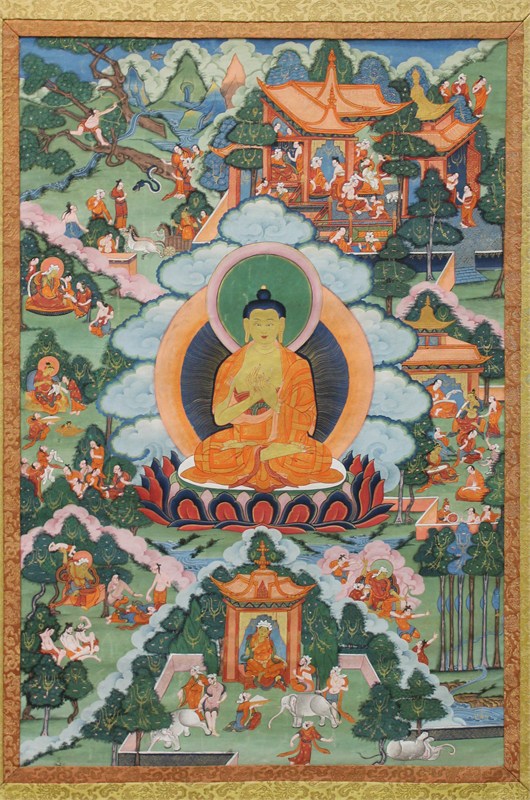
Let your eyes move slowly. Notice repeated colors and rhythms, but also pauses and open space. See how the central presence relates to the smaller figures and landscape. This kind of attentive looking can invite calm, concentration, compassion, and respect without turning the image into entertainment or a promise of supernatural results. For a broader foundation, begin with an introduction to Buddhism, then explore more cultural guides in the Eastern Story archive.
Respectful display at home
First decide whether your thangka is a consecrated devotional image, an unconsecrated painting, a historical artwork, or a reproduction. A religious image may come with display practices meaningful to its community; ask a qualified teacher or temple connected to that tradition about offerings, coverings, orientation, or placement. Cultural display in an ordinary home does not require inventing universal rules about eye level, bedrooms, nighttime cloths, or proximity to electronics.
- Choose a stable interior wall away from direct sunlight and strong ultraviolet exposure.
- Avoid kitchens, bathrooms, damp exterior walls, heating vents, fireplaces, and places exposed to oil smoke or water vapor.
- Support the mount evenly and make sure rods, cords, and hanging hardware are sound.
- If glazing is appropriate, keep the painted surface from touching glass or acrylic; professional framing advice is safest.
- Limit unnecessary handling and keep food, candles, incense smoke, and household sprays away from the surface.

Moving, storing, and caring for a thangka
Safe handling and movement
Wash and dry your hands before handling a stable modern mount; for fragile or valuable works, follow a conservator’s advice about gloves and support. Hold the textile mounting or supported rods with both hands, never the painted center. Clear the route before moving it. Do not pull on ribbons, lift from one corner, or let the lower rod swing against furniture.

Conservative storage
A flexible, stable thangka designed to roll may be rolled slowly around suitable support without tight pressure, then protected with clean, conservation-appropriate material. Never fold it. Avoid airtight plastic, crushing weight, damp cupboards, attics, basements, and places with rapid changes in temperature or humidity. Because materials and mounts vary, a single humidity number is not right for every household; stability, clean air, and regular inspection are more useful goals.

If paint is lifting, flaking, powdering, or cracking, do not roll the work. Keep it supported and stop handling it until a conservator experienced with paintings on cloth or paper can advise you.
What not to do
Do not apply water, solvent, wet cloths, glue, varnish, tape, chemical insect repellents, insecticide, or household cleaner. Do not brush a fragile painted surface, shine a strong light through the back to “test” it, trim the painted cloth to fit a case, press it with metal, or attempt repainting and DIY repair. Mold, insects, tears, tide lines, detached silk, or pigment loss call for professional assessment. If a religious image can no longer be used, ask its community about respectful options rather than burying, burning, cutting, or discarding it on your own.
A thoughtful way to live with thangka art
A thangka brings together disciplined craft, visual memory, teaching, devotion, and beauty. Its symbols are not a puzzle to solve in one glance. Give the image time, learn its name and context, and allow the relationships within it to unfold. Respect is expressed through attention: accurate language, careful handling, a stable environment, and willingness to ask for guidance when the work’s religious or material needs exceed your knowledge.

For readers drawn to objects that carry wishes for peace, protection, compassion, wisdom, and a beautiful life, our Blessing collection offers a separate path designed for everyday use. Keeping that role distinct helps a thangka remain grounded in the sacred and artistic tradition from which it comes.
Frequently Asked Questions
Related Posts


