
Xingyue Bodhi (星月菩提), or Star-and-Moon Bodhi, is a seed-bead tradition named for many dark “stars” around a larger “moon” mark. A good beginner strand feels comfortable, is cleanly drilled and consistently made, and comes with a plain explanation of its processing. With patient handling, its pale surface may gradually warm in color and gain a mellow sheen. More than a material checklist, it can become a daily companion for calm, steady growth, protection, and peace.
The word bodhi (菩提) means awakening in Buddhist language. In today’s bead market, however, “Bodhi seed” covers several unrelated plant materials. Xingyue is a recognizable commercial and cultural category, but it should not automatically be described as a consecrated ritual object. People may wear it as a bracelet, use it as a mala, turn it quietly in the hand, or give it as a wish for patience and 平安如意—a peaceful life in which things unfold well.
What are Xingyue Bodhi beads?
The small dark dots are called the “stars,” or xing (星), while the larger pit or eye is called the “moon,” or yue (月). Across the pale bead, the pattern recalls a night sky gathered around one moon. It invites associations with centered awareness, changing cycles, guidance, and the patience to let a meaningful object grow familiar over time.

The marks come from the seed’s structure as it is cut and polished. Xingyue is often linked in commerce to rattan-palm seeds, and the older botanical name Daemonorops margaritae appears frequently. Current plant taxonomy treats that name as a synonym within Calamus melanochaetes, a climbing palm with a broad South and Southeast Asian range. Market supply and naming are not uniform, so “yellow rattan seed,” a place name, or a seller’s local label should not be treated as a complete botanical conclusion for every strand.
Star, moon, and other Xingyue terms
| Player term | Chinese | Practical meaning |
|---|---|---|
| Star and moon | 星月 | Small dark points and one larger moon-like mark |
| Centered moon | 正月 | A moon positioned near the center of a chosen bead face |
| Side or crescent moon | 弦月 | A moon closer to an edge, creating a less symmetrical composition |
| Uniform pale strand | 顺白 | Beads matched for a light, relatively consistent base color |
| Patina | 包浆 | The smoother color and sheen associated with time and handling |
| Jade-like or glassy look | 玉化 / 玻璃底 | Collector language for a luminous, polished visual effect |
| Surface network | 开片 | Fine lines that may emerge as an aged seed changes |
These are useful appearance and market terms, not universal grades. A centered moon may make a strand look orderly; a side moon can feel natural and lively. Neither position proves density or objective quality. Likewise, fine stars, wide pale areas, “needle-eye stars,” and the phrase yue lang xing xi (月朗星稀, “bright moon, sparse stars”) describe a visual preference. They cannot, by themselves, establish durability, origin, or authenticity.

Choose bead shape and size by feel
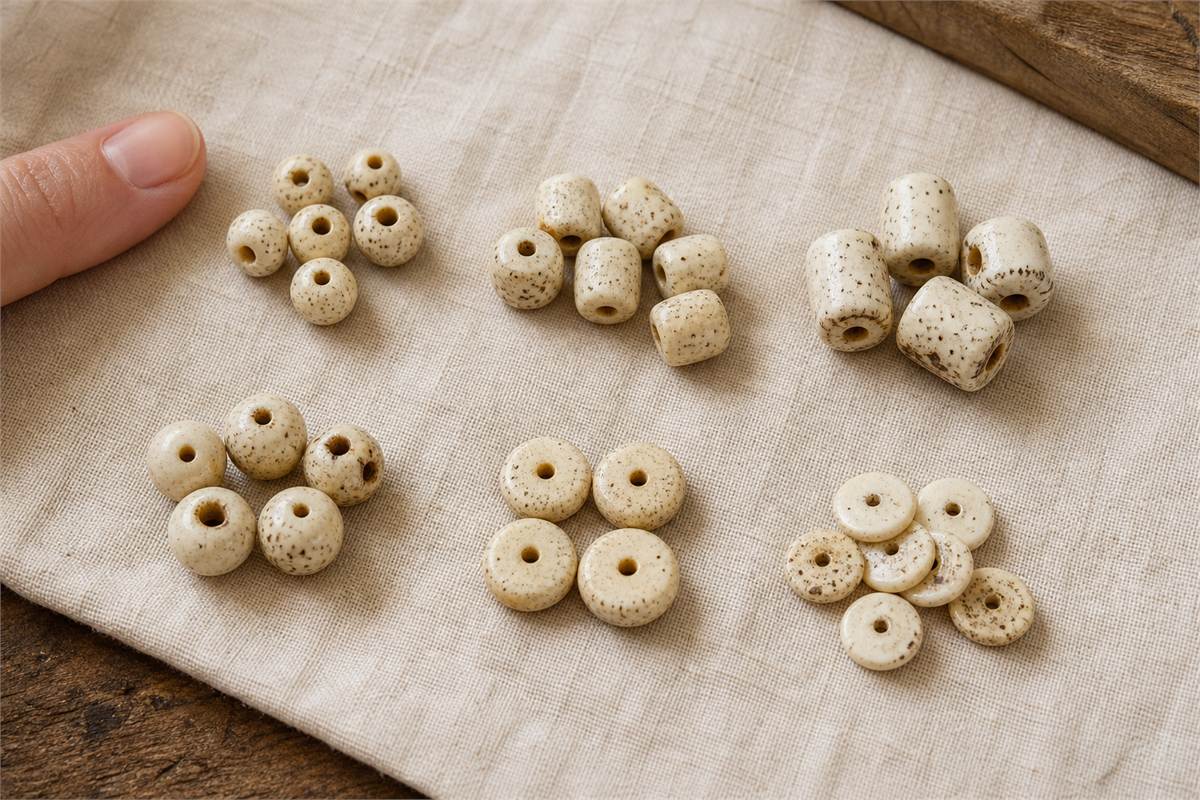
Shape changes both the mood of a strand and the way it moves through the fingers. Market names overlap, so look at the actual profile rather than relying on a label alone.
| Shape | Appearance | Handling character |
|---|---|---|
| Round | Classic and continuous | Rolls smoothly with few edges |
| Old-style barrel | Short cylinder with softened shoulders | Substantial but often comfortable |
| Straight-cut barrel | Clean, defined sides | More noticeable edges and rhythm |
| Apple or drum | Short, rounded and full | Sits close to the wrist |
| Abacus | Wide faces with a compressed profile | Shows the pattern clearly |
| Thin disc | Light, graphic silhouette | Edges need protection from knocks |
Common small and medium beads may be around 6–10 mm, while beads above 11 mm feel visibly bolder and heavier. These ranges are references, not rules about who should wear them. Choose by wrist circumference, total strand weight, flexibility, whether you count beads or roll them one by one, and the scale you enjoy. For a mala, bead count, spacers, guru bead, cord and intended practice also matter. For a bracelet, inner circumference is more useful than a “one size” label.
How to choose Xingyue Bodhi quality
Look at the whole strand
- Compare matching. Check bead dimensions, base color, shape and the rhythm of stars and moons across the entire strand.
- Inspect the surface. Look for sound material rather than soft, crumbling pits, deep active cracks or loose fragments around the stars.
- Check drilling. Sight along the strand for tilted holes, sharp exits, chips and rough edges that may damage the cord.
- Handle equal sizes together. Weight can offer context, but moisture, processing, dimensions and added materials affect it. A heavy bead is not automatically better.
- Use neutral light. Warm photography can make cream beads look golden and hide uneven color.
- Ask what was done. Dry grinding, wet grinding, boiling, bleaching, waxing, oiling, dyeing and accelerated aging are different claims and should be explained separately.
Do not turn one clue into a verdict
Star size and spacing can help you compare appearance and surface integrity, but they are not a dependable density test. The same is true of a centered moon, a “needle-eye” star pattern, a bright tone, a hand-heft impression, or the sound made when two beads touch. Water-immersion tests risk altering a seed bead and still do not settle identity or quality. A careful choice combines visible condition, workmanship, consistency, seller disclosure and how the strand feels in its intended use.

Origin deserves the same restraint. Hainan is important in the Xingyue trade, but a Hainan label does not make every bead superior, and beads associated with Vietnam or Laos are not inherently lower-density. Growing conditions, seed selection, moisture history, processing and workmanship can vary within every source.
Dry-ground, wet-ground, and market styles
Dry grinding shapes the material without using water as the grinding medium; wet grinding uses water during cutting or polishing to control dust and heat and to support a smoother process. Sellers often attach broader quality stories to these methods, but the terms are not standardized grades. Either method can be followed by additional cleaning, heating, lightening, waxing, oiling or coloring, so the finished surface and honest process description matter more than a slogan.

Names such as “raw white,” “old seed,” “stone-jade material,” and “chicken-oil yellow” may refer to an appearance, an age claim, a processing route or a sales category. Cream, bright white, warm yellow and translucent-looking surfaces can each have more than one cause. Do not classify a strand as natural or artificial from color alone. Ask for close daylight photographs and a simple account of processing, then judge whether the look suits you.
How color, patina, and opening develop
A Xingyue strand may move from pale cream toward ivory, honey, amber, reddish brown or deeper brown, while high points become smoother and more reflective. The change is created by a combination of long-term friction, skin contact, oxidation, light, environmental moisture, cleanliness and earlier processing. It will not follow the same schedule or color sequence on every strand.

Players call a mellow, handled surface baojiang (包浆, patina), and may describe a luminous finish as “jade-like” or “glass-bottom.” These phrases celebrate the beauty of age; they do not name a scientific protective film or a guaranteed final stage. The Bodhi bead patina guide explores this gradual relationship between touch, color and care in more detail.
Fine surface networks called kaipian (开片) may appear as an older seed dries, ages and experiences structural change. Some collectors enjoy the look, while other strands never develop it. Deep, sharp or spreading cracks are damage rather than a milestone. Do not force opening through water, heat, extreme dryness or rapid temperature changes; let age write its own quiet pattern.
A gentle beginner routine for handling
Begin by wiping the strand with a clean, soft cotton cloth. If the surface feels dusty or newly finished, use a clean cotton glove for a few light sessions while you learn the material. Once it feels clean and stable, dry hands are usually the simplest way to handle it. Rotate the strand and include the areas near the holes rather than rubbing one face repeatedly.

There is no required “three days on, one day off” calendar. Let the beads tell you when to pause. If they feel tacky, look unevenly damp or have collected visible grime, stop, wipe gently and allow them to rest. A flexible rhythm—brief clean handling followed by time in a stable environment—supports a more even relationship than long sweat-heavy sessions. Photographing the strand occasionally in the same daylight can help you notice real change without chasing it.
Xingyue Bodhi care and storage
- Avoid soaking, showering or swimming with the beads. If they become wet, blot them promptly with a soft cloth and let them dry gradually away from direct heat.
- Keep them away from strong sun, heaters, air-conditioning vents and sudden moves between very cold and hot spaces.
- Wipe away sweat after wear. Do not leave sweat, cooking oil, lotion, perfume or grime on the surface.
- Avoid rubbing the beads on the face or hair to speed darkening.
- Do not apply generous oil. Excess oil can collect dirt, darken unevenly and gather around holes and star pits.
- Store in a clean cloth pouch or breathable container in a stable, ventilated place that is dry without being aggressively dehydrating.
- Avoid sealed damp storage, added water, powerful desiccants and other extreme humidity tricks.
- Keep metal jewelry and hard surfaces from repeatedly striking the beads, and inspect cord, knots and spacers from time to time.

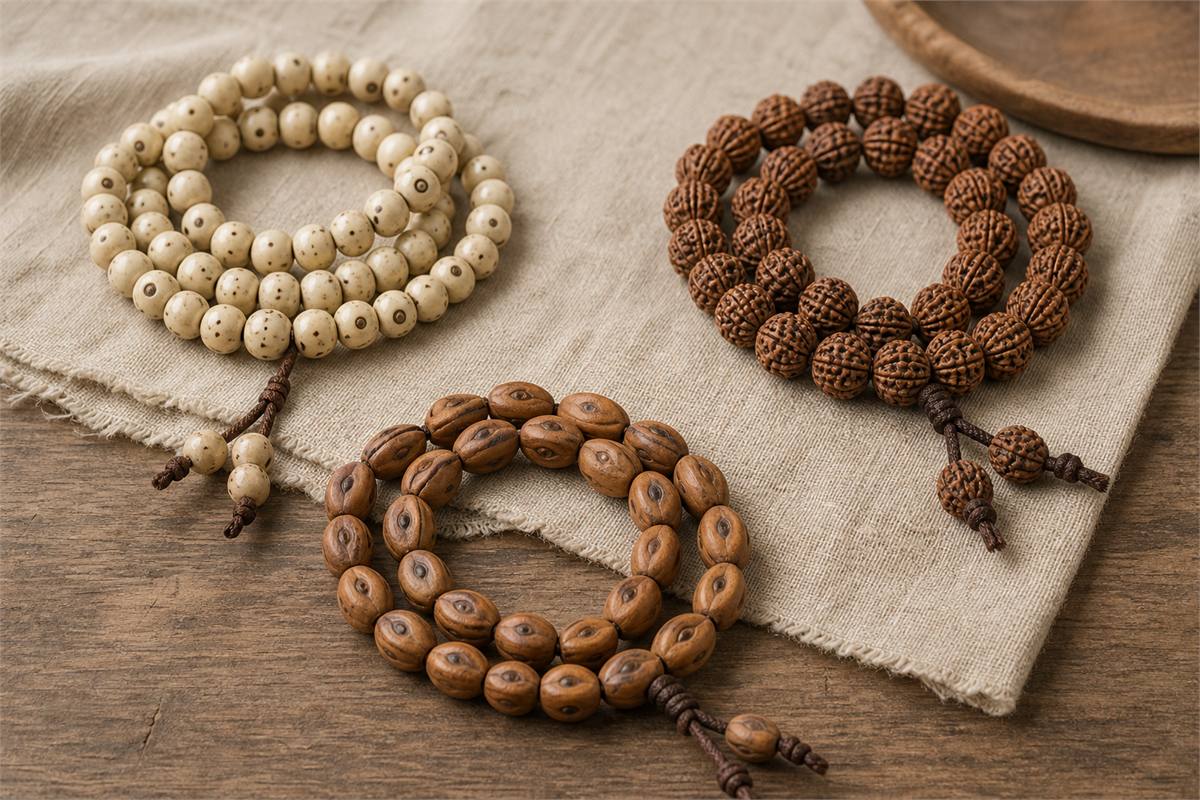
Xingyue, Jingang, or phoenix-eye Bodhi?
| Bead family | Recognizable surface | Why someone may choose it |
|---|---|---|
| Xingyue | Dark stars around a moon mark | A clear visual record of touch, patience and gradual change |
| Jingang / Vajra | Deep ridges and segmented faces | A more textured hand feel and a bold, grounded presence |
| Phoenix-eye | A natural eye-shaped line or mark | A quieter, watchful motif associated with wisdom and awareness |
These names belong to different seed materials and market traditions, even though all may be sold under the broad word “Bodhi.” Choose according to touch, symbolism, care preference and the relationship you hope to build, rather than an absolute ranking. Learn more in the Jingang Bodhi guide and Phoenix-eye Bodhi guide.
A final buying checklist
- Confirm bead count, measured dimensions, total weight and inner bracelet circumference.
- Choose the shape for comfort, counting habits or hand play.
- Inspect stars, moons, cracks, drill exits, matching, cord and spacers in neutral light.
- Ask how the beads were ground, cleaned, colored, waxed, oiled or aged.
- Treat moon position and surface style as aesthetic choices, not automatic grades.
- Avoid absolute claims about origin, instant patina or a guaranteed color timeline.
- Choose a strand you will enjoy touching and caring for, not one built around the loudest market label.

A quiet companion shaped by time
A thoughtful first Xingyue strand is comfortable, sound, cleanly made and honestly described. Its stars and moon need not be mathematically perfect to carry beauty. In daily life, each pause to turn a bead can invite steadiness, while the slow warming of the surface records patience and companionship. Bodhi beads express a wish—a medium through which people hope to bring about wealth, health, virtue, longevity, or a specific outcome in life. For Xingyue, that wish may be especially simple and enduring: to meet change with a calm heart, welcome protection and peace, and grow gently into a more beautiful life. Explore the Eastern Story Blessing collection for more meaningful objects chosen to accompany such hopes.

Frequently Asked Questions
Related Posts


